Synthflow AI has established itself as a popular no-code platform for businesses looking to deploy a voice AI agent quickly. It excels at simplifying the creation of conversational bots, allowing users to build functional voice interfaces without touching a single line of code. Its primary strength lies in its accessibility for beginners.
However, as businesses scale, some users have reported limitations. Common feedback on Reddit and G2 points toward high latency in voice responses, unpredictable pricing models as call volume grows, and occasional stability issues with complex integrations. These friction points have led many growing companies to seek more robust, specialized alternatives that offer better performance.
To help with that decision, we subscribed to dozens of Synthflow AI alternatives and competitors, evaluated them based on latency, ease of setup, and integration depth. In this guide, we feature 7 top-tier platforms, ranging from the user-friendly Solvea to high-performance developer tools like Vapi.
TL;DR: What are the Best Synthflow Alternatives (Quick Comparison)
The best Synthflow alternatives focus on reducing latency and improving business workflow integration. Solvea is the top choice for small businesses needing an easy AI receptionist, while Retell AI and Vapi lead in technical performance. For niche markets, Talkie.ai dominates healthcare, and Ringly.io is built specifically for Shopify stores.
Tool | Best for | Key Strengths | Starting Price | Free Trial | Integrations | Ease of Setup | Customization |
Solvea | Small businesses needing fast setup and multichannel automation | No-code setup, multi-channel, native CRM Sync | $30/month | 7-day free trial phone number | Google Calendar, Sheets, CRM, files | Live in under 3 minutes | High |
Goodcall | Local businesses need a simple AI front desk | Fast deployment, basic call handling, Google integration | $66/month | 14-day | Yelp, Google, Zapier | Easy | Moderate |
Retell AI | Teams wanting human-like conversations and low latency | Natural voice quality, Ultra-low latency | $0.07-$0.31/ minute | $10 in free credits | Make Twillio n8n | Moderate | High |
Talkie.ai | Clinics needing patient call automation | HIPAA, EHR Native Integration, Proactive Outreach | Custom | Demo required | Athenahealth, ModMed, MedicalPractice | Moderate | High |
Ringly.io | E-commerce brands needing Shopify support | Order management, store-aware automation | $349/month | 14-day | Shopify and custom integrations via Zapier | Easy | Moderate |
Bland AI | Teams needing rapid outbound and lead qualification | High-volume calling, custom workflows, highly programmable API | $0.14/minute | No | Zapier, CRMs, Webhooks | Moderate | High |
Vapi | Technical teams needing deep API customization | Developer control, fast, low-latency custom voice | Pay as you go $0.05/min | $10 in initial credits | Developer APIs and custom | Harder | Very high |
Why Are Businesses Looking for Synthflow Alternatives
While Synthflow is an excellent no-code AI agent platform, many businesses still compare it with alternatives before making a commitment. Based on our deep dive into verified G2 reviews and candid discussions within the Reddit automation community, we’ve identified the critical friction points that drive businesses to seek high-performance Synthflow AI substitutes.
·Noticeable Response Latency: Users frequently report a 1–2 second "lag" that disrupts natural conversation. This delay can feel awkward compared to the sub-800ms response times offered by newer, higher-performance alternatives.
·Costly Integration Complexity: Native connectors are often limited, forcing users to pay for third-party middleware like Zapier. This adds technical overhead and extra monthly fees to achieve deep, two-way CRM synchronization.
·Unpredictable Scaling Costs: Total expenses can reach $0.15–$0.24 per minute plus monthly number fees. This compounding structure makes it significantly more expensive and harder to budget for than transparent, flat-rate competitors.
·Inconsistent Voice Quality: During extended interactions, the AI can lose its natural cadence and sound increasingly "robotic." It lacks the advanced emotional-tuning models found in premium competitors that maintain human-like warmth.
·Restrictive Logic Limitations: Handling multi-step business logic, such as cross-checking multiple calendars for rescheduling, is notoriously difficult to build. Businesses often hit a "scaling wall" when requiring complex, autonomous decision-making.
·Limited Global Support: International businesses often struggle with telephony compliance and local number availability outside North America. This lack of global flexibility makes it difficult for companies to scale into European or Asian markets.
How We Evaluated These Alternatives to Synthflow
To provide an objective and authoritative ranking, we didn't rely solely on marketing claims. Our team conducted hands-on testing and cross-referenced data from trusted platforms like G2, Trustpilot, and Reddit. We evaluated each Synthflow competitor through a structured framework designed to measure real-world business performance and reliability.
Evaluation Criteria | What We Looked For (Key Benchmarks) | Evaluation Method |
Response Latency | We measured the time between the user finishing a sentence and the AI responding, strictly targeting sub-1-second "Real-Time" performance to ensure natural, human-like conversation flow. | Live call stress-testing and technical latency logs analysis. |
Integration Depth | We analyzed the stability of native, two-way sync with essential tools like Google Calendar, Shopify, and enterprise CRMs to ensure data flows without requiring expensive middleware. | Hands-on setup of API connections and CRM data mapping. |
Setup & UX | We assessed the "Time-to-Value" for non-technical users, focusing on the quality of no-code builders, industry-specific templates, and the clarity of the onboarding process for small teams. | Simulating a "5-minute build" from a new user perspective. |
Cost Transparency | We scrutinized pricing models to identify hidden per-minute markups or "concurrency fees," prioritizing platforms that offer predictable ROI and clear scaling paths for growing businesses. | Comparative analysis of public pricing vs. actual usage bills. |
Security & Compliance | We verified technical safeguards such as HIPAA compliance for healthcare, STIR/SHAKEN for outbound telephony, and enterprise-grade data encryption to protect sensitive customer information. | Verification of BAA availability and security documentation. |
7. Best Synthflow AI Alternatives & Competitors in 2026
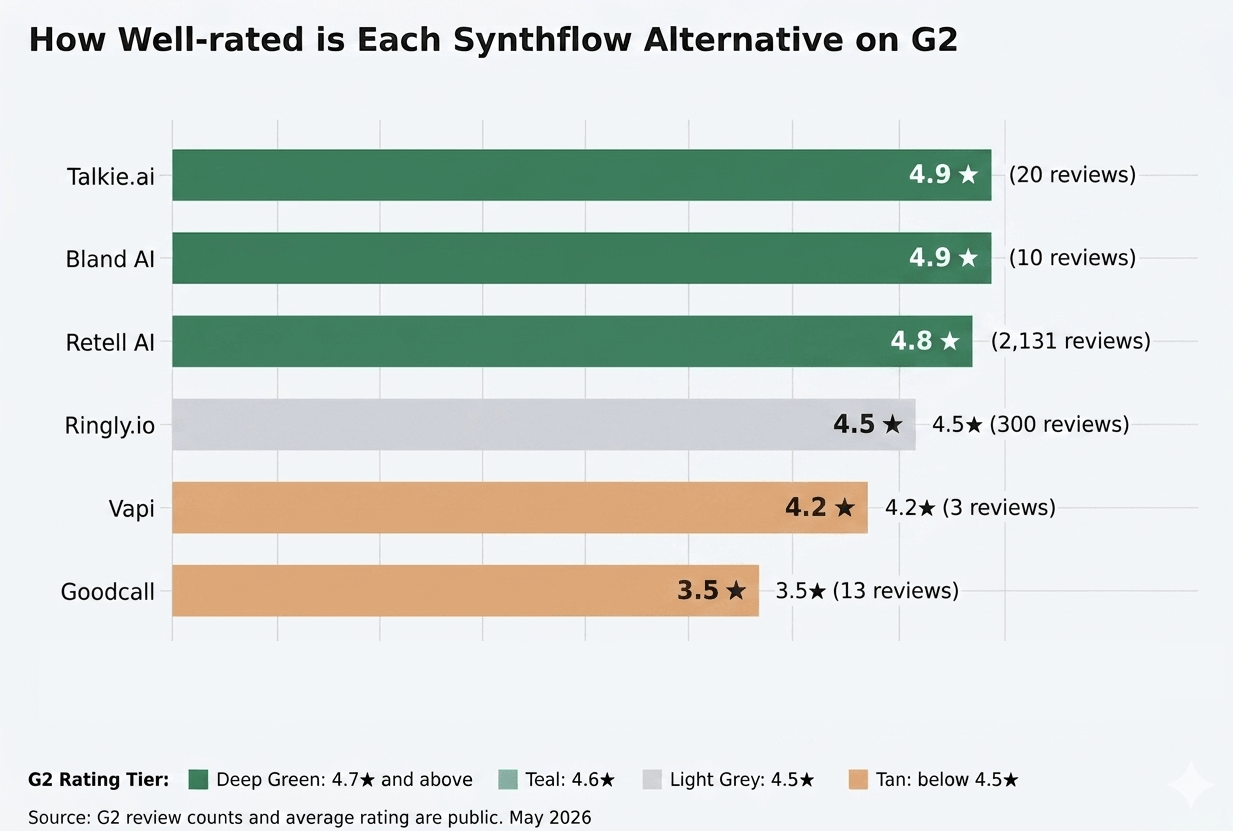
Retell AI stands out with the strongest balance of scale and sentiment at 4.8 stars across 2,131 reviews, while Talkie.ai and Bland AI post higher ratings with much smaller samples. Ringly.io shows more established validation with 300 reviews at 4.5 stars, whereas Goodcall and Vapi currently have limited review volume, making their ratings more directional than statistically representative.
1. Solvea: Best AI Receptionist for Small Business Needing Seamless Integration and Multi-Channel Automation
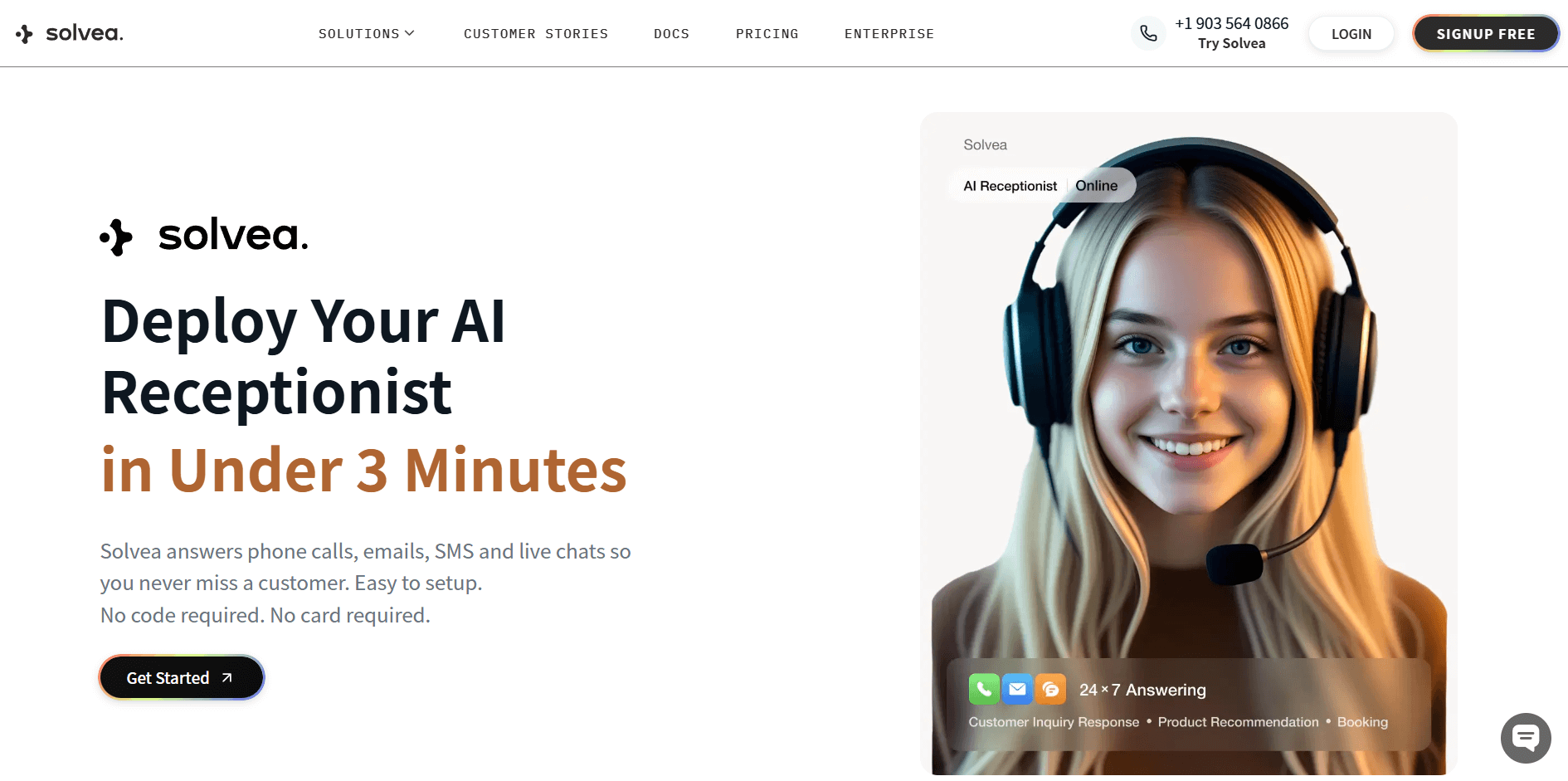
Solvea stands out as an affordable Synthflow AI receptionist alternative designed specifically for service-based small businesses that have outgrown basic voice bots. Unlike Synthflow’s fragmented setup, Solvea provides a unified interface that manages voice, SMS, and web chat simultaneously. It excels at turning conversations into actions, whether it’s booking an appointment directly into your calendar or updating a lead’s status in your CRM with ultra-accuracy and zero latency.
Best for: Small to medium businesses like hotels, software companies, law firms, medical spas, and real estate agencies looking for a high-ROI, "set-it-and-forget-it" AI receptionist.
Key Advantages vs Synthflow AI:
- Native Two-Way Integration: Solvea offers direct, deep-level sync with Google Calendar and Sheets, eliminating the need for expensive third-party connectors often required by Synthflow.
- Multi-Channel Continuity: While Synthflow is voice-heavy, Solvea seamlessly transitions between voice and text, allowing the AI to send follow-up booking links or summaries instantly via SMS.
- Rapid Knowledge Base Injection: You can train your Solvea agent in minutes by simply uploading PDFs or URLs, creating a highly specialized expert that understands your unique business rules.
- Human-Grade Interaction: The AI receptionist sounds warm and professional, avoiding the "robotic" cadence sometimes reported in basic Synthflow setups.
- Built-in Business Skills: Solvea comes with industry-specific "skills" like property inquiry handling, making it a functional team member rather than just a caller.
- Predictable No-Code Builder: The intuitive interface allows non-technical owners to build and deploy an agent in under 3 minutes without ever touching a line of code or complex webhooks.
Limitations:
- Primarily optimized for inbound reception and customer care rather than aggressive mass-market cold calling.
- Lacks low-level API control for developers compared to high-code platforms like Vapi.
Pricing:
Plan | Price | Key Features |
Free | $0 /month | 3 agents, 50MB knowledge base, integrations |
Basic | $30 /month | 10 agents, 500MB knowledge base, integrations |
Enterprise | Custom | Advanced setup, Success manager (CSM), Customized models, Full access |
2. Goodcall: Best Simple AI Front Desk for Local Business Seeking Fast Setup and Basic Call Handling
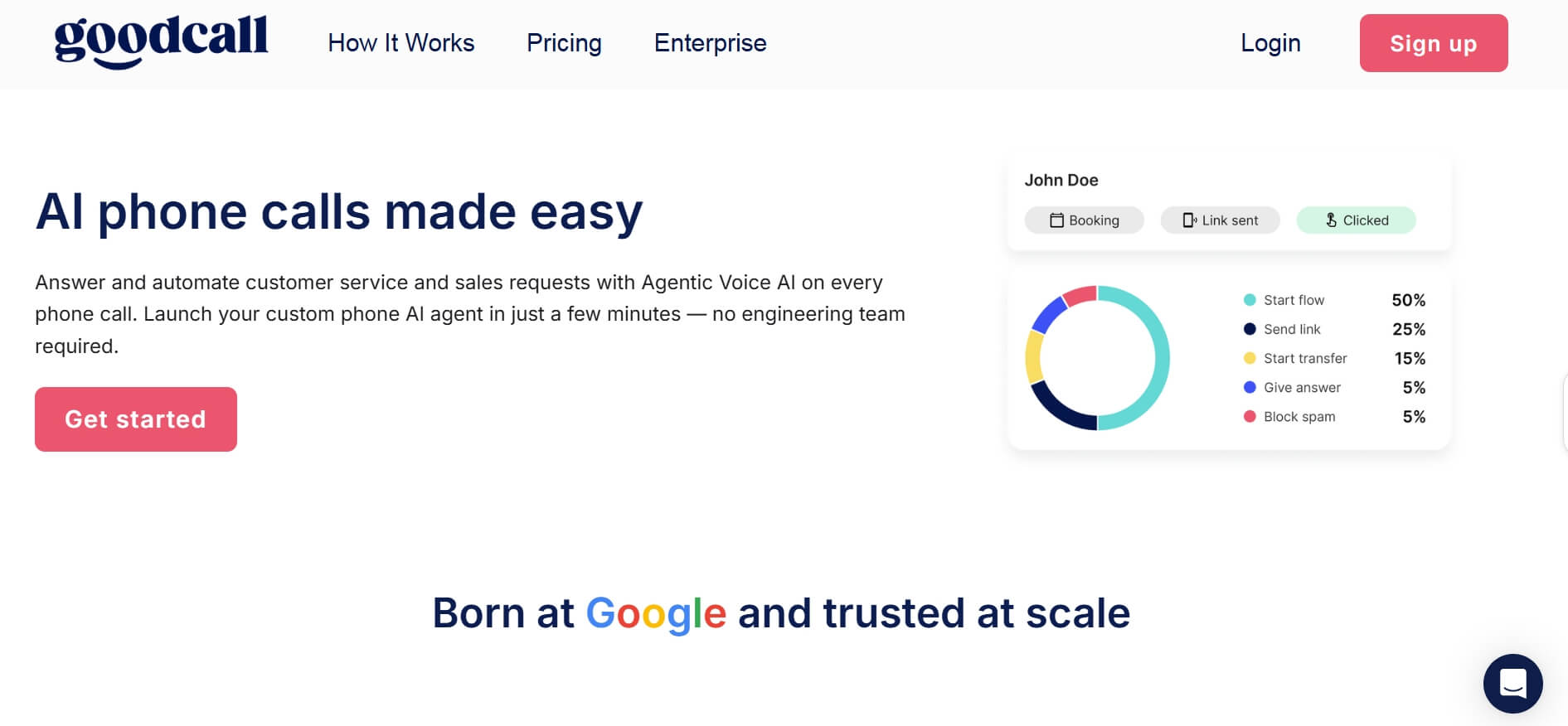
Goodcall is engineered for the local business owner who needs an immediate solution to missed calls without the complexity of building custom logic. Currently holding a strong presence in the local service market, it leverages your Google Business Profile to create a functional assistant in seconds. While it focuses on simplicity, studies show it effectively replaces voicemail with active engagement, capturing essential lead data that would otherwise be lost to "hang-ups" after the tone.
Best for: Local retail shops, restaurants, and salons that need a low-cost, 24/7 assistant to handle FAQs and simple message taking.
Key Advantages vs Synthflow AI:
- 5-Minute Deployment: Goodcall is significantly faster to set up than Synthflow because it auto-populates your business data from existing Google records.
- Superior Spam Protection: It features an industry-leading spam filter that blocks telemarketers and robocalls before they can interrupt your workday.
- Cost-Effective Entry: With a starting price much lower than Synthflow, it’s the most accessible option for micro-businesses on a tight budget.
- Google Ecosystem Synergy: Deeply integrated with Google’s local search data, making it highly effective for customers calling directly from "Google Maps."
- Simplicity by Design: The interface is stripped of technical jargon, making it far easier for non-tech users to manage compared to Synthflow’s dashboard.
Limitations:
- Lacks the depth for complex multi-step workflows like dynamic rescheduling.
- Voice customization is limited compared to high-end conversational platforms.
Pricing:
Plan | Price | Key Features |
Starter | $66/month/agent $0.50/customer after 100 | unlimited minutes and tokens 7 days of call & customer details 100 unique customers monthly |
Growth | $108/month/agent $0.50/customer after 250 | unlimited minutes and tokens 30 days of call & customer details 250 unique customers monthly |
Scale | $208/month/agent $0.50/customer after 500 | unlimited minutes and tokens unlimited call & customer details 500 unique customers monthly |
3. Retell AI: Best Conversational AI for Professionals Wanting Low Latency and Human-Like Interactions
Retell AI is the technical leader for businesses where dialogue quality and response speed are non-negotiable. While Synthflow often struggles with a noticeable 1-2 second lag, Retell’s proprietary infrastructure achieves sub-600ms latency. This creates a "real-time" feeling where the AI can handle interruptions and natural turn-taking, making it nearly indistinguishable from a human professional during high-stakes consultations or technical support calls.
Best for: Professionals in high-end consulting, insurance, or tech support where a "robotic" delay could damage trust or lose a high-value lead.
Key Advantages vs Synthflow AI:
- Market-Leading Latency: Retell’s infrastructure is built for speed, virtually eliminating the "awkward pause" that often plagues Synthflow’s voice agents.
- Smart Interruption Handling: The AI recognizes when a caller starts speaking and stops its own output instantly, mimicking the natural flow of human conversation.
- High-Fidelity Voices: Access to premium, emotionally aware voices that can convey empathy and professionalism far better than standard TTS engines.
- Granular Prompt Control: Offers a deeper "Reasoning Engine" that allows for complex logic and conditional responses during a call.
- Developer-First Tools: Provides robust logs and debugging tools that give tech-savvy users much more control over the conversation than Synthflow.
Limitations:
- Higher complexity; requires more time to "tune" the agent's behavior compared to AI tools like Solvea.
- Pricing is usage-heavy, which can be unpredictable for businesses with fluctuating call volumes.
Pricing:
Plan | Price | Key Features |
Pay as you go | $0.07-$0.31/min for AI Voice Agents | Full Platform Access, Pre-built Agent Templates, Call Analytics and Transcripts |
Enterprise | Custom | Dedicated Implementation Support (add-on), Custom MSA/DPA terms, Role-based Access Control, Dedicated Stable Server |
4.Talkie.ai: Best AI Medical Receptionist for Clinics Needing HIPAA-Compliant Patient Call Automation
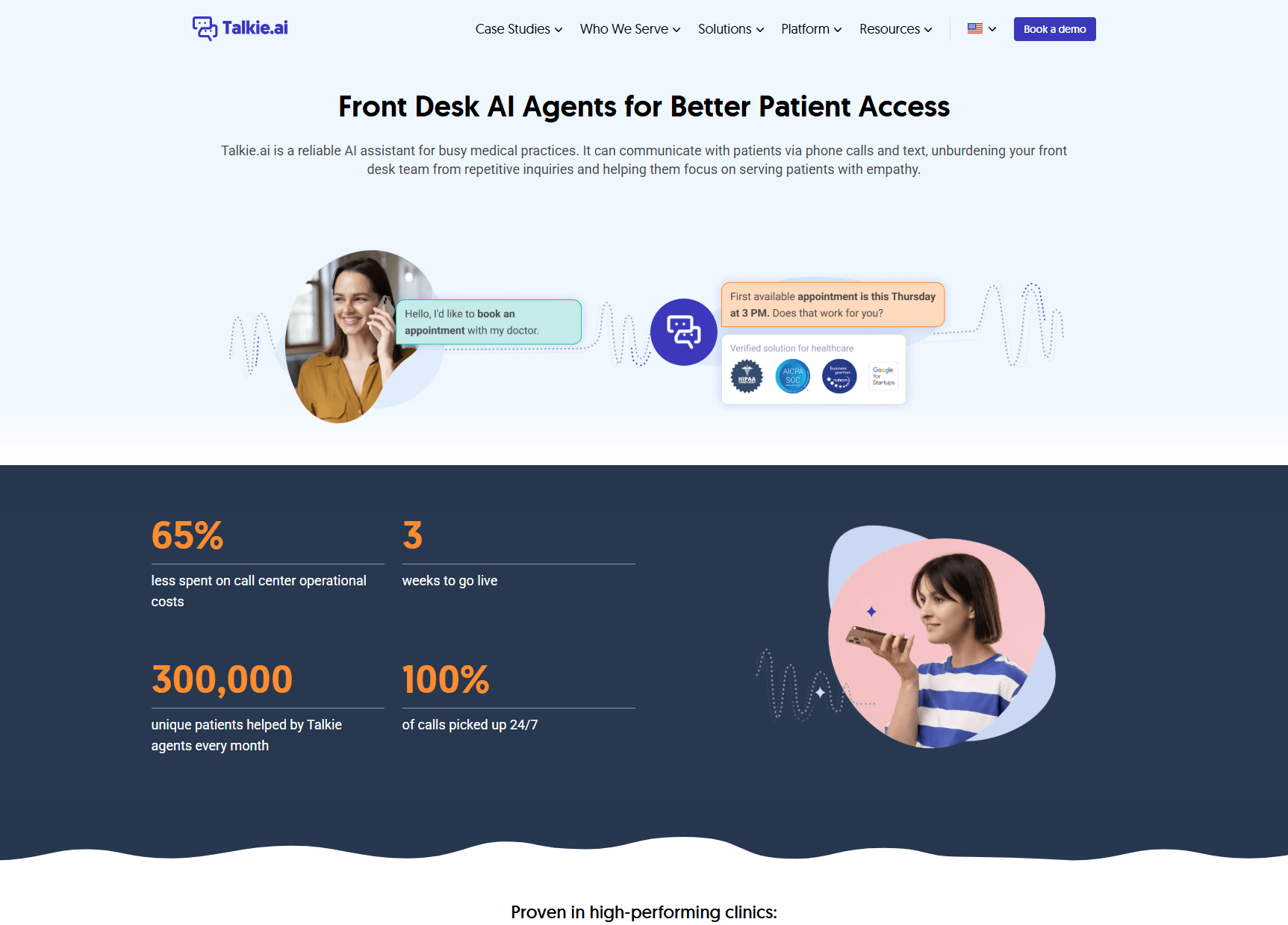
Talkie AI is a vertically integrated specialist that provides the medical-grade security and EHR connectivity that general tools like Synthflow lack. According to its own performance data, Talkie handles over 100 calls per day per staff member effortlessly, automating routine tasks like prescription refills and appointment scheduling. By maintaining strict HIPAA compliance and signing BAAs, it offers a safe, 24/7 multilingual experience that boosts clinic efficiency and patient satisfaction
Best for: Dental practices, medical clinics, and hospital groups that require secure, HIPAA-compliant automation for scheduling and patient data management.
Key Advantages vs Synthflow AI:
- EHR Native Integration: Talkie.ai connects directly with systems like Epic and Athenahealth to update patient records in real-time—a feature Synthflow cannot natively match.
- HIPAA & BAA Security: The platform is built specifically for PHI (Protected Health Information), offering the legal and technical safeguards required in healthcare.
- Medical Logic Templates: Includes pre-configured workflows for medical triage, ensuring patients are routed correctly based on the urgency of their symptoms.
- Professional Medical Lexicon: The AI is trained specifically on medical terminology, ensuring it correctly identifies drug names and clinical procedures.
- Automated Appointment Reminders: Beyond just taking calls, it proactively manages the patient journey to reduce "no-show" rates through integrated follow-ups.
Limitations:
- Highly specialized; not a suitable choice for general marketing or retail businesses.
- Setup involves a more rigorous onboarding process to ensure clinical accuracy and compliance.
Pricing: Custom enterprise pricing generally requires a high monthly minimum or setup fee.
5. Ringly.io: Best Voice AI for E-commerce Brands Needing Native Shopify and Order Management Support
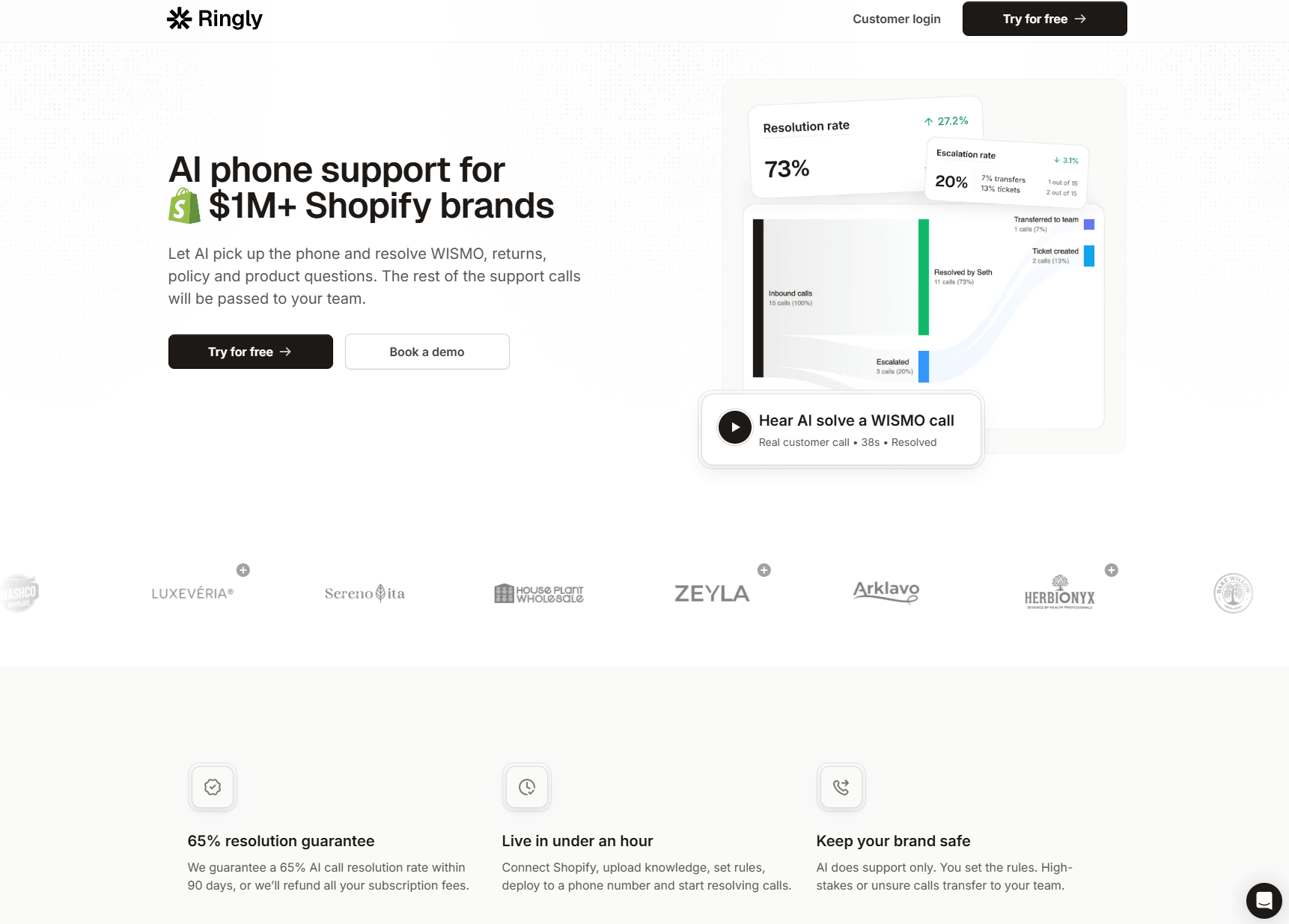
Ringly.io is the ultimate Synthflow alternative for the retail sector, designed to turn a phone line into a profit center. It boasts an impressive 73% resolution rate across 2,100+ active customers, largely due to its native Shopify integration. While Synthflow requires manual work to fetch data, Ringly's AI "reads" your store’s backend to instantly answer order status questions, process returns, or even cross-sell products based on purchase history.
Best for: E-commerce store owners and D2C brands that want to automate 80% of their customer support calls while increasing lifetime customer value.
Key Advantages vs Synthflow AI:
- One-Click Shopify Sync: Ringly pulls order data and tracks numbers directly from Shopify, providing instant answers that Synthflow would struggle to fetch.
- Automated Returns Processing: The AI can initiate the return or exchange process on the call, drastically reducing the workload on your support team.
- Cart Recovery Calls: Uniquely designed to proactively call customers who abandon high-value carts to offer assistance or a discount.
- Inventory Awareness: The AI knows what is in stock and can suggest alternatives if a caller is looking for an out-of-stock item.
- Revenue Focused: Built with a "Marketing First" mindset, focusing on sales and retention rather than just simple call answering.
Limitations:
- With a starting price of $349/month, it is significantly more expensive than entry-level competitors.
- Requires a Shopify (or similar) store to unlock its most powerful automation features.
Pricing:
Plan | Price | Key Features |
Grow | $349/month | |
Enterprise | Custom | Dedicated Implementation Support (add-on), Custom MSA/DPA terms, Role-based Access Control, Dedicated Stable Server |
6. Bland AI: Best Hyper Scale Calling Solution for Teams Needing Rapid Outbound and Lead Qualification
Bland AI is positioned for teams that need high-volume outbound calling and lead qualification at scale. It is especially relevant when the goal is not just to answer calls, but to run a large number of conversations efficiently. That makes it a strong option for growth teams and organizations with serious calling volume.
Best for: large sales organizations, lead generators, and high-volume outbound campaigns that prioritize cost-per-call and massive scalability.
Key Advantages vs Synthflow AI:
- Unrivaled Concurrency: While Synthflow may struggle with high call volumes, Bland can handle thousands of simultaneous calls without a dip in performance.
- Low Cost: With per-minute rates as low as $0.14, it is the most affordable solution for mass-market outbound calling.
- "Bland Turbo" Engine: A specialized infrastructure that reduces the gap between voices to nearly zero, creating a blistering response speed.
- Simple API Integration: Designed for teams that want to trigger calls programmatically from their own software or apps.
- Mass Qualification: Perfect for "scrubbing" lead lists—the AI can quickly identify who is interested and transfer only the "hot" leads to a human.
Limitations:
·Businesses that want a simple front desk may find it too aggressive for their needs.
- The interface is more technical and may be intimidating for basic users.
Pricing:
Plan | Price | Key Features |
Start | $0.14/minute, $0/month platform fee | 10 concurrent calls, 1 voice clone, 10 knowledge bases, 100 calls/day |
Build | $0.12/minute, $299/month platform fee | 50 concurrent calls, 5 voice clones, 50 knowledge bases, 2,000 calls/day |
Scale | $0.12/minute, $299/month platform fee | 100 concurrent calls, 15 voice clones, 100 knowledge bases, 5,000 calls/day |
7. Vapi: Best Voice AI Agent for Tech Teams Needing High Speed and Deep API Customization
Vapi is the premier "Voice-as-a-Service" platform for developers who find Synthflow’s no-code environment too restrictive. Trusted to have processed over 300 million calls, it provides the low-level building blocks—allowing you to choose your own LLM, voice engine, and logic flow. It is the gold standard for tech teams building custom voice applications that require sub-500ms response times and complete control over the technical stack.
Best for: SaaS founders, developers, and product teams that want to embed a highly customized voice AI directly into their own proprietary software.
Key Advantages vs Synthflow AI:
- Pick-Your-Own Stack: Vapi lets you swap between OpenAI, Groq, and Anthropic for the "brain," and ElevenLabs or Play.ht for the "voice."
- Sub-500ms Latency: Engineered for maximum speed, Vapi is often the fastest platform on the market for real-time interactions.
- Deep Tool Use: You can program the AI to execute specific code functions or fetch data from your own internal APIs during a live call.
- No "Platform Tax": Transparent usage-based pricing that avoids the high monthly fees found in more "bundled" platforms.
- Developer Dashboard: Provides advanced debugging logs and visualization tools that make it easy to refine the AI’s behavior.
Limitations:
- Not for non-coders; there is no "drag-and-drop" builder for business owners.
- You must manage your own integrations and business logic from scratch.
Pricing:
Plan | Price | Key Features |
Build | Usage-based call minutes | 60+ minutes included, 10 call concurrencies, HIPAA at $2K/month |
Scale | Fixed Platform fee + Volume-based per-minute pricing | Priority model and provider access, Support SLA, Dedicated account team, HIPAA at $2K/month |
How to Choose the Right Synthflow Alternative for Your Business
The right choice depends less on the brand name and more on the job you want the agent to do. A local business, a clinic, a Shopify store, a sales team, and a developer team will usually value different things, even if they all want voice automation. You can refer to the decision matrix below to narrow down your search.
Business Need | Recommended Tool | Why |
Ease of Use & CRM Sync | Solvea | Best balance of no-code setup and professional business logic. |
Healthcare Compliance | Talkie AI | The only one with HIPAA and native EHR integration focus. |
Lowest Latency | Retell AI | Leading the market in natural conversation speed and flow. |
Shopify Integration | Ringly.io | Built specifically for the needs of e-commerce store owners. |
Mass Outbound Volume | Bland AI | Designed for scale and low-cost per-minute calling. |
Developer API Access | Vapi | Maximum flexibility to build your own custom voice stack. |
If you are migrating from Synthflow, start by mapping your current call flows, integrations, and prompt logic. Then identify which flows must be preserved exactly, which can be simplified, and which can be improved during the move. Most teams get the best results by testing one live workflow first, such as booking, lead capture, or after-hours routing, before switching everything at once.
Your AI Receptionist, Live in Minutes.
Scale your front desk with an AI that never sleeps. Solvea handles unlimited multi-channel inquiries, books appointments into your calendar automatically, and ensures zero missed opportunities around the clock.
FAQs
Which AI receptionist platform is easiest for non-technical users?
Solvea and Goodcall are the easiest Synthflow AI replacement options on the list. Goodcall is essentially a "one-click" setup using your Google profile, while Solvea offers a user-friendly dashboard to build complex business logic without writing code. Both are significantly more intuitive for a small business owner than the standard Synthflow setup.
What is the most cost-effective Synthflow alternative for a small business on a tight budget?
For a small business on a tight budget, Solvea is currently one of the most accessible options with plans starting at approximately $30/month. Goodcall serves as another viable alternative starting around $66/month, which is tailored for local businesses seeking simplified call handling.
Which alternative should I choose for high-volume outbound cold calling?
Bland AI is the undisputed king of high-volume outbound. It is built for massive concurrency and costs as little as $0.14 per minute. If you need to reach thousands of leads quickly, it is a much more robust engine for cold calling than Synthflow.
Is there a Synthflow alternative specifically optimized for Shopify and E-commerce?
Yes, Ringly.io is built specifically for Shopify. It features a native integration that allows it to check order statuses, initiate returns, and answer inventory questions directly from your Shopify backend, which requires heavy manual work in Synthflow.
Which Synthflow alternative gives developers the most customization?
Vapi offers the most customization. It is a developer-first platform that lets you choose your own LLM, your own text-to-speech engine, and write custom functions for the AI to execute, giving you total control over the technical stack.
Which Synthflow alternative is best for healthcare clinics requiring deep EHR integration?
Talkie.ai is the best alternative to Synthflow for medical settings. It is HIPAA-compliant and offers native integration with major EHR systems like Epic. It is designed specifically for clinical workflows, such as patient triage and appointment scheduling.
Can I migrate from Synthflow to one of these alternatives without losing my existing call flows or data?
Yes. While you can't click a single "export" button, you can copy your prompt instructions and knowledge base files into platforms like Solvea. Since the platform uses a similar but more advanced logic engine, you can recreate your flows in minutes and often improve them in the process.