B2B Growth Automation Metrics That Actually Matter
B2B growth automation is easy to over-measure and still misunderstand.
A dashboard can show thousands of automated emails, summaries, tasks, routing decisions, and AI replies. That does not mean the system is creating qualified pipeline. It may only mean the team has found a faster way to generate noise.
The useful question is narrower: did automation move the right buyer conversation to the right next step with enough context for a human or system to continue?
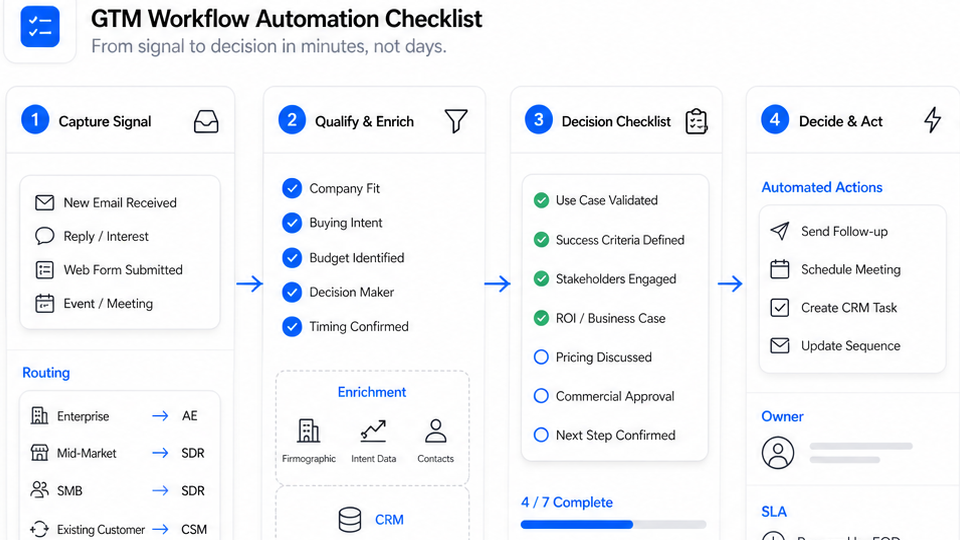
That is the standard this guide uses. It is built for service businesses and lean GTM teams that are using automation across calls, SMS, email, chat, forms, content, CRM updates, appointments, and follow-up. It also fits teams evaluating AI GTM agents, AI receptionists, and workflow automation tools.
Quick answer: the B2B growth automation metrics to track
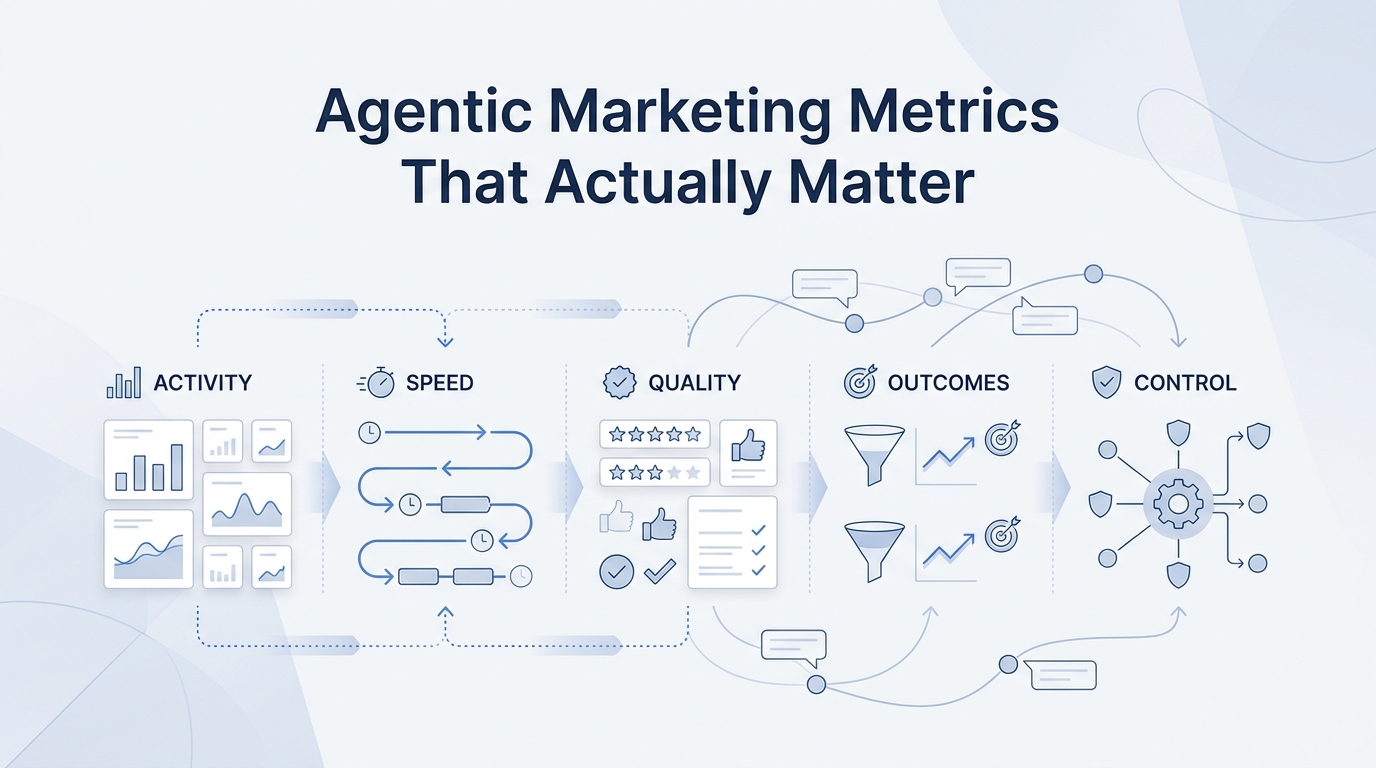
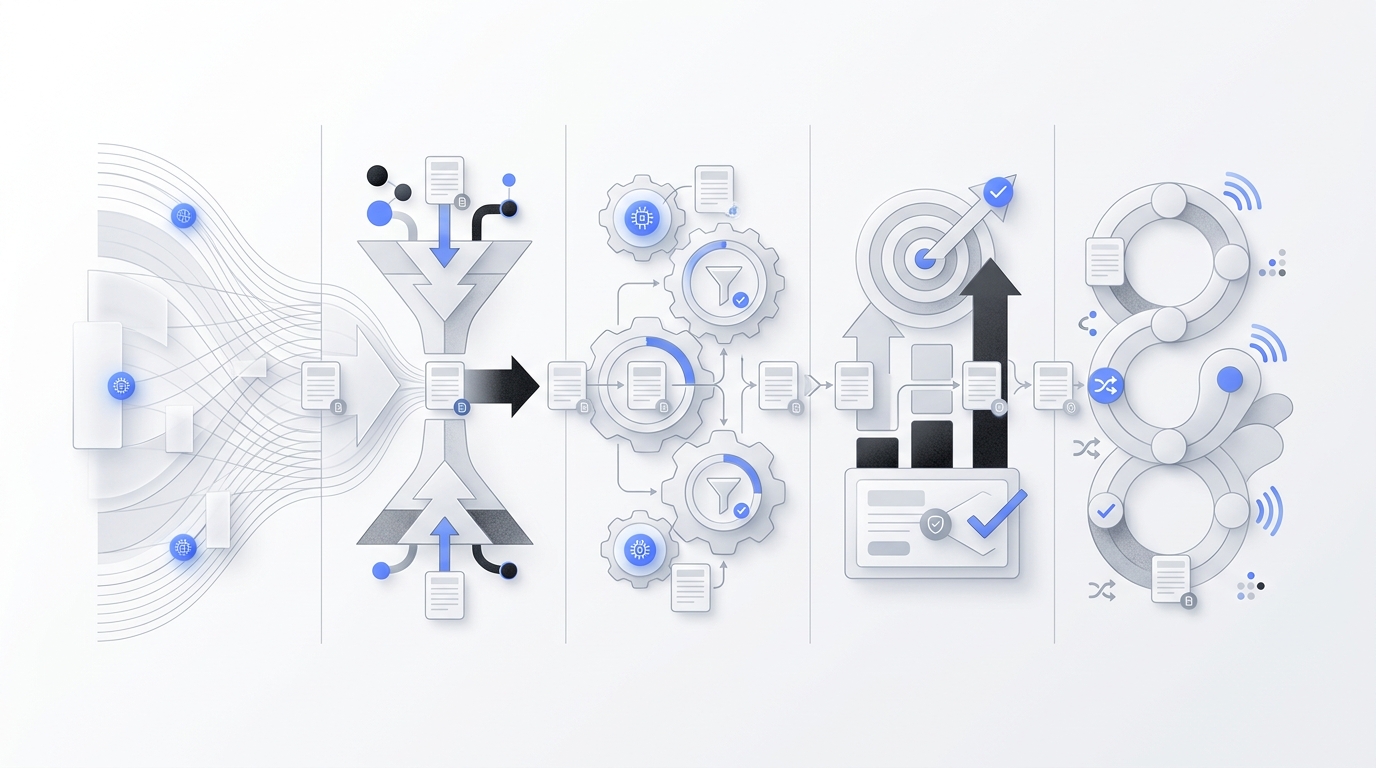
Track B2B growth automation with five layers: coverage, speed, quality, outcomes, and control.
| Metric layer | What it proves | Metrics to track |
|---|---|---|
| Coverage | Automation is touching the right workflow | Eligible workflow volume, automation coverage rate, channel coverage |
| Speed | The workflow moves faster | Trigger-to-first-response time, time-to-owner, time-to-next-step |
| Quality | The output is useful | qualified conversation capture rate, data completeness, handoff acceptance, correction rate |
| Outcomes | The workflow creates business value | qualified signups, bookings, callbacks, pipeline created, assisted conversions |
| Control | Automation is safe enough to scale | escalation rate, unresolved exceptions, rollback events, customer confusion, compliance-sensitive handoffs |
Do not judge B2B growth automation by activity alone. Count outputs, but make the decision on qualified next steps.
The metrics that look useful but are weak alone
Some automation metrics are fine as diagnostic signals. They become misleading when they are treated as proof of growth.
| Weak metric | Why it misleads | Better question |
|---|---|---|
| Automated messages sent | More messages can create more low-quality touches | Did the message move a qualified buyer to the next step? |
| AI tasks completed | A completed task may not matter to revenue | Which workflow outcome changed? |
| Leads touched | Touching every lead is not the same as prioritizing good leads | Which leads became qualified conversations? |
| Time saved | Saved time can disappear into review, cleanup, or rework | Did owner review time drop without hurting quality? |
| Open rate | Opens rarely prove purchase intent by themselves | Did the buyer reply, book, sign up, or continue? |
| Tool adoption | High usage can mean the team is dependent on a messy system | Are users correcting less and trusting the workflow more? |
B2B growth automation should reduce delay, improve handoff quality, preserve buyer context, and help teams act on real demand. If the dashboard cannot show those things, it is not finished.
Metric 1: eligible workflow volume
Before you calculate automation performance, define the workflow that automation is allowed to handle.
Examples:
- missed calls from new prospects;
- website chat questions during business hours;
- after-hours appointment requests;
- demo form submissions from target accounts;
- unworked leads older than 24 hours;
- quote requests missing required fields;
- trial users who reach an activation milestone;
- blog visitors who click into pricing or a product page.
Eligible workflow volume is the number of events that match the automation rules. It keeps the measurement honest. If 1,000 leads enter the business but only 180 qualify for the automated workflow, measure against 180, not 1,000.
Use this formula:
| Metric | Formula |
|---|---|
| Eligible workflow volume | Events matching the workflow rule |
| Automation coverage rate | Automated events / eligible workflow events |
| Manual exception rate | Manual-only events / eligible workflow events |
For B2B growth automation, the first win is not 100% automation. The first win is a clearly bounded workflow that automation can handle repeatedly without hiding exceptions.
Metric 2: trigger-to-first-response time
Automation should reduce the delay between buyer intent and response.
Measure the time from trigger to first useful response. The trigger might be a call, SMS, chat, form, calendar request, CRM stage change, or content conversion event. The first useful response is the moment the buyer receives a relevant answer, qualification question, scheduling option, or human handoff.
Track this by channel:
| Channel | Trigger | First useful response |
|---|---|---|
| Phone | Missed or inbound call | AI answer, callback task, or owner escalation |
| SMS | New customer message | Relevant reply or qualification question |
| Website chat | Visitor asks a question | Answer from knowledge base or handoff |
| Form | Demo or quote request | Confirmation, routing, or next-step request |
| CRM | Lead enters a stage | Assignment, enrichment, or outreach draft |
The goal is not instant response at any cost. The goal is a fast response that moves the workflow forward without creating cleanup.
Metric 3: qualified conversation capture rate
B2B growth automation should capture demand that would otherwise get lost.
For service businesses, this often means calls, texts, chats, and appointment requests that happen while the team is busy. For software or B2B teams, it may mean demo requests, trial questions, integration questions, or pricing inquiries.
Qualified conversation capture rate measures how many automated interactions produce enough information for a next step.
Use a practical qualification checklist:
| Field | Example |
|---|---|
| Who | Name, company, phone, email, customer status |
| Need | Service request, product question, use case, urgency |
| Fit | Location, segment, budget signal, plan interest, account type |
| Next step | booking, callback, quote, demo, trial help, escalation |
| Owner | person, team, queue, or system responsible |
| Evidence | transcript, message, form fields, source URL, or CRM record |
If the automation captures only a name and a vague summary, the rate should not count as qualified. Good B2B growth automation leaves the team with enough context to act.
Metric 4: data completeness before action
Automation fails when it acts without the data required for the decision.
Define the required fields before launch. For an appointment workflow, the agent may need service type, location, preferred time, contact information, business hours, and calendar rules. For a content-assisted signup workflow, the team may need landing page, article URL, campaign source, signup status, and whether the user reached a product action.
Use a simple score:
| Completeness level | Definition |
|---|---|
| Complete | All required fields are present before the next action |
| Usable | One non-critical field is missing, but the next step is safe |
| Incomplete | Required context is missing and the action should not proceed |
Track incomplete records by source. If one channel consistently creates weak records, fix the form, script, agent prompt, integration, or routing rule before scaling.
Metric 5: handoff acceptance rate
Human handoff is not a failure. It is part of a controlled B2B growth automation system.
The metric to watch is handoff acceptance rate: how often the receiving person can use the handoff without starting over.
| Handoff quality | What it looks like |
|---|---|
| Accepted | Owner understands the context and takes the next step |
| Reworked | Owner can proceed, but must correct or fill in missing information |
| Rejected | Owner cannot use the handoff and must restart the conversation |
A useful handoff includes the customer, channel, timestamp, transcript or source record, summary, urgency, qualification fields, proposed next step, owner, and escalation reason.
This is where automation often creates hidden work. If the AI agent says "lead needs follow-up" but does not explain why, who owns it, or what happened, the handoff is weak.
Metric 6: automated next-step completion
The strongest B2B growth automation workflows do more than respond. They complete the next step.
Examples:
- a missed call becomes a qualified callback task;
- an appointment request becomes a confirmed booking or a proposed time;
- a website chat becomes a product page visit or contact record;
- a trial question becomes an activation task;
- a content visitor becomes a qualified signup;
- a stale lead becomes a reviewed reactivation draft;
- a customer issue becomes a routed ticket with summary and owner.
Track next-step completion rate:
| Metric | Formula |
|---|---|
| Next-step completion rate | Automated interactions with completed next step / eligible automated interactions |
| Assisted next-step rate | Automated interactions that contributed to a later conversion / eligible automated interactions |
This keeps the team focused on progress. B2B growth automation is valuable when the workflow advances, not when the system produces another note.
Metric 7: human correction rate
Automation quality is not proven by confidence. It is proven by how often humans need to fix the output.
Track corrections by type:
| Correction type | Example |
|---|---|
| Wrong summary | AI misunderstood the buyer request |
| Missing field | Required service, account, or contact data is absent |
| Bad routing | Lead went to the wrong owner or queue |
| Unsafe answer | AI answered something that should be escalated |
| Tone issue | Reply sounded off-brand or confusing |
| Duplicate action | Workflow created duplicate tasks, replies, or records |
Correction rate should be reviewed with examples, not just a percentage. A low volume of serious corrections can matter more than a higher volume of harmless edits.
Use this decision rule:
| Correction pattern | Action |
|---|---|
| Repeated missing fields | Change intake questions or form requirements |
| Repeated bad routing | Fix ownership rules or CRM logic |
| Repeated unsafe answers | Narrow permissions and add escalation rules |
| Repeated vague summaries | Improve transcript-to-summary prompts and required fields |
| Rare minor edits | Keep monitoring |
Metric 8: qualified signup and pipeline quality
If the workflow is connected to acquisition, measure qualified signups and pipeline quality.
A qualified signup is not just a form fill. Define it in a way that matches the business. For a B2B product, that might include business email, relevant industry, target team size, correct region, completed onboarding step, first product action, or a pricing/demo page visit. For a service business, it might be a caller or lead with service need, location fit, contact details, and a booked or requested next step.
Keep two metrics separate:
| Metric | Meaning |
|---|---|
| Signup volume | How many people created an account or submitted a lead |
| Qualified signup rate | How many signups met your qualification definition |
More signups are not always better. If B2B growth automation increases total signups while qualified signup rate falls, the workflow may be attracting or routing the wrong demand.
Metric 9: assisted conversions from the article URL
This task's measurement plan includes organic clicks, indexed URL count, qualified signups, and assisted conversions from the article URL. Those metrics need different tools.
Use Google Search Console for search visibility signals such as clicks, impressions, CTR, and average position. Use Google Analytics 4 or your backend data for qualified signups and conversion paths. GA4 key events can mark meaningful actions, and attribution reports can help show how touchpoints contributed before conversion.
For this article, track:
| Measurement | Source |
|---|---|
| Indexed URL count | Search Console URL inspection or indexing reports |
| Organic clicks | Search Console Performance report |
| Impressions and average position | Search Console Performance report |
| Product-page click-through | GA4 landing page and path analysis |
| Qualified signups | GA4 key event plus backend qualification |
| Assisted conversions | GA4 attribution/path exploration or CRM source history |
Do not force last-click attribution to carry the whole story. A buyer may discover a B2B growth automation guide, return through branded search, visit pricing, and sign up later. The article still assisted the conversion if it started or influenced the path.
Metric 10: control health
Automation that cannot be controlled should not scale.
Control health measures whether the workflow can be paused, reviewed, corrected, and expanded safely.
Track:
| Control metric | Why it matters |
|---|---|
| Escalation rate | Shows how often automation reaches its boundary |
| Unresolved exception count | Shows where workflows are breaking |
| Rollback events | Shows whether actions had to be undone |
| Duplicate action rate | Prevents repeated messages or records |
| Sensitive-topic handoffs | Keeps legal, pricing, medical, refund, and policy issues under review |
| Customer confusion reports | Catches experience problems early |
| Owner review time | Shows whether automation actually reduces work |
NIST's AI Risk Management Framework is useful background here because it frames AI work around identifying, measuring, managing, and governing risk. In a practical B2B growth automation pilot, that means permissions, evidence, review, and rollback matter as much as speed.
The dashboard structure
A useful B2B growth automation dashboard does not need 40 metrics. Start with 10.
| Metric | Owner | Review cadence | Good signal |
|---|---|---|---|
| Eligible workflow volume | Growth ops | Weekly | The workflow is large enough to matter |
| Automation coverage rate | Ops owner | Weekly | Automation touches the intended events |
| Trigger-to-first-response time | Channel owner | Daily/weekly | Buyers receive faster useful responses |
| Qualified conversation capture rate | Sales or service owner | Weekly | More usable demand is preserved |
| Data completeness | Ops owner | Weekly | Records are ready before action |
| Handoff acceptance rate | Receiving team | Weekly | Humans can act without restarting |
| Next-step completion rate | Workflow owner | Weekly | Automation moves the workflow forward |
| Human correction rate | Workflow owner | Daily/weekly | Quality improves over time |
| Qualified signups or pipeline created | Growth owner | Weekly/monthly | Outcomes improve, not just activity |
| Assisted conversions | Marketing ops | Monthly | The article, workflow, or channel influences later revenue |
The key is sequence. Coverage and speed tell you whether automation is running. Quality tells you whether the output is usable. Outcomes tell you whether it matters. Control tells you whether it is safe to expand.
A 14-day pilot plan
Use a short pilot before expanding B2B growth automation across channels.
Days 1-2: choose one workflow
Pick one workflow close to revenue. Good examples include missed-call response, appointment qualification, demo request routing, trial activation follow-up, or after-hours lead capture.
Write the trigger, eligible events, required fields, allowed actions, escalation rules, and primary KPI.
Days 3-5: configure and test
Connect only the systems required for the workflow. Load the knowledge base or approved answers. Test messy examples:
- missing contact details;
- duplicate customer records;
- vague buyer requests;
- angry or confused messages;
- out-of-hours urgency;
- questions the automation should not answer;
- appointment conflicts;
- low-fit leads.
Keep the first version narrow. It is easier to expand a controlled workflow than repair a broad one after it touches customers.
Days 6-10: run with daily review
Review transcripts, summaries, routing decisions, and completed next steps every day. Track correction types and handoff acceptance.
Do not only ask "was the AI right?" Ask:
- Did it have the right context?
- Did it ask for missing data?
- Did it route correctly?
- Did it stop when it should?
- Did the next owner know what to do?
- Did the buyer move closer to a qualified next step?
Days 11-14: decide keep, adjust, expand, or stop
Compare the pilot against the baseline.
| Decision | When to choose it |
|---|---|
| Keep | Quality and control are acceptable, but expansion is not ready |
| Adjust | The workflow works, but one metric needs repair |
| Expand | Quality, outcome, and control metrics are all strong |
| Stop | Corrections, unsafe actions, or weak outcomes make the workflow unready |
The best pilots usually produce a small number of very concrete fixes. That is the point. B2B growth automation improves when the workflow learns from real exceptions.
Where Solvea fits
Solvea is relevant when B2B growth automation starts with customer conversations.
The current Solvea product is a business phone and helpdesk with AI answering, live call context, customer history, summaries, transcripts, SMS, email, live chat, and team follow-up across mobile and PC. Solvea's site also describes an AI Agent Builder, knowledge base, outbound calling, contact management, analytics, integrations, and live translation.
That makes Solvea a practical fit when the metric problem is close to the front door:
- missed calls are not becoming qualified callbacks;
- after-hours inquiries are not getting captured;
- SMS, email, chat, and calls are split across tools;
- customer history disappears when a teammate is off;
- booking requests need qualification before a human steps in;
- owners need visibility into response time, drop-offs, handoffs, and outcomes.
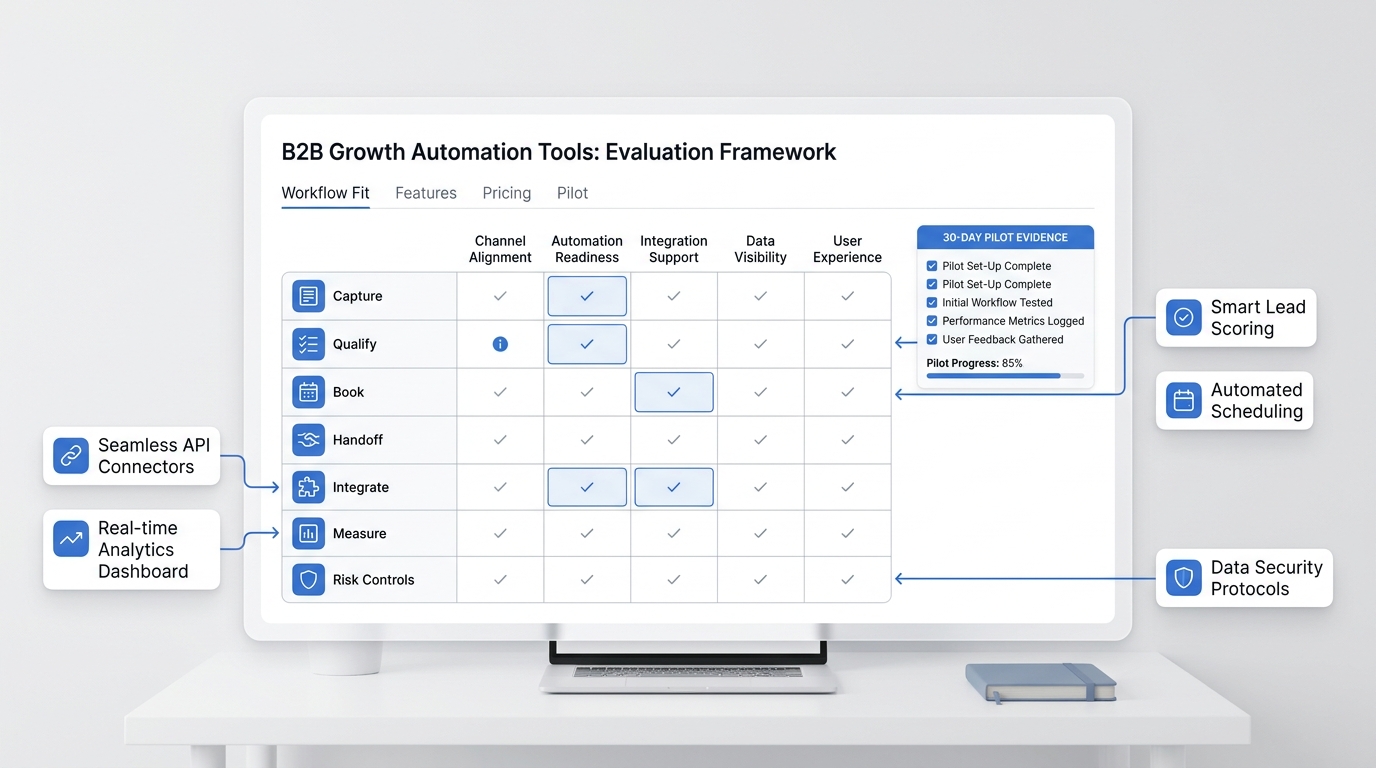
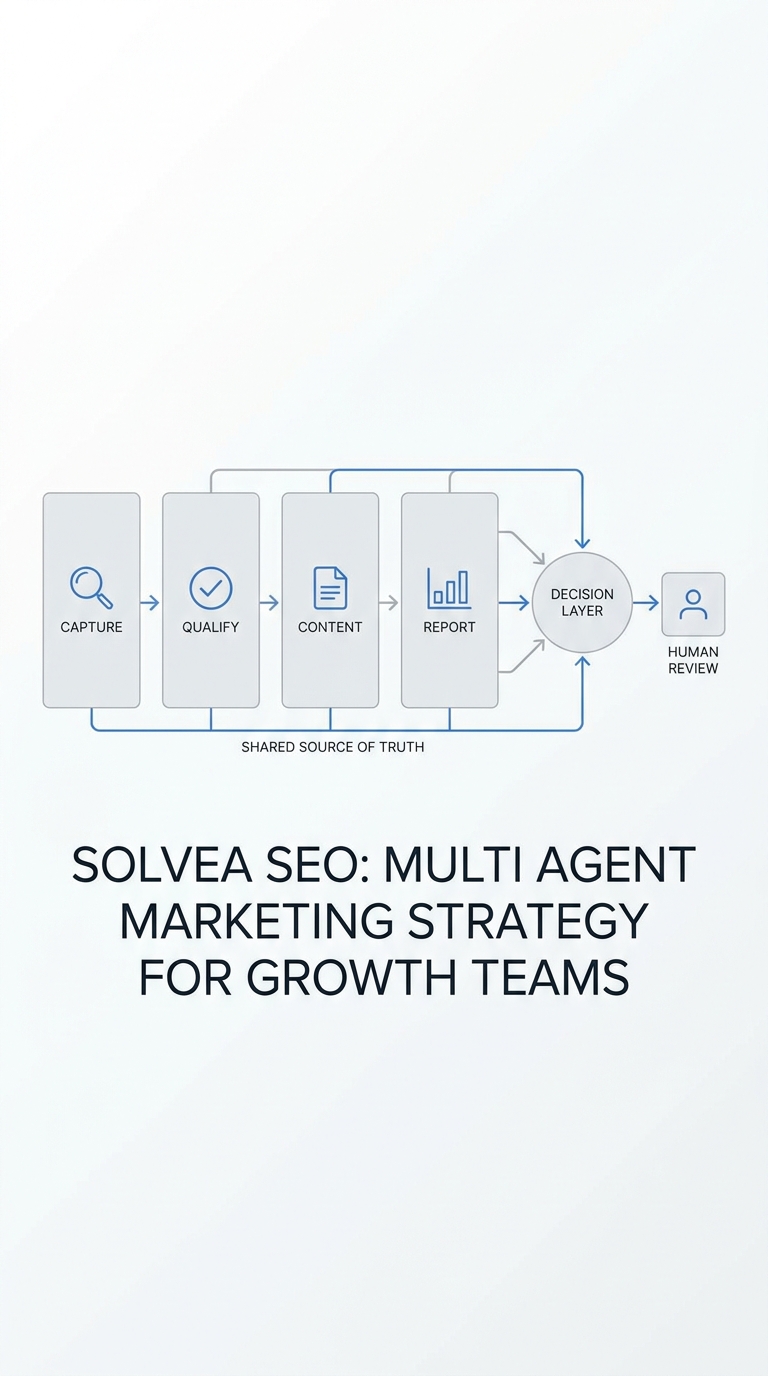
For this use case, review Solvea's AI Agent Builder, AI Receptionist, omnichannel inbox, analytics, and integrations. For adjacent evaluation context, read the B2B growth automation tools framework, agentic marketing metrics guide, and AI GTM agents strategy guide.
Solvea is not the first tool to evaluate if your main problem is enterprise ad orchestration, broad data warehousing, or a custom engineering platform. It is strongest when the growth leak is customer response, qualification, booking, follow-up, and handoff.
Your AI Receptionist, Live in Minutes.
Scale your front desk with an AI that never sleeps. Solvea handles unlimited multi-channel inquiries, books appointments into your calendar automatically, and ensures zero missed opportunities around the clock.
FAQ
What is B2B growth automation?
B2B growth automation is the use of software, workflow rules, and AI agents to move prospects, customers, campaigns, or accounts from one growth step to the next. Good automation is bounded by clear triggers, data access, permissions, handoff rules, and measurable outcomes.
What is the most important B2B growth automation metric?
The most important metric is the one tied to the workflow outcome. For acquisition workflows, that may be qualified signups, booked demos, qualified conversations, callbacks completed, or pipeline created. Activity metrics are useful only when paired with outcome and quality metrics.
How do you measure AI growth automation quality?
Measure quality with data completeness, handoff acceptance, human correction rate, customer confusion, duplicate actions, and next-step completion. These metrics show whether automation is creating usable work or just moving tasks around.
How should a team measure assisted conversions from SEO content?
Use Search Console to track organic visibility and GA4 or backend data to track qualified signups and conversion paths. Mark meaningful actions as key events, then review whether the article URL appeared before later pricing visits, product visits, signups, or sales conversations.
What B2B growth automation metrics should executives see?
Executives should see workflow coverage, first response time, qualified demand captured, next-step completion, qualified signup or pipeline contribution, assisted conversions, correction rate, and major control risks. They usually do not need every activity count.
When is B2B growth automation ready to scale?
B2B growth automation is ready to scale when the workflow has enough eligible volume, faster useful response, high handoff acceptance, low serious correction rate, a visible outcome lift, and clear controls for exceptions, review, and rollback.
Final recommendation
Measure B2B growth automation like a workflow, not like a content machine.
Start with one revenue-adjacent workflow. Define the trigger. Count only eligible events. Track response speed, qualified capture, data completeness, handoff acceptance, next-step completion, correction rate, qualified signups, assisted conversions, and control health.
If the workflow starts with customer conversations, Solvea is worth evaluating. Use the AI Agent Builder and conversation analytics to test whether automation can capture the right demand, route it with context, and create a qualified next step your team can actually use.