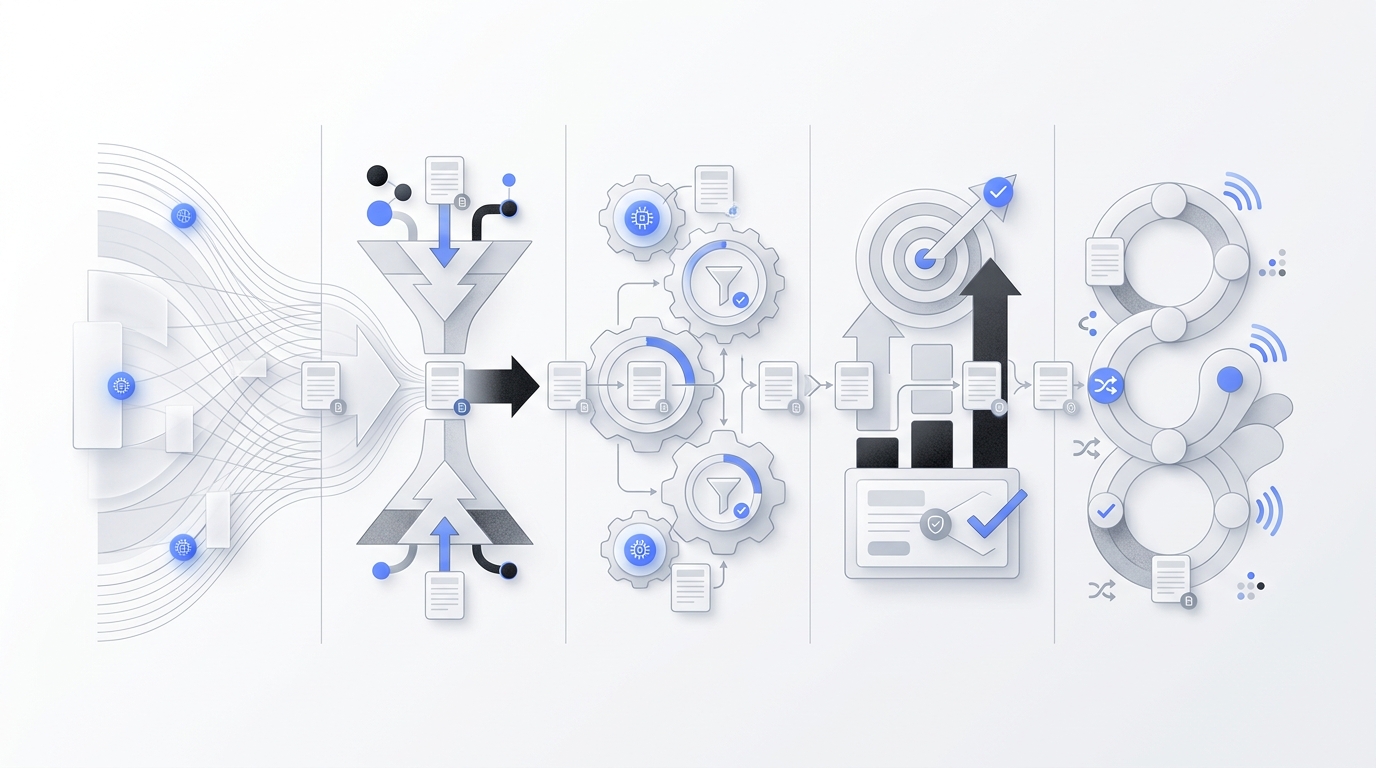
Agentic marketing is marketing work handled by AI agents that can use context, choose a next step, take a bounded action, and hand off when the situation needs a person.
That sounds broad because the phrase is broad. A lot of products now describe themselves as agents, copilots, assistants, or agentic platforms. The practical question is narrower: should an AI agent own part of your growth workflow, or would a normal automation rule, template, or human checklist be safer?
For service businesses and lean GTM teams, agentic marketing matters when delay, missing context, or repeated handoffs cost you real opportunities. It matters less when the work is creative judgment, high-risk approval, or a one-time campaign that still needs a human owner.
This guide gives you a simple way to decide when agentic marketing is useful, when it is overkill, and what to test first.
What agentic marketing means
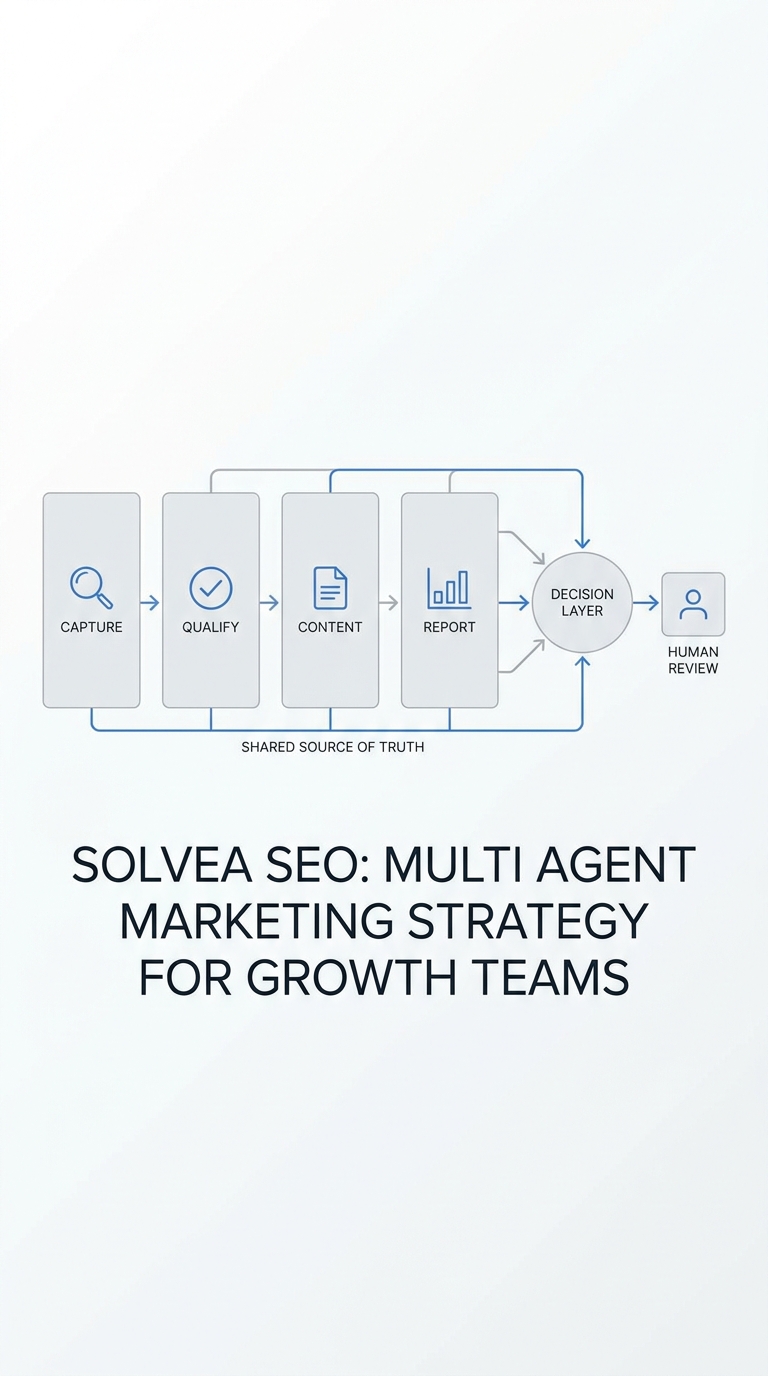
Agentic marketing applies agentic AI to marketing and growth workflows. IBM describes agentic AI as systems that can pursue a specific goal with limited supervision, using agent behavior such as planning, tool use, and task execution. In marketing, that translates into workflows where an AI agent can observe a trigger, use approved context, act within rules, and leave evidence for review.
A normal automation rule says:
When a form is submitted, send this email.
An agentic marketing workflow says:
When a new lead arrives, read the source, check the conversation history, ask the missing qualification question, route urgent cases to the owner, update the record, and leave a summary.
The difference is not that the second workflow uses AI. The difference is that it uses context and judgment inside a bounded process.
That boundary is important. Agentic marketing is not a license to let AI run the whole funnel. It is a way to assign a narrow, measurable next step to an agent when the rules are clear enough and the risk is manageable.
Agentic marketing vs marketing automation
Marketing automation is still useful. In many cases, it is exactly what you need.
Use ordinary automation when the trigger, action, and result are predictable. Examples include sending a confirmation email, tagging a lead source, creating a task from a form, or adding someone to a newsletter segment.
Use agentic marketing when the workflow needs context before the next step is obvious. Examples include deciding whether a caller is urgent, checking whether a reply needs a human, qualifying an appointment request, or choosing the right follow-up based on what the customer already said.
| Question | Ordinary automation | Agentic marketing |
|---|---|---|
| What starts it? | A fixed trigger | A trigger plus context |
| What does it use? | A rule or static field | Customer history, knowledge, tools, and instructions |
| What can it do? | One predefined action | A bounded set of allowed actions |
| When does it stop? | Usually after the action | When confidence is low, risk is high, or a handoff rule is met |
| How do you measure it? | Completion and delivery | Speed, quality, outcome, handoff accuracy, and evidence |
If the next step never changes, do not make it agentic. If the next step depends on the customer, channel, urgency, or business context, agentic marketing may matter.
When agentic marketing matters
Agentic marketing is worth testing when at least one of these conditions is true.
1. Response speed affects revenue
If customers call, text, chat, or email because they want help now, a slow response is not just an operational issue. It is a growth issue.
This is where agentic marketing can be practical for service SMBs. A missed call, booking request, quote question, or after-hours message can become a structured follow-up record instead of a voicemail or forgotten inbox item.
For example, Solvea's AI Receptionist is built around missed customer calls: AI can answer first, capture caller intent, summarize the call, and send the next step to PC Desk. That is agentic marketing when the workflow is tied to lead capture, qualification, and follow-up.
2. The work crosses channels
Many growth workflows fail because the customer does not stay in one channel. A person may call first, text later, email a document, and then ask a question in chat.
Agentic marketing matters when the agent can see enough context to avoid treating each message as a new conversation. A unified conversation layer makes the workflow more useful because the agent can respond to the customer history, not just the latest message.
Solvea's omnichannel inbox is designed for this kind of work: voice, SMS, email, WhatsApp, LINE, and live chat can land in one inbox with customer context. That gives an agentic workflow a better source of truth than disconnected inboxes.
3. A repeated decision slows the team down
Agentic marketing is strongest when the same decision appears every day:
- Is this lead urgent?
- What service does this customer need?
- Which owner should handle the next step?
- Does this request need a human?
- What approved follow-up should go out?
- Is the knowledge base missing an answer?
These decisions are not fully creative, but they are not always simple rules either. They require context, thresholds, and escalation. That makes them good candidates for a bounded agent.
4. The workflow has a visible handoff
A good agentic marketing workflow has a clean stopping point. It should be obvious when the agent hands work to a human and what the human should do next.
Examples:
- A lead capture agent escalates emergency requests to the owner.
- A qualification agent routes high-fit inquiries to sales.
- A follow-up agent drafts a message when the customer has not replied.
- A content operations agent flags unsupported claims before publishing.
- A reporting agent summarizes organic clicks, qualified signups, and assisted conversions without claiming causation it cannot prove.
If there is no handoff rule, the workflow is not ready.
5. The agent can leave proof
Agentic marketing matters only if the team can inspect what happened.
Useful proof includes the source conversation, transcript, summary, fields updated, message sent, owner assigned, timestamp, confidence issue, and final outcome. Without that evidence, the team cannot debug mistakes or decide whether the agent is helping.
This is also where governance matters. The NIST AI Risk Management Framework is not a marketing playbook, but its emphasis on managing AI risk and trustworthiness is a useful reminder: more autonomy should come with clearer controls, not less oversight.
When agentic marketing is overkill
Agentic marketing is not the right answer for every marketing problem.
It is usually overkill when:
- The workflow is a simple rule, such as sending one fixed confirmation email.
- The data is too messy for the agent to make a useful decision.
- The task involves legal, medical, financial, refund, or emergency judgment that should stay human-owned.
- The team cannot review outputs or trace decisions.
- The workflow happens too rarely to justify setup.
- The goal is just to generate more content without a distribution, conversion, or review process.
It is also a bad fit when the team has not named the outcome. "Use AI for marketing" is not a workflow. "Recover missed calls after hours and create qualified follow-up tasks" is.
The decision threshold
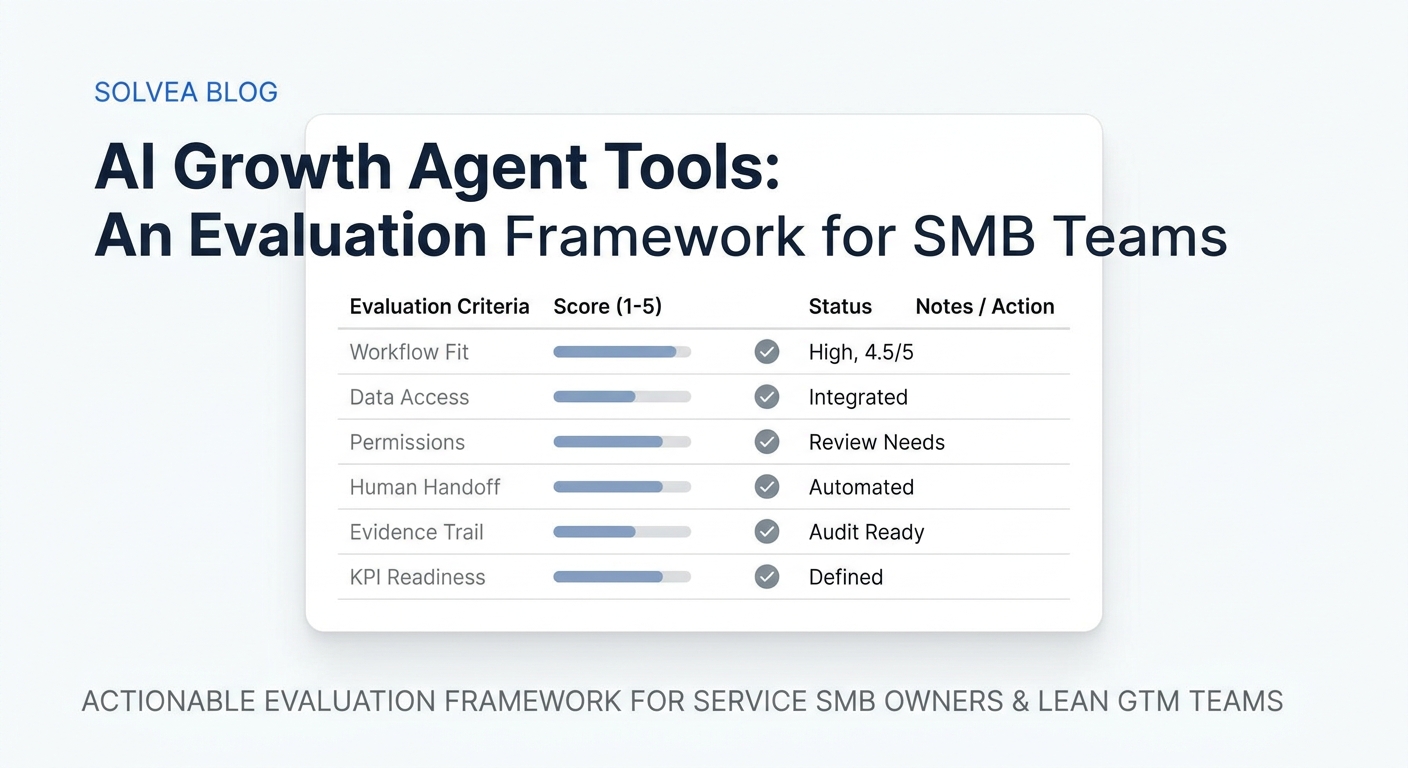
Use this threshold before buying agentic marketing tools or expanding an existing platform.
| Threshold question | If yes | If no |
|---|---|---|
| Is there a repeated trigger? | The workflow may be testable. | Keep it human or checklist-based. |
| Does the next step depend on context? | Agentic marketing may help. | Use ordinary automation. |
| Can the agent access the approved context? | Continue. | Fix the data layer first. |
| Are allowed actions clear? | Continue. | Define permissions before launch. |
| Is there a handoff rule? | Continue. | Do not automate edge cases yet. |
| Can the team inspect evidence? | Continue. | Add logs, summaries, owners, and review. |
| Can one metric prove improvement? | Pilot it. | Clarify the business outcome first. |
If a workflow passes most of these checks, agentic marketing is worth a small pilot. If it fails two or more, the problem is probably workflow design, data access, or governance rather than the lack of an AI agent.
A practical workflow formula
Write the workflow in one sentence before you choose a tool:
When
[trigger]happens, the agent should[allowed action]using[approved context], unless[handoff rule]is true. Success is measured by[metric].
Examples:
| Workflow | One-sentence version |
|---|---|
| Missed-call response | When a customer call is missed after hours, the agent should answer or follow up using business hours, service rules, and conversation history, unless the request is urgent or unclear. Success is measured by response time and qualified follow-up tasks. |
| Appointment qualification | When a booking request arrives, the agent should collect required details and route the lead using approved intake questions, unless the customer asks for sensitive advice. Success is measured by qualified booking requests. |
| Quote follow-up | When a quote has no reply after a set period, the agent should draft or send an approved follow-up using the prior conversation, unless there is a complaint or negotiation. Success is measured by follow-up completion and reply rate. |
| Content QA | When an article is ready to publish, the agent should check source claims, metadata, links, CTA, and schema, unless a claim lacks evidence. Success is measured by unsupported claims caught before launch. |
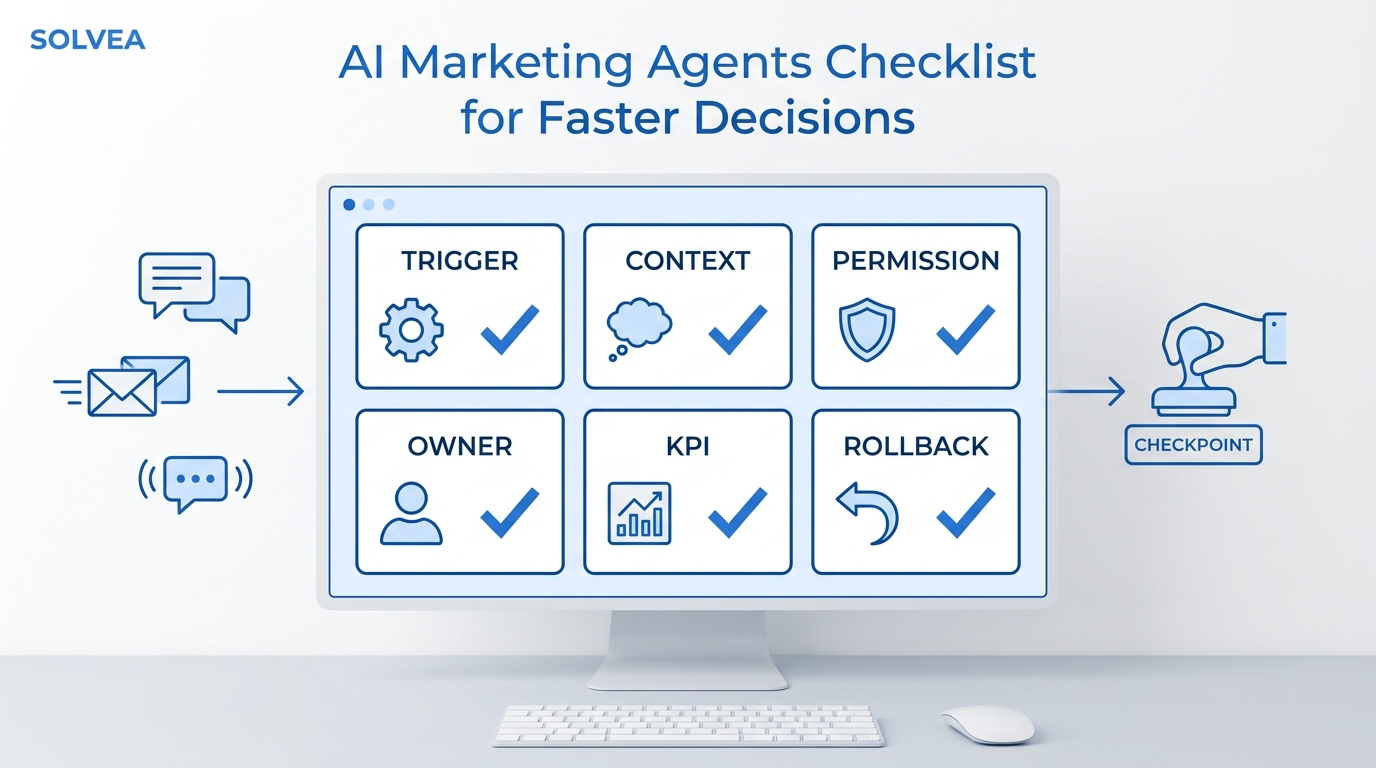
This formula keeps agentic marketing operational. It forces the team to define trigger, context, permission, handoff, and measurement in plain language.
Where agentic marketing tools fit
Agentic marketing tools now appear in several categories.
Enterprise CRM suites such as Salesforce Agentforce position AI agents inside broader customer-success, sales, service, and marketing workflows. Customer-platform tools such as HubSpot Breeze connect AI features and agents to CRM, marketing, sales, service, content, and data workflows.
Those platforms can make sense when the team already operates inside a mature CRM and has the data hygiene to support it.
For a service SMB, the first useful agentic marketing workflow may be closer to the front desk: calls, texts, bookings, FAQs, summaries, routing, and follow-up. Solvea fits this layer with AI Agent Builder, AI Receptionist, PC Desk, customer conversation history, knowledge base, analytics, and integrations for tools such as Google Calendar, Google Sheets, HubSpot, Slack, Freshdesk, Zendesk, Shopify, email, WhatsApp, LINE, and live chat.
If you are comparing tools, use the agentic marketing tools evaluation framework. If you already know you need a buyer checklist, use the agentic marketing comparison guide. This article is the earlier decision point: whether the workflow should be agentic at all.
A 14-day pilot plan
Do not evaluate agentic marketing with a demo alone. Run a small pilot around one workflow.
Days 1-2: Pick the workflow
Choose one high-friction workflow. Good starting points are missed calls, booking requests, quote follow-up, lead qualification, customer message routing, or content QA.
Write the one-sentence workflow formula. If you cannot write it, do not pilot yet.
Days 3-5: Prepare context and permissions
List the context the agent can use:
- Business hours.
- Services offered.
- Service area.
- Approved questions.
- Customer history.
- Knowledge base answers.
- Calendar or booking rules.
- Owner routing rules.
- Escalation rules.
Then define allowed actions: answer, ask, summarize, tag, route, draft, send, book, or escalate. Start with lower-risk permissions first.
Days 6-10: Run with review
Let the agent handle normal cases, but review the evidence trail daily. Look for:
- Missing context.
- Wrong routing.
- Weak summaries.
- Unsupported answers.
- Unclear handoffs.
- Repeated customer questions that should be added to the knowledge base.
Do not expand autonomy during this period. Fix the workflow first.
Days 11-14: Decide
Compare the pilot against the baseline. Use a small metric set:
- Median first response time.
- Qualified leads captured.
- Follow-up tasks created.
- Human handoffs completed.
- Correction rate.
- Customer complaints or opt-outs.
- Owner review time.
- Assisted conversions from the workflow or landing page.
Google Search Console can track organic clicks and page performance for the article or landing page, while Google Analytics key events can help measure important site actions and assisted paths. Keep causation claims conservative: a page or agent workflow can assist conversion without being the only reason it happened.
What to automate first
For most service SMBs, the strongest first agentic marketing workflow is not full campaign orchestration. It is customer intent capture.
Start where the customer is already asking for help:
- Missed calls.
- After-hours booking requests.
- Quote or service inquiries.
- Repeated FAQs before scheduling.
- Follow-up after no reply.
- Customer message routing across channels.
These workflows are narrow enough to control and close enough to revenue to measure.
Agentic marketing becomes meaningful when it turns a live customer signal into a useful next step before the opportunity goes cold. It becomes noise when it creates more activity without a clearer owner, better handoff, or measurable outcome.
Your AI Receptionist, Live in Minutes.
Scale your front desk with an AI that never sleeps. Solvea handles unlimited multi-channel inquiries, books appointments into your calendar automatically, and ensures zero missed opportunities around the clock.
FAQ
What is agentic marketing?
Agentic marketing is the use of AI agents to complete bounded marketing or growth workflows using context, tools, permissions, and handoff rules. It is different from simple automation because the next step can depend on customer context.
How is agentic marketing different from AI marketing?
AI marketing is a broad category that can include content generation, analytics, segmentation, recommendations, and assistants. Agentic marketing is narrower: it focuses on AI agents that can own a defined workflow step and take action within limits.
When does agentic marketing matter for small businesses?
It matters when speed, context, and follow-up affect revenue. Missed calls, appointment requests, quote inquiries, and customer message routing are often better starting points than broad campaign automation.
What should not be handled by an agentic marketing workflow?
Do not give an agent unsupervised ownership of legal, medical, financial, refund, emergency, or sensitive customer decisions. Use AI to summarize, draft, or route those cases, but keep the final decision human-owned.
How should a team measure an agentic marketing pilot?
Measure one business outcome and one control metric. For example: response time plus correction rate, qualified leads plus misrouting rate, or follow-up completion plus complaint rate. Avoid measuring only AI activity volume.
The bottom line
Agentic marketing matters when a repeated growth workflow needs context, action, evidence, and a clean human handoff. It does not matter just because a product calls itself an agent.
Start with one workflow where delay costs money. Define the trigger, approved context, allowed action, handoff rule, and success metric. If that sentence is clear, agentic marketing may be worth testing. If it is not clear, fix the workflow before adding an AI agent.
For service businesses where the first growth problem is missed customer conversations, Solvea can be a practical starting point: AI answers first, captures the next step, keeps context in one place, and gives the team a clearer handoff to act on.