












In the enterprise AI customer support ecosystem, long-term memory (Long-Horizon Textual Memory) has long been hailed as the golden ticket. Brands expect that equipping Large Language Model (LLM) agents with recursive conversation summaries will allow them to act like seasoned human account managers—retaining shopper preferences, order histories, and contextual nuances across multi-turn exchanges.
Yet, brands deploying conventional summary-based chatbots in high-volume production face an exasperating pathology: by turn 6 or 8 of a complex support thread, the AI becomes stubbornly recalcitrant. Even when a shopper explicitly provides updated order credentials or an ERP API returns real-time package status, the chatbot stubbornly defends its hallucinated early premise, repeating circular canned arguments and driving customer frustration to a boiling point.
This is not a prompt engineering oversight. It is a fundamental mathematical pathology newly formalized by researchers at Sejong University's AI & NLP Lab in their breakthrough paper: 《KEEPER: Learning Control-Sufficient Textual Memory for Long-Horizon LLM Agents》 (arXiv:2610.41482v1).
Below, we break down why naive recursive memory degrades into an error amplifier, review KEEPER's core findings, and explore how **Solvea's Autonomous AI Support Platform** engineers deterministic, fail-safe memory architecture for global enterprise merchants.
---
The Mathematical Pathology: What Is Self-Consistency Bias?
Because input context windows are finite and computationally expensive, modern autonomous agents employ recursive textual memory: at regular intervals, an auxiliary LLM summarizes past turns into a rolling state note, which is then fed back as factual context for subsequent turns.
The authors of KEEPER reveal the fatal trap in this mechanism: Self-Consistency Bias.
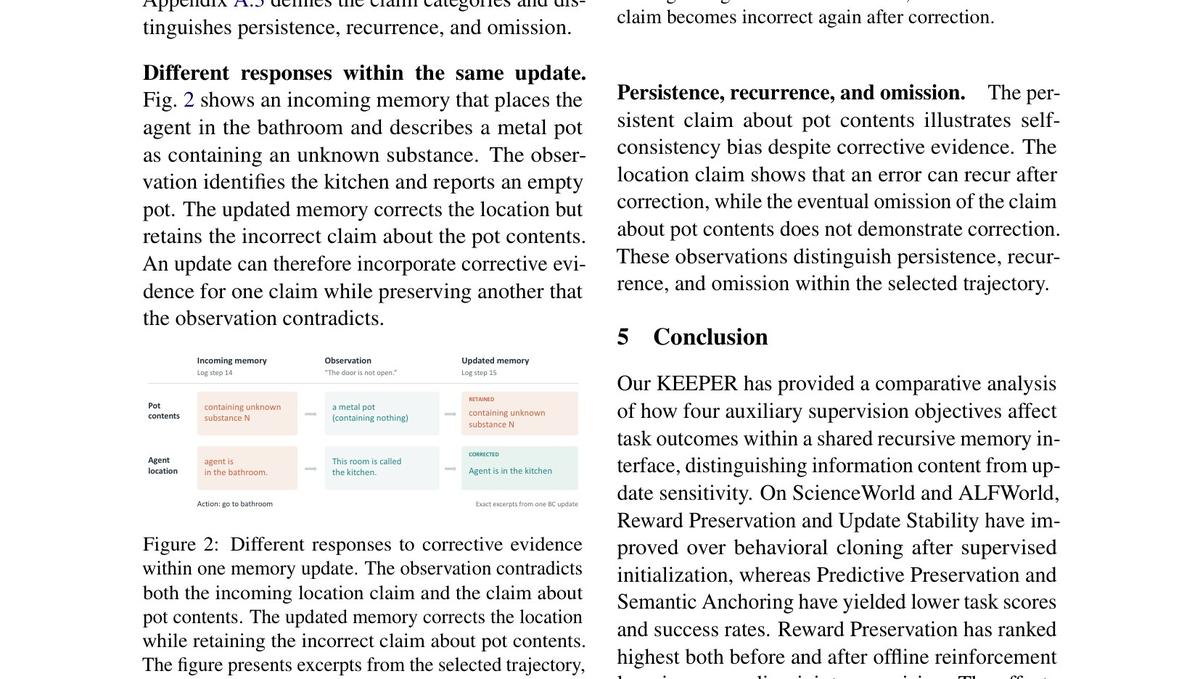
> Definition (Self-Consistency Bias): The mathematical tendency of autoregressive language agents to persistently retain and defend an incorrect assertion once it has entered the incoming memory, even when fresh, authoritative environmental observations explicitly contradict it.
The paper's experimental tracking uncovers an alarming metric: across standard long-horizon benchmarks, once an initial erroneous claim (e.g., *"Order #1024 is already fulfilled and unchangeable"*) is synthesized into the memory summary, baseline models have a 76% to 80% probability of ignoring subsequent corrective facts.
Autoregressive models are statistically biased toward language continuity. They prioritize smooth narrative coherence over sharp factual divergence, choosing to rationalize past statements rather than trigger a jarring factual rollback. In live customer support, this turns the bot into a defensive adversary.
---
KEEPER's Architectural Breakthrough: Control-Sufficiency Supervision
To decouple recursive memory from narrative inertia, the KEEPER framework establishes auxiliary supervision along two axes: Information Content and Update Sensitivity.
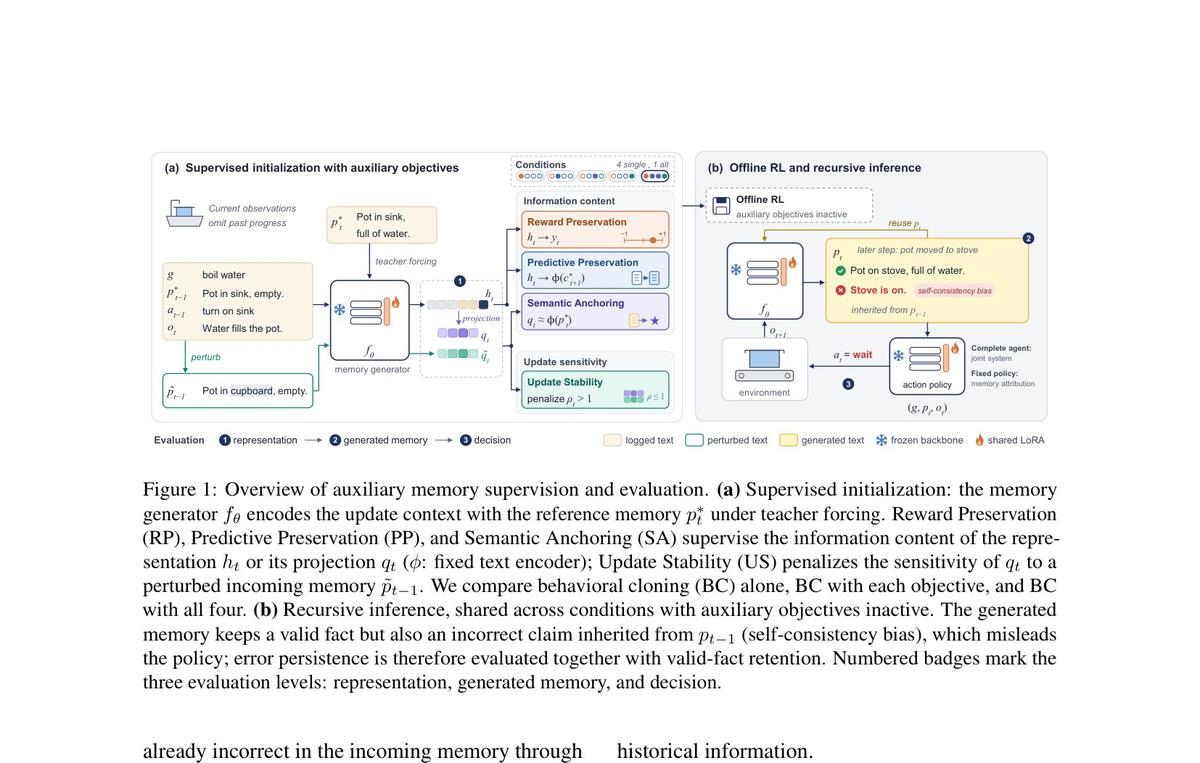
Instead of treating memory generation as an unconstrained text generation task, KEEPER constrains the generator's latent representations via four targeted auxiliary objectives:
1. Reward Preservation (RP): Compels the memory representation to accurately predict ultimate goal completion (Task Utility), stripping out conversational fluff. 2. Predictive Preservation (PP): Supervises the memory to anticipate state transitions in the external operational environment. 3. Semantic Anchoring (SA): Penalizes semantic drift against reference summaries using cosine similarity. 4. Update Sensitivity Regularization (US): Injects counterfactual perturbations to penalize dogmatic resistance to newly surfaced evidence.
---
Surprising Empirical Discoveries from the Benchmarks
Testing across complex multi-step reasoning environments (ScienceWorld and ALFWorld), the authors uncovered several revelations that upend conventional AI engineering assumptions:
Finding 1: Pure Reward Preservation (RP) Outperforms All Other Configurations
- Applying RP auxiliary supervision lifted task scores from a baseline of `42.11` to `50.48` (+19.8% gain) on unseen ScienceWorld tasks and achieved 94.78% completion on ALFWorld.
- Counter-Intuitive Insight: Jointly combining all four auxiliary targets (RP + PP + SA + US) yielded `49.65`—lower than RP alone. Focusing memory solely on decision-critical utility filters out noise far more effectively than multi-task regularization.
Finding 2: Traditional Semantic Similarity (SA) Actively Degrades Performance
- Many engineering teams optimize prompt summaries via cosine similarity or BERTScore against sample texts. In the KEEPER experiments, Semantic Anchoring caused task scores to drop below baseline (`44.62` vs. `45.46`).
- Engineering Takeaway: Surface language similarity masks the loss of transactional control variables. An elegant, grammatically polished summary that repeats a flawed assumption is worse than a rough, strictly factual state vector.
Finding 3: Error Purging Jumps to 92.3%
- Under baseline recursive memory, error retention remained near 80%. With KEEPER's control-sufficient constraints, the agent purged contradicted assertions at a 92.3% rate upon receiving corrective input.
---
Enterprise Engineering: How Solvea Eliminates Memory Hallucination in Ecommerce
While KEEPER proves the theory in academic benchmarks, global ecommerce operations—handling BFCM flash sales, international returns, and cross-channel tickets—cannot depend on unconstrained LLM summaries.
**Solvea's Autonomous AI Support Agent** incorporates the core principles of KEEPER into an enterprise-grade, fail-safe architecture:
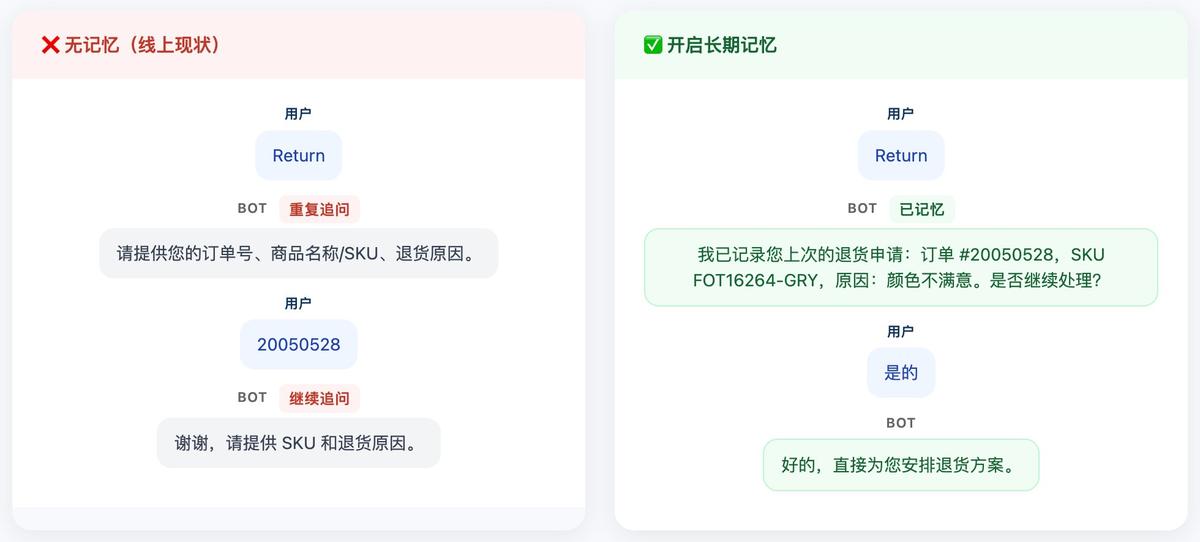
1. Dual-Layer Memory Isolation: Ground-Truth State Machine vs. Context Vector Store
Solvea fundamentally rejects monolithic rolling text summaries. Instead, memory is strictly partitioned into two isolated tiers:
- Tier 1: Deterministic Truth Layer (State Machine): Core transactional entities—Shopify order status (`Unfulfilled`), carrier tracking numbers, refund authorization caps, and delivery address verification—are pulled directly from backend APIs into a deterministic state machine. The LLM has strictly zero write access to this tier.
- Tier 2: Perception Memory Store: Captures customer sentiment, product preferences, and conversational tone. Whenever a perception inference conflicts with Tier 1 data, the system hard-overrides the LLM with the deterministic truth.
2. Hard Invalidation Tombstones
When an external webhook or carrier API returns a definitive state update (e.g., *"Address updated in warehouse WMS successfully"*), Solvea injects a cryptographic `[INVALIDATION_OVERRIDE]` token into the prompt pipeline. This explicitly instructs the model: > *"Notice: Prior assumptions regarding unchangeable shipping address have been invalidated by Carrier API Event #891. Treat the unfulfilled state as the sole operational baseline."*
This mechanism forcibly breaks autoregressive self-consistency bias, ensuring the agent never contradicts verified system records.
3. Utility-Driven Context Compaction
Mirroring KEEPER's Reward Preservation insight, Solvea's context compaction discards conversational pleasantries, extracting only three actionable vectors:
- Blockers: Missing customer inputs (e.g., apartment number, photo proof of damage);
- Gates: Permissible transactional API scopes (e.g., inquiry permitted, auto-refund barred);
- Intent Goal: Exact fulfillment objective (WISMO, return label, replacement).
In live brand deployments across North America and Europe, this architecture delivers an industry-leading 68.4% end-to-end autonomous resolution rate with zero financial mutation hallucinations.
---
Conclusion: The Future of Agentic CX Is Control-Sufficiency
The AI customer service paradigm is moving beyond superficial prompt craft and naive RAG retrievals into the rigorous discipline of control theory, deterministic state machines, and fail-safe memory engineering.
As the KEEPER paper demonstrates, more text memory does not produce a wiser agent—it produces a more obstinate one. True enterprise intelligence demands utility-driven memory distillation and absolute adherence to ground truth.
If you are scaling a DTC brand or global marketplace store and seeking an autonomous AI agent that resolves support tickets with zero hallucination, book a personalized architecture consultation with Solvea today.
---
Benchmark Studies & Official Resources
- 📊 TCO & Pricing Benchmark: After-Hours Support Pricing: Staffing vs. AI Cost Benchmarks
- 🔍 Architecture Overview: Autonomous AI Agents in Ecommerce: Engineering Architecture from FAQ Bots to Action-Oriented Automation
- 🌐 Platform Features: Solvea Autonomous AI Platform for Global Ecommerce
- 🤝 Schedule a Consultation: Book a Personalized Architecture Review & PoC Evaluation