After Hours Call Answering Service ROI: The Revenue Cost of Missed Calls Outside Business Hours
If you are evaluating an after hours call answering service, the cost question is usually framed too narrowly. Teams compare monthly software fees, answering-service retainers, or staffing quotes. They forget to price the revenue that disappears when the phone rings after hours and nobody turns that intent into a usable next step.
That missing piece is often the largest cost in the model.
For service businesses, missed calls outside business hours are rarely random noise. They are estimate requests, consult inquiries, urgent service questions, rescheduling requests, and high-intent leads who contacted you while they were ready to act. If the business relies on voicemail, incomplete notes, or next-day callbacks without structured intake, a meaningful share of that demand goes cold.
This guide shows how to estimate the revenue cost of missed after-hours calls, where an after hours call answering service changes the math, and how to think about ROI without relying on inflated vendor promises.
Ahrefs research for this cluster was last verified on July 16, 2026. At that point, after hours call answering service showed 500 monthly US searches with KD 1, and after hours answering service showed 1200 monthly US searches with KD 1. Fresh hosted Ahrefs checks on July 17, 2026 were blocked by a 429 / Cloudflare challenge, so this article uses that verified July 16 snapshot plus current first-party Solvea and public labor sources checked on July 17, 2026.
The real cost problem behind an after hours call answering service
Most buyers start with the visible cost:
- what a human answering service charges
- what AI software costs each month
- what after-hours staffing would cost
Those numbers matter, but they are not the whole model.
The larger question is this:
What happens to revenue when an after-hours caller does not get a useful response?
For most service SMBs, the cost of a missed call is not the ring itself. It is one or more of these outcomes:
- the caller never leaves a message
- the message is too vague to convert cleanly
- the follow-up happens too late
- the business has no structured record of intent
- the customer moves to a competitor before the next callback
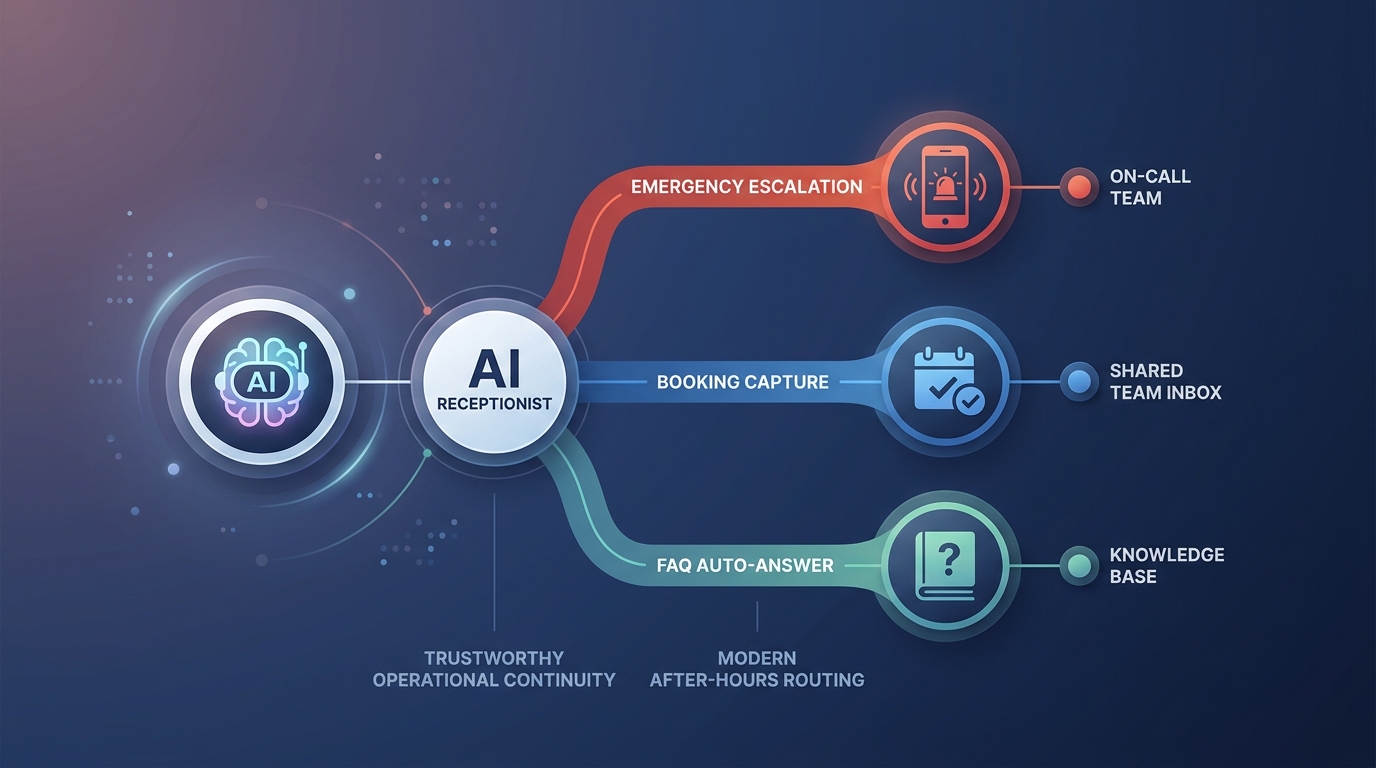
That is why the best after hours call answering service is not just a coverage layer. It is a recovery system for intent.
A simple formula for the revenue cost of missed calls
Use this model first:
Monthly missed-call cost =
  after-hours missed calls
  x high-intent call rate
  x conversion rate if recovered
  x average revenue per converted opportunity
  x share of opportunities lost because follow-up is weak or late
This formula is useful because it forces you to price lost demand, not only answering-service spend.
Here is a modeled example:
| Input | Conservative scenario | Moderate scenario | Aggressive scenario |
|---|---|---|---|
| After-hours missed calls per month | 30 | 60 | 90 |
| High-intent share | 35% | 45% | 55% |
| Recoverable conversion rate | 25% | 30% | 35% |
| Average revenue per converted opportunity | $150 | $250 | $400 |
| Share lost due to weak follow-up | 50% | 50% | 50% |
| Modeled monthly revenue lost | $196.88 | $1,012.50 | $3,465.00 |
This is not a universal benchmark. It is a planning model. The point is that a business can lose more from weak after-hours recovery than from the monthly cost of a better workflow.
Why voicemail hides the ROI problem
Voicemail makes missed demand look smaller than it is.
That happens because voicemail creates a false sense of capture. A business sees a message and assumes the opportunity is still alive. In reality, several things may already have gone wrong:
- the caller did not leave enough detail
- the caller did not trust that anyone would respond quickly
- the next-morning callback came after the customer had moved on
- the team had to ask basic questions again before taking action
In that workflow, the business measures messages received, not revenue preserved.
An after hours call answering service improves ROI when it does more than store audio. It should capture intent clearly enough that the morning team can act without rebuilding the conversation from scratch.
The staffing comparison most teams skip
If the alternative to an after-hours workflow is human coverage, you should compare it against loaded labor cost, not only base wage.
Using current Bureau of Labor Statistics sources checked on July 17, 2026:
- the BLS occupational wage page for receptionists and information clerks lists a $17.90 median hourly wage from May 2024
- the BLS Employer Costs for Employee Compensation table shows private-industry wages at 69.9% of compensation and benefits at 30.1% in March 2026
That produces a modeled loaded hourly receptionist cost of:
$17.90 / 0.699 = $25.61 per hour
Using 4.33 weeks per month:
| Coverage model | Monthly hours | Modeled monthly cost |
|---|---|---|
| 10 after-hours hours per week | 43.3 | $1,108.83 |
| 20 after-hours hours per week | 86.6 | $2,217.65 |
| 40 after-hours hours per week | 173.2 | $4,435.31 |
Those figures still do not include the opportunity cost of weak handoff quality, fragmented customer context, or missed bookings. They only price the labor layer.
Where an after hours call answering service changes the math
A stronger after hours call answering service can improve ROI in four ways:
- It answers while the customer is still engaged.
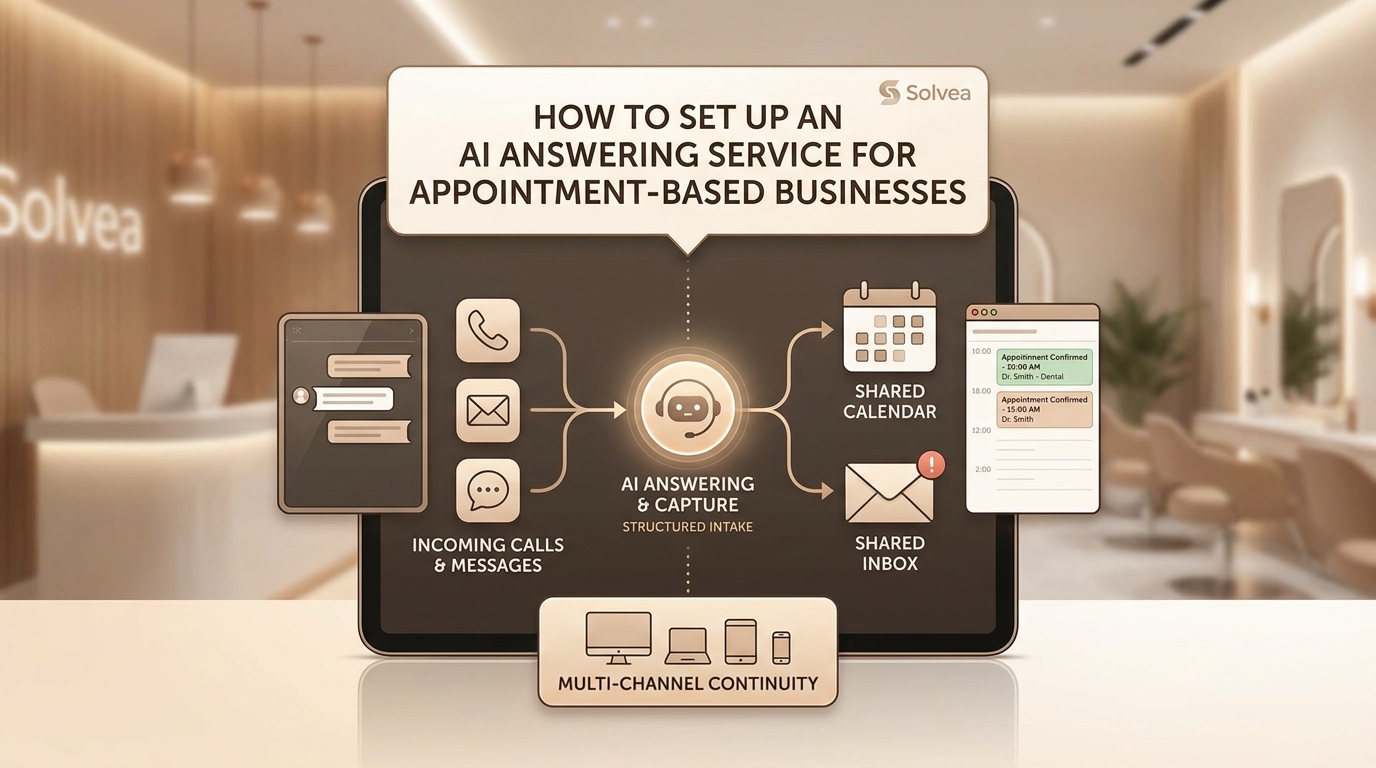
- It captures structured intake instead of a vague message.
- It gives the next staff member a usable handoff.
- It keeps the interaction visible if the customer follows up in another channel later.
That fourth point matters more than many buyers expect. A caller may phone at 8:30 PM, then text at 8:45 PM, and email the next morning. If those interactions live in separate tools, the business may answer each one as if it were the first contact.
That is where Solvea’s current first-party positioning is relevant. The live product overview and inbox materials position Solvea around one shared workflow across voice, SMS, email, chat, WhatsApp, and LINE, with human follow-up happening inside the same conversation history. For after-hours ROI, that is more valuable than a simple “we answered the call” claim.
The highest-leverage ROI inputs to measure
If you want a realistic business case, track these five inputs for 2 to 4 weeks:
| Input | Why it matters | How to estimate it |
|---|---|---|
| After-hours missed calls | Defines the volume of the problem | Count calls outside staffed hours that are unanswered, abandoned, or sent to voicemail |
| High-intent share | Separates noise from revenue opportunity | Tag which calls relate to bookings, estimates, intake, or urgent service |
| Recovery rate | Shows whether follow-up actually happens | Measure how many of those calls receive a usable same-day or next-morning response |
| Conversion value | Prices recovered demand | Use average booked revenue, consult value, estimate win value, or first-visit value |
| Lost-opportunity share | Captures workflow failure | Estimate how many opportunities go cold because context or speed was weak |
These inputs will usually tell you more than a vendor pricing page alone.
A modeled ROI example for a service SMB
Suppose a business misses 60 after-hours calls each month.
45%are high-intent30%of recovered high-intent calls convert- average revenue per converted opportunity is
$250 - half of those opportunities are currently lost because the team gets weak or late follow-up
That gives:
60 x 0.45 x 0.30 x $250 x 0.50 = $1,012.50/month
If the business can recover even part of that with a better after hours call answering service, the ROI discussion changes fast.
For example:
| Improvement level | Revenue recovered per month |
|---|---|
| Recover 25% of the modeled loss | $253.13 |
| Recover 50% of the modeled loss | $506.25 |
| Recover 75% of the modeled loss | $759.38 |
That is why many teams underprice the problem. They compare software cost against labor cost instead of comparing recovered demand against lost demand.
What Solvea can safely claim in this ROI conversation
Current first-party sources support an operational ROI case for Solvea without forcing unstable claims.
Verified current positioning checked on July 17, 2026:
- Solvea pricing lists $19.90 per extra seat per month with 500 monthly credits per seat
- Solvea positions its AI receptionist around missed-call coverage, booking support, FAQ handling, and shared follow-up workflow
- Solvea’s inbox and docs emphasize that interactions become tickets and stay visible for human handoff
- Solvea’s medspa solution page publicly claims 100% call answer rate, 30% increase in patient bookings, and 40% cost savings for that specific customer context
Those medspa figures should be treated as a vertical proof point, not a universal guarantee. They do show why the ROI conversation should focus on captured demand and workflow continuity rather than only on answer rate.
The ROI mistake buyers make when comparing tools
Many buyers still compare options like this:
- voicemail
- outsourced human answering
- AI answering software
That frame is incomplete.
The better comparison is:
| Option | What you are really buying | Typical weakness |
|---|---|---|
| Voicemail | storage after a missed interaction | low intake quality and slow recovery |
| Human answering service | live pickup with labor-backed coverage | cost and variable handoff quality |
| AI-first after-hours workflow | immediate response plus structured intake and continuity | depends on good routing rules and approved knowledge |
An after hours call answering service wins on ROI when it improves the downstream workflow, not just the first-touch moment.
Where the ROI is usually strongest
The revenue case is usually strongest when:
- missed calls are tied to appointments or estimates
- demand peaks after normal staffed hours
- the business receives repeat FAQ and booking patterns
- multiple people need shared visibility on follow-up
- the customer often switches from phone to text or email
That is why the ROI case is especially clear in service categories like medspa, home services, legal intake, hospitality, and other appointment-led teams.
If your team wants a practical next step, Solvea already has public resources for an AI appointment setter, a quick-start deployment flow, and an inbox workflow overview. For operators who want to compare broader cost structure, Solvea also has an AI receptionist cost calculator.
How to measure your own after-hours ROI before buying anything
Use this short audit:
- Count after-hours missed calls for the last 30 days.
- Mark which ones were bookings, estimates, urgent requests, or other high-intent calls.
- Measure how many got a same-day or next-morning response with enough context to act.
- Estimate the average value of a recovered booking or lead.
- Calculate how many were likely lost because the first response was weak, delayed, or fragmented.
If those numbers already show lost revenue, the correct question is not “What does an after hours call answering service cost?”
It is “How much are we already paying to keep handling after-hours demand badly?”
Final takeaway
The best ROI case for an after hours call answering service is usually not labor savings alone. It is revenue recovery.
Once you price lost booking intent, incomplete intake, delayed follow-up, and fragmented customer context, missed calls outside business hours stop looking like a minor phone problem. They become an operations and revenue problem.
For teams that need immediate response, structured intake, and one workflow across voice and follow-up channels, Solvea is a strong fit because it is built around continuity, not only call pickup.
If your after-hours process still ends with voicemail and hope, you are probably not measuring the most expensive part of the problem.
Your AI Receptionist, Live in Minutes.
Scale your front desk with an AI that never sleeps. Solvea handles unlimited multi-channel inquiries, books appointments into your calendar automatically, and ensures zero missed opportunities around the clock.
FAQ
How do you calculate the revenue cost of missed calls after hours?
Start with missed call volume, then estimate the high-intent share, the conversion rate if those calls were recovered, the average revenue per converted opportunity, and the share lost because follow-up is weak or late.
What is the biggest ROI benefit of an after hours call answering service?
Usually it is recovered revenue, not only labor savings. A stronger after hours call answering service can preserve booking intent, improve intake quality, and make the next follow-up faster and more consistent.
Is voicemail enough for after-hours lead capture?
Often no. Voicemail stores a message after the missed interaction. It does not classify intent, capture structured intake, or create a clean handoff while the customer is still engaged.
When is the ROI case strongest?
The ROI case is usually strongest for appointment-led and service businesses where missed calls are tied to bookings, estimates, urgent service issues, or other high-intent demand outside staffed hours.