It is 9:05 a.m., the queue is already full, and three agents are still finishing follow-ups from yesterday. The forecast said Monday would be busy, but it did not show how many callers would ask the same routine questions before reaching a person.
That gap is where workforce management and AI front desk automation start to meet. Workforce management plans the people. An AI receptionist can reduce the repeatable work those people have to absorb.
What Workforce Management Means
Workforce management for contact center teams is the process of putting the right number of people with the right skills in the right place at the right time. In practice, it includes forecasting, staffing, scheduling, intraday management, adherence tracking, and post-day review.
The goal is not simply to keep every agent busy. If occupancy is too high for too long, agents burn out and service quality drops. If staffing is too high, the business pays for idle time. Good workforce management balances customer wait time, labor cost, agent experience, and service quality.
ICMI explains workforce management around accurate forecasting, scheduling, reporting, and the ability to meet service level obligations in its workforce management research for small and midsize contact centers. A practice-oriented overview of call center workforce planning also frames the field around demand forecasting, capacity planning, scheduling, and operational control.
For teams using an AI receptionist such as Solvea, workforce management still matters. The AI front desk can handle routine demand and prepare better handoffs, but leaders still need to plan human capacity for conversations that require judgment, exception handling, or relationship work.
Contact Center Forecasting
Contact center forecasting starts with demand. How many contacts are expected? When will they arrive? Which channels will they use? How long will they take to handle? Which contacts require special skills?
A useful forecast needs more than total daily call volume. It should look at intervals because contact centers are sensitive to timing. The INFORMS overview of call center workforce planning notes that operational forecasting often predicts call volume at the interval level, usually per quarter hour, for each queue or skill. Ten extra calls spread across a day may be manageable. Ten extra calls in one interval can create a queue.
Forecast inputs often include:
- Historical contact volume
- Seasonality
- Marketing campaigns
- Product launches
- Holidays
- Website incidents
- Billing cycles
- Average handle time
- Channel mix
AI receptionists can help improve the demand picture when they create structured records of routine calls. If many customers ask the same availability, booking, pricing, or order status question, those patterns can become planning inputs instead of anecdotal noise.
In Solvea workflows, inbound conversations can be handled across phone, email, and live chat. That cross-channel view is useful because workforce pressure rarely comes from one channel alone.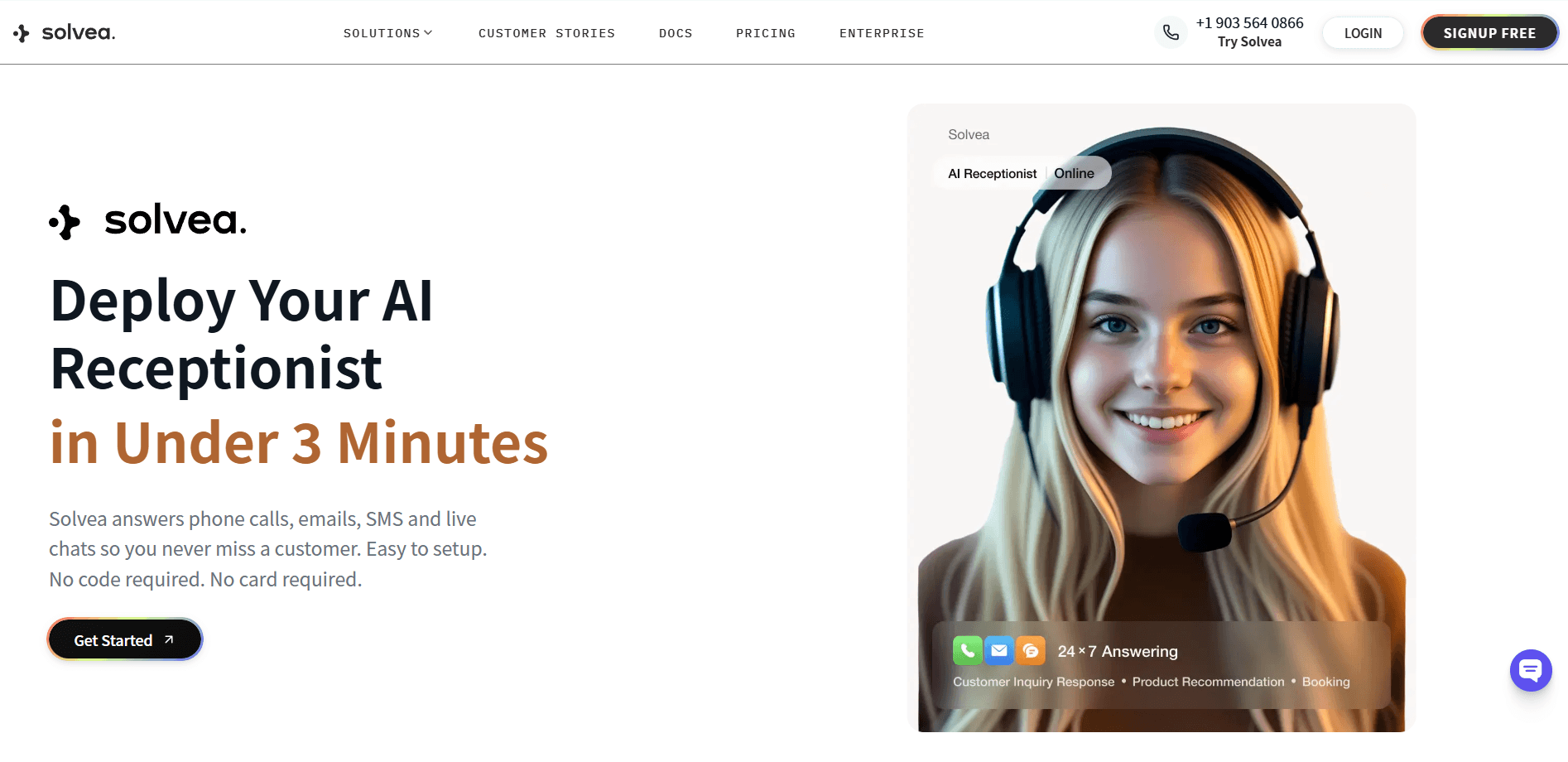
Staffing for Contact Center Demand
Staffing turns a forecast into a people requirement. If the forecast says the team will receive a certain number of contacts, staffing determines how many agents are needed to meet the target service level.
This is where contact center workforce management becomes a balancing act. Managers need to account for work volume, handle time, shrinkage, breaks, training, meetings, absences, and the fact that demand arrives unevenly.
The planning question is not only:
How many agents do we need?
It is also:
Which work should reach agents in the first place?
This is where an AI receptionist can support the workforce plan. Routine calls about hours, availability, booking, order status, or basic qualification can often be handled before they become agent workload. More complex cases can be handed off with context so agents do not waste time reconstructing the conversation.
Solvea fits this layer as a front desk automation system that can answer customer inquiries, use business knowledge, and route unresolved cases to human agents. That does not replace staffing strategy. It gives the staffing model a better workload mix.
Agent Scheduling
Agent scheduling maps staffing requirements onto actual shifts. A forecast may say the team needs eight agents from 10 a.m. to noon, but scheduling decides who works, when breaks happen, which skills are available, and how coverage changes across the day.
Good schedules reflect the real pattern of demand. If Monday mornings are heavy, lunch coverage matters. If after-hours inquiries are common, the team needs either extended coverage, automated handling, or a clear next-day follow-up process.
AI front desk automation can reduce scheduling pressure in two ways.
First, it can cover routine demand outside staffed hours. A customer who calls after closing can still get basic answers, request a booking, or leave structured details for follow-up.
Second, it can reduce repeated contacts during peak periods. If the AI receptionist resolves common questions, fewer contacts need to enter the human queue.
That makes agent scheduling more realistic. The business is not pretending demand disappeared. It is separating repeatable work from human-required work.
Intraday Management
Intraday management is the work of adjusting plans during the day. The forecast is never perfect. Agents call out, handle time changes, a promotion performs better than expected, or a website issue creates a sudden spike in contacts.
ICMI's workforce management principles emphasize the planning and management process from service level objectives and data collection to forecasting, real-time management, reporting, and analysis. Intraday management uses actual data from the current day to make decisions before the queue gets out of control.
Common intraday actions include:
- Moving breaks
- Reassigning agents between channels
- Asking for overtime
- Offering voluntary time off
- Updating queue priorities
- Watching service level risk
- Reviewing adherence exceptions
AI receptionists can support intraday management by absorbing predictable front desk questions during spikes. If a queue is overloaded, automated answers for routine calls can protect human capacity for urgent or high-value conversations.
In a Solvea-style workflow, unresolved cases can still move to human agents through handoff. That distinction is important. The AI should not trap customers in automation. It should help triage demand so the workforce can focus where people are needed.
Real-Time Adherence
Real-time adherence measures whether agents are doing the activities they were scheduled to do at the right times. It is a sensitive metric because it affects service levels, but it should be used with context.
If agents are frequently out of adherence because they are finishing complex after-call work, the problem may not be behavior. It may be workload design. If schedule adherence is low because breaks are poorly aligned with demand, the schedule may need adjustment.
AI receptionist data can help explain some adherence problems. For example, if agents are repeatedly pulled into the same routine question, managers can decide whether that question should be answered by the AI front desk, added to a knowledge base, or routed differently.
The useful question is:
Is the workforce plan failing because of agent behavior, demand volatility, or repeated work that should be redesigned?
That question keeps real-time adherence from becoming a blame metric.
Human Handoff
Human handoff is where AI front desk automation connects back to workforce management. The AI can answer routine questions, but some conversations need a person.
A good handoff should include:
Handoff note:
- Who contacted the business
- What the customer wanted
- What the AI already answered
- Which details were collected
- What still needs human attention
- How urgent the request appears
This protects agent time. Without context, agents have to restart the conversation. With a useful handoff, they can move directly to resolution.
For Solvea, this is one of the clearest connections to contact center workforce management. The product's AI receptionist can handle first-contact conversations and route unresolved cases to staff. That helps managers think about workforce capacity in terms of exception work, not only raw inbound volume.
Contact Center Workforce Management Software
Contact center workforce management software usually supports forecasting, scheduling, intraday management, adherence, time-off planning, and reporting. Larger operations may need specialized WFM tools because manual spreadsheets become fragile when contact volume, shift rules, skills, and channels become more complex.
AI receptionist tools sit next to that category rather than inside every part of it. They do not need to replace WFM software to be valuable. They can change the workload that WFM software must plan for.
A practical technology stack may include:
- Contact routing
- Workforce management software
- Quality management
- Analytics
- Knowledge base
- AI receptionist
- Shared inbox
- CRM or booking system
The connection point is demand. Workforce tools plan capacity. AI receptionists can reduce or reshape the demand that reaches human agents.
For a team using Solvea, the useful question is not whether AI replaces WFM. The useful question is which repeatable front desk contacts can be resolved by AI, which should be handed off, and how those patterns should influence staffing assumptions.
Workforce Metrics
Workforce metrics help managers see whether staffing plans are working. The most useful metrics depend on the operation, but contact centers commonly track:
- Service level
- Average speed of answer
- Abandonment rate
- Average handle time
- Occupancy
- Shrinkage
- Schedule adherence
- Forecast accuracy
- Agent availability
- Transfer rate
AI front desk workflows add another set of useful signals:
- AI-handled conversations
- Human handoff volume
- Unresolved topic volume
- After-hours contacts
- Repeated routine questions
- Channel mix
- Follow-up completion
These AI signals should not replace workforce metrics. They add context. If handoff volume rises, managers can investigate whether demand increased, knowledge content is missing, or the AI is correctly escalating more complex work.
For broader labor context, the U.S. Bureau of Labor Statistics maintains an Occupational Outlook Handbook page for customer service representatives, including role duties, training, and employment outlook. That kind of labor context can be useful when contact center leaders think about hiring, training, and automation boundaries.
AI Receptionists in Workforce Planning
AI receptionists can influence workforce planning in three practical ways.
First, they reduce repetitive demand. If customers often ask the same routine questions, the AI front desk can answer them consistently.
Second, they improve demand visibility. Structured conversation records show what customers were trying to do, even when the issue was resolved without a human.
Third, they improve agent focus. Human agents receive handoff cases with context, which can reduce repetition and make complex work easier to handle.
This is the strongest angle for Solvea and workforce management. Solvea is relevant because it can act as the front door for customer conversations across phone, email, and live chat. Workforce leaders can then use conversation patterns to make better decisions about coverage, training, knowledge updates, and escalation rules.
The workflow can be simple:
AI-assisted workforce planning loop:
- Review inbound volume
- Separate AI-resolved contacts from handoffs
- Identify repeated routine topics
- Update knowledge for high-volume questions
- Review staffing impact during peak intervals
- Adjust handoff rules
- Recheck service level and agent load
This keeps AI automation tied to the workforce plan instead of treating it as a separate experiment.
Your AI Receptionist, Live in Minutes.
Scale your front desk with an AI that never sleeps. Solvea handles unlimited multi-channel inquiries, books appointments into your calendar automatically, and ensures zero missed opportunities around the clock.
FAQ
What is workforce management for contact center teams?
Workforce management for contact center teams is the process of forecasting demand, planning staffing, creating schedules, managing intraday changes, and reviewing performance so the right people are available at the right time.
Why is contact center forecasting important?
Contact center forecasting is important because staffing decisions depend on expected contact volume, timing, channel mix, and handle time. A weak forecast can lead to long queues, idle agents, or poor service levels.
How does agent scheduling affect service level?
Agent scheduling affects service level by matching available staff to expected demand. Even a good staffing plan can fail if breaks, shifts, and skill coverage do not line up with busy intervals.
What is intraday management?
Intraday management is the process of adjusting the workforce plan during the day based on actual demand, absences, handle time changes, and queue conditions.
How can an AI receptionist support workforce management?
An AI receptionist can support workforce management by handling routine inquiries, capturing customer intent, creating structured handoffs, and reducing the number of repetitive contacts that reach human agents.
Does Solvea replace workforce management software?
Solvea supports the front desk workload by handling customer conversations and routing unresolved cases. Workforce management software still handles forecasting, scheduling, adherence, and staffing workflows for contact center teams.
Which metrics should contact center managers track?
Contact center managers should track service level, average speed of answer, abandonment rate, handle time, occupancy, shrinkage, adherence, forecast accuracy, AI-handled conversations, and human handoff volume.