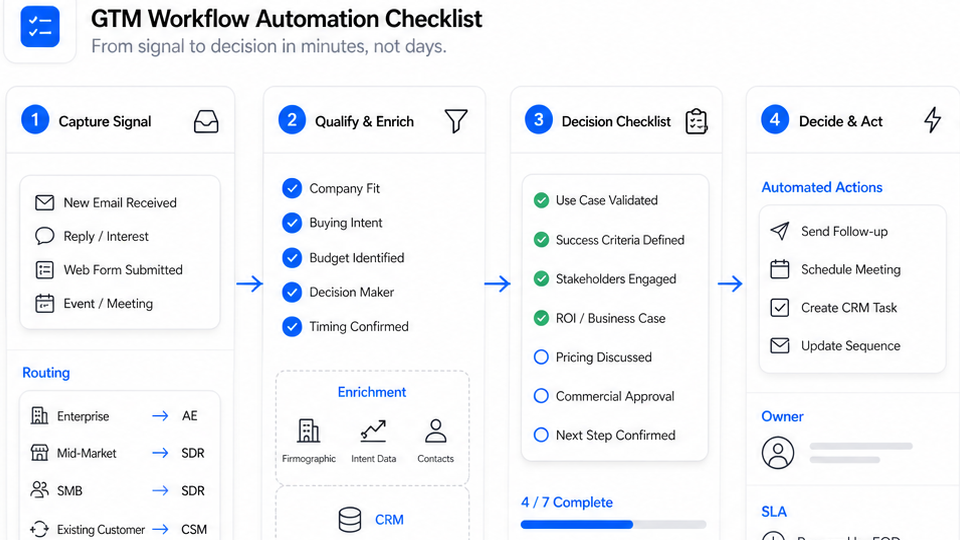
B2B Growth Automation: A Practical Guide for Teams
B2B growth automation works best when it is treated like an operating model, not a pile of tools.
Most teams do not need more automation ideas. They need one workflow that is clearly owned, clearly bounded, and easy to review. When that workflow is working, automation can handle the repeatable parts, and humans can focus on the exceptions that actually need judgment.
This guide is for SMB operators and GTM teams that want a practical way to use B2B growth automation without turning the stack into a mess. It covers what to automate first, how to assign ownership, how to roll out the workflow, and where Solvea fits when the work starts with customer conversations.
Quick answer: start with one workflow
The best first use of B2B growth automation is a workflow with:
- one trigger;
- one owner;
- one required data set;
- one allowed action set;
- one escalation rule;
- one review cadence.
If a workflow cannot be described that simply, it is too broad for a first pass.
The goal is not to automate everything. The goal is to remove manual friction from one revenue-adjacent path and prove that the path can run with less delay and less rework.
What to automate first
Start with workflows where speed and context matter more than volume.
| Workflow | Why it is a good first candidate |
|---|---|
| Missed calls and after-hours leads | The lead is already warm, and response speed matters immediately. |
| Demo or quote requests | The workflow already has a clear next step and owner. |
| Pricing or availability questions | The answer is usually bounded and repeatable. |
| Lead reactivation | The workflow benefits from consistent follow-up and routing. |
| Internal handoff and assignment | Teams lose time when ownership is unclear. |
If your current problem is that leads are arriving but nothing happens next, B2B growth automation should begin there. If your current problem is that the team is retyping the same facts into multiple systems, begin there instead.
The operating model
B2B growth automation gets easier when each role is explicit.
| Role | Owns |
|---|---|
| Growth owner | The business result and the workflow goal. |
| Ops owner | The systems, routing rules, and workflow setup. |
| Sales or service owner | The quality of the handoff and the next step. |
| Reviewer | Edge cases, exceptions, and correction review. |
| System admin | Access, permissions, and maintenance. |
If one person owns all five roles forever, the workflow usually becomes fragile. The system needs a real owner, but it also needs a real reviewer.
The tool stack
Most teams do not need a large stack. They need a stack with clear layers.
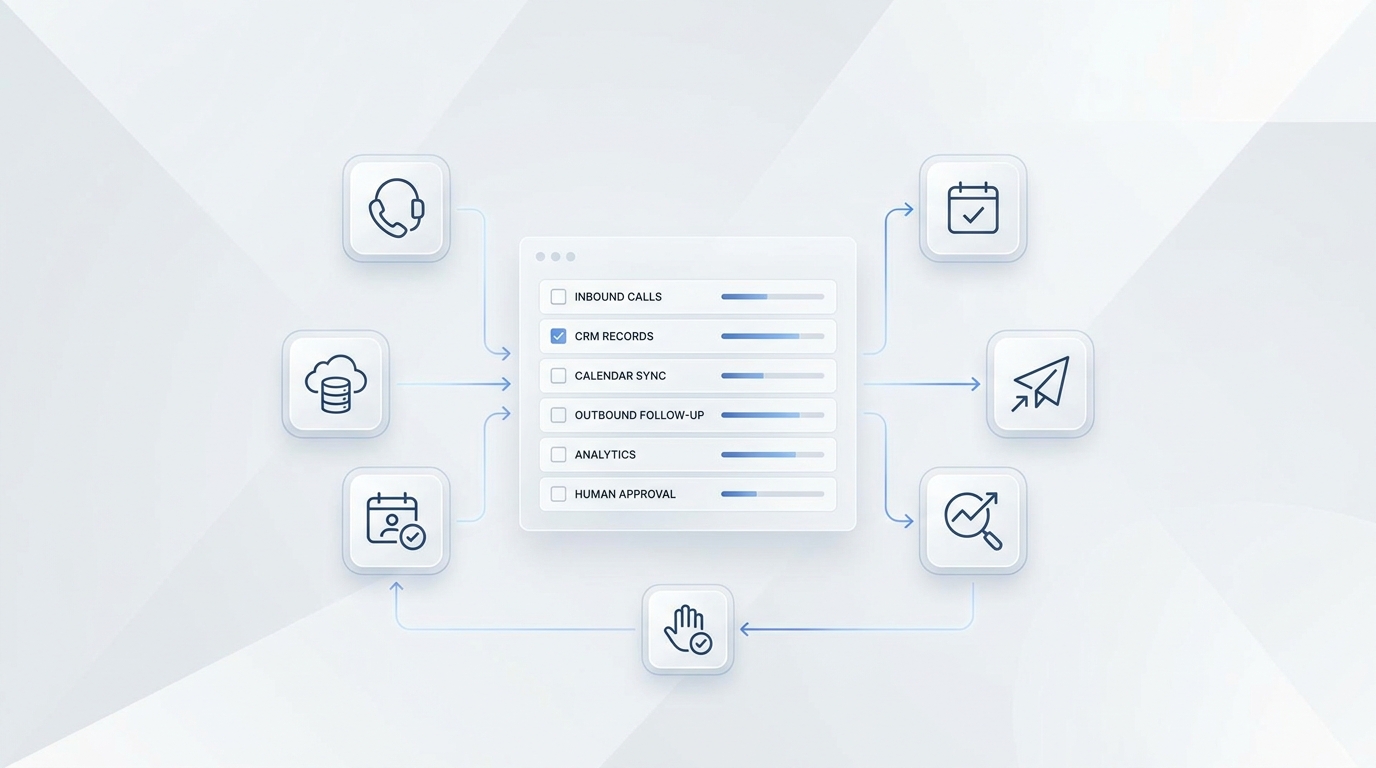
| Layer | What it does | What Solvea already covers |
|---|---|---|
| Capture | Receives calls, SMS, email, and chat | AI receptionist, omnichannel inbox |
| Context | Gives the workflow the right knowledge and history | knowledge base, customer context |
| Action | Routes, books, replies, and follows up | AI Agent Builder, integrations |
| Review | Shows what happened and what to fix | analytics, drop-off analysis, recommendations |
Solvea is relevant when the workflow starts with customer conversations. Its current site describes an AI receptionist that can be live in minutes, a conversational setup flow, industry templates, one-click integrations, an omnichannel inbox, and analytics for response, resolution, and drop-off review.
That makes it a reasonable fit for teams whose growth problem is not abstract marketing orchestration, but the practical path from inbound intent to a qualified next step.
A 14-day rollout plan
Use a short rollout before you expand B2B growth automation to adjacent workflows.
| Days | What to do | Output |
|---|---|---|
| 1-2 | Pick one workflow and define the trigger, owner, and allowed actions. | A one-page workflow scope. |
| 3-5 | Connect only the tools required for the workflow. | A working draft with routing and handoff rules. |
| 6-10 | Test messy cases: missing data, duplicate records, low-fit leads, and unclear requests. | A list of fixes and exceptions. |
| 11-14 | Decide whether to keep, adjust, expand, or stop. | A go/no-go decision for the next step. |
Do not expand before the first workflow is stable. The fastest way to make B2B growth automation fail is to connect too many systems before the workflow itself is clear.
Common mistakes
| Mistake | What goes wrong | Better approach |
|---|---|---|
| Starting with tools instead of a workflow | The stack gets busy before it gets useful. | Define the trigger and outcome first. |
| Automating without an owner | No one knows who reviews the edge cases. | Assign one accountable owner. |
| Ignoring handoff quality | Humans must re-ask for context. | Preserve the source, summary, and next step. |
| Measuring activity only | The team sees motion but not value. | Measure the next step and the business result. |
| Expanding too soon | More automation creates more cleanup. | Prove one workflow before adding another. |
Where Solvea fits
Solvea fits B2B growth automation when the workflow starts with customer conversations.
The current product surface matters here:
- AI Receptionist for missed-call handling and call context;
- AI Agent Builder for conversational setup and workflow rules;
- omnichannel inbox for voice, SMS, email, WhatsApp, LINE, and live chat;
- integrations for calendars, CRMs, and connected tools;
- analytics for resolution, drop-off, and improvement review;
- pricing if you want to start with the current free-to-start plan and Pro seats.
That combination is useful when the immediate goal is not a broad growth platform, but a cleaner path from inbound intent to a qualified next step.
If your main problem is ad orchestration, enterprise data plumbing, or a custom engineering program, Solvea is probably not the first system to evaluate. If your problem is missed calls, fragmented inboxes, and weak follow-up, it is much closer to the mark.
Your AI Receptionist, Live in Minutes.
Scale your front desk with an AI that never sleeps. Solvea handles unlimited multi-channel inquiries, books appointments into your calendar automatically, and ensures zero missed opportunities around the clock.
FAQ
What is B2B growth automation?
B2B growth automation is the use of software and AI to move a buyer or lead through a repeatable revenue workflow with less manual work. Good automation is bounded by clear triggers, ownership, handoffs, and review.
What should teams automate first?
Start with one revenue-adjacent workflow such as missed calls, after-hours leads, pricing questions, demo requests, or lead reactivation. Choose the workflow where delay and missing context create the most waste.
How long should the first pilot run?
A 14-day pilot is usually enough to see whether the workflow is stable enough to keep, adjust, or expand. Longer-cycle motions may need a longer review window, but the first pass should stay narrow.
What makes a workflow ready to scale?
A workflow is ready to scale when the trigger is clear, the handoff is clean, the team no longer retypes the same facts, and the workflow consistently creates the next step without creating extra cleanup.
How does Solvea fit this category?
Solvea fits best when the workflow starts with customer conversations. It combines an AI receptionist, omnichannel inbox, AI Agent Builder, analytics, and integrations in a way that helps teams capture intent and move it forward.
Final recommendation
Treat B2B growth automation like a workflow design problem.
Start small. Pick one trigger. Assign one owner. Connect only the tools the workflow needs. Test the edge cases. Then expand only after the handoff is clean and the team trusts the output.
If the workflow begins with calls or messages, Solvea is a practical place to test that model.