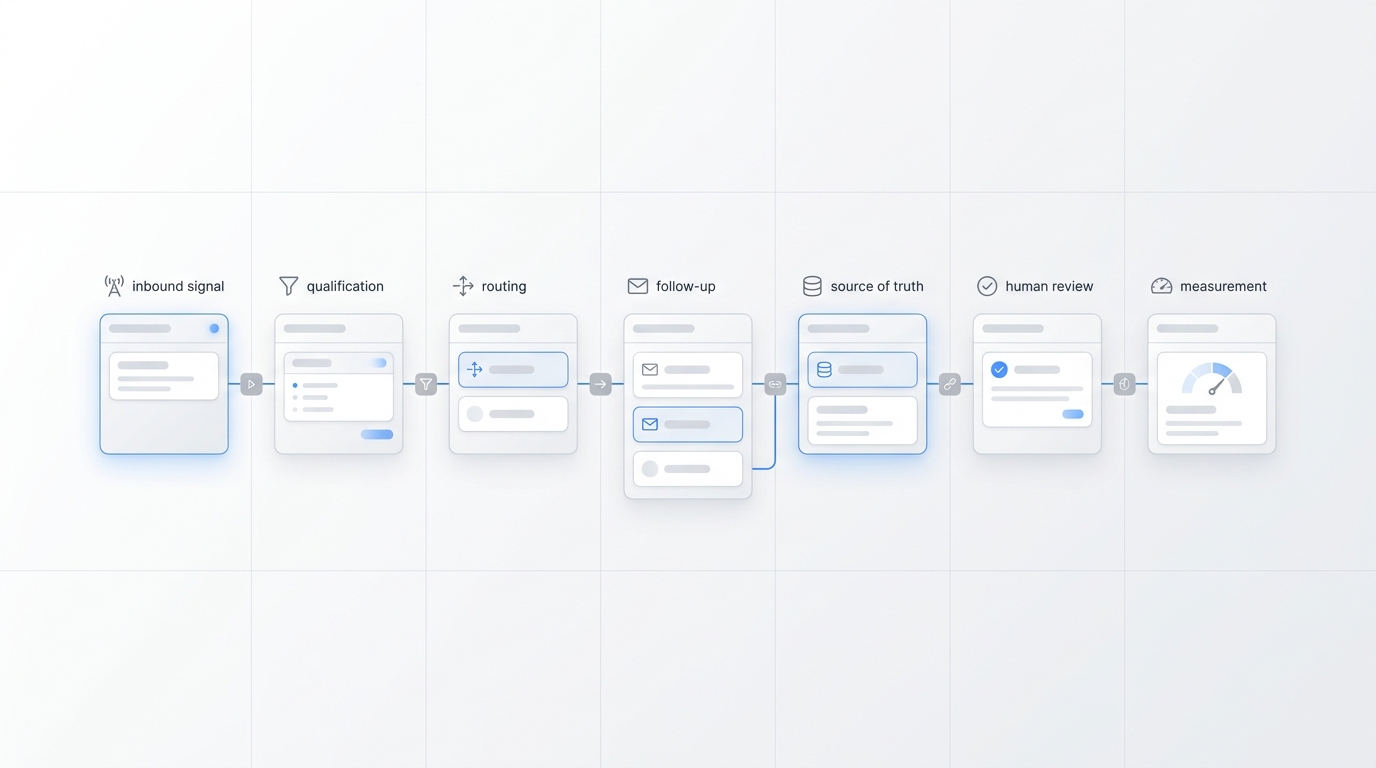
AI marketing agents can speed up decisions only when the workflow is narrow, measurable, supervised, and easy to reverse. If the agent only drafts copy, summarizes vague reports, or asks a human to paste context into a prompt, it is not really owning the decision. It is an assistant.
The practical question is not whether AI marketing agents sound impressive in a demo. The practical question is whether one agent can take a real signal, use approved context, make one bounded call, hand off the right evidence, and improve a metric the team already cares about.
Use this checklist before you buy, build, or expand AI marketing agents. It is designed for SMB operators and lean GTM teams that need faster decisions without giving automation more authority than the workflow can support.
What AI marketing agents should own
AI marketing agents should own a decision step, not an entire marketing department.
A good workflow looks like this:
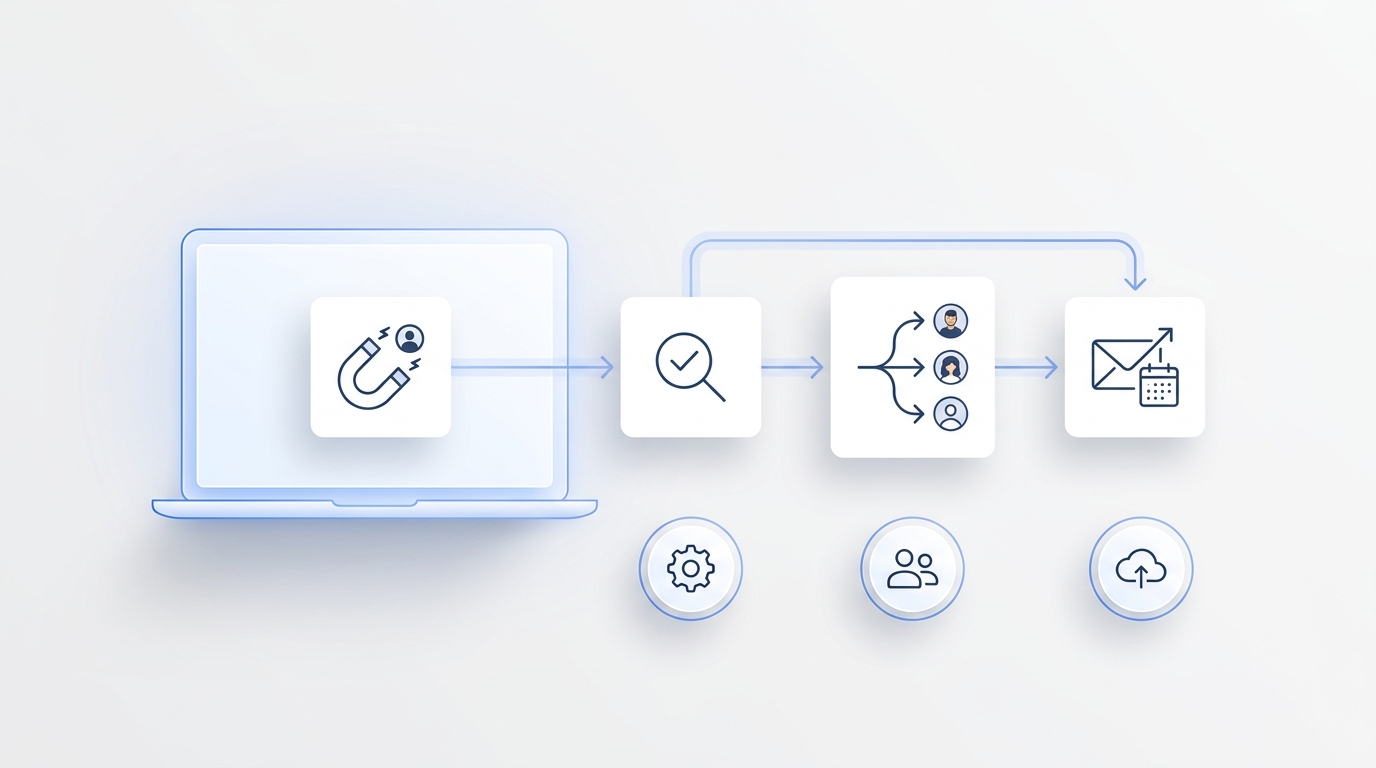
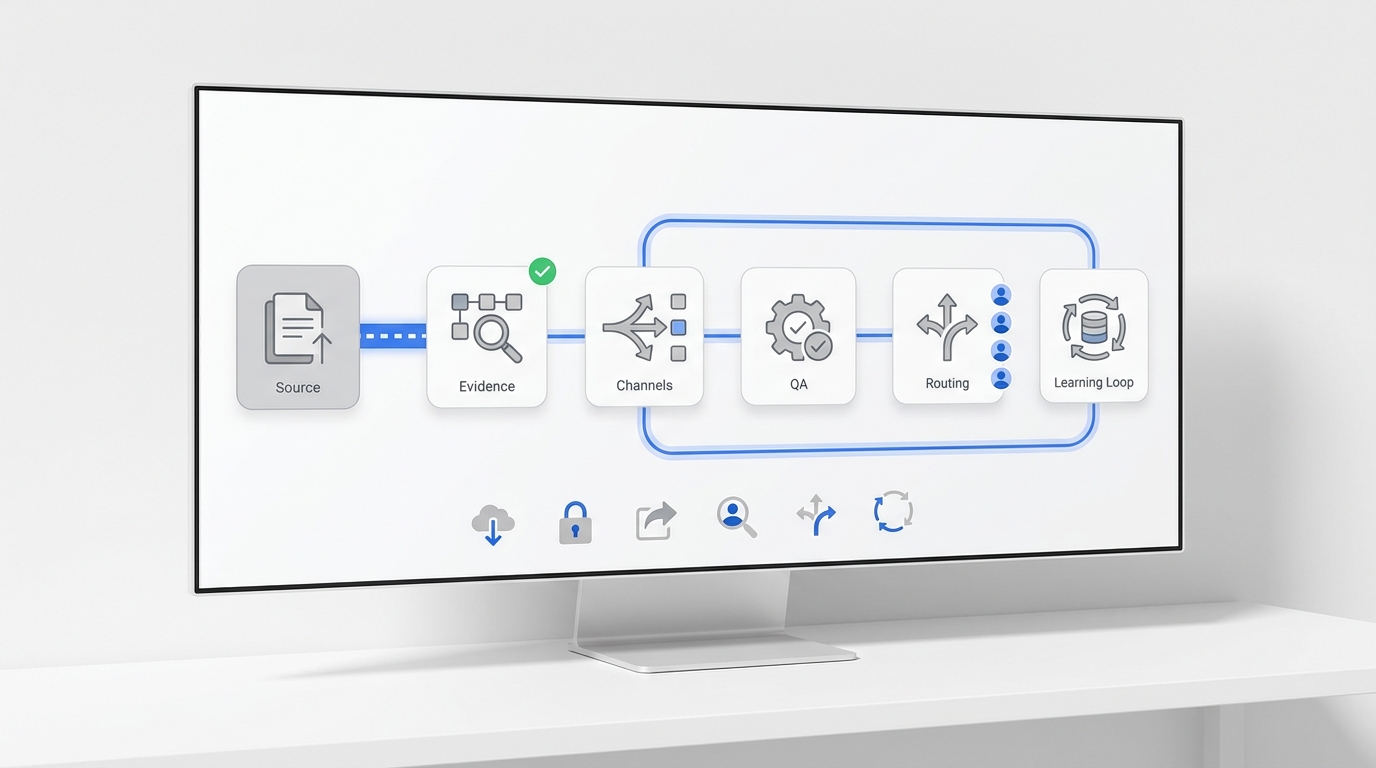
When a defined trigger happens, the agent checks approved context, makes one bounded decision, takes one allowed action, records evidence, and hands off when the risk is too high.
Examples:
- A missed-call agent identifies caller intent and routes urgent jobs.
- A lead qualification agent asks the missing intake questions before a sales handoff.
- A follow-up agent drafts or sends an approved reply when a quote goes quiet.
- A reporting agent flags the few changes that need a human decision instead of dumping a dashboard.
- A content QA agent checks sources, metadata, links, and schema before publication.
IBM's agentic AI guidance describes agents as systems that can pursue goals with planning, tool use, and action. In marketing, that does not mean "run growth." It means the agent has enough context and permission to complete a bounded step without turning every exception into human rework.
That boundary matters. Salesforce Agentforce and HubSpot Breeze both position agents inside customer, sales, service, marketing, content, and data workflows. Those systems can be useful when the surrounding data layer is mature. For many SMBs, the safer starting point is closer to customer conversations: missed calls, booking requests, qualification, routing, reminders, and follow-up.
The AI marketing agents checklist
Score each workflow before you pilot it.
| Check | Green flag | Red flag | Why it matters |
|---|---|---|---|
| Trigger | One event starts the workflow | "It just runs marketing" | The agent needs a clear starting line. |
| Context | Data is live and approved | Someone must paste context manually | Slow context kills decision speed. |
| Decision | The agent makes one bounded call | It changes multiple things at once | Narrow scope is easier to test. |
| Permission | Allowed actions are explicit | The agent can act without rules | More autonomy needs clearer limits. |
| Human review | Approval rules are named | Review happens only after mistakes | Sensitive calls need a gate. |
| System of record | The result is written somewhere trusted | The output lives in a prompt thread | Teams need operational memory. |
| Evidence | The agent leaves a summary, source, and timestamp | Nobody can inspect what happened | Debugging requires proof. |
| Metric | One outcome proves value | The team tracks only activity volume | Faster decisions should improve a real workflow. |
| Owner | One person owns QA and tuning | Nobody owns the agent after launch | Agents drift when ownership is vague. |
| Rollback | The action can be undone quickly | There is no reversal path | Reversibility lowers launch risk. |
Use the score this way:
- 8-10 green flags: pilot the workflow.
- 5-7 green flags: narrow the scope, fix context, or reduce permissions first.
- 4 or fewer green flags: keep the workflow human-led and automate a smaller step.
This is the part many AI marketing agents guides skip. A demo can look strong while the live workflow fails because no one defined the owner, evidence trail, handoff rule, or rollback path.
The decision-speed test
AI marketing agents are supposed to help teams decide faster. That only matters if they shorten a real decision loop.
Before launch, write the current loop in plain language:
| Decision loop | Current delay | Agent candidate | Success measure |
|---|---|---|---|
| New lead arrives | Owner sees it hours later | Qualify and route the lead | Median time to first useful response |
| Customer asks a booking question | Team checks calendar manually | Ask required details and suggest next step | Qualified booking requests |
| Quote goes quiet | Follow-up depends on memory | Draft or send approved follow-up | Follow-up completion and reply rate |
| Weekly report is ready | Team reads every chart | Flag only changes needing action | Decision-ready report count |
| Article is ready | Review misses source gaps | Check claims, links, schema, and CTA | Unsupported claims caught before publish |
If the agent does not reduce delay, improve quality, or remove a repeated handoff, it is not a faster-decision workflow. It is just more software.
A permission ladder for AI marketing agents
Do not start AI marketing agents at full autonomy. Start with the lowest permission level that can prove value.
| Level | What the agent can do | Good first use case | Promotion rule |
|---|---|---|---|
| Observe | Read a signal and summarize it | Call summaries, lead summaries, weekly highlights | Summaries are accurate enough for the owner. |
| Recommend | Suggest the next action | Lead routing recommendation, follow-up draft | Human accepts recommendations consistently. |
| Draft | Prepare the message or task | Quote follow-up, appointment reminder | Drafts need light edits only. |
| Act with approval | Take action after a named human approves | Send follow-up, create CRM task, book tentative slot | Errors are rare and easy to reverse. |
| Act within policy | Take low-risk actions automatically | Confirm routine details, tag records, route clear requests | Metrics improve and evidence is complete. |
| Escalate exceptions | Stop and hand off high-risk cases | Pricing disputes, complaints, urgent service requests | Handoffs are timely and complete. |
The permission ladder keeps AI marketing agents useful without pretending every workflow deserves the same autonomy. A reporting agent might safely summarize and recommend. A customer-conversation agent might route clear requests automatically but escalate complaints, pricing exceptions, and sensitive cases.
The NIST AI Risk Management Framework is not a marketing checklist, but its emphasis on trustworthy AI, controls, and risk management is a useful operating principle: as autonomy goes up, evidence and oversight should go up too.
What to automate first
Start where the work is repetitive, measurable, and close to a customer signal.
- Inbound lead qualification. Ask the same required questions about intent, service, urgency, fit, location, timing, or budget.
- Missed-call response. Capture why the person called, what they need next, and who owns the follow-up.
- Appointment requests. Collect the required details and connect the customer to an approved scheduling path.
- Routine follow-up. Reopen leads that went quiet with approved language and a visible owner.
- Message routing. Decide whether a request belongs to sales, support, billing, dispatch, or a specialist.
- Reporting triage. Turn analytics into decisions, not a longer meeting.
- Content operations QA. Check sources, internal links, metadata, schema, and CTA before the page goes live.
This is where Solvea fits the category. Solvea is not positioned as a broad autonomous campaign brain. It is strongest when the "marketing agent" starts with customer conversation and ends with a clean handoff: AI Receptionist, AI Agent Builder, omnichannel inbox, integrations, customer history, knowledge base, analytics, and follow-up workflows.
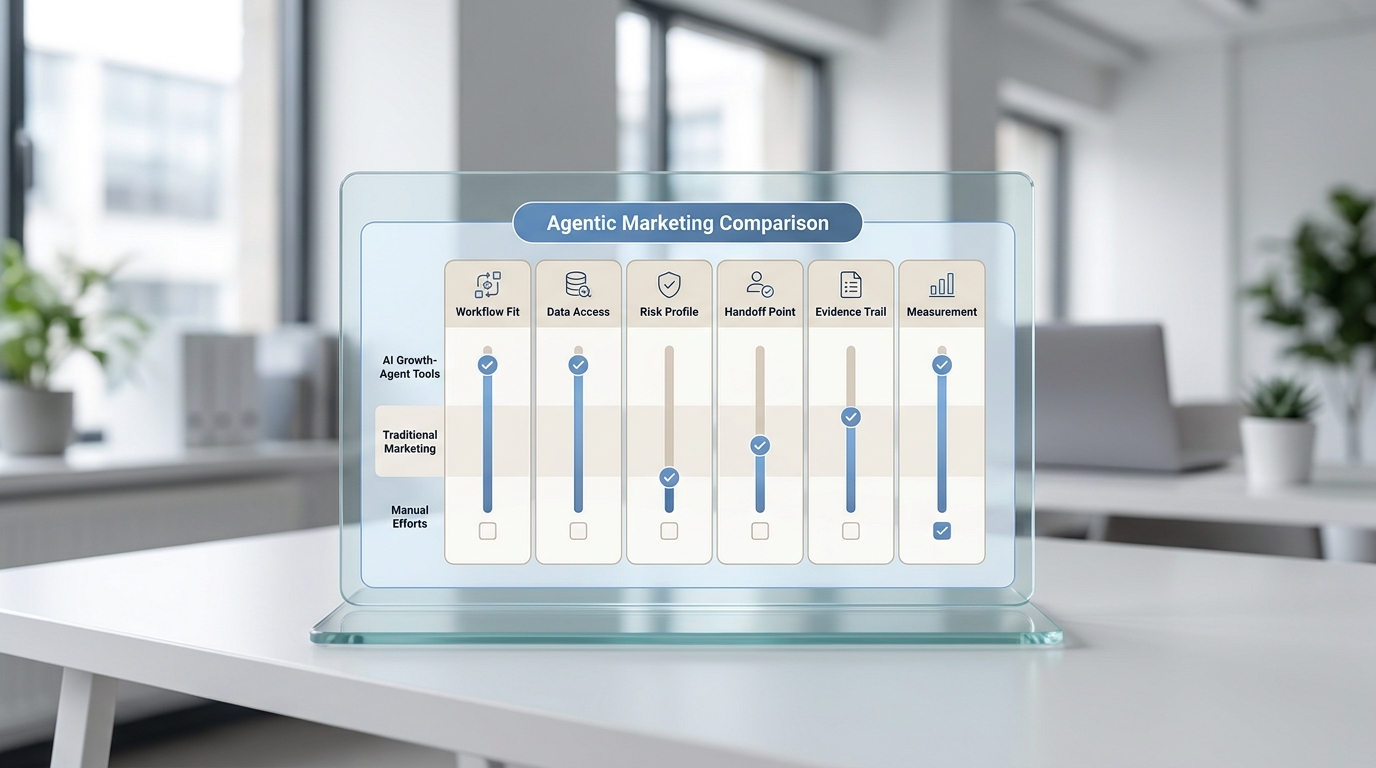
For teams already comparing broader agentic marketing platforms, use Solvea's agentic marketing comparison checklist. For the earlier decision of whether a workflow should be agentic at all, see what agentic marketing means and when it matters.
What to keep human
AI marketing agents should not make every marketing decision. Keep people in the loop when the action changes money, risk, brand trust, or customer safety.
Keep these human-owned:
- Pricing changes, discounts, refunds, and contract terms.
- Legal, medical, financial, compliance, or emergency-sensitive decisions.
- Ad budget shifts and campaign changes above a defined threshold.
- Public brand statements that could create reputation risk.
- Customer complaints, cancellations, or exceptions.
- Any action the team cannot review, trace, or reverse.
The agent can still help. It can summarize the issue, collect missing fields, draft a response, route the case, and show evidence. But the final call should stay with the person accountable for the outcome.
The 14-day AI marketing agents pilot plan
Do not evaluate AI marketing agents with a vendor demo alone. Run a small pilot around one workflow.
Days 1-2: Pick the decision
Choose one repeated decision that currently slows the team down.
Use this sentence:
When
[trigger]happens, the AI marketing agent should[allowed action]using[approved context], unless[handoff rule]is true. Success is measured by[metric].
If you cannot fill in that sentence, the workflow is not ready.
Days 3-5: Prepare context and rules
List the exact context the agent can use:
- Customer conversation history.
- Business hours and service area.
- Approved qualification questions.
- Product, service, or FAQ knowledge.
- Calendar, CRM, inbox, or ticketing data.
- Owner and escalation rules.
- Allowed response templates.
- Actions the agent must never take.
This is also where integrations matter. AI marketing agents work better when they can read and write to the tools that already run the workflow. If the agent cannot access the system of record, the team will still spend time copying outputs into the real process.
Days 6-10: Run with review
Let the agent handle ordinary cases, but review evidence daily.
Check:
- Did it use the right trigger?
- Did it have enough context?
- Was the decision inside scope?
- Was the handoff clear?
- Was the summary accurate?
- Did it write back to the right place?
- Did a human need to correct it?
- Did any failure reveal a missing policy or knowledge-base gap?
Do not expand autonomy during this period. Fix the workflow first.
Days 11-14: Decide
Compare the pilot against the baseline.
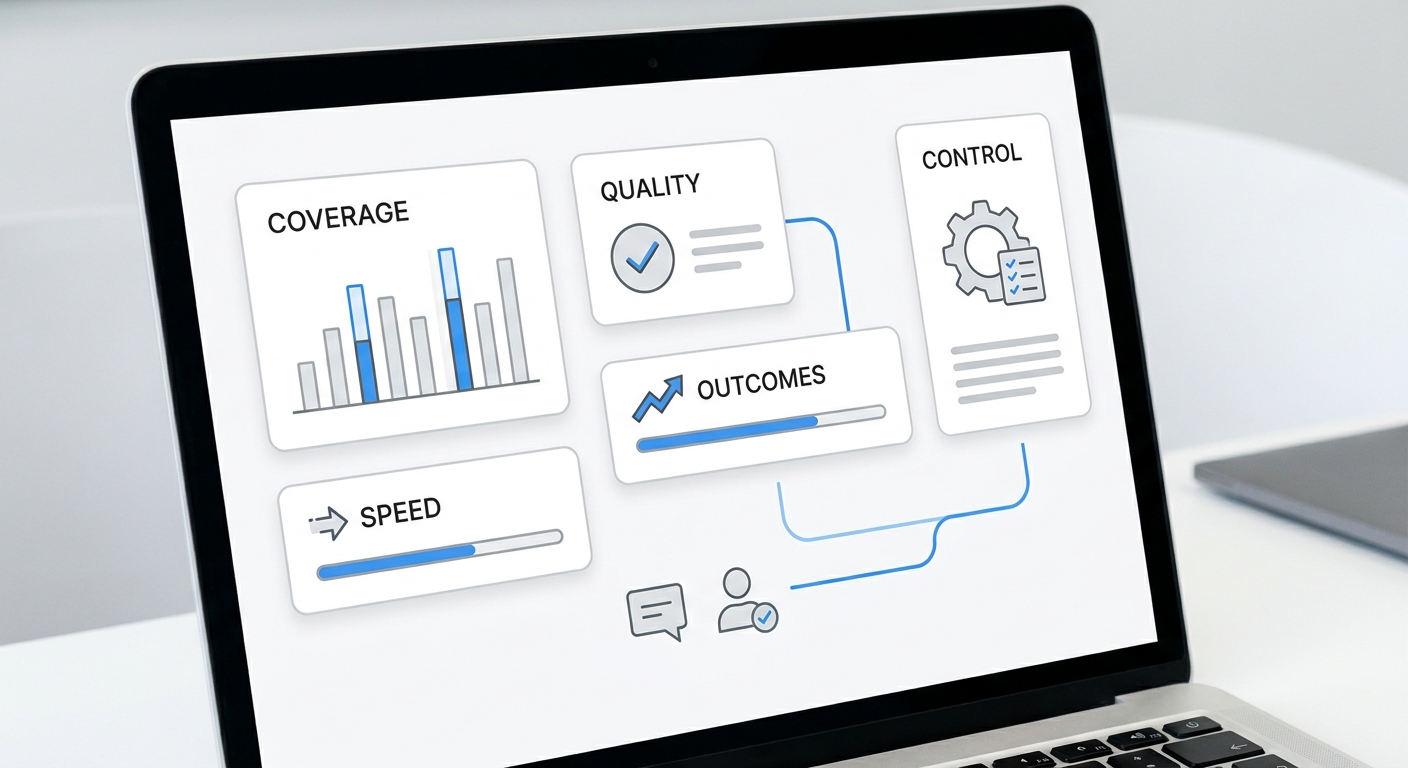
Track a small metric set:
| Metric | Why it matters |
|---|---|
| Median first useful response time | Shows whether the agent sped up the decision loop. |
| Qualified leads or tasks captured | Shows whether more useful work reached the team. |
| Correct routing rate | Shows whether the decision was reliable. |
| Human correction rate | Shows whether the workflow needs more control. |
| Handoff completion rate | Shows whether work actually reached the right owner. |
| Assisted conversions or booked outcomes | Shows whether the workflow helped a business result. |
Use Google Search Console for organic clicks and indexed URL monitoring. Use Google Analytics key events for signups, demos, trials, or assisted conversion paths. Keep causation claims conservative: an article or workflow can assist a conversion without being the only reason it happened.
How to compare AI marketing agents tools
When you compare AI marketing agents tools, do not start with feature volume. Start with workflow proof.
Ask each vendor or internal builder:
- Which trigger starts the agent?
- Which systems can the agent read?
- Which systems can the agent write to?
- What actions are blocked by policy?
- Where does the evidence trail live?
- How does a human approve or override?
- What happens when the agent is unsure?
- How do we roll back a bad action?
- Which metric should improve in 14 days?
- Who owns QA after launch?
If a tool cannot answer these questions, the problem is not the interface. The problem is that the tool is selling autonomy without enough operating detail.
For a deeper tool-selection pass, use the AI growth agent tools evaluation framework and the content operations AI checklist. Both are useful companion reads when the workflow is closer to GTM operations than phone-first customer response.
Your AI Receptionist, Live in Minutes.
Scale your front desk with an AI that never sleeps. Solvea handles unlimited multi-channel inquiries, books appointments into your calendar automatically, and ensures zero missed opportunities around the clock.
FAQ
What are AI marketing agents?
AI marketing agents are AI systems that can own a bounded marketing or growth workflow step: detect a trigger, use approved context, choose the next action, act within limits, record evidence, and hand off when needed.
How are AI marketing agents different from automation?
Automation follows fixed rules. AI marketing agents can use context inside a bounded workflow. If the next step never changes, ordinary automation is usually simpler and safer.
What should AI marketing agents automate first?
Start with repetitive, measurable workflows close to customer intent: missed-call response, lead qualification, appointment requests, routine follow-up, message routing, reporting triage, and content QA.
What should stay human?
Keep humans responsible for pricing, legal, medical, financial, compliance, emergency, complaint, budget, and brand-risk decisions. Agents can summarize, draft, route, and prepare evidence, but high-risk judgment needs a human owner.
How should a team measure an AI marketing agents pilot?
Measure one outcome and one control metric. For example: response time plus correction rate, qualified leads plus routing accuracy, or follow-up completion plus complaint rate. Avoid measuring only AI activity volume.
The bottom line
The best AI marketing agents are not the most autonomous. They are the easiest to trust, inspect, and improve.
Start with one repeated decision. Define the trigger, context, permission, handoff, evidence, metric, owner, and rollback path. If the workflow passes the checklist, pilot it for 14 days. If it does not, narrow the scope before adding more AI.
For service businesses where the first growth problem is missed customer conversations, Solvea is a practical starting point: AI can answer first, capture intent, keep conversation context in one place, and give the team a clear next step to act on.