Your receptionist answers calls, books appointments, and greets visitors, all while managing office chaos. It is a demanding role. But as we move through 2026, many business owners are asking a tough question: AI Receptionist vs Human Receptionist, which is better for business growth?
In this blog, we move beyond the common debate between AI and human receptionists. Instead, we cut straight to the metrics that impact your bottom line: True Cost and ROI. If you are looking to scale your operations without doubling your overhead, this deep dive is essential reading.
TL;DR: AI Receptionist vs Human Receptionist Comparison in 2026
AI receptionists excel in cost, speed, and scale. Humans shine in empathy and nuance. Most small businesses benefit from AI agents for routine tasks, with humans for complex cases. Here are the key differences at a glance:
Dimension | AI Receptionist | Human Receptionist |
Availability | 24/7, instant | Business hours only |
Call Volume | Unlimited simultaneous | One at a time |
Empathy | Scripted responses | Natural emotional connection |
Accuracy | 97-99% consistent | Varies by fatigue |
Cost | Low predictable cost | High variable cost |
Scalability | Instant, no hiring | Requires training/recruiting |
Data & Integrations | Real-time CRM/App syncing | Manual data entry |
Complex Issues | Escalates quickly | Solves creatively |
Setup Effort | Fast (Template-based) | Lengthy (Recruitment/Onboarding) |
Brand Feel | Efficient, modern | Warm, personal |
Why the Receptionist Role Is Still the "Frontline" of Your Business
The front desk is more than a greeting station; it is your brand's first handshake. Whether digital or physical, the receptionist sets the tone for the entire customer journey and acts as a filter for business growth.
- First Impression Mastery: The receptionist is your primary gatekeeper. A professional, instant response signals a "premium" business, while a busy signal sends prospects straight to your competitors.
- Lead Capture Excellence: They turn anonymous callers into customers by capturing "hot leads" when intent is highest, preventing the common lead decay caused by delayed callbacks.
- Workflow Coordination: By filtering out 80% of administrative noise (FAQs/Rescheduling), they keep your specialized team focused on billable, high-value tasks.
- Customer Retention: High-quality initial interaction builds immediate trust. A seamless first contact creates the "emotional glue" that turns one-time visitors into loyal advocates.
- Market Intelligence: The receptionists hear real-time feedback on your pricing, services, and what your competitors are doing better.
The Financial Case: Calculating True Cost and ROI
Benchmark note: Costs below reflect a typical U.S.-based hair salon with 200+ monthly calls. Based on salary data from ZipRecruiter and VelvetJobs (2026) and Solvea AI receptionist. Individual results vary by call volume and local labor market.
AI receptionists see heavy adoption in appointment-heavy businesses like hair salons, e-commerce support, and home services where routine calls dominate. To truly understand the impact on business, let's analyze the cost and return on investment (ROI) within a high-traffic Hair Salon. For example:
The Real Cost of a Human Receptionist (Hair Salon):
In the U.S., a salon receptionist earns an average base salary of $32,000–$37,000, according to 2026 data from ZipRecruiter and VelvetJobs. But the "true cost" to the owner is significantly higher:
- Base salary: $32K–$37K.
- Benefits/insurance: $5K–$9K (15-25%).
- Payroll taxes: $3.2K–$5.6K (10-15%)
- Vacations/sick time: $2.5K–$3.5K.
- Training/turnover: $2K–$3K (40% rate).
- Total employer cost reaches $48K–55K/year.
The most overlooked cost is turnover. With a 40% annual churn rate in front-desk roles, the average salon replaces its receptionist every 2.5 years — triggering a new recruitment and training cycle each time.
The Cost of an AI Receptionist (Solvea Case):
In contrast, Solvea's AI receptionist runs at approximately $300/year — roughly 0.6% of the human equivalent. That includes:
•One dedicated business phone number
•10 specialized AI agents for different call types
•500MB knowledge base (PDFs, help docs, FAQs)
•Voice, Shopify, Google Calendar, Google Sheets, and email integrations
•Resolution rate and conversation volume dashboards
Net annual saving: $48K (human) - $300 (Solvea AI) = $47.7K — enough to fund a new hire in a revenue-generating role.
Cost Component | Human Receptionist (Hair Salon) | AI Receptionist (Solvea) |
Base salary / Subscription | $32,000–$37,000/year | $300/year |
Benefits & insurance | $5,000–$9,000/year | $0 |
Payroll taxes | $3,200–$5,600/year | $0 |
Vacation & sick time | $2,500–$3,500/year | $0 |
Training & turnover (40% rate) | $2,000–$3,000/year | $0 |
TOTAL TRUE COST | $48,000–$55,000/yr | ~$300/year |
Annual Savings with AI | — | $47,700+ |
Pros and Cons of AI Receptionist vs Human Receptionist: A Realistic Assessment
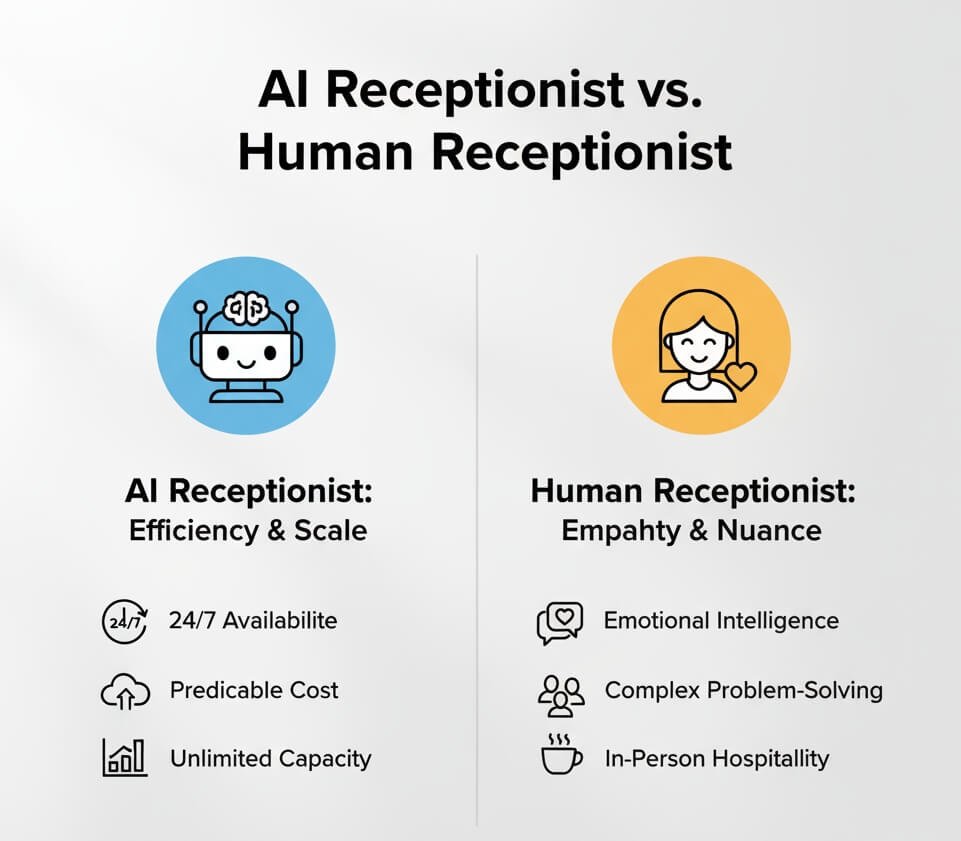
AI receptionists outperform humans on cost and availability, while human receptionists remain superior for high-emotion interactions and complex logistics. Here is where each model genuinely excels and falls short.
AI Receptionist: Unbeatable Strengths and Limitations
- 24/7 Availability: AI handles bookings at 9 PM when your business is closed, ensuring no after-hours revenue is lost to competitors.
- Unlimited Concurrency: It manages 10 call volumes during the lunch rush, preventing the "busy signals" that frustrate customers and kill bookings.
- Predictable Scaling: Annual costs stay fixed regardless of call volume, unlike humans, who require expensive scaling during busy seasons.
- Data Integrity: Every inquiry auto-syncs to your calendar with 99% accuracy, eliminating the common "human error" of double-booked stylists.
- The Uncanny Valley: AI struggles with complex, non-standard requests or highly emotional complaints, which can feel robotic if not properly monitored.
Human Receptionist: Critical Edge and Drawbacks
- High-Touch Empathy: A skilled human can sense a client's distress over a hair disaster and offer a personalized, compassionate fix that AI cannot replicate.
- Complex Logistics: They expertly navigate "grey-area" scheduling puzzles—like fitting in a treatment mid-service—that would confuse most automated systems.
- Physical Hospitality: Humans provide the essential "front-of-house" warmth, such as greeting walk-ins or pouring coffee, that defines a premium salon experience.
- Operational Volatility: High turnover and training time create "knowledge drains," while staff absences lead to inconsistent service quality and management headaches.
AI Receptionist vs. Human Receptionist: Which Is Better for Your Business
The answer depends on your business type, call volume, and the emotional stakes of your customer interactions. Here is a practical decision framework based on patterns we have observed across 500+ Solvea customers.
Primary Driver | Recommended Strategy |
High volume of routine, simple tasks | AI-First |
High-touch, emotional, or sensitive issues | Human-Only |
Complex logistics or crisis management | Human-Only |
Growth with a limited budget | AI-First |
Need for 24/7 availability & lead capture | AI-First |
Premium, tailored customer experience | Hybrid (AI Triage + Human Handoff) |
When an AI Receptionist Is the Better Choice
AI thrives in environments where speed, consistency, and volume are the primary drivers of growth.
- Scenario 1: High-Volume Appointment Businesses. For businesses like hair salons or dental practices managing hundreds of bookings monthly, AI eliminates "busy signals." It ensures that every booking inquiry is captured instantly, keeping your calendar full while your staff focuses on providing the actual service.
- Scenario 2: After-Hours Demand If your customers are retail shoppers or homeowners searching for help in the evenings or on weekends, AI ensures you never miss a lead while your office is dark. Capturing a request at 8 PM can often be the difference between winning a client and losing them to a competitor.
- Scenario 3: Tight Budget Growth For startups or freelancers managing lean budgets, AI provides a professional 24/7 front-office presence for a fraction of the cost of a full-time hire. This allows you to scale your operations without the overhead of payroll, benefits, and HR management.
- Scenario 4: Repetitive FAQs If your team spends hours daily answering the same questions—such as "What are your business hours?", "Where are you located?", or "What is your pricing?"—AI handles these routine queries with 100% accuracy, freeing your team for complex work.
When a Human Receptionist Is Still Better
Humans excel in high-stakes environments where empathy and complex problem-solving are paramount.
- Scenario 1: High-Emotion Interactions. For law firms, luxury medical practices, or funeral homes, the first voice a client hears must convey deep empathy. When a client is in crisis, a human can read between the lines, offer comfort, and provide the reassurance that scripts simply cannot mirror.
- Scenario 2: In-Person Coordination In hospitality or boutique retail, the receptionist's job is to create a physical atmosphere. A human is essential for greeting walk-ins, managing the physical office environment, and providing the "extra mile" service, such as pouring coffee or guiding guests.
- Scenario 3: Internal Escalations When a situation requires navigating complex office politics—such as shifting a last-minute staffing emergency or calming an irate long-term VIP client—a human professional can negotiate and resolve conflicts creatively, ensuring the customer feels personally valued.
Can AI Receptionists Actually Replace Humans? The Truth About the Hybrid Model
They shouldn't. The most successful businesses in 2026 use a Hybrid Model. In this setup, AI handles 80% of routine tasks—FAQs, basic bookings, and lead screening. This "boring" work is offloaded, allowing your human staff to handle 20% of calls that require deep empathy or complex escalation.
The hybrid model is thriving especially in:
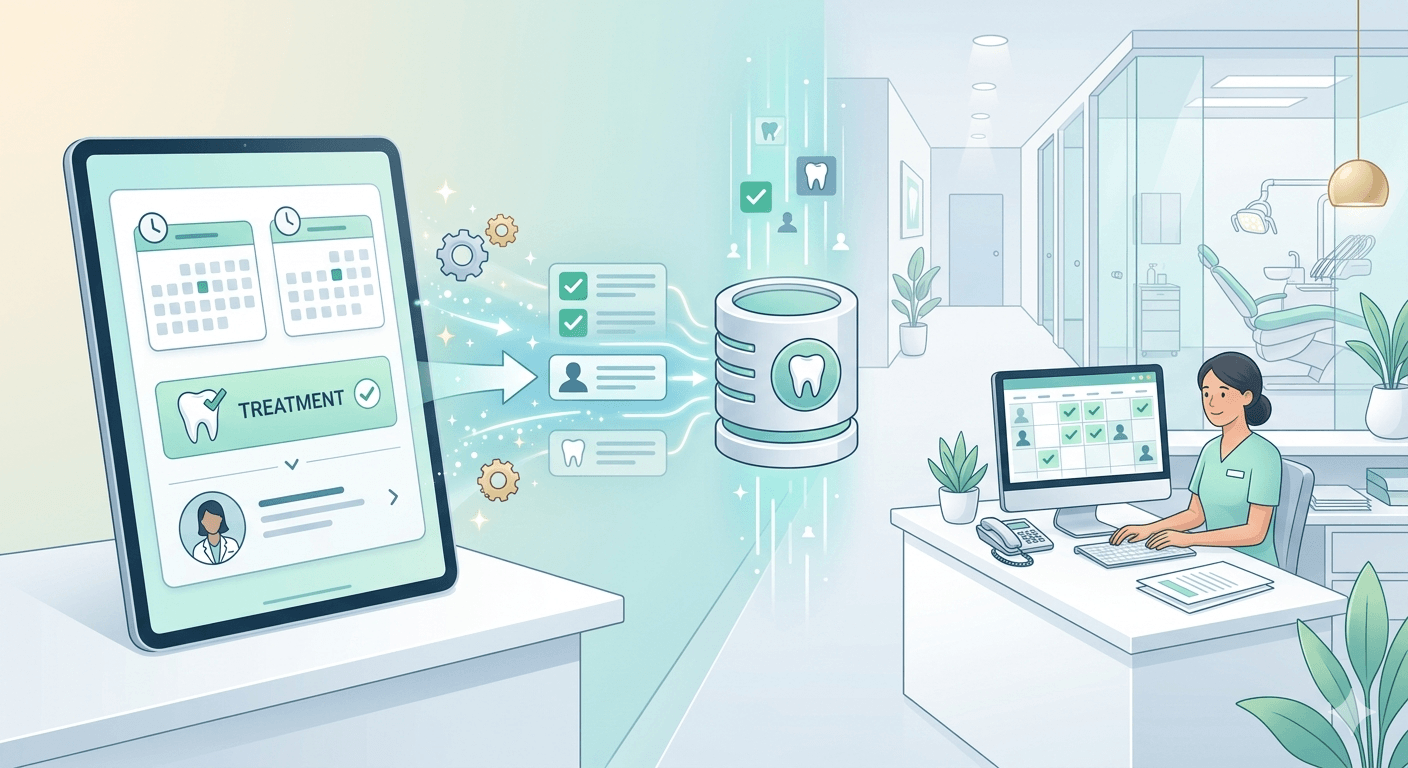
•Healthcare and MedSpas: AI handles appointment booking, reminders, and FAQ calls. Human staff focuses on sensitive patient communications and in-person care coordination.
•Real Estate and Sales: AI screens inbound leads and books showings 24/7. Agents focus their time on qualified prospects who are ready to move.
•Law, Finance, Consulting: AI handles intake screening and FAQ calls. Human receptionists manage the calls requiring judgment, discretion, or emotional intelligence.
What Makes Solvea a Great AI Receptionist for Your Business
Alt=AI receptionist vs human receptionist Solvea
Best for: SMB owners, salons, MedSpas, hotels, home services, real-estate, law firms, and freelancers who need a professional front desk without the $50k price tag.
What makes Solvea stand out: Solvea is built specifically for growing businesses that cannot afford to miss a single lead. It integrates deeply with your existing tools—CRM systems, e-commerce platforms, email, and voice —allowing you to automate bookings, confirmations, and order queries across multiple channels.
You simply choose a template, add your specific business knowledge, and launch. It even analyzes your Resolution Rate and total conversations so you can see exactly how it is performing.
Key Advantages:
- Zero Missed Calls: Total coverage during peak hours and after-hours.
- Multilingual Support: Reach a broader customer base instantly.
- Seamless Integration: Works with your current calendar and CRM.
- Instant Knowledge Base: Upload your PDFs or website links to "teach" your AI in minutes.
- Cost Efficiency: For roughly $300/year, you get the utility of a full-time staff member.
Pricing:
- Free for individuals: 1K credits/month, 3 agents, 50MB knowledge base, 1 free phone number.
- Basic for small business: $30/month or $300/year, 30K credits/month, 10 agents, 500MB knowledge base, 1 free phone number.
In Conclusion: Choosing the Right Reception Strategy for 2026
AI receptionist or human receptionist, which is better for business growth? The right question is: which tasks should each handle? AI wins on cost, scale, consistency, and availability, which human receptionists win on empathy, complex judgment, and physical presence.
For most SMBs or startups in 2026, the path to sustainable growth is clear: deploy AI to handle the call volume, so your people can focus on the conversations that actually build relationships and drive revenue.
Your AI Receptionist, Live in Minutes.
Scale your front desk with an AI that never sleeps. Solvea handles unlimited multi-channel inquiries, books appointments into your calendar automatically, and ensures zero missed opportunities around the clock.
FAQs
1. What are the benefits of AI receptionists?
AI receptionists provide 24/7 availability, ensuring no lead is lost after hours. They handle unlimited concurrent calls, eliminating busy signals and wait times. Additionally, they integrate directly with digital calendars and CRMs, automating data entry and significantly reducing the overhead costs associated with human staffing.
2. Can AI receptionists handle complex tasks?
AI excels at structured tasks like booking appointments, answering FAQs, and screening leads. However, it struggles with "grey area" logic or highly emotional situations. While it can follow complex if-then rules, it lacks the creative problem-solving and deep empathy that a trained human professional brings to a crisis.
What are the costs associated with AI receptionists?
Costs are typically subscription-based and very predictable. For example, Solvea costs around $300 per year. There are no payroll taxes, insurance premiums, or training costs. The setup is usually a "DIY" process using templates, which removes the need for expensive consultants or long recruitment cycles.
Are human receptionists still necessary?
Yes, especially for high-touch businesses. If your service relies on physical hospitality (like a hotel) or involves high-stakes emotional support (like a crisis center), a human is essential. In these cases, AI should be used as a "co-pilot" to handle routine scheduling so the human can focus on the client.
Is an AI receptionist worth it for a small business?
Absolutely, especially if you lose leads due to missed calls or high overhead. For a small monthly or annual fee, it eliminates the "missed call" revenue leak and allows you to scale without adding payroll. It pays for itself by capturing even just one or two extra bookings per month.
What happens when an AI receptionist can't answer a question?
Reliable AI systems are designed with "fallback" protocols, such as automatically routing the caller to a human staff member or taking a detailed message for a follow-up. This ensures that the customer is never left in a dead-end loop, maintaining a positive brand experience.