Agent workflow management is not valuable because an AI agent completes tasks. It is valuable when the workflow improves a business outcome at a lower total cost, with acceptable risk, and without creating more cleanup work for employees.
That distinction matters for service businesses. A workflow that answers every inquiry but books the wrong appointment can destroy value. A workflow that handles only routine requests, escalates uncertain cases, and captures leads after hours can produce a measurable return even if it never eliminates a job.
This agent workflow management: cost and ROI guide gives small and midsize businesses a practical 2026 framework for estimating total cost, calculating risk-adjusted returns, comparing vendors, and deciding whether to expand, redesign, or stop a workflow after a controlled pilot.
Updated August 11, 2026: This edition keeps the ROI calculator, marginal cost model, approval packet, owner-time economics, 30-day evidence log, 12-week ROI review cadence, and owner/CFO scorecard. It now adds a marginal ROI expansion matrix and budget-control triggers so teams can decide which next workflow deserves funding after the first pilot proves value.
Agent workflow management cost at a glance
The total cost of an agent workflow has four layers:
- Implementation cost: process mapping, configuration, integrations, testing, and training.
- Recurring platform cost: subscriptions, usage, phone or messaging charges, and connected software.
- Operating cost: monitoring, exception handling, knowledge updates, and workflow improvements.
- Risk cost: errors, poor handoffs, customer friction, security exposure, or missed revenue caused by unreliable automation.
The return normally comes from one or more of these outcomes:
- fewer missed leads;
- faster response times;
- more completed bookings;
- lower administrative workload;
- more consistent customer service;
- better after-hours coverage;
- fewer avoidable errors or no-shows.
The simplest monthly calculation is:
Net monthly benefit = recovered revenue + labor value + avoided costs − recurring workflow cost − expected error cost
Then calculate:
ROI = (annual net benefit − implementation cost) ÷ implementation cost × 100
For planning purposes, also calculate payback:
Payback period in months = implementation cost ÷ net monthly benefit
These formulas are useful only when the inputs are based on an observed baseline rather than optimistic assumptions.
2026 budgeting rule: price the workflow, not the agent
Many agent workflow budgets fail because the buyer compares monthly software prices while ignoring the work required to make the workflow reliable. A better budget starts with the business process and then assigns cost to each layer that must operate in production.
Use this three-part budget rule:
- Base workflow cost: the minimum subscription, usage, setup, and oversight needed for the first live workflow.
- Expansion cost: the extra cost of adding another channel, location, team, integration, language, or service line.
- Control cost: the recurring cost of keeping the workflow accurate, compliant with internal rules, and trusted by employees.
For a service business, the first workflow is often after-hours lead capture, routine appointment booking, missed-call follow-up, FAQ handling, or reschedule coordination. Each has a different cost shape. A phone-heavy workflow may be sensitive to call minutes. A booking workflow may be sensitive to calendar integrations and exception review. A support workflow may be sensitive to knowledge-base maintenance.
Budget by scope before you compare vendors:
| Scope choice | Cost impact | ROI risk if ignored |
|---|---|---|
| One channel vs omnichannel | More channels increase configuration, testing, and monitoring | Customers receive inconsistent answers by channel |
| One location vs multiple locations | Adds calendars, service areas, staff rules, and routing logic | Appointments are booked with the wrong team or location |
| FAQ only vs action-taking workflow | Actions require permissions, integrations, and rollback paths | The agent answers correctly but cannot complete the outcome |
| Simple handoff vs conditional escalation | More conditions require training data, rules, and review | Employees receive vague or late handoffs |
| Static knowledge vs changing policies | More updates require ownership and cadence | The agent repeats stale prices, hours, or service rules |
This is why the cheapest subscription is not always the cheapest workflow. A narrower platform with reliable handoffs can produce better economics than a broader tool that creates more review work than it removes.
Agent workflow management cost and ROI approval packet
Before funding a workflow, give the owner or leadership team a one-page approval packet. The packet should make the business case visible before anyone debates vendor features.
A strong packet answers eight questions:
| Approval field | What to include | Why it matters |
|---|---|---|
| Workflow scope | Trigger, channels, permitted actions, handoffs, and excluded cases | Prevents the pilot from expanding before economics are known |
| Baseline | Current volume, response time, labor minutes, completed outcomes, and leakage | Separates real demand from anecdotal urgency |
| Implementation cost | Setup, integrations, knowledge work, testing, training, and internal time | Keeps the investment visible even when the invoice is small |
| Monthly run cost | Subscription, usage, oversight, exception handling, and maintenance | Shows the cost of operating the workflow, not just buying software |
| Expected benefit | Recovered gross profit, redeployed labor, avoided cost, and retired tools | Connects automation to financial outcomes |
| Risk controls | Error categories, escalation rules, permissions, and rollback plan | Shows how downside cost will be limited |
| Named owner | Person responsible for quality, knowledge updates, and review cadence | Prevents the workflow from becoming unmanaged automation |
| Decision threshold | Stop, fix, hold, and scale rules | Turns the pilot into a decision, not an open-ended experiment |
This packet is useful even for a small first pilot. If a buyer cannot name the workflow, baseline, owner, and decision threshold, the team is not ready to compare agent workflow management cost and ROI across vendors.
Use the packet during procurement, then keep it as the first page of the pilot file. When results arrive, replace estimated values with observed values instead of rebuilding the business case from memory.
August 2026 scorecard for agent workflow management cost and ROI
The approval packet starts the business case. The scorecard keeps it honest after launch. Use the same scorecard every week so the team can see whether the workflow is improving the outcome, shifting work to employees, or quietly increasing operating risk.
A practical scorecard has five rows:
| Scorecard row | What to measure | Healthy signal | Warning signal |
|---|---|---|---|
| Outcome volume | Completed bookings, qualified leads, resolved requests, or another finished result | Completed outcomes rise versus baseline | Activity rises but finished outcomes do not |
| Unit cost | Total monthly workflow cost divided by successful outcomes | Cost per outcome falls or stays below the current process | Usage, review, or exception cost grows faster than outcomes |
| Human burden | Human touches, owner-time drag, and exception minutes per successful outcome | Manual work per outcome declines after stabilization | Staff spend more time checking the agent than serving customers |
| Quality and risk | Error rate by impact level, failed handoffs, and customer corrections | High-impact errors stay below the agreed threshold | One failure category repeats for two review cycles |
| Expansion readiness | Stable knowledge owner, clean handoffs, dashboard visibility, and marginal ROI | The next workflow has positive marginal net benefit | The team wants to scale before the first workflow is stable |
This scorecard prevents two common mistakes. The first is celebrating automation volume when the business result has not improved. The second is treating saved time as cash before the team proves that time was redeployed, overtime was avoided, or new revenue was captured.
For a small business owner, the most useful executive view is usually one sentence: this workflow produced $_ in verified monthly benefit, cost $ to operate, required __ human touches per outcome, and is ready to stop, fix, hold, or scale. If the team cannot fill in that sentence after a pilot, the workflow is not ready for a larger budget discussion.
A 12-week ROI review cadence
Use a 12-week cadence when the workflow touches customer communication, booking, lead follow-up, or support. It gives the team enough production evidence to separate launch noise from durable economics.
| Review window | Main question | Evidence to collect | Decision output |
|---|---|---|---|
| Weeks 1-2 | Is the workflow safe enough to keep live? | Failed handoffs, incorrect answers, missing knowledge, employee overrides | Fix urgent gaps or pause the workflow |
| Weeks 3-4 | Is the workflow handling real demand? | Eligible volume, completion rate, channel mix, after-hours share | Confirm scope or narrow the pilot |
| Weeks 5-8 | Is unit economics improving? | Cost per outcome, owner-time drag, exception minutes, integration failures | Decide whether fixes are working |
| Weeks 9-12 | Is the workflow worth scaling? | Net monthly benefit, conservative payback, quality floor, marginal cost of the next workflow | Stop, fix, hold, or scale |
Do not wait until week 12 to correct obvious failures. The point of the cadence is to create a decision rhythm, not to tolerate poor customer experience. High-impact failures should trigger immediate review, while ordinary measurement should stay on a weekly operating cadence.
The 12-week view also helps vendor comparison. A vendor that looks cheaper in week one may be more expensive by week eight if it creates more monitoring, brittle integrations, or unclear handoffs. A vendor that costs more upfront can still produce better ROI if it lowers owner-time drag and improves completed outcomes with fewer corrections.
For Solvea buyers evaluating customer communication workflows, this cadence pairs naturally with conversation summaries, transcripts, ownership statuses, and analytics. Those records make it easier to connect customer interactions to completed follow-up instead of judging the workflow only by calls answered or messages sent.
August 2026 marginal ROI expansion matrix
The first agent workflow should prove that the operating model works. The second workflow should prove that the economics improve as the system expands. That is why the next budget decision should use marginal ROI, not only total ROI.
Marginal ROI asks a narrower question: if the business adds one more workflow, channel, location, or integration, will the additional benefit exceed the additional cost and risk? This matters because many setup costs are shared. Knowledge preparation, handoff rules, analytics habits, and employee training may support more than one workflow. At the same time, some expansion costs rise quickly when the next workflow adds a new system, language, policy area, or customer risk.
Use this matrix before expanding beyond the first pilot:
| Expansion option | Additional cost to estimate | Additional benefit to prove | Best decision rule |
|---|---|---|---|
| Add a second channel | Channel setup, message fees, QA by channel, handoff testing | More reachable customers and fewer missed inquiries | Scale only if answers and handoffs stay consistent across channels |
| Add another location | Calendar rules, routing logic, service-area knowledge, manager review | More completed bookings without central staff growth | Scale only if cost per successful outcome remains below the current process |
| Add an adjacent workflow | New triggers, permissions, exception paths, dashboard fields | Reused knowledge and higher customer completion rate | Scale only if owner-time drag does not rise faster than outcomes |
| Add a new integration | Field mapping, API failure handling, duplicate checks, data ownership | Less manual entry and faster follow-up | Scale only if integration failures are visible and recoverable |
| Add a higher-risk action | Permissions, approval rules, audit trail, rollback path | Less employee delay on valuable requests | Scale only if high-impact errors stay below the agreed quality floor |
A simple expansion formula is:
Marginal net benefit = added gross profit + added labor value + added avoided cost - added software cost - added oversight - added risk cost
If marginal net benefit is positive but quality is unstable, hold the workflow instead of scaling it. Positive spreadsheet ROI does not justify expansion when employees still distrust handoffs, customers still need corrections, or the owner is personally repairing the workflow every week.
For service businesses, the strongest second workflow is usually close to the first one. If the first workflow captures after-hours calls, the second might route those leads into appointment follow-up. If the first workflow answers routine booking questions, the second might handle reschedules or confirmations. Adjacent expansion reuses knowledge and reporting, which improves the chance that total agent workflow management cost and ROI gets better with scale rather than worse.
Budget-control triggers
Set budget-control triggers before the next workflow goes live. These triggers keep a useful pilot from turning into unmanaged subscription and cleanup cost.
| Trigger | What it means | Action |
|---|---|---|
| Usage cost exceeds forecast by 20% for two weeks | Volume, routing, or billing assumptions were wrong | Reforecast the workflow and narrow scope if needed |
| Human touches per outcome rises for two review cycles | Automation is shifting work instead of reducing it | Fix knowledge, handoffs, or permissions before expanding |
| One error category repeats after a documented fix | The failure is structural, not a one-off launch issue | Pause that path and redesign the rule or escalation |
| Owner-time drag exceeds the weekly limit | The workflow lacks operational ownership | Assign ownership or reduce scope before adding spend |
| Cost per successful outcome is above the manual baseline | The workflow is not yet economically better | Hold expansion and test a narrower version |
These triggers are not meant to punish experimentation. They make spending visible while the team still has time to change course. A disciplined team can keep a workflow live, fix the operating model, and still protect cash by pausing expansion until the marginal case improves.
What is agent workflow management?
Agent workflow management is the discipline of designing, assigning, monitoring, and improving work shared by AI agents, software automations, and people.
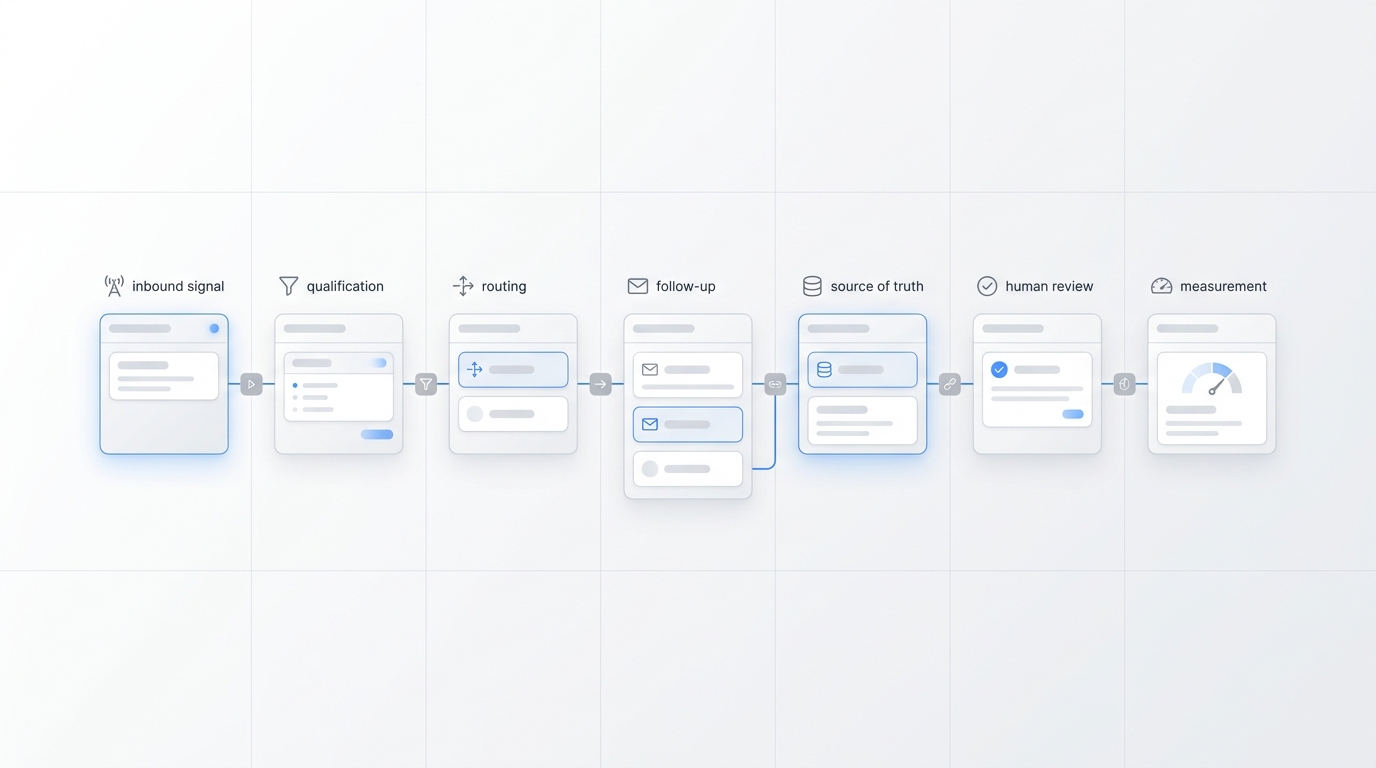
A managed workflow usually has seven components:
- Trigger: a call, message, form, booking change, scheduled event, or status update starts the process.
- Context: the agent receives customer details, business rules, availability, conversation history, and relevant knowledge.
- Decision: rules or AI reasoning determine the next appropriate step.
- Action: the workflow responds, books, routes, updates, summarizes, or creates a task.
- Handoff: uncertain, sensitive, or high-value cases move to a named person or team.
- Record: the system keeps enough history to understand what happened.
- Review: the business measures outcomes, failures, overrides, and improvement opportunities.
Buying an AI tool covers only part of this system. Workflow management also includes permissions, knowledge quality, integration health, escalation rules, human ownership, and performance reporting.
If you have not mapped the process yet, use the GTM automation beginner guide before comparing platforms. A clear lead-to-outcome map prevents teams from automating a process they do not understand.
The complete agent workflow cost model
1. Process discovery and design
Before implementation, someone must define the current process and the desired outcome. This work includes:
- listing triggers and channels;
- documenting business rules;
- identifying required customer information;
- defining acceptable and unacceptable actions;
- mapping human handoffs;
- choosing success metrics;
- recording the current baseline.
For a narrow workflow, this may take a few focused sessions. For a workflow that touches several teams, locations, or systems, discovery can become the largest setup cost.
The cost is not only consultant or employee hours. Delayed decisions, unclear ownership, and repeated revisions also consume capacity.
2. Platform and usage fees
Recurring software cost may be based on seats, conversations, actions, minutes, messages, integrations, or usage credits. Ask what event creates a billable unit and model the cost at normal, busy, and peak volume.
Do not compare platforms using the advertised entry price alone. Compare the expected monthly cost of your actual workflow, including the channels and usage level you need.
For Solvea, use the live pricing page for current plan details. Evergreen ROI models should link to live pricing because plans and included usage can change.
3. Integration and data cost
Agent workflows often depend on calendars, customer records, forms, phone systems, inboxes, spreadsheets, or payment tools. Integration cost includes:
- initial connection and field mapping;
- data cleanup;
- permission configuration;
- duplicate prevention;
- failure alerts;
- maintenance when another system changes.
An integration is not finished when data moves once. It is finished when the business can detect failed or incorrect movement and knows who must fix it.
4. Knowledge preparation
An agent can only apply the information available to it. Businesses may need to organize:
- services and prices;
- service areas;
- booking policies;
- staff availability;
- frequently asked questions;
- cancellation and rescheduling rules;
- escalation criteria;
- approved claims and prohibited statements.
Poor knowledge creates an ongoing tax. Employees correct answers, customers repeat themselves, and managers lose confidence in the workflow.
The guide on building a customer support knowledge base explains how to create a maintainable source instead of a one-time document dump.
5. Testing and launch cost
Testing should include the common path, edge cases, incomplete information, unavailable appointments, duplicate customers, abusive messages, and requests that must be handed to a person.
Launch cost also includes employee training. Staff need to know:
- what the agent can do;
- what it cannot do;
- where handoffs appear;
- how quickly they must respond;
- how to report a bad outcome;
- who can change the workflow.
6. Human oversight
Most useful agent workflows still require human ownership. Oversight can include daily exception review, weekly quality sampling, knowledge updates, integration checks, and monthly business reviews.
Estimate oversight with this formula:
Monthly oversight cost = review hours × loaded hourly cost
Include manager time as well as frontline time. A workflow can save employee minutes while creating a hidden management burden.
Owner-time drag
The hidden cost in many agent workflow pilots is not software. It is the owner time spent explaining edge cases, checking quality, updating knowledge, and rescuing work that should have escalated cleanly.
Track owner-time drag separately from ordinary oversight:
Owner-time drag = founder or manager hours spent repairing the workflow × loaded owner hourly value
This number matters because owner time is usually the scarcest resource in a service business. A workflow that saves five frontline hours but consumes three owner hours may still be useful, but the ROI model should show the tradeoff honestly.
Set a weekly owner-time limit before launch. If the workflow exceeds that limit after the stabilization period, treat it as a fix signal. The answer may be narrower scope, cleaner handoffs, better knowledge, or a different workflow owner.
7. Expected error cost
Not every error has the same business impact. A slightly awkward answer may have little cost. An incorrect appointment, missed emergency, or mishandled high-value lead may have a large cost.
Estimate expected monthly error cost as:
Expected error cost = error volume × average business impact per error
Use separate categories when impact varies. For example, routine FAQ errors and failed booking handoffs should not share one average.
This risk-adjusted approach keeps the ROI model honest. It also shows why better escalation can be more valuable than a higher automation rate.
Build an ROI baseline before automation
An ROI model needs a starting point. Measure the current workflow for at least two normal operating weeks when possible.
Track:
| Baseline metric | What it reveals |
|---|---|
| Inquiries by channel and hour | Real workload and after-hours demand |
| Median first-response time | Current customer wait |
| Missed or abandoned inquiries | Revenue and service leakage |
| Qualified leads | Addressable opportunity volume |
| Booked appointments | Current conversion outcome |
| Administrative minutes per case | Recoverable employee capacity |
| Rework and correction volume | Process quality cost |
| Escalations and exceptions | Complexity the agent must handle |
| No-shows or failed follow-ups | Downstream leakage |
Do not use the busiest week of the year as the only baseline. If volume is seasonal, calculate a normal case and a peak case.
The U.S. Small Business Administration recommends separating fixed and variable costs when calculating break-even. The same discipline improves workflow evaluation: separate implementation cost, monthly fixed software cost, and volume-sensitive usage cost before calculating payback. See the SBA’s break-even point guidance.
Copy-and-paste agent workflow ROI calculator
Use this worksheet before requesting proposals, then replace estimates with observed pilot data. Keep monthly values and one-time values separate so the payback calculation remains visible.
Step 1: record one-time implementation cost
| One-time input | Your estimate |
|---|---|
| Process mapping and workflow design | $_____ |
| Configuration and setup | $_____ |
| Integration work | $_____ |
| Knowledge preparation | $_____ |
| Testing and employee training | $_____ |
| Launch contingency | $_____ |
| Total implementation cost | $_____ |
Include internal employee time even when no invoice is issued. If three managers spend six hours each on design and testing, that is part of the investment.
Step 2: record monthly operating cost
| Monthly input | Formula | Your estimate |
|---|---|---|
| Fixed software fees | subscription + required add-ons | $_____ |
| Usage fees | billable units × unit cost | $_____ |
| Integration and data fees | connector + storage + API cost | $_____ |
| Oversight | review hours × loaded hourly cost | $_____ |
| Exception handling | exception hours × loaded hourly cost | $_____ |
| Expected error cost | error count × average impact | $_____ |
| Maintenance | update hours × loaded hourly cost | $_____ |
| Total monthly operating cost | sum of monthly costs | $_____ |
Model usage fees at normal and peak volume. A workflow can look attractive at a low-volume trial while becoming uneconomic during the busiest month.
Step 3: record monthly realized benefit
| Monthly input | Formula | Your estimate |
|---|---|---|
| Recovered gross profit | added completed outcomes × gross profit per outcome | $_____ |
| Realized labor savings | removed paid hours × loaded hourly cost | $_____ |
| Redeployed capacity value | redeployed hours × verified value per hour | $_____ |
| Avoided overtime or outsourcing | actual budget reduction | $_____ |
| Avoided refunds, rework, or leakage | observed reduction × average cost | $_____ |
| Retired software | tools actually removed | $_____ |
| Total monthly realized benefit | sum of realized benefits | $_____ |
Do not automatically treat every saved minute as cash. If time creates capacity but does not reduce cost or improve a measured outcome, report it separately as operational capacity.
Step 4: calculate ROI, payback, and unit economics
Use these five calculations:
Net monthly benefit = total monthly realized benefit − total monthly operating cost
12-month ROI = ((net monthly benefit × 12) − implementation cost) ÷ implementation cost × 100
Payback period in months = implementation cost ÷ net monthly benefit
Cost per successful outcome = total monthly operating cost ÷ successful completed outcomes
Risk-adjusted net benefit = net monthly benefit − expected monthly error cost not already included
Avoid double-counting error cost. Include it either in monthly operating cost or as a separate adjustment, not both.
Cost per successful outcome is especially useful when comparing an AI-led workflow with an employee, outsourced service, or another platform. Use the same definition of “successful” across every option. For a booking workflow, that may be a completed appointment rather than an answered call or scheduled appointment.
Step 5: calculate marginal cost per added workflow
After the first workflow is stable, expansion decisions should use marginal cost instead of the original setup cost. The second workflow may be cheaper because the team already has a knowledge base, escalation process, and reporting rhythm. It may also be more expensive if it requires a new integration or higher-risk decision.
Use this formula:
Marginal monthly cost = added platform or usage cost + added oversight + added exception handling + added integration maintenance + added error exposure
Then compare it with the incremental benefit:
Marginal net benefit = added monthly benefit - marginal monthly cost
Do not allocate the full original implementation cost to every future workflow. That makes promising expansions look worse than they are. Do allocate shared costs honestly when a second workflow forces a plan upgrade, adds a new manager review process, or increases risk across the whole system.
A practical rule: scale the next workflow only when the first workflow has stable outcome tracking and the marginal case is positive under a conservative assumption. If the first workflow still needs daily rescue work, expansion usually compounds the problem.
Step 6: run four sensitivity tests
Change one assumption at a time and recalculate the result:
- Volume test: What happens if addressable demand is 25% lower than forecast?
- Conversion test: What happens if successful outcomes improve by only half the expected amount?
- Oversight test: What happens if human review takes twice as many hours?
- Risk test: What happens if exception or error cost is twice the expected case?
If a small assumption change destroys the business case, the workflow is fragile. Narrow the scope, reduce implementation cost, improve the handoff design, or choose a use case with clearer economic value.
Step 7: define stop, fix, and scale rules
Set these rules before the pilot so the decision is not distorted by sunk cost.
| Decision | Example evidence |
|---|---|
| Stop | Harmful errors, no measurable outcome lift, or negative economics after reasonable stabilization |
| Fix | Demand exists, but knowledge gaps, integrations, routing, or handoffs are suppressing performance |
| Scale | Quality threshold is met, downside economics remain acceptable, and additional volume does not create disproportionate oversight |
A workflow should not scale simply because the demo works. Scale when production data shows that the workflow creates a valuable completed outcome at an acceptable cost and risk level.
How to value the benefits
Recovered revenue
Recovered revenue should be based on the number of additional qualified opportunities that reach a measurable outcome.
For an appointment-based business:
Recovered gross profit = additional completed appointments × average gross profit per appointment
Use completed appointments rather than scheduled appointments if cancellations and no-shows are material.
For lead capture:
Recovered gross profit = additional qualified leads × close rate × average gross profit per sale
Do not count every answered call as revenue. The value appears only when the workflow changes a downstream result.
Labor capacity
Time saved is valuable when the business can redeploy it. Use:
Monthly labor value = hours genuinely redeployed × loaded hourly cost
Loaded hourly cost may include wages, payroll costs, benefits, and relevant overhead. Use your accounting method consistently.
If employees save 20 hours but those hours are not reassigned, the business has created capacity, not necessarily cash savings. Track capacity separately from realized financial benefit.
Avoided cost
Avoided cost can include overtime, temporary coverage, outsourced answering fees, preventable refunds, duplicate work, or software the new workflow replaces.
Only count an avoided cost when the business actually removes or reduces it. A theoretical saving is not the same as a budget change.
Customer experience value
Faster answers and more consistent service can affect reviews, repeat business, and referrals. These effects matter, but they are difficult to assign a precise dollar value during an early pilot.
Treat them as supporting metrics until enough data connects them to retention or revenue.
A practical risk-adjusted ROI example
Consider a hypothetical home-services company evaluating an agent workflow for after-hours calls and booking requests.
Current monthly baseline
- 240 after-hours inquiries;
- 90 become qualified service opportunities;
- 32 are currently recovered by next-day follow-up;
- average gross profit per completed job is $180;
- employees spend 28 hours on repetitive intake and scheduling;
- loaded labor cost is $30 per hour.
Pilot results
- 12 additional completed jobs per month;
- 18 employee hours genuinely redeployed;
- $140 in avoided overtime;
- $620 in monthly platform and usage cost;
- 6 oversight hours at $38 per hour;
- expected monthly error and recovery cost of $120;
- one-time implementation cost of $4,800.
Calculation
| Benefit or cost | Monthly value |
|---|---|
| Recovered gross profit: 12 × $180 | $2,160 |
| Redeployed labor: 18 × $30 | $540 |
| Avoided overtime | $140 |
| Platform and usage | −$620 |
| Oversight: 6 × $38 | −$228 |
| Expected error cost | −$120 |
| Net monthly benefit | $1,872 |
Payback is approximately:
$4,800 ÷ $1,872 = 2.6 months
First-year net benefit after implementation is:
($1,872 × 12) − $4,800 = $17,664
This example is illustrative, not a benchmark. A business with lower job value, weaker conversion, higher usage, or heavier oversight may reach a very different result.
Test three scenarios, not one forecast
Create conservative, expected, and strong cases before approval.
| Input | Conservative | Expected | Strong |
|---|---|---|---|
| Addressable monthly cases | 150 | 240 | 330 |
| Successful incremental outcomes | 5 | 12 | 20 |
| Monthly oversight hours | 12 | 6 | 4 |
| Expected error cost | High | Medium | Low |
| Usage cost | Normal | Normal | Peak-adjusted |
The conservative case should assume lower adoption, more handoffs, and more staff review. If the business case fails under a modest downside scenario, reduce the implementation cost, narrow the workflow, or choose a higher-value use case.
The metrics that determine whether to scale
Measure the workflow at four levels.
1. Demand
- eligible inquiries;
- channel and time distribution;
- peak volume;
- percentage of workload included in the pilot.
2. Execution
- workflow completion rate;
- integration failure rate;
- time to first response;
- human handoff rate;
- time waiting for a human;
- employee override rate.
3. Quality
- correct outcome rate;
- booking or routing accuracy;
- policy compliance;
- repeat-contact rate;
- correction and recovery volume.
4. Business outcome
- qualified leads captured;
- completed bookings;
- gross profit recovered;
- administrative hours redeployed;
- avoided cost;
- net monthly benefit;
- payback period.
Add one diagnostic metric: human touches per successful outcome. A workflow may complete more cases while quietly creating extra review and repair work. Tracking human touches exposes that hidden operating cost before it becomes normal.
An automation rate is not a business outcome. A workflow can automate 90% of interactions and still lose money if the remaining errors are expensive.
Governance is part of the ROI model
NIST’s AI Risk Management Framework organizes AI risk work around Govern, Map, Measure, and Manage. For a small business, that does not require an enterprise committee. It does require clear answers to four questions:
- Govern: Who owns the workflow and approves changes?
- Map: Where can the workflow affect customers, employees, money, or sensitive data?
- Measure: Which quality, failure, and business metrics reveal whether it works?
- Manage: What happens when performance degrades or a high-impact exception appears?
The official NIST AI Risk Management Framework provides a useful structure for building those controls into the operating model.
Good governance can improve ROI because it shortens incident recovery, reduces repeated errors, and prevents employees from abandoning the system after a bad experience.
Build, buy, or use a managed workflow?
| Approach | Cost profile | Best fit | Main risk |
|---|---|---|---|
| Build internally | Higher setup and maintenance | Team with technical capacity and unique requirements | Ongoing engineering dependence |
| Buy a workflow platform | Subscription plus internal configuration | Clear process and capable operator | Underestimating setup and governance |
| Managed implementation | Higher service fee, lower internal build burden | Time-poor team needing faster launch | Provider dependence and change costs |
| Narrow no-code workflow | Lower entry cost and limited scope | First pilot with common integrations | Outgrowing the initial design |
Compare options across at least one full year. For strategic workflows, use a three-year total-cost view that includes maintenance, migration, staff time, and expected usage growth.
Service businesses evaluating front-desk automation can also review how an AI receptionist handles calls, messages, booking, and customer questions in one operating workflow.
Vendor evaluation questions
Ask each vendor the same questions:
- What creates billable usage?
- Which setup tasks are included, and which require paid services?
- Which channels and integrations are included?
- How does the system use our policies and business knowledge?
- How are uncertain requests escalated?
- Can staff see decisions, actions, failures, and handoffs?
- How quickly can we change a rule or knowledge item?
- How are failed integrations detected?
- What quality and outcome reporting is available?
- How is customer data protected and retained?
- What happens to our data and workflows if we leave?
- Can we run a narrow pilot before a larger commitment?
Request a cost model using your volume. A useful proposal should show implementation, expected monthly usage, oversight assumptions, and the metrics used to judge the pilot.
The management dashboard that proves ROI
An agent workflow should have a simple operating dashboard before launch. The goal is not to admire automation activity. The goal is to see whether the workflow is creating verified outcomes at an acceptable cost.
Track these metrics weekly during the first 90 days:
| Dashboard metric | Why it matters | Decision use |
|---|---|---|
| Total eligible volume | Shows the real addressable workload | Confirms whether the pilot is large enough to judge |
| Successful completed outcomes | Measures the business result, not agent activity | Feeds cost per successful outcome and ROI |
| Automation completion rate | Shows how often the agent completes the intended path | Helps identify training or scope problems |
| Human touches per outcome | Reveals hidden labor and cleanup work | Prevents overstated labor savings |
| Escalation speed | Shows whether handoffs protect customer experience | Flags staffing or routing gaps |
| Error rate by impact level | Separates minor defects from business-critical failures | Feeds expected error cost and stop rules |
| Cost per successful outcome | Normalizes software, usage, and labor cost | Compares the workflow with staffing or outsourcing |
| Gross profit recovered or protected | Connects workflow performance to economics | Feeds net benefit and payback |
A small business does not need a complex analytics stack to start. A weekly spreadsheet is enough if the definitions are consistent. The important discipline is to count completed outcomes and human rescue work together. A workflow that books 40 appointments but requires 40 manual corrections did not produce the same ROI as a workflow that books 40 appointments with three clean handoffs.
Solvea's analytics and conversation history can support this operating rhythm for customer communication workflows, but the same measurement discipline applies no matter which platform you use.
The 30-day evidence log
For the first month after launch, keep a simple evidence log. The log should capture what happened, what changed, and whether the change improved the business outcome. This is especially important when multiple channels, campaigns, or handoffs are involved. The same operating discipline described in the multi-channel content operations workflow playbook applies here: source truth, evidence, handoff ownership, and live proof should stay together.
Use one row per week:
| Week | Evidence to capture | Decision it supports |
|---|---|---|
| Week 1 | Launch issues, failed handoffs, unanswered edge cases, employee corrections | Whether the workflow is safe enough to keep live |
| Week 2 | Volume, successful outcomes, owner-time drag, exception categories | Whether the scope is too wide or knowledge is incomplete |
| Week 3 | Cost per successful outcome, repeat errors, integration failures, customer friction | Whether fixes are improving unit economics |
| Week 4 | Baseline comparison, net monthly benefit estimate, downside scenario, scale readiness | Whether to stop, fix, hold, or expand |
The evidence log should include links to conversation records, tasks, dashboard snapshots, or weekly spreadsheets when available. It should also note every meaningful workflow change. Without a change log, teams often attribute improvement to the agent when the real driver was a new routing rule, better knowledge, or more staff review.
A useful rule: do not scale an agent workflow until the evidence log shows two things at the same time: completed outcomes are increasing, and human rescue work is not increasing faster than outcomes. That keeps the agent workflow management cost and ROI discussion tied to production evidence instead of demo quality.
Threshold rules for stop, fix, or scale
Set decision thresholds before the pilot starts. Otherwise teams tend to keep adjusting the workflow because the technology feels promising, even when the economics are not working.
Use these rules as a starting point:
| Decision | Use when | Next action |
|---|---|---|
| Stop | The workflow creates negative net benefit in the conservative case and the failures are structural | Shut down or return to manual handling until the process is redesigned |
| Fix | Outcome quality is promising but errors, handoffs, or knowledge gaps create too much labor | Limit scope, repair knowledge, improve routing, and rerun the pilot |
| Hold | Net benefit is positive but volume or confidence is too low to expand | Keep the workflow live and collect another measurement period |
| Scale | Conservative marginal net benefit is positive and exception work is stable | Add the next channel, team, location, or adjacent workflow |
The scale rule should include a quality floor as well as a financial floor. For example, a workflow may need to stay below an agreed high-impact error rate before it can expand to another location or channel.
A 90-day decision framework
Days 1–15: baseline and design
- select one high-volume, measurable workflow;
- document the current process;
- record baseline demand, labor, conversion, and error metrics;
- define permitted actions and mandatory handoffs;
- assign an owner;
- approve conservative, expected, and strong financial cases.
Days 16–30: configure and test
- prepare the minimum required knowledge;
- connect only essential systems;
- test common and high-impact edge cases;
- train employees on handoffs and corrections;
- confirm tracking before launch.
Days 31–60: controlled production pilot
- release to a limited channel, time window, or customer segment;
- review exceptions daily;
- sample completed cases for quality;
- fix knowledge and routing issues quickly;
- avoid expanding scope during the measurement window.
Days 61–90: calculate and decide
- compare outcomes with the baseline;
- calculate recurring cost, oversight, and error cost;
- verify that labor was genuinely redeployed;
- calculate payback under all three scenarios;
- compare cost per successful outcome with the current process;
- apply the pre-agreed stop, fix, and scale rules;
- decide to scale, redesign, maintain, or stop.
The decision should not be “Did the demo work?” It should be “Did the production workflow create enough reliable value to justify its full cost?”
Common ROI mistakes
Counting all automated activity as value
Messages sent, calls answered, or tasks completed are activity metrics. Connect them to completed bookings, recovered gross profit, redeployed time, or avoided cost.
Ignoring exceptions
If employees spend substantial time finding and fixing failures, that work belongs in the cost model.
Using revenue instead of gross profit
Revenue overstates the economic benefit when delivering the service has meaningful variable cost. Use gross profit when practical.
Treating capacity as cash savings
Saved time becomes financial value only when it is redeployed, reduces overtime, avoids hiring, or supports additional revenue.
Expanding too early
Adding channels and integrations before one workflow is stable increases failure points and makes the pilot harder to evaluate.
Having no named owner
Without ownership, knowledge becomes stale, alerts go unanswered, and performance slowly declines.
Agent workflow ROI checklist
Before approving a rollout, confirm that:
- the workflow has one measurable business outcome;
- budget uses workflow scope rather than advertised software price;
- marginal cost is modeled before adding a second workflow;
- stop, fix, hold, and scale thresholds are defined before launch;
- the current baseline is documented;
- implementation and internal labor are included;
- monthly software and usage are modeled at peak volume;
- integrations have failure alerts and owners;
- oversight and exception handling are costed;
- expected error cost is included;
- recovered revenue uses completed outcomes;
- time savings are separated from realized savings;
- conservative, expected, and strong scenarios are calculated;
- the pilot has explicit stop and scale criteria;
- a person owns ongoing review and improvement;
- the approval packet has a named owner, rollback plan, and scale threshold;
- owner-time drag is tracked separately from ordinary oversight;
- the first 30 days have an evidence log that connects workflow changes to outcomes.
Your AI Receptionist, Live in Minutes.
Scale your front desk with an AI that never sleeps. Solvea handles unlimited multi-channel inquiries, books appointments into your calendar automatically, and ensures zero missed opportunities around the clock.
Frequently asked questions
How much does agent workflow management cost?
Cost depends on scope, implementation, usage, integrations, knowledge preparation, oversight, and error exposure. Compare total workflow cost rather than entry-level subscription price, and model the marginal cost of each added workflow before expanding.
What is a good ROI for an AI agent workflow?
There is no universal target. The required return depends on implementation risk, cash constraints, strategic importance, and alternative uses of the budget. A short payback period and durable outcome improvement are usually easier for a small business to evaluate than a large percentage based on uncertain assumptions.
How long should an agent workflow take to pay back?
Use your cash-flow needs and risk tolerance. Calculate payback from observed pilot results and test a downside case before scaling.
Should employee time savings count as ROI?
Count time as realized value when it reduces labor cost, avoids overtime or hiring, or is redeployed to measurable revenue or service work. Otherwise report it as available capacity.
What should go into an agent workflow management business case?
Include the workflow scope, baseline, one-time implementation cost, monthly run cost, expected benefit, risk controls, named owner, rollback plan, and stop or scale thresholds. The business case should make agent workflow management cost and ROI visible before the team compares vendor features.
What should a service business automate first?
Start with a repetitive, high-volume workflow connected to a measurable outcome, such as after-hours lead capture, appointment confirmation, routine booking, missed-call follow-up, or FAQ handling with clear escalation.
Is a higher automation rate always better?
No. The best workflow automates appropriate cases and hands off the rest. Higher completion with costly mistakes can produce worse ROI than a lower automation rate with reliable escalation.
How often should an agent workflow be reviewed?
Review exceptions frequently during launch, quality and integrations weekly during stabilization, and financial performance on a regular operating cadence. Increase review after pricing, staffing, policy, or system changes.
Make the workflow prove its value
Agent workflow management should be treated as an operating investment, not a software experiment. Start with a narrow workflow, record the baseline, include the cost of people and risk, and measure the business result through a real production pilot.
The best workflow is not the one that appears most autonomous. It is the one that consistently improves a valuable outcome, escalates uncertainty cleanly, and produces a return the business can verify.
If customer communication and booking are the first workflows you want to improve, explore Solvea’s AI receptionist and check the live pricing options to build a volume-based pilot estimate. Use this agent workflow management cost and ROI guide as the operating file for the first 90 days, then keep the August 2026 scorecard, marginal ROI matrix, and budget-control triggers as the recurring review page for every added workflow.