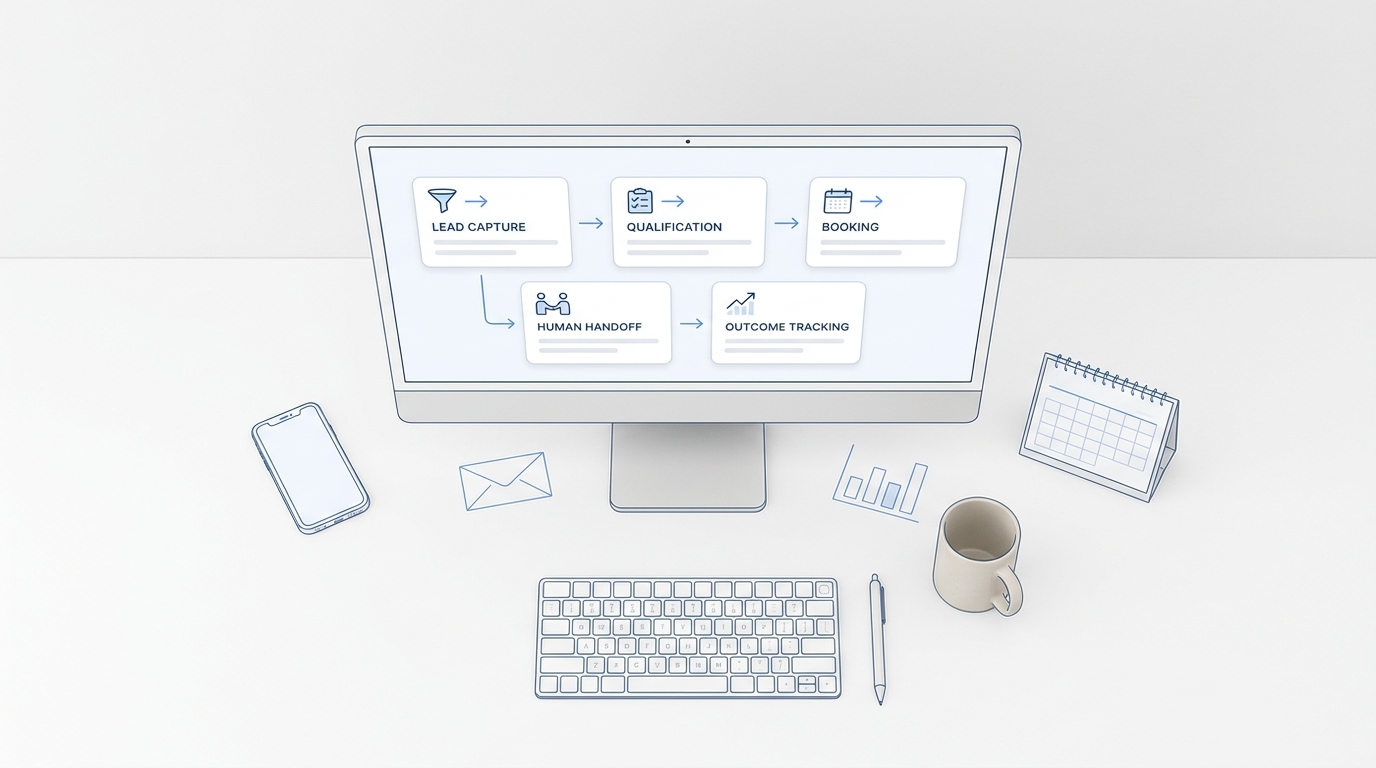
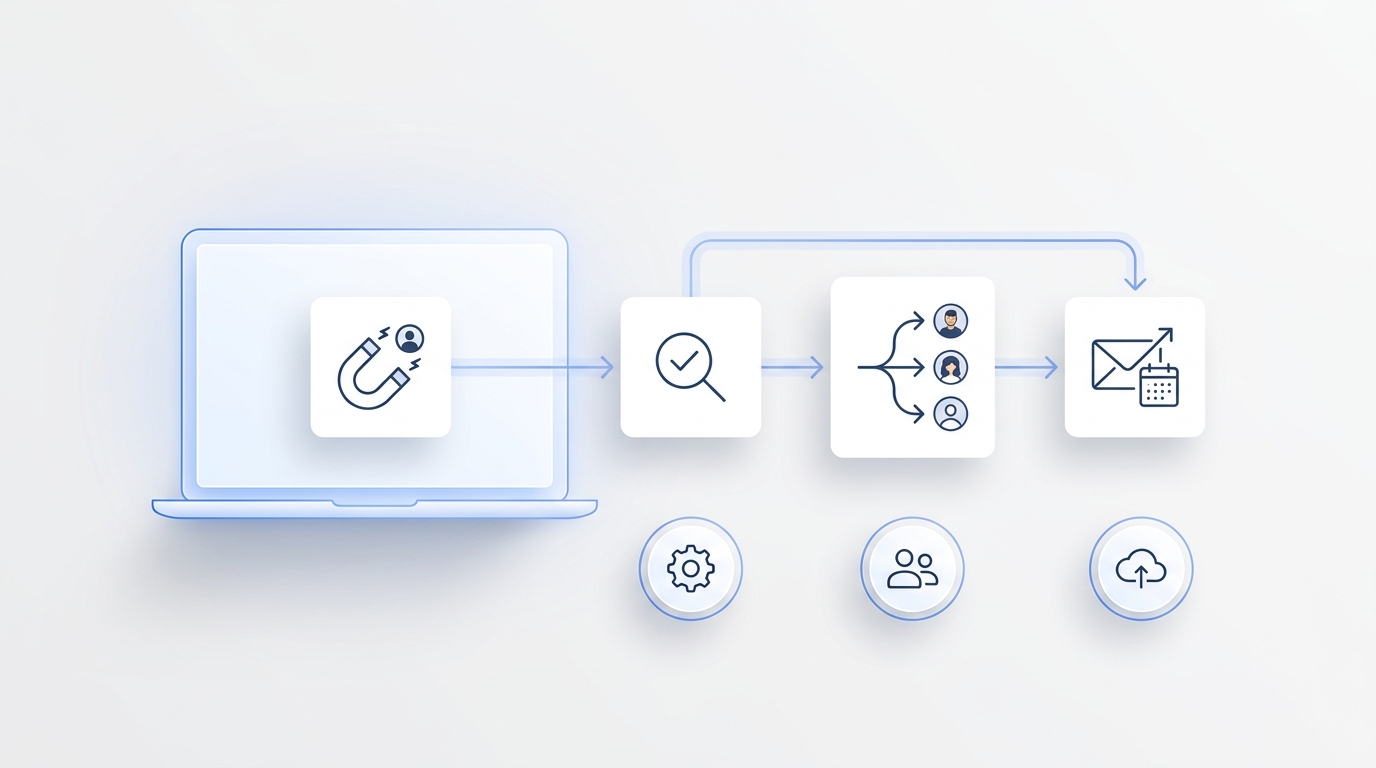
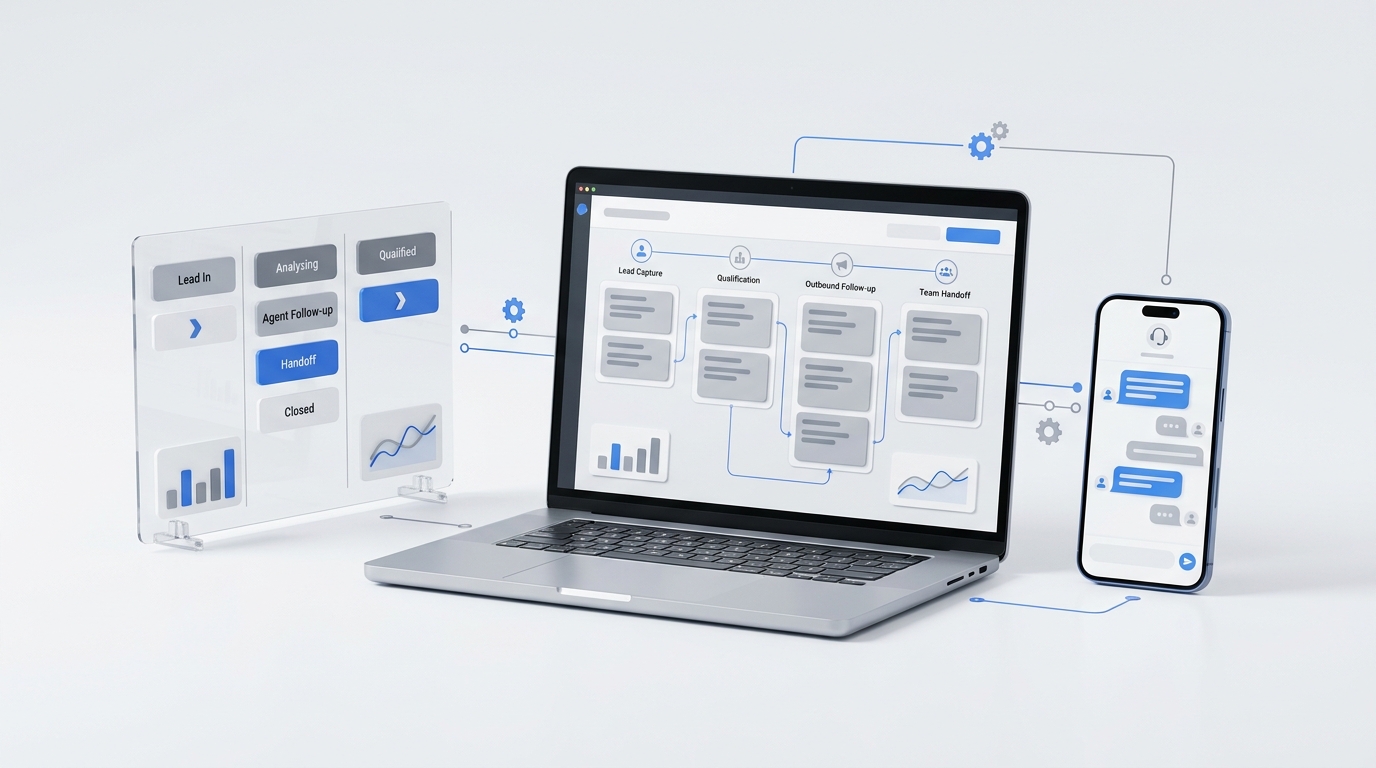
An AI growth agent is an AI system that helps move a growth workflow from trigger to next step. It does not just write copy or summarize a meeting. A useful AI growth agent watches for a business event, reads the right context, takes an approved action or recommendation, and leaves a record your team can review.
That definition matters because the phrase "AI growth agent" is still used loosely. Some teams use it for AI marketing agents. Some use it for sales-development automation, customer-service agents, CRM cleanup, campaign operations, or lead qualification. The practical question is not whether a tool calls itself an AI growth agent. The question is whether it can safely own one step in the growth system.
For a service business, that step might be:
- a missed call that needs to become a qualified callback;
- a booking request that needs routing;
- a chat or SMS thread that needs a clear next step;
- a stale lead that needs follow-up;
- a customer question that should become a support or sales task.
An AI growth agent matters when that handoff is slow, inconsistent, or close to revenue. It matters less when the workflow is vague, the data is messy, or the team only wants more AI-generated output.
Quick Answer: What Is an AI Growth Agent?
An AI growth agent is a bounded AI workflow that helps a business capture, qualify, route, follow up, or measure demand.
The word "agent" implies more than a chatbot. IBM describes agentic AI around systems that can pursue goals, use tools, and act with limited oversight. Google Cloud's marketing-agent guide describes agents as systems that can understand goals, make decisions, and handle complex workflows. In a growth context, that means the agent should connect a trigger to an outcome.
Use this simple test:
If the AI only creates an asset, it is probably a tool. If it watches a trigger, uses context, chooses a next step, and creates a record, it may be an AI growth agent.
That does not mean every AI growth agent should be fully autonomous. In most teams, the safest first version observes, recommends, or drafts. It earns permission to act only after the workflow, data, owner, handoff, and metric are clear.
AI Growth Agent vs. Automation vs. Assistant
The easiest way to understand an AI growth agent is to compare it with adjacent tools.
| Category | What it does | Example | Best fit |
|---|---|---|---|
| AI assistant | Responds to a user prompt | Draft a follow-up email from notes | Individual productivity |
| Automation | Runs fixed rules | If a form is submitted, create a CRM task | Stable repeatable steps |
| AI growth agent | Uses context to move a growth workflow | Qualify an inbound request, summarize it, route it, and log the next step | Workflows with judgment, handoff, and measurable outcomes |
An automation is usually better when the rule is simple and reliable. An assistant is usually better when a person is still doing the work and only needs help drafting or summarizing. An AI growth agent becomes useful when the step requires context, language understanding, prioritization, or a decision about what should happen next.
When an AI Growth Agent Matters
An AI growth agent matters when one of these conditions is true.
1. Demand Arrives Faster Than Your Team Responds
Growth is often lost before a campaign report notices it. A customer calls while the team is busy. A booking request lands after hours. A form submission waits until the next day. A quote request gets buried in email.
In those moments, the problem is not content volume. It is response delay.
A practical AI growth agent can:
- answer or acknowledge the inquiry;
- ask approved qualification questions;
- capture urgency, service need, contact details, and preferred next step;
- summarize the conversation;
- create a follow-up task or route the thread to the right owner.
This is where Solvea fits the AI growth agent category for service businesses. Solvea's public product pages position the product around a business phone, AI receptionist, PC Desk, shared inbox, summaries, transcripts, owners, statuses, Agent Builder, and integrations. For teams that lose growth through missed calls or scattered customer conversations, the first useful agent is often a customer-response agent.
2. The Workflow Has Judgment, Not Just a Rule
Simple rules do not always need agents. If every new form should create the same task in the same CRM, ordinary automation may be enough.
An AI growth agent matters when the next step depends on meaning:
- Is the person a new lead, existing customer, vendor, or spam caller?
- Is the request urgent?
- Does the request match the business's services?
- Is the person asking to book, reschedule, complain, compare options, or get pricing?
- Should the next step be a callback, appointment, quote, support ticket, or human escalation?
The agent does not need to be perfect. It does need boundaries. The team should decide what the AI may do alone, what it may draft, and what must go to a person.
3. The Handoff Is the Bottleneck
Many growth workflows fail between systems:
- call to inbox;
- chat to CRM;
- booking request to calendar;
- customer question to support owner;
- campaign reply to sales task;
- lead qualification to follow-up.
An AI growth agent matters when it makes that handoff cleaner. The deliverable is not just a message. It is a useful record: who contacted you, what they wanted, what happened, who owns it, and what should happen next.
For service SMBs, this is often more valuable than asking AI to "run marketing." A captured, routed, and followed-up customer conversation is closer to revenue than another generic campaign idea.
4. The Work Has a Measurable Outcome
Do not pilot an AI growth agent against a vague goal like "save time" or "use AI more." Pick one primary metric.
Useful metrics include:
- qualified conversations captured;
- booked appointments;
- missed calls recovered;
- response time;
- follow-up completion rate;
- lead-to-booking rate;
- CRM or inbox writeback completeness;
- escalation accuracy.
If the agent cannot improve or clarify one of those metrics, it may not matter yet.
5. A Human Can Review the Work
AI growth agents are easier to trust when the team can inspect what happened. Review is not a sign that the system failed. It is how the workflow gets better.
Before you let an AI growth agent act, make sure a person can see:
- the original trigger;
- the context the agent used;
- the message or action it produced;
- where the record was saved;
- when it escalated;
- what the outcome was.
Without that record, the agent becomes hard to improve and hard to roll back.
When an AI Growth Agent Does Not Matter Yet
An AI growth agent is not the right first move in every business.
| Situation | Why an agent may not help | Better first step |
|---|---|---|
| The workflow is not defined | The agent will automate confusion | Write the trigger, allowed action, handoff, and metric |
| The data source is unclear | The agent may use stale or conflicting context | Name the source of truth |
| The task is a fixed rule | AI adds cost and risk without much benefit | Use ordinary automation |
| The action is high-risk | A wrong action can hurt trust, compliance, or revenue | Keep the agent in draft or recommend mode |
| Nobody owns review | Mistakes become invisible | Assign an owner and weekly QA habit |
| The only goal is more content | More output does not prove growth | Tie the workflow to demand capture, follow-up, or conversion |
The point is not to avoid AI. The point is to avoid assigning an agent to a job the business has not defined.
The 10-Minute AI Growth Agent Workflow Test
Use this worksheet before buying or building an AI growth agent.
| Question | Good answer | Weak answer |
|---|---|---|
| What trigger starts the workflow? | "A missed call after business hours from a new number." | "When a lead appears." |
| What should the agent do? | "Answer, ask three intake questions, summarize, and create a callback task." | "Handle growth." |
| What context does it need? | "Business hours, services, locations, booking rules, escalation contacts, customer history." | "Whatever is in the CRM." |
| What can it do without approval? | "Capture details and create a task." | "Anything the customer asks." |
| When does it stop? | "Emergency request, unclear service fit, angry customer, pricing exception." | "When it is unsure." |
| Where is the record saved? | "Shared inbox thread with summary, transcript, owner, and status." | "In the AI tool." |
| What is the success metric? | "More qualified callbacks from missed calls." | "More automation." |
| Who reviews it? | "Operations manager checks samples every Friday." | "The vendor." |
| How do we roll it back? | "Pause AI answering and route calls to the old voicemail path." | "Ask support." |
If you cannot fill this table, do not buy a broad AI growth agent yet. Start by narrowing the workflow.
Common AI Growth Agent Workflows
Inbound Capture Agent
An inbound capture agent watches calls, forms, chat, SMS, or email. It captures intent, qualifies the request, and creates the next step.
This is a strong first workflow for service businesses because the demand already exists. The agent is not trying to manufacture attention. It is helping the team respond before the lead goes cold.
Related Solvea paths: AI receptionist, customer conversations in one place, and AI appointment setter.
Qualification Agent
A qualification agent asks structured questions and routes the result. It can help separate new leads, existing customers, support requests, urgent issues, service-fit questions, and booking requests.
The risk is over-scoring. Keep the first version simple. The goal is not perfect lead scoring. The goal is fewer unworked inquiries and cleaner follow-up.
Booking and Scheduling Agent
A booking agent helps move interest into a scheduled next step. It matters when requests arrive across calls, SMS, chat, email, or web forms.
The key boundary is confirmation. The agent must distinguish between "the customer requested Tuesday" and "the appointment is confirmed for Tuesday." That difference affects customer trust.
Follow-Up Agent
A follow-up agent sends or drafts reminders after missed calls, quote requests, no-shows, or incomplete booking flows.
This agent matters when follow-up is valuable but inconsistent. It should use approved message templates, respect opt-outs, and route exceptions to a person.
CRM or Inbox Cleanup Agent
This agent cleans records, adds summaries, tags threads, and updates statuses. It matters when growth teams lose time because every handoff starts with hunting for context.
Start with low-risk fields and human review. Do not let the agent merge records, overwrite source-of-truth fields, or change customer commitments until the rules are tested.
Reporting Agent
A reporting agent summarizes what changed and recommends the next action. It matters when the team has data but no regular decision rhythm.
The best reporting agent ends with a decision prompt: keep, pause, change, expand, or investigate.
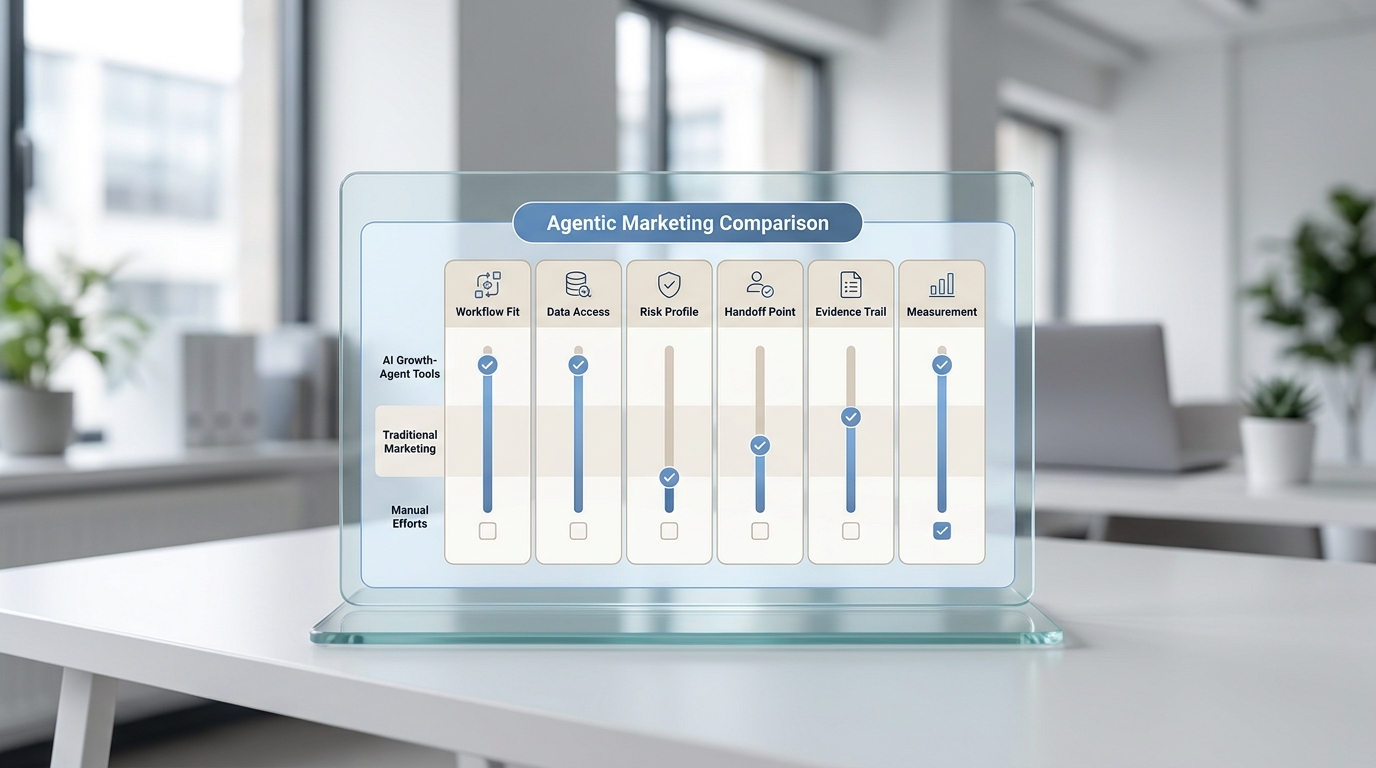
What to Look For in AI Growth Agent Tools
Use these checks during evaluation.
Workflow Fit
Ask the vendor to show your exact workflow, not a generic demo. For example:
When a missed call arrives after hours, the AI growth agent should answer, ask approved intake questions, summarize the caller's need, create a follow-up owner, and stop if the request is urgent or outside policy.
If the vendor cannot map the agent from trigger to outcome, the product may not fit the job.
Source of Truth
Ask which system owns customer identity, conversation history, booking status, lead status, and next step. If nobody can answer, keep the agent in recommend or draft mode.
Permission Levels
Separate the permissions:
- read;
- summarize;
- draft;
- tag;
- write;
- send;
- schedule;
- escalate.
Most teams should start with read, summarize, draft, tag, or escalate. Let the AI growth agent earn write, send, or schedule permission after the team has reviewed enough real cases.
Handoff Quality
The handoff should include the customer, request, urgency, context, summary, next step, owner, and record link. A handoff that says "follow up with this lead" is not enough.
Measurement
Ask for the pilot report before the pilot starts. It should show the primary metric, sample size, exceptions, human corrections, and outcome by workflow.
How Solvea Fits This Category
Solvea is not a general-purpose enterprise agent platform. It is most relevant when growth depends on customer conversations.
Based on the current public site, Solvea brings together:
- a business phone and mobile app;
- AI receptionist coverage for missed customer calls;
- call summaries, transcripts, notes, owners, and statuses;
- a PC Desk shared inbox for team follow-up;
- Agent Builder for configuring how the AI answers;
- integrations and knowledge-base context;
- live translation and SMS as part of the phone workflow.
That makes Solvea a practical AI growth agent option when the first growth problem is inbound demand capture, lead qualification, appointment booking, and follow-up.
If your bottleneck is enterprise campaign planning, ad-budget optimization, or broad CRM orchestration, you may need a different agent platform or a connected marketing suite. If your bottleneck is missed conversations turning into lost leads, start at the front door.
For broader strategy, read AI marketing agents strategy for growth teams. For funnel mapping, use GTM workflow automation by funnel stage. If you are already comparing sales tools, see sales automation agents evaluation framework and AI growth agents compared and alternatives.
A Practical 14-Day Pilot Plan
Keep the first AI growth agent pilot narrow.
Days 1-2: Pick the Workflow
Choose one trigger and one outcome.
Good examples:
- missed call to qualified callback;
- booking request to scheduled appointment draft;
- stale lead to follow-up task;
- chat inquiry to owner-routed summary.
Write the workflow in one sentence:
When [trigger] happens, the AI growth agent should [allowed action], unless [handoff condition] is true.
Days 3-5: Prepare the Context
Gather the facts the agent needs:
- business hours;
- services and exclusions;
- locations;
- booking rules;
- common questions;
- escalation contacts;
- tone guidelines;
- handoff owners;
- examples of good and bad outcomes.
Days 6-10: Run in Review Mode
Let the agent observe, recommend, or draft. Review every output.
Track:
- correct captures;
- missing information;
- unnecessary escalations;
- human edits;
- customer confusion;
- records saved in the right place.
Days 11-14: Decide Whether to Expand
Expand only if the pilot proves:
- the trigger is reliable;
- the source data is trustworthy;
- the handoff is useful;
- the owner can review the workflow;
- the primary metric improved or became easier to measure.
If those conditions are not true, revise the workflow before adding more channels or more autonomy.
Your AI Receptionist, Live in Minutes.
Scale your front desk with an AI that never sleeps. Solvea handles unlimited multi-channel inquiries, books appointments into your calendar automatically, and ensures zero missed opportunities around the clock.
FAQ
What is an AI growth agent?
An AI growth agent is a bounded AI workflow that helps capture, qualify, route, follow up, or measure demand. It matters when it moves a real growth event from trigger to next step with context, guardrails, and a reviewable record.
Is an AI growth agent the same as an AI marketing agent?
Not always. An AI marketing agent usually focuses on marketing workflows such as content, campaigns, personalization, insights, or measurement. An AI growth agent can include marketing, sales, service, booking, retention, and customer-response workflows as long as the work moves growth forward.
When should a small business use an AI growth agent?
A small business should consider an AI growth agent when it is losing leads or bookings because calls, messages, forms, or chats are not answered and routed quickly enough. The first pilot should be narrow and close to revenue.
What should an AI growth agent not do at first?
It should not own high-risk customer commitments, pricing exceptions, refunds, sensitive advice, or broad CRM writes before the team has tested the workflow. Start with observe, recommend, draft, summarize, route, or escalate.
How do you measure an AI growth agent?
Measure one primary workflow outcome, such as qualified conversations captured, booked appointments, response time, follow-up completion, or missed calls recovered. Pair it with a quality metric such as correction rate, escalation accuracy, or customer complaints.
Final Takeaway
An AI growth agent matters when it owns a clear, measurable growth workflow. It does not matter because the tool sounds autonomous. It matters when a real trigger becomes a useful next step: a call becomes a qualified callback, a message becomes a routed task, a booking request becomes a scheduled handoff, or a report becomes a decision.
If customer conversations are where growth leaks, start with that workflow first. With Solvea, you can give customers one business number, let AI answer when your team cannot, and follow up from a shared inbox with context.