When a customer calls an electrical company, the person answering should not try to diagnose a circuit, direct the caller to open a panel, or promise that a technician can make a specific repair before an inspection. The job is to capture what the caller can observe, identify immediate danger signals, route the request correctly, and make the next step clear.
That is what a practical electrician answering service script should do.
The strongest script is not one long speech. It is a structured workflow with a consistent opening, required intake fields, safety boundaries, routing rules, and separate branches for urgent calls, routine repairs, estimates, inspections, appointments, and existing-job questions.
This guide gives electrical contractors a copy-ready framework for business-hours, overflow, and after-hours calls.
What an electrician answering service script should accomplish
Every inbound call should end with an operational result. Before the conversation closes, your team should know:
- who is calling and the best callback number;
- where service is needed;
- whether the caller is an owner, tenant, property manager, or authorized business contact;
- what the caller can see, hear, or smell without investigating;
- whether anyone is in immediate danger;
- whether the issue affects the whole property or one area;
- whether the request is for repair, installation, inspection, estimate, or follow-up;
- the approved appointment or escalation path;
- who owns the next step and when the caller should expect it.
The script should help a receptionist classify and route the call. It should not turn the receptionist into a remote electrician.
This distinction matters after hours. Voicemail records a message. A structured answering workflow can create a complete service request, alert the approved on-call contact, offer an eligible appointment window, and preserve the conversation for follow-up. See after-hours lead capture for home services: AI vs voicemail for the broader workflow comparison.
Electrician call intake checklist
Use these fields as the minimum record for a new electrical service call.
| Intake field | What to capture | Why it matters |
|---|---|---|
| Caller name | First and last name | Identifies the customer and supports follow-up |
| Callback number | Best number, read back for confirmation | Prevents a lost job caused by a mistyped number |
| Service address | Street, unit, city, ZIP, access notes | Supports service-area checks and dispatch |
| Caller relationship | Owner, tenant, property manager, business contact | Clarifies authorization and coordination |
| Property type | Single-family, multifamily, retail, office, industrial, other | Helps route the request to the right team |
| Observed issue | What the caller sees, hears, smells, or has lost power to | Gives the electrician usable context without diagnosis |
| Immediate danger signals | Fire, smoke, active sparking, electric shock, downed line, water contacting electrical equipment | Triggers the approved emergency boundary |
| Scope | Whole property, several rooms, one room, one device, exterior, unknown | Helps classify the request |
| Timing | When it started and whether it is changing | Helps the dispatcher prioritize review |
| Access constraints | Gate, tenant notice, pets, parking, business hours | Prevents failed visits |
| Service history | Recent work, repeat issue, warranty or open job | Routes the call to the correct owner |
| Scheduling preference | Approved day and time windows | Enables booking when policy permits |
| Next action | Emergency instruction, on-call review, booked visit, estimate follow-up, office callback | Makes ownership explicit |
The receptionist should confirm the key details before ending the call: name, callback number, service address, appointment or response window, and the person or team responsible for the next step.
The safety boundary: observe, do not diagnose
Electrical calls require a firm boundary. The answering agent should record observations and follow the electrical contractor's approved emergency policy. The agent should not instruct a caller to touch electrical equipment, remove a panel cover, reset unfamiliar equipment, test conductors, approach a downed line, or continue using an area that appears unsafe.
If a caller reports fire, smoke, active sparking, electric shock, a downed power line, or another immediate threat, stop routine intake and use the company's approved emergency language. Public safety guidance from OSHA and Ready.gov reinforces the importance of avoiding electrical hazards and downed lines.
A conservative emergency statement is:
“For your safety, please move away from the affected area and do not touch the equipment or any nearby wire. If there is fire, an injury, a downed line, or immediate danger, contact emergency services or your electric utility now. I can record your contact details for the electrical team once you are in a safe place.”
The exact wording should be approved by the electrical contractor and aligned with local emergency procedures. The answering service should never imply that it has made the area safe.
A flexible script structure for electrical calls
Use one consistent opening, then move into the correct branch.
1. Opening and contact confirmation
“Thank you for calling [Company]. This is [Name or virtual receptionist]. I can help get the right next step started. May I have your name, the best callback number, and the service address?”
Read the phone number and address back to the caller. If the address is outside the service area, use the approved out-of-area close rather than continuing through a long intake.
2. Intent question
“Are you calling about an electrical issue happening now, a planned installation or estimate, an appointment, or work already in progress?”
This question separates the main workflows early and prevents irrelevant questions.
3. Observation question
“Please describe what you can observe without touching or opening any electrical equipment.”
Useful follow-ups include:
- “Do you see smoke, fire, active sparking, or a downed line?”
- “Has anyone received an electric shock or been injured?”
- “Do you smell a burning odor?”
- “Is water in contact with an outlet, panel, appliance connection, or other electrical equipment?”
- “Is power out across the property, in several areas, or at one outlet or fixture?”
- “When did you first notice the issue?”
- “Is the condition changing right now?”
The answers should be saved as caller observations, not converted into a diagnosis.
4. Routing statement
Use the branch approved for the observed situation:
- immediate safety instruction;
- urgent on-call review;
- priority appointment;
- routine booking;
- estimate or project consultation;
- administrative follow-up.
5. Confirmation and close
“I have [summary]. The next step is [owner and action]. You should expect [response or appointment window] by [phone or text]. Is the callback number ending in [digits] correct?”
Specific ownership is better than “someone will call you back.”
Copy-ready electrician answering service scripts
These templates are starting points. Replace brackets with your approved operating rules.
Script 1: Immediate danger report
“I am going to pause the normal service questions. Please move away from the affected area and do not touch the equipment, wire, or anything nearby. If there is fire, injury, a downed line, or immediate danger, contact emergency services or the electric utility now. Once you are in a safe location, may I confirm your name, callback number, and address so I can notify the electrical team according to policy?”
Record the exact words the caller used. Do not downgrade the report because the caller sounds calm.
Script 2: Partial or complete loss of power
“I can document this for the electrical team. Is the power loss affecting the whole property, several rooms, or one area? Do nearby properties appear affected? Do you see smoke, active sparking, a downed line, or any immediate danger? Please do not open the panel or touch electrical equipment for this call. I will route the details to [on-call review or scheduling path].”
Your policy may route a neighborhood-wide outage toward the utility while still recording the customer request. The receptionist should not make that determination without an approved rule.
Script 3: Outlet, switch, light, or breaker concern
“Please describe what you noticed without touching or opening anything. Is the concern limited to one outlet, switch, light, or area? When did it begin? Do you see smoke or active sparking, smell burning, or know of any water near the equipment? I will use those details to arrange the correct review.”
Do not tell the caller to repeatedly reset a breaker, remove a cover, or test an outlet unless a qualified person has created and approved a specific policy for that situation.
Script 4: Planned installation or estimate
“I can help start the estimate request. What would you like installed or upgraded? Is this for a home or business? Is there a preferred project timeline? Are you the property owner or authorized decision-maker? I will collect the project details and arrange [an estimate appointment or estimator callback].”
Useful categories include EV charger installation, lighting, panel upgrade, generator connection, remodel work, dedicated circuits, surge protection, and commercial improvements. Capture the request without promising feasibility or price.
Script 5: Inspection, code, or permit question
“I can route that to the right person. Is this related to a property sale, remodel, permit, inspection finding, insurance request, or another requirement? Which city or jurisdiction is the property in? Please share the exact wording from any notice if available. The electrical team will review it before confirming scope or next steps.”
Avoid interpreting code requirements on the call. Requirements can depend on the project and jurisdiction.
Script 6: Existing appointment or active job
“I can help update the service record. May I have the name, address, and appointment date or job number? Are you calling to confirm, reschedule, provide access details, request a status update, or report a new concern? I will route the update to [assigned technician, dispatcher, or office team].”
Keep administrative calls out of the urgent queue unless the caller reports a new safety concern.
Script 7: After-hours non-dangerous request
“I have recorded the issue and do not have an immediate danger report from you. The next approved option is [on-call review / earliest appointment / office callback]. You should expect [specific window]. I will send or repeat the confirmation now.”
Only state a response time that the company can consistently meet.
Script 8: Caller outside the service area
“Thank you for the details. This address is outside our current service area, so I do not want to promise a visit we cannot provide. If your situation involves immediate danger, please contact emergency services or the electric utility. For routine service, you will need a licensed electrical contractor serving [area].”
This protects the customer experience and keeps the dispatch queue accurate.
A simple electrical call priority matrix
The electrical contractor should approve the final matrix. A practical starting structure is:
| Priority | Caller observations | Next step |
|---|---|---|
| Immediate safety boundary | Fire, smoke, active sparking, shock or injury, downed line, immediate danger | Stop routine intake; use approved emergency language |
| Urgent on-call review | Burning odor without visible fire, worsening condition, significant power loss at a critical property, water reported near electrical equipment | Notify approved on-call owner; provide only the approved response window |
| Priority booking | Partial outage, repeated loss of power, important circuit unavailable, commercial disruption without immediate danger | Offer earliest eligible slot or dispatcher review |
| Routine booking | Outlet, switch, lighting, fan, inspection, maintenance, non-urgent repair | Book an approved appointment window |
| Estimate or project | Installation, upgrade, remodel, EV charger, generator, panel, commercial project | Route to estimator or book consultation |
| Administrative | Reschedule, invoice, warranty, permit document, job status | Route to office or assigned owner |
Consistency matters more than the labels. Two agents hearing the same observations should select the same path.
Common script mistakes that lose electrical jobs
Asking only, “Is this an emergency?”
Callers use the word “emergency” differently. Ask about observable danger signals instead.
Giving remote troubleshooting instructions
A call-intake workflow should not become a repair tutorial. Capture observations and route the call to a qualified person.
Promising an exact diagnosis or price
“It is probably the breaker” or “that should cost about…” creates expectations before inspection. Use the company's documented pricing rules or explain the estimate process.
Failing to distinguish a utility outage from contractor work
Capture the scope and nearby conditions, then follow a documented rule. Do not improvise responsibility while the caller waits.
Ending without a named owner and window
“We will get back to you” creates uncertainty. State who reviews the request, what happens next, and when the caller should expect contact.
Capturing a message but not the dispatch fields
A name and phone number are not enough. Address, property type, observations, access, authorization, and requested outcome turn the call into useful work.
How to implement the script in seven days
- Group your top call reasons. Review recent calls and separate safety reports, outages, repairs, installations, estimates, inspections, appointments, active jobs, and administrative questions.
- Define required fields. Decide what must be complete before a record reaches dispatch or scheduling.
- Approve safety language. Have operations leadership define when normal intake stops and which external emergency contact the caller should use.
- Build the priority matrix. Map caller observations to a queue, owner, and response target.
- Connect booking rules. Expose only appointment windows the receptionist is allowed to reserve.
- Test realistic calls. Include homeowners, tenants, property managers, business operators, stressed callers, incomplete addresses, and repeat customers.
- Audit outcomes weekly. Review missing fields, incorrect routing, callback time, booked-job rate, and calls that still fall into voicemail.
If your company also handles HVAC or plumbing, keep the same workflow architecture while changing the trade-specific questions. The HVAC answering service script and plumbing answering service script show how the shared framework adapts by trade.
Metrics that show whether the script works
Track outcomes, not just answer rate:
- percentage of calls with complete contact and service-address data;
- percentage of calls correctly assigned to safety, urgent, priority, routine, estimate, or administrative paths;
- qualified calls booked during the first conversation;
- after-hours requests converted to appointments;
- urgent requests acknowledged within the approved target;
- records returned to the receptionist because information is missing;
- reschedules and confirmations completed without another callback;
- booked-job rate by call reason;
- calls recovered through text after the caller disconnects;
- service requests with a documented final outcome.
A missed-call text-back workflow can provide a second recovery path for callers who hang up before completing intake. For financial measurement, use the framework in home services AI receptionist ROI.
Your AI Receptionist, Live in Minutes.
Scale your front desk with an AI that never sleeps. Solvea handles unlimited multi-channel inquiries, books appointments into your calendar automatically, and ensures zero missed opportunities around the clock.
Turn the script into a working electrical front desk
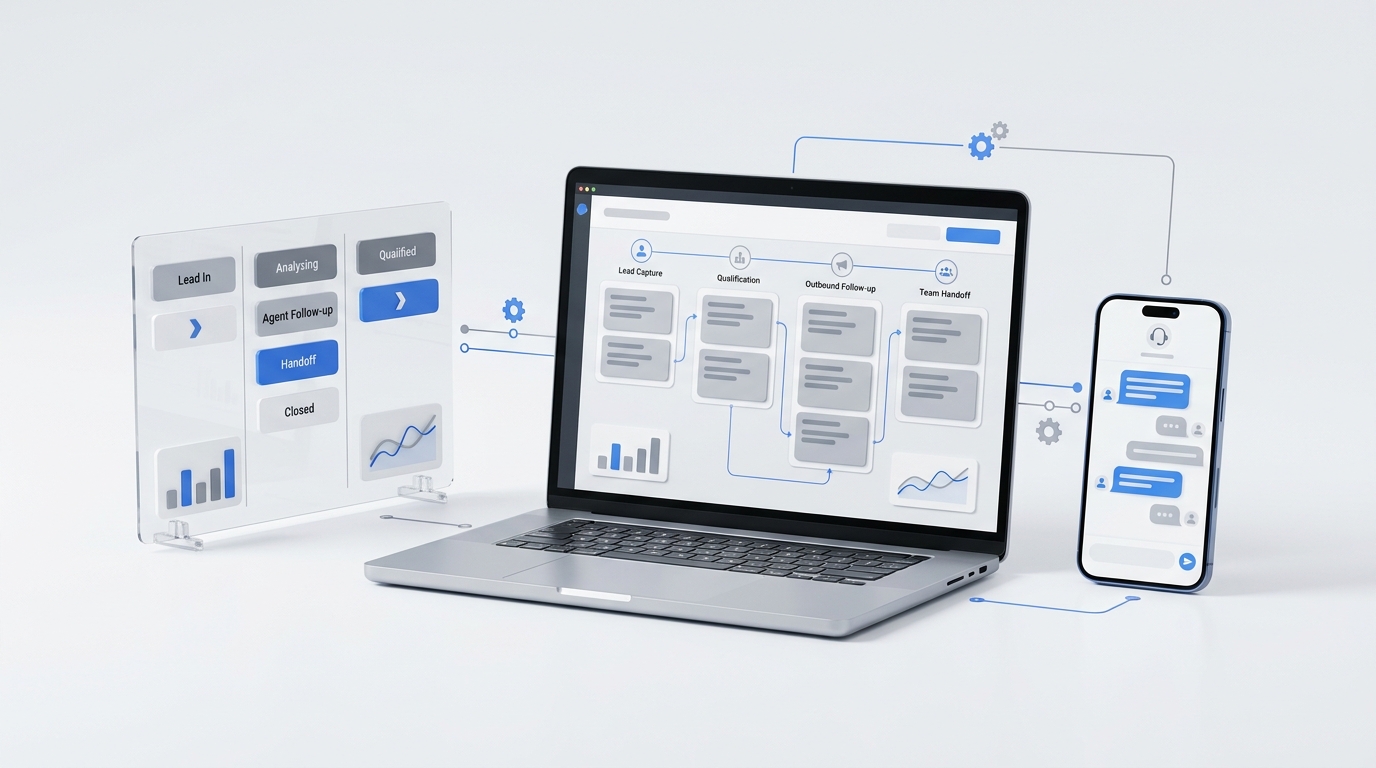
A script becomes valuable when it connects to phone answering, customer records, scheduling rules, confirmation messages, and clear human handoffs.
Solvea helps home-service teams answer customer calls, capture structured request details, maintain conversation records, support approved appointment workflows, and keep follow-up visible across mobile and desktop. Teams can connect tools such as Google Calendar as they build the process.
Explore Solvea for home services and use these templates as the starting point for your electrician call-intake workflow.