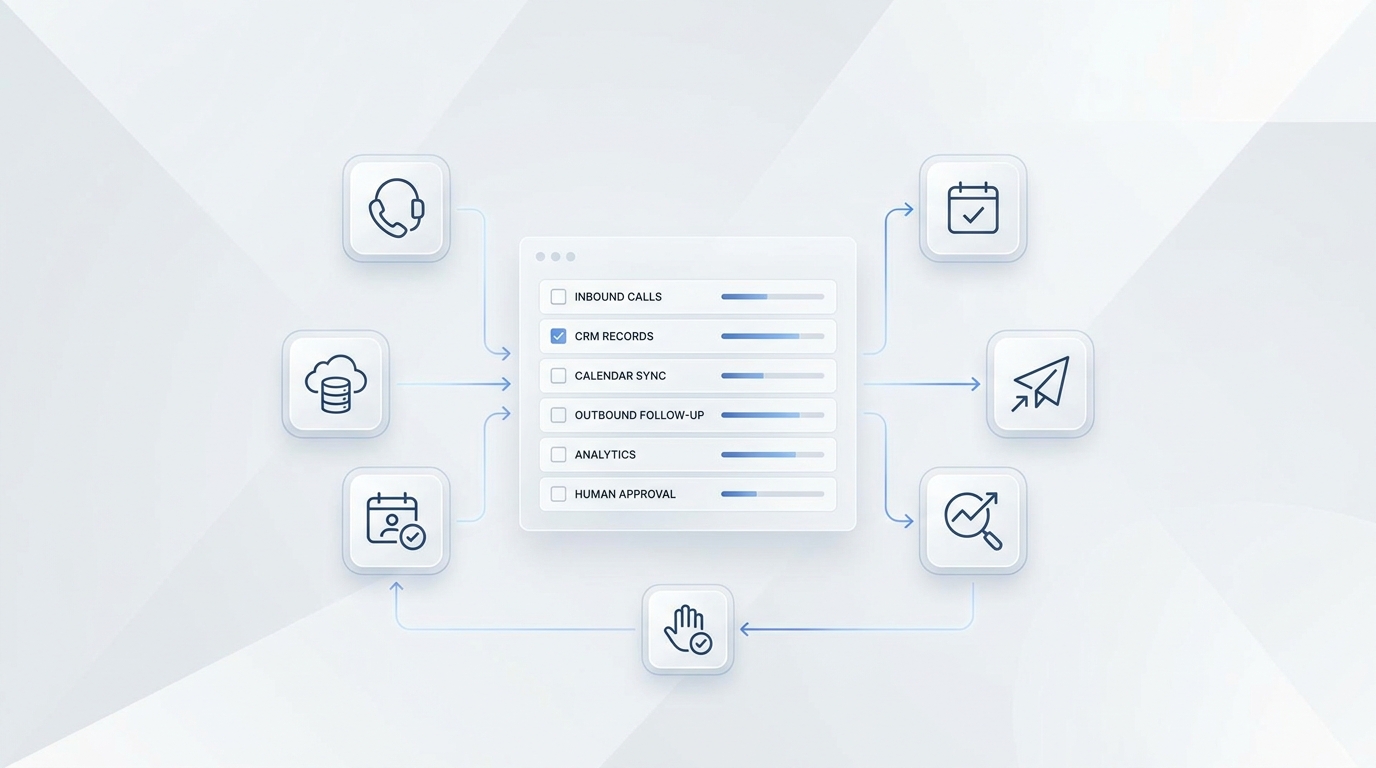
When a plumbing call comes in, the person answering does not need to diagnose the pipe, fixture, drain, or water heater. They need to control the conversation, capture the facts a dispatcher needs, identify immediate safety concerns, and give the caller a clear next step.
That is the job of a strong plumbing answering service script.
The best script is not a rigid paragraph that sounds the same on every call. It is a decision framework: one opening, a short set of required questions, approved priority rules, and separate branches for emergencies, estimates, appointments, maintenance, and existing-job follow-up.
This guide gives plumbing companies a practical call-intake checklist and copy-ready templates for business hours, after-hours coverage, and AI receptionist workflows.
What a plumbing answering service script should accomplish
Every inbound call should produce an operational outcome. By the end of the conversation, your team should know:
- who is calling and how to reach them;
- where service is needed;
- what the caller can observe;
- whether water is actively spreading or an immediate hazard is reported;
- whether the property has water service;
- whether the caller is authorized to approve work;
- the preferred appointment window;
- who owns the next step and when the caller should expect it.
The script should help the receptionist classify and route the call. It should not encourage the receptionist to promise a diagnosis, guarantee an arrival time, quote an unapproved price, or tell a caller to perform a risky repair.
This distinction matters even more after hours. A voicemail collects a message. A trained answering workflow creates a structured service request that can be dispatched, booked, or followed up. For a broader comparison, see after-hours lead capture for home services: AI vs voicemail.
Plumbing call intake checklist
Use the following fields as the minimum record for a new plumbing call.
| Intake field | What to capture | Why it matters |
|---|---|---|
| Caller name | First and last name | Identifies the contact and supports follow-up |
| Callback number | Best number, read back for confirmation | Prevents lost jobs caused by a mistyped number |
| Service address | Street, unit, city, ZIP, access notes | Supports territory checks and dispatch |
| Property type | House, apartment, commercial, rental, other | Helps route equipment and authorization questions |
| Caller role | Owner, tenant, property manager, staff member | Clarifies who can approve work |
| Observed issue | Caller’s own description | Gives the technician useful context without diagnosis |
| Start time | When the issue began or was noticed | Helps the dispatcher understand progression |
| Active water | Whether water is currently flowing or spreading | Supports priority classification |
| Affected area | Fixture, room, floor, drain, water heater, exterior line | Helps the team prepare |
| Water availability | Full service, partial service, or no water | Identifies high-impact calls |
| Safety concern | Electrical contact, ceiling damage, sewage exposure, slip risk, other | Triggers the company’s approved safety handoff |
| Previous work | Recent repair, recurring issue, warranty possibility | Routes existing-customer and callback cases correctly |
| Availability | Preferred day and time window | Supports booking |
| Next step | Booked, dispatcher callback, technician callback, estimate follow-up | Prevents vague endings |
Add any fields required by your service area, licensing model, membership program, warranty policy, or dispatch software. Keep required questions short enough that a stressed caller can answer them.
Universal opening script
Use one consistent opening for new calls:
“Thank you for calling [Company Name]. This is [Name]. I can help get the right information to our plumbing team. May I start with your name and the best callback number?”
Then confirm the service location:
“What is the full address where service is needed, including any unit number?”
Set the expectation before asking issue questions:
“I’ll ask a few quick questions about what you can see, then I’ll explain the next step. I won’t ask you to inspect or repair anything unsafe.”
That sentence does three useful things. It reduces caller anxiety, keeps the receptionist within an intake role, and signals that the call has a clear structure.
Script for an active leak or flooding report
“Please describe what you can see right now. Where is the water coming from, and is it actively flowing or spreading?”
“Is the water near an electrical panel, outlet, appliance, sagging ceiling, or another immediate hazard?”
“Is everyone able to stay away from the affected area safely?”
“Thank you. I’m marking this for priority review by our dispatcher. I cannot diagnose the source or promise an arrival time, but [dispatcher/technician] will contact you by [time or response window]. If you believe anyone is in immediate danger, contact emergency services.”
Your company may have approved instructions for a clearly identified main water shutoff. If so, use only the exact language approved by management, and only when the caller says it is safe to access. Do not improvise electrical, gas, structural, or repair instructions.
Script for a clogged drain or toilet
“Which fixture or drain is affected?”
“Is this the only affected fixture, or are multiple drains backing up?”
“Is wastewater overflowing or exposed inside the property?”
“When did you first notice the problem, and has it happened before?”
“I’ve recorded those details. The next step is [appointment booking/dispatcher review]. The available window is [window], and you will receive confirmation by [SMS/email/call].”
Avoid telling the caller to mix drain-cleaning products or disassemble plumbing. The receptionist’s job is to document what is happening and keep the area away from unnecessary contact until the plumbing team advises the caller.
Script for no water or low water pressure
“Is there no water throughout the property, or is the issue limited to one fixture or area?”
“Are nearby properties affected, if you happen to know?”
“Did the change happen suddenly or gradually?”
“Has any plumbing work recently been completed at the property?”
“Thank you. I’ll route this as [priority level] for [dispatcher review/booking]. You can expect [next action] by [time window].”
Do not state that the issue is definitely on the customer’s property. Municipal service interruptions, building systems, valves, frozen lines, fixtures, and other causes can produce similar caller descriptions. Capture observations and let the appropriate party determine the cause.
Script for a water heater call
“Are you calling about no hot water, inconsistent temperature, visible water, unusual noise, or another concern?”
“Can you tell whether the unit is electric, gas, or unknown without touching or opening anything?”
“Is water actively leaking or spreading around the unit?”
“Has the unit or surrounding area recently been serviced?”
“I’ve added those details for the technician. The next step is [booking/callback], and you should hear from us by [time window].”
If the caller reports a gas odor, fire, smoke, or another immediate danger, stop the normal intake flow and follow your company’s approved emergency policy. The answering agent should not troubleshoot the equipment.
Script for an estimate or installation request
“What would you like installed, replaced, or evaluated?”
“Is this for an existing property, a remodel, or new construction?”
“Is there a target date for the work?”
“Are you the property owner or the person authorized to approve the project?”
“The next step is [estimate visit/sales callback/photo request]. We have [window] available, or our estimator can call you by [time]. Which do you prefer?”
Do not turn an estimate call into an interrogation. Capture only the details needed to schedule the right visit or route the opportunity to the right estimator.
Script for maintenance and routine service
“Which plumbing system or fixture would you like serviced?”
“Are you experiencing a current problem, or is this preventive maintenance?”
“Is there a preferred day or time window?”
“I can offer [available window]. Would you like me to reserve that?”
“You are booked for [date/window] at [address]. We’ll send confirmation to [phone/email].”
Routine calls are where a connected calendar creates immediate value. Instead of ending with “someone will call you back,” the answering workflow can reserve an approved slot and send confirmation. Learn how the broader AI receptionist for home services workflow connects calls, qualification, and booking.
Script for an existing appointment or technician ETA call
“May I have the name, service address, and callback number on the appointment?”
“Are you calling to confirm, reschedule, cancel, or ask about the arrival window?”
“I can help with [approved action]. For technician location or arrival updates, I’ll send this to [dispatcher/team]. You can expect an update by [time window].”
Only share information that your system and policy allow. Do not invent an ETA because the schedule appears open or because a previous job was expected to finish.
After-hours plumbing answering script
The after-hours opening should state the coverage model without making every call sound like an emergency:
“Thank you for calling [Company Name]. Our office is currently closed, but I can collect the details, check for an approved appointment option, and route urgent requests to the on-call team.”
Then use this sequence:
- Capture name, callback number, and service address.
- Ask what the caller can observe.
- Ask whether water is actively spreading, water service is unavailable, wastewater is exposed, or an immediate hazard is reported.
- Apply the company’s priority matrix.
- Explain the next owner and response window.
- Send a confirmation message when available.
Example close for a routed urgent call:
“I have sent the request to the on-call team with the details you provided. They will review it and contact you by [window]. Please keep away from any unsafe area. If conditions change or anyone is in immediate danger, contact emergency services.”
Example close for a non-urgent call:
“I have your request ready for the office team. The next available appointment is [window], or the team can call you after [opening time]. Which option would you prefer?”
A simple plumbing call priority matrix
Your service manager should approve the final matrix. A starting structure looks like this:
| Priority | Caller observations | Next step |
|---|---|---|
| Immediate safety handoff | Fire, smoke, gas odor, electrical contact, structural concern, person at risk | Stop routine intake; follow approved emergency policy |
| Urgent dispatch review | Active water spreading, major loss of water service, exposed sewage, rapidly worsening condition | Notify on-call dispatcher; provide response window |
| Priority booking | Important fixture unavailable, recurring backup, contained leak, commercial disruption | Offer earliest approved slot or dispatcher review |
| Routine booking | Slow drain, fixture repair, maintenance, replacement estimate | Book an approved appointment window |
| Administrative | Invoice, warranty question, reschedule, job follow-up | Route to office or assigned owner |
The labels matter less than consistency. Two receptionists hearing the same facts should choose the same workflow.
Common script mistakes that cost plumbing jobs
Asking “Is this an emergency?”
Callers define emergencies differently. Ask observable questions instead: Is water actively spreading? Is wastewater exposed? Is the property without water? Is there an immediate safety concern?
Ending with “someone will call you back”
Name the owner and window: “The on-call dispatcher will review this and contact you within 20 minutes,” or “The office team opens at 8:00 a.m. and will call by 8:30 a.m.” Use only windows your operation can meet.
Diagnosing from the call
“It sounds like your sewer line” can create false certainty. Record the symptoms and route them to a qualified technician.
Quoting prices without an approved rule
If your company has a documented dispatch fee or flat-rate service, the script can state it exactly. Otherwise, explain the estimate process rather than inventing a number.
Collecting details without confirming them
Read back the phone number, address, appointment window, and next step. A 20-second confirmation can prevent a failed dispatch.
How to implement the script in seven days
- List your top call reasons. Review recent calls and group them into leak, drain, toilet, water heater, no-water, estimate, maintenance, appointment, and administrative categories.
- Define required fields. Decide what every service record must contain before it reaches dispatch.
- Approve safety language. Have operations leadership define when routine intake stops and what the answering agent says next.
- Build the priority matrix. Assign each observation pattern to a routing path, owner, and response target.
- Connect booking rules. Expose only appointment windows that the answering workflow is allowed to reserve.
- Test realistic calls. Include stressed callers, tenants, property managers, repeat customers, and incomplete information.
- Review outcomes weekly. Compare booked calls, abandoned calls, incorrect priorities, missing fields, and callback times.
Metrics to track
A plumbing answering service should improve more than answer rate. Track:
- percentage of calls answered;
- percentage of new leads with complete contact and address data;
- qualified calls booked during the first conversation;
- after-hours calls converted to appointments;
- urgent calls acknowledged within the target window;
- calls requiring staff to recollect missing information;
- reschedules and cancellations completed without a callback;
- booked-job rate by call reason;
- recovered revenue from calls that previously reached voicemail.
For a practical measurement model, see home services AI receptionist ROI.
Your AI Receptionist, Live in Minutes.
Scale your front desk with an AI that never sleeps. Solvea handles unlimited multi-channel inquiries, books appointments into your calendar automatically, and ensures zero missed opportunities around the clock.
Turn the script into a working front desk
A document is only the beginning. The script becomes useful when it is connected to call answering, customer context, scheduling rules, confirmation messages, and clear human handoffs.
Solvea helps home-service businesses answer customer calls 24/7, capture structured job details, route urgent requests, and book approved appointment windows from one AI receptionist workflow. Teams can start without a credit card and connect tools such as Google Calendar as they build the process.
Explore Solvea for home services and use the templates above as the foundation for your plumbing intake workflow.