AI Receptionist for Small Business ROI: From Missed Calls to Booked Revenue
If you are evaluating an ai receptionist for small business, the real buying question is not whether the software sounds impressive. It is whether the system can recover enough missed demand, captured bookings, and staff time to pay for itself quickly.
That is where many category pages fall short. They talk about automation in broad terms, but they do not help an owner-operator model the payoff. The better way to evaluate an ai receptionist for small business is to start with the leaks you already have today: unanswered calls, after-hours inquiries that go cold, appointment requests that never become confirmed bookings, and staff time lost repeating the same information over and over.
Once you frame the decision that way, ROI gets much easier to understand. You do not need a perfect estimate. You need a simple model that shows whether better response coverage and cleaner booking capture can create more booked revenue than the system costs.
Why ROI is the real decision point for an AI receptionist for small business
Most small businesses do not buy an ai receptionist for small business because they want another software dashboard. They buy because the front desk, phone line, or lead inbox is leaking money:
- calls reach voicemail during busy hours
- after-hours demand arrives when nobody is available
- staff lose time answering the same intake questions
- booking requests stall between first contact and confirmed appointment
- conversation context gets lost when a customer switches from phone to text or email
Those are measurable operational problems. If the system helps cover them, the value usually appears in one or more of three places:
- Recovered revenue from leads that would have been missed or delayed.
- More booked appointments from faster and more consistent follow-up.
- Labor savings from taking repetitive front-desk work off the team.
That is a much better evaluation lens than generic claims about being available twenty-four seven.
Start with the leak that costs the most, not the feature list
The fastest way to justify an ai receptionist for small business is to begin with the workflow where delay already costs you money. For many service businesses, that means missed calls first. For appointment-heavy teams, it may be booking friction. For teams buried in repetitive questions, it may be FAQ handling across channels.
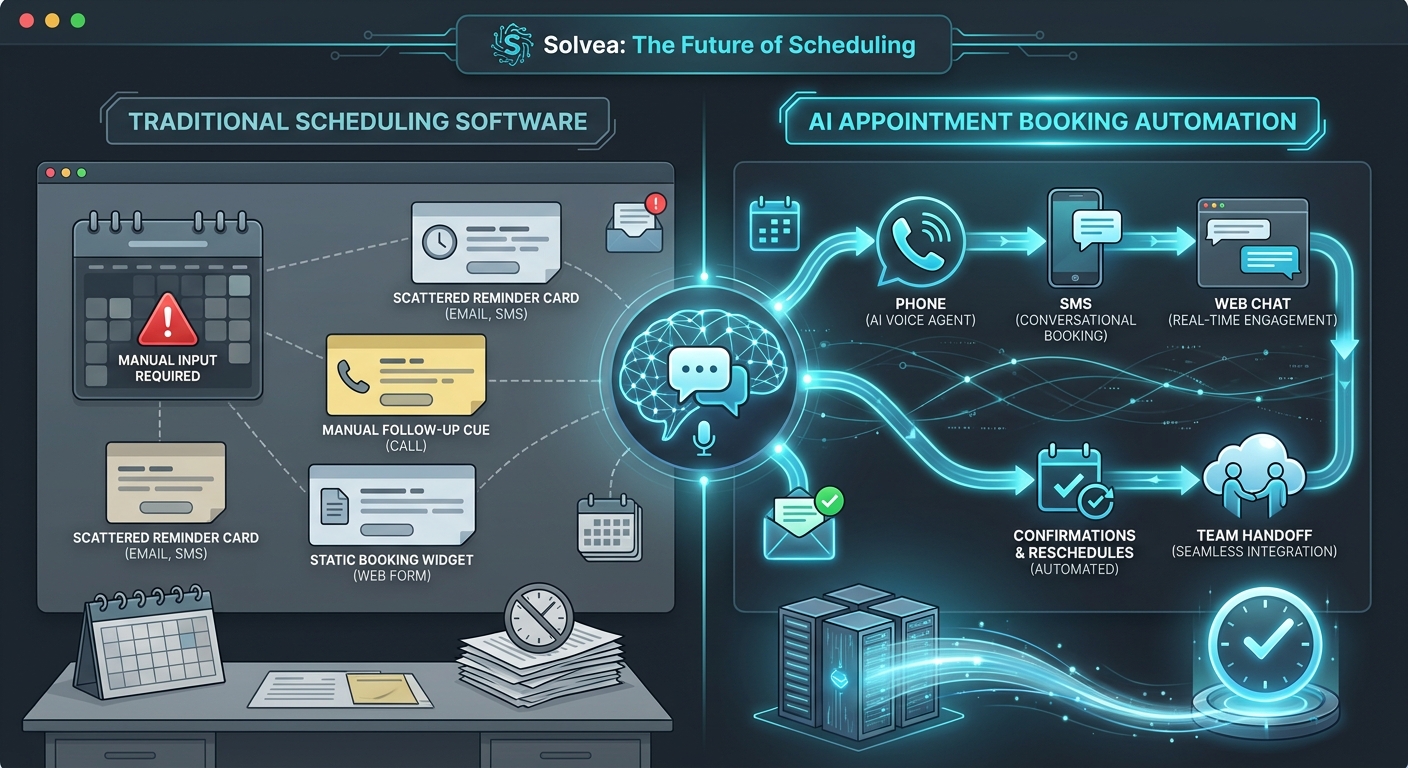
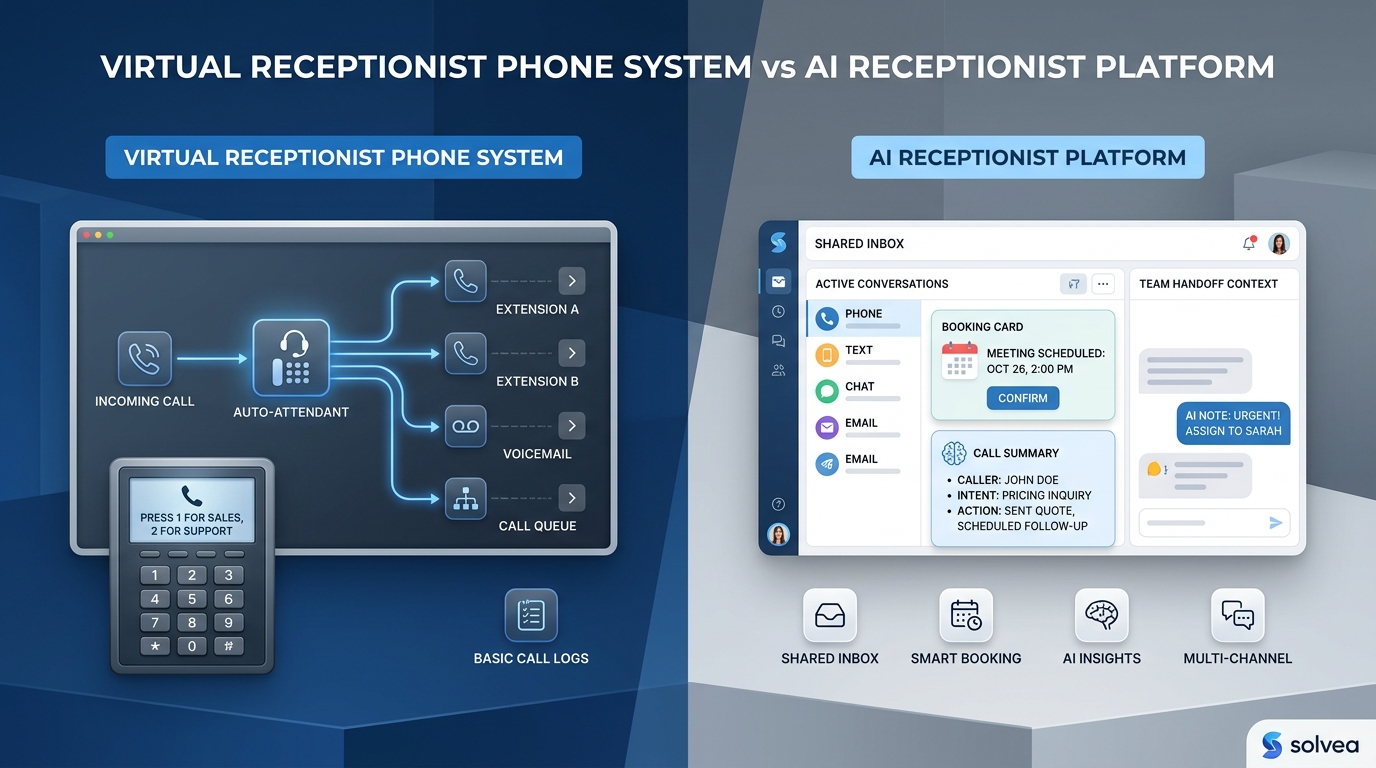
This is also where the difference between an ai answering service and a broader system becomes important. A basic ai answering service can answer and capture messages. A stronger system can help connect voice, SMS, email, WhatsApp, live chat, booking logic, and a shared inbox so follow-up does not break when the conversation moves channels.
Solvea's approved product positioning is useful here because it covers the exact operator concern behind ROI: one system can handle inbound conversations across phone, SMS, email, WhatsApp, LINE, and live chat, while keeping those interactions visible in one inbox. That matters because response coverage alone is not enough if the team still loses context after the first touch.
The simplest ROI model for an AI receptionist for small business
You can estimate ai receptionist for small business ROI with a short worksheet. Start with one week or one month of real operating numbers, then work through the following table.
| Input | What to measure | Why it matters |
|---|---|---|
| Missed inbound calls | Calls that hit voicemail, ring out, or wait too long | Shows demand currently leaking before staff can respond |
| After-hours inquiries | Calls or messages outside staffed hours | Indicates how much demand arrives when coverage is weakest |
| Booking value | Average revenue from a booked appointment, consult, or estimate | Converts recovered demand into potential revenue |
| Lead-to-booking rate | Share of qualified inquiries that become booked appointments | Keeps the model grounded in your actual funnel |
| Staff time on repetitive inquiries | Hours spent answering routine questions and collecting intake details | Captures the labor side of ROI |
| Current handoff gaps | How often customers have to repeat themselves or wait for follow-up | Shows where a virtual receptionist system may outperform phone-only tools |
Then calculate three payoff buckets:
1. Recovered missed-call revenue
If even a portion of missed calls become answered conversations, some of those conversations become booked revenue. The formula is simple:
missed calls recovered x qualified lead rate x booking rate x average booking value
This matters because the first gain from an ai receptionist for small business often comes before you optimize anything else. You are simply stopping obvious leakage.
2. After-hours booking capture
An after hours call answering service style deployment is often the cleanest first wedge because it covers the hours where the business is least available and the customer is most likely to move on if no one responds.
If your business gets evening or weekend demand, model:
after-hours inquiries captured x booking rate x average booking value
This is especially useful for medspas, home services, legal consults, real estate, and other businesses where a delayed response can send the prospect to the next option.
3. Labor time saved
Now add the time your staff spends on repetitive front-desk work:
- repeating hours, service area, and policy answers
- collecting the same intake details
- confirming simple booking steps
- summarizing calls manually for follow-up
The labor formula is:
hours saved x loaded hourly cost
This number alone may not justify the purchase. But combined with recovered bookings, it gives a more accurate view of the total return.
A practical ROI worksheet example
You do not need industry benchmarks to make this useful. Use your own numbers. Here is the structure:
| Scenario | Example question |
|---|---|
| Missed calls | How many inbound calls do we fail to answer in a typical week? |
| Qualified demand | Of those missed calls, how many are likely real customers rather than spam or wrong numbers? |
| Booking conversion | When we do connect with a qualified lead, how often does it become a booked appointment or next step? |
| Booking value | What is the average revenue per booked appointment, consult, or estimate? |
| After-hours demand | How many opportunities arrive when the team is unavailable? |
| Front-desk time | How many staff hours go to repetitive questions and intake work each week? |
If the answer to those questions already suggests lost revenue, the ROI case for an ai receptionist for small business is usually much stronger than a feature checklist alone would show.
Where ROI usually appears first
For most owner-operators, the fastest payoff does not come from fully replacing the front desk. It comes from tightening one high-leak workflow first.
Missed-call recovery
This is often the easiest first win. If staff are busy with customers, in the field, or unavailable after hours, every missed call is a chance for demand to disappear before anyone even sees it.
An ai receptionist for small business creates value here by answering immediately, capturing intent, and routing or summarizing the next step clearly. If your current fallback is voicemail, that improvement alone can be meaningful.
Booking capture
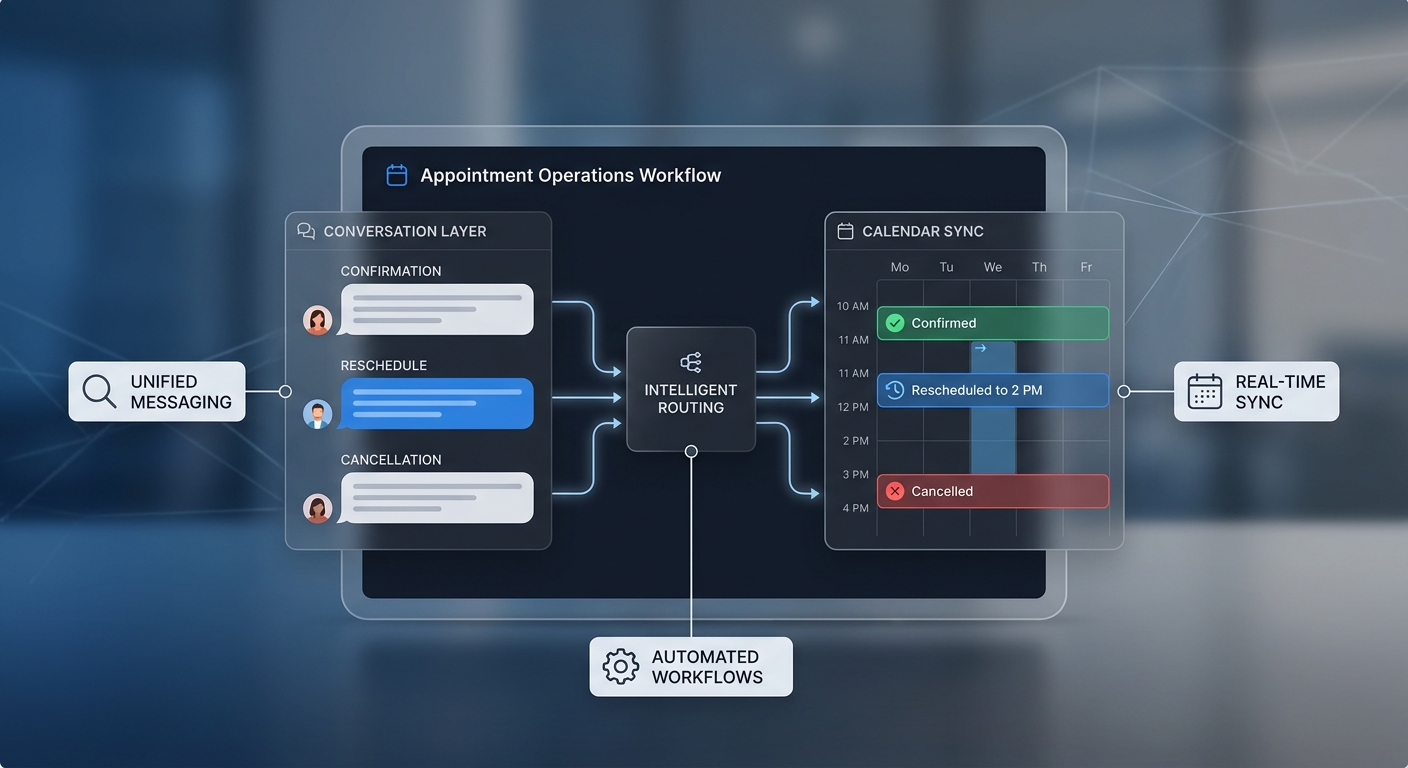
Appointment-driven teams often see ROI next in the calendar flow. If inquiries come in but booking details are slow, inconsistent, or dependent on one person being available, the business loses momentum.
This is where an AI appointment setter style workflow can matter more than a generic ai answering service. The point is not only to answer. It is to move the customer from interest to a confirmed next step.
Your AI Receptionist, Live in Minutes.
Scale your front desk with an AI that never sleeps. Solvea handles unlimited multi-channel inquiries, books appointments into your calendar automatically, and ensures zero missed opportunities around the clock.
Repetitive FAQ load
Some teams are not losing money because calls are unanswered. They are losing productivity because staff spend hours repeating the same information. In that case, the ROI is partly revenue protection and partly labor recovery.
Follow-up continuity
When the first reply is fine but the customer journey breaks later, a stronger virtual receptionist system can outperform phone-only tools. The business benefits when the team can see one conversation history instead of piecing together notes from separate channels.
Common ROI objections and how to pressure-test them
Small business owners usually hesitate for sensible reasons. The strongest objections are not anti-AI. They are operational.
"We do not get enough call volume to justify it"
That may be true for some businesses. But if a small number of missed calls carries high booking value, the ROI can still work. Model revenue impact, not only call count.
"Our staff already handles this"
Maybe during normal hours. The question is whether they handle it consistently during busy periods, lunch breaks, evenings, weekends, and channel switches.
"I only need an answering service, not a full system"
That may be the right first step. If your main leak is first-response coverage, an ai answering service style rollout can be enough to validate the category. If the business also needs booking logic, FAQ consistency, and shared follow-up visibility, a broader platform may be worth more.
"I do not want the customer experience to feel robotic"
That is a real concern. It is also why the first rollout should focus on high-frequency, clearly defined workflows instead of edge cases or sensitive conversations. Start narrow, monitor quality, and keep uncertain cases human.
What makes the ROI case stronger for Solvea
The safest first-party proof points for Solvea are operational, not speculative:
- multi-channel coverage across phone, SMS, email, WhatsApp, LINE, and live chat
- one inbox for customer conversations across channels
- no-code setup designed to go live quickly
- knowledge-base support so the AI has approved answers
- workflow fit for lead capture, appointment booking, and customer support use cases
Solvea's internal proof set also includes examples such as a medspa deployment reporting a full call-answering outcome and a booking lift, which supports the broader point that response coverage and booking continuity can create measurable upside when the workflow is a good fit.
The key point is not that every business will get the same result. It is that the value comes from recoverable operational leaks, not vague efficiency language.
When an AI answering service is enough and when you need more
Use a narrower ai answering service wedge if your main problem is simple:
- you miss calls during busy or closed hours
- you need immediate first response
- you mainly want message capture and clearer handoff
Move toward a broader virtual receptionist system when:
- customers switch between phone, text, email, and chat
- appointment logic matters
- the team needs one shared view of the conversation
- follow-up quality affects booked revenue
That distinction is what keeps the ROI model honest. You should buy the smallest solution that closes the leak. But if the leak spans multiple channels and handoffs, phone-only coverage may solve too little.
How to decide whether to run a trial
An ai receptionist for small business trial is worth running when all three statements are true:
- You can identify a real response or booking leak today.
- You can estimate the value of fixing that leak.
- You can start with one workflow that is clear enough to measure.
In practice, that often means beginning with missed calls or after-hours booking capture. If the business sees faster response, more captured intent, and less front-desk drag, the next rollout decision becomes much easier.
Final takeaway
The best ROI case for an ai receptionist for small business does not begin with a product demo. It begins with the revenue and labor leaks you already know exist. Count the missed calls. Estimate the booking value. Look at after-hours demand. Measure repetitive front-desk work. Then decide whether better coverage and cleaner follow-up can recover enough value to justify the system.
That is the practical path from missed calls to booked revenue. Model your ROI with Solvea.
FAQ
How do I calculate AI receptionist for small business ROI?
Start with missed-call recovery, after-hours inquiry capture, and staff time saved. Estimate how many opportunities currently leak, what share would likely become qualified conversations, how many of those convert into bookings, and what those bookings are worth.
Is an AI answering service enough for a small business?
It can be enough if the main problem is first-response coverage. If the business also needs booking logic, FAQ consistency, and cross-channel follow-up visibility, a broader system may create more value.
Why is after-hours coverage important for ROI?
After-hours demand is often high intent and poorly covered. If a business currently relies on voicemail or delayed callbacks, an after hours call answering service style rollout can recover opportunities that would otherwise go cold.
When does a virtual receptionist system outperform a phone-only tool?
It usually wins when customer conversations move across phone, text, email, or chat and the team needs one shared view of the relationship rather than separate message silos.