You're in the middle of a job. The phone rings. You're knee-deep in work, the caller gets voicemail, and they hang up without leaving a message. It feels like a minor inconvenience. It happens a dozen times a week. Most small business owners never add it up.
The cost of missing calls for small business isn't one large number on a bad quarter — it's a steady leak. New leads who don't call back. Existing clients who quietly start researching alternatives. Reviews that mention "I called and never heard back." Each one is small. Together, they're among the most expensive operational gaps a small business can have.
This article breaks down what that gap actually costs, which businesses feel it most, and what works to close it.
TL;DR
The core problem | Most small businesses miss a significant share of inbound calls — especially after hours and during peak times |
Why callers don't call back | Research shows leads contacted within the first hour convert at 7x the rate of those reached later; cold leads rarely re-engage |
Hidden costs beyond the lost sale | Wasted ad spend, empty appointment slots, negative reviews, and competitor advantage all compound the damage |
Which industries are hit hardest | Home services, medical/dental, legal, salons — anywhere the phone is the primary booking channel |
What actually fixes it | Call forwarding, answering services, and AI-powered call handling — each with different cost profiles |
How Many Calls Do Small Businesses Actually Miss?
The pattern is consistent across service industries: a significant portion of inbound calls reach voicemail or go unanswered, not because owners don't care, but because small teams can't be everywhere at once. The same person answering a customer's questions at the counter can't simultaneously pick up the phone.
After hours, the problem becomes near-universal. A caller reaching out to a plumber at 6 PM, a medspa on a Saturday morning, or a law office during lunch has effectively no chance of speaking to a live person. They leave a message — or more commonly, they don't, and they move to the next result on Google.
The challenge is structural: for most small businesses, there's no system in place to catch overflow calls. The phone is either answered or it isn't.
What Does a Missed Call Actually Cost a Small Business?
Lost Revenue from New Leads
The most expensive calls to miss are from people who haven't hired you yet. A first-time caller is typically at or near a decision point — they've already done their research, chosen to reach out, and they're ready to book or buy. When they hit voicemail, that momentum stops.
Research published in Harvard Business Review found that companies contacting inbound leads within the first hour are nearly 7x more likely to qualify those leads than companies that wait even one hour longer — and after the first few hours, conversion odds drop sharply.[1] The implication for a business where calls go unreturned for hours or days is significant.
For a business where the average new customer generates $400–$800 in first-year revenue, missing 8–10 new lead calls per month represents $3,000–$8,000 in potential monthly revenue that simply never entered the pipeline.
Customer Churn from Existing Clients
Existing customers who can't reach you don't always escalate or complain — they just quietly start exploring alternatives. According to Salesforce's 2024 State of Service report, 88% of customers say good service makes them more likely to purchase again — and the inverse is equally true. Consistent inaccessibility erodes the trust that repeat business depends on.
The first missed contact often goes unmentioned. By the third or fourth, they've already booked elsewhere.
Reputation Damage That Outlasts the Missed Call
Callers who feel ignored frequently say so in public. BrightLocal's 2024 Local Consumer Review Survey found that 98% of consumers used the internet to find information about local businesses — and reviews are a primary input in that research. Phrases like "I called multiple times and never heard back" appear frequently in one-star reviews for service businesses across every industry.
The reputational cost extends beyond one unhappy customer. A review citing poor phone responsiveness shapes the decision of every future caller who reads it before ever picking up the phone.
The Compounding Effect: When One Missed Call Turns Into Many Problems
The lost sale is just the entry point. Here's what happens simultaneously:
- Ad spend is wasted — if you spent $600 on Google Ads to generate 30 inbound calls and 18 went unanswered, your effective cost-per-acquired-customer didn't just increase — it doubled
- Appointment slots go empty — every unanswered booking call is overhead with no revenue attached to it
- Staff time is consumed by callbacks — chasing cold leads costs more than answering warm calls would have
- Competitors build compounding advantage — the caller who couldn't reach you is now a loyal customer of someone else, and they'll refer others
This is why the cost of missing calls is almost always larger than owners estimate at first. The visible loss is the sale. The invisible loss is everything that never started.
Which Small Businesses Are Hit Hardest?
Not every business feels this equally. The table below shows where missed calls cause the most damage — and who specifically bears the highest risk.
Industry | Why Calls Are the Primary Booking Channel | Risk Level | Who It's Worst For |
Home Services (HVAC, plumbing, electrical) | Customers call in urgent need and hire whoever answers first | Very High | Solo operators and small crews |
Medical & Dental | Patients have low tolerance for inaccessibility; they book the next available practice | Very High | Independent practices without dedicated front desk coverage |
Legal Services | High-value clients expect fast response; one missed call can mean a lost retainer | High | Solo attorneys and small firms |
Salons & Spas | Booking windows are narrow; missed calls mean empty chairs with fixed overhead | High | Owner-operated locations |
Restaurants | Reservation and catering inquiries are time-sensitive; competitors are one call away | Medium–High | Independents without online booking |
Local Retail | Product and availability questions go unresolved; callers buy online instead | Medium | Boutiques and specialty stores |
Note: The higher your average customer lifetime value, the more each missed call costs. A medspa that misses a single consultation call may lose a client worth $3,000+ per year in recurring services.
How Small Businesses Are Solving the Missed Call Problem
This is one of the most solvable operational problems a small business has. The options range from free to a few hundred dollars a month — and the math is rarely close.
1. Call Forwarding and Ring Groups
Route overflow calls to a mobile number or a second team member before they reach voicemail. Most phone systems support this natively at no additional cost. It takes minutes to configure and immediately recovers calls that would otherwise go unanswered during busy periods.
2. Professional Answering Services
Third-party services answer on your behalf, qualify the caller, and pass bookings or detailed messages back to you. Typical cost: $150–$400/month. For most service businesses, a single recovered booking per month covers the expense.
3. Voicemail-to-Text with Rapid Callback
When calls must go to voicemail, transcription services that deliver message text via SMS allow callbacks in minutes rather than hours. Speed of response is the decisive factor in lead conversion — closing the gap between "voicemail received" and "call returned" directly improves recovery rates.
4. AI-Powered Call Handling
AI receptionists answer every call around the clock, understand caller intent, book appointments, answer FAQs from your knowledge base, and route complex requests to a human — without hold music or callback queues. For after-hours coverage especially, this is the most cost-effective option for small businesses that receive consistent call volume outside business hours.
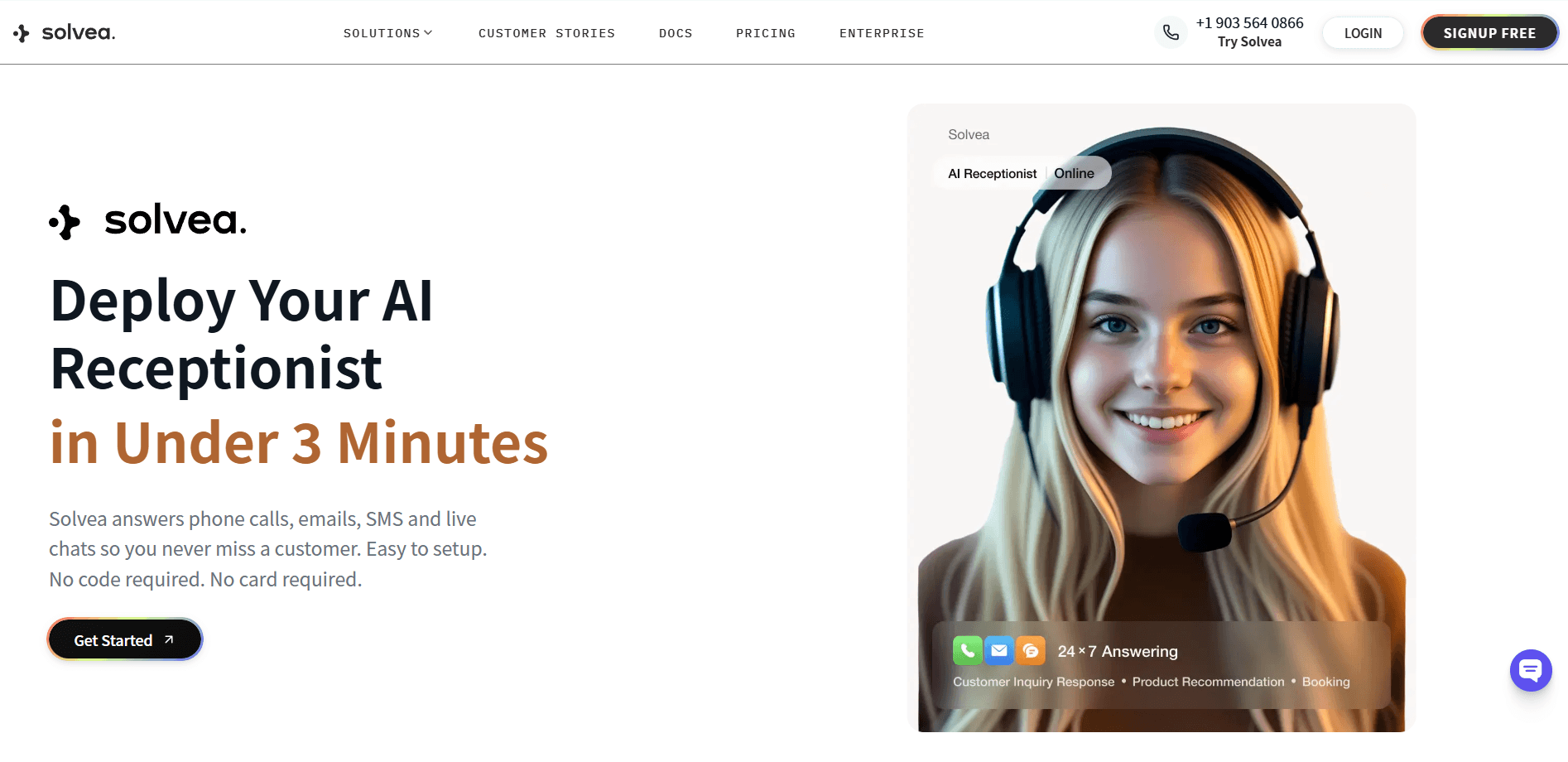
Solvea is an AI receptionist platform designed for small business, enabling business owner to create an AI receptionist in just 3 minutes. Even without technical background, you can set up your AI agent with a simple prompt or based on a industry-sepecific template (such as retail, hotel, real estate, and medspa).
Curious what this looks like in practice? See how Solvea handles it →
Putting It Together
A business generating $500,000 in annual revenue that misses 5% of qualified inbound leads is quietly leaving $25,000+ on the table every year — with no line item on the P&L to show for it. The missed calls don't announce themselves. They just don't convert.
The fix doesn't require a full-time hire or a complex technology project. Start by pulling your phone system logs and counting how many calls go unanswered. The number is almost always larger than the owner expects. From there, even a basic call forwarding rule or answering service covers the majority of the gap.
Your AI Receptionist, Live in Minutes.
Scale your front desk with an AI that never sleeps. Solvea handles unlimited multi-channel inquiries, books appointments into your calendar automatically, and ensures zero missed opportunities around the clock.
Frequently Asked Questions
How much revenue does a missed call cost a small business?
It depends on your average customer lifetime value and how quickly you follow up. If a new customer generates $500 in first-year revenue, and research shows that same-hour response is 7x more effective than delayed response, a pattern of missed calls and slow callbacks can represent thousands of dollars in monthly lost revenue. Multiply your monthly missed call count by your average customer value for a business-specific estimate.
Why don't callers leave voicemails?
Most callers — particularly new leads — don't leave voicemails because they don't have an existing relationship with the business. Without a reason to wait, they move to the next option. Voicemail works best for existing customers with a specific reason to leave a message; for new leads, it's effectively a lost call.
Do missed calls affect small business reviews?
Yes. Unanswered calls are among the most commonly cited complaints in local business reviews on Google and Yelp. According to BrightLocal's 2024 Local Consumer Review Survey, 98% of consumers use the internet to evaluate local businesses — and reviews explicitly mentioning poor phone accessibility consistently suppress future inquiry rates.
Is an answering service worth the cost for a small business?
For most service-based businesses, yes. If your average new customer generates $500 or more, a single recovered call per month covers the cost of most answering services at $150–$300/month. The break-even calculation favors action in nearly every scenario where phone calls are a primary lead channel.
What's the difference between a virtual receptionist and an AI receptionist?
A virtual receptionist is a human agent working remotely who answers calls on behalf of your business. An AI receptionist uses voice AI to handle calls autonomously — booking appointments, answering FAQs, and escalating to a human when needed. AI receptionists are typically available 24/7 at a lower cost per call; virtual receptionists offer more nuanced handling for complex or sensitive inquiries.
What's the fastest way to stop losing leads to missed calls?
The fastest fix is call forwarding to a mobile number — it costs nothing and can be active within minutes. For consistent after-hours coverage or higher call volumes, AI-powered call handling provides the most complete solution without adding headcount.