













The customer
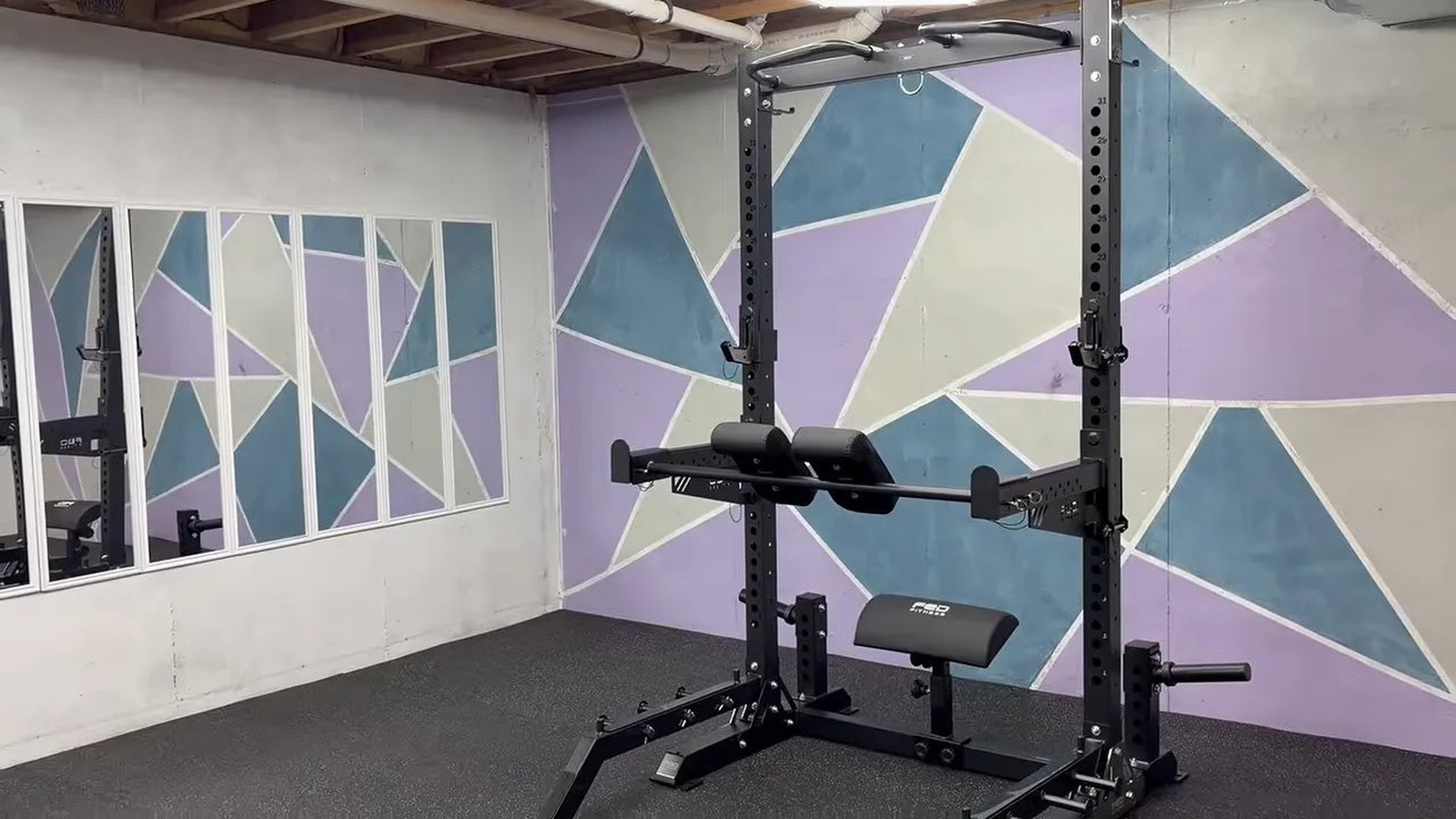
深圳市神来一笔科技有限公司 (FED Fitness) makes home-gym products including squat racks, strength-training equipment and cardio machines. Its business covers dozens of countries and regions including the United States, Europe and Southeast Asia, it has served more than 10 million households, and it has repeatedly held Amazon Best Seller status in multiple categories.
Large gym equipment has a complex structure and many parts, so after-sales decisions usually cannot be made from a single customer description alone.
The challenge
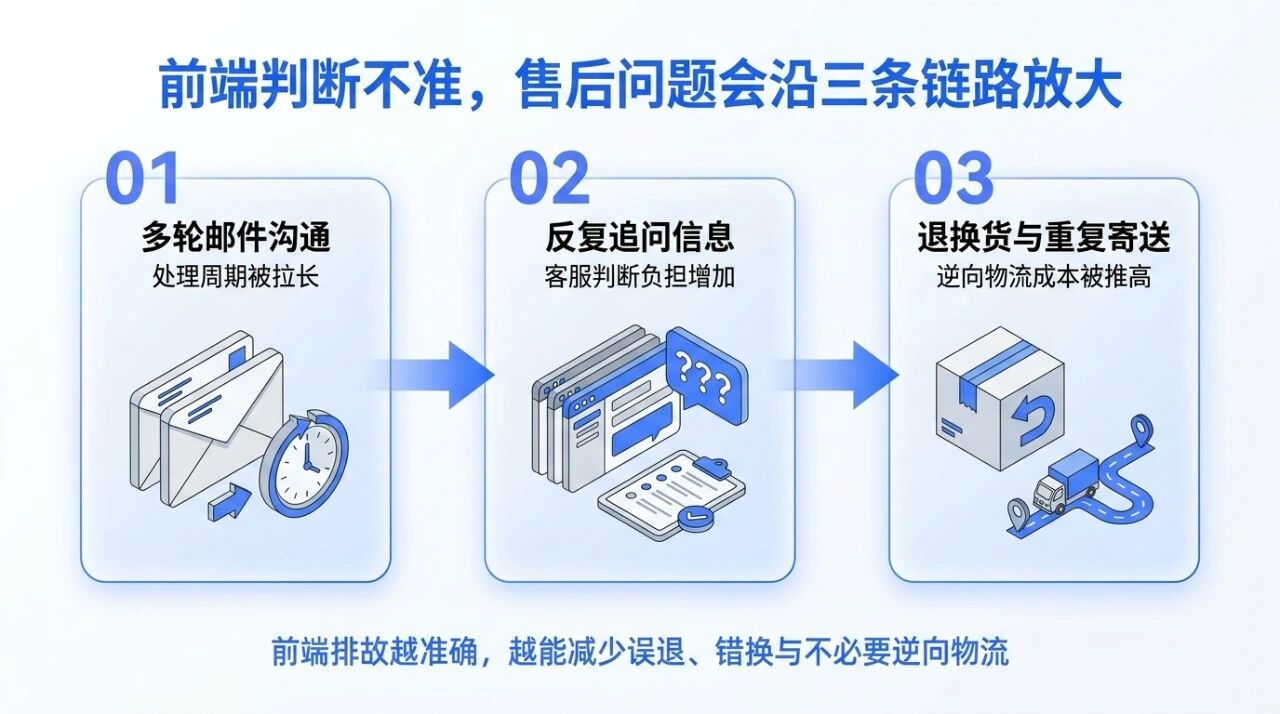
When a customer says “a part is missing,” “I can’t assemble it,” or “the product is damaged,” the underlying issue may be a missing part, a wrong shipment, transit damage, an installation problem, or a product fault. The first email is also often incomplete. If key information is not collected in time and the issue is not located accurately, the ticket can fall into multiple rounds of email, the handling cycle stretches out, and a problem that could have been solved with a replacement part or installation guidance may escalate into a return, an exchange or a repeat shipment, raising reverse-logistics costs.
One mistaken judgment can lead to a completely different handling path and after-sales cost. A problem that could be solved with installation guidance may be treated as a product fault. A case that only needs one part to be resent may be pushed toward a full-unit exchange.
AI triages and collects evidence first; people make the key decisions
To handle this kind of complex after-sales work, FED Fitness introduced Shulex AI support agents. Phase one focused on email tickets and high-frequency product troubleshooting. AI was given priority on responding to customer emails and on frequent troubleshooting inquiries such as missing parts, installation and faults.
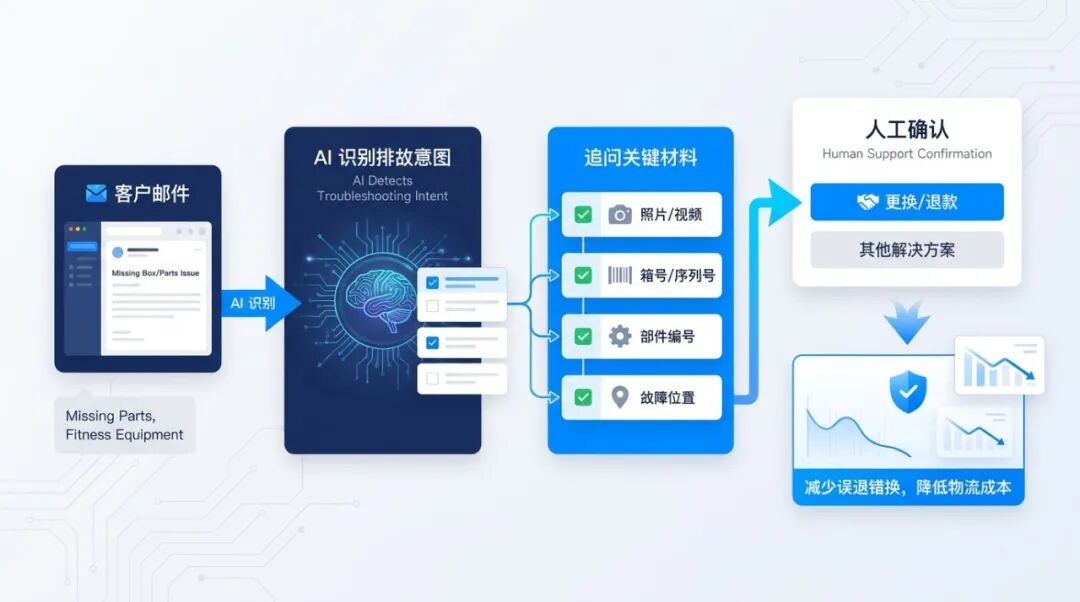
Take, as an illustration from the source article (the original image is marked as an example and is not evidence of a real ticket), a multi-box home gym where the customer has received only one box and is also missing the manual. The case may look like a “missing part,” but the team still has to confirm whether the remaining boxes are still in transit, which cartons the customer has actually received, whether the packaging is damaged, whether a whole carton or a specific part is missing, and whether photos and order information are complete. Agents previously had to ask these questions over several rounds. Now AI first identifies troubleshooting intents such as a missing carton or missing part, then uses product knowledge and after-sales processes to check the information already provided and continue asking for necessary materials such as photos, carton numbers, part numbers and the fault location.
When the case reaches steps that need human confirmation, such as resending a part or arranging an exchange, AI hands it over with the full context, and a person makes the key decision. The aim is to resolve more issues first through installation guidance, replacement parts or exchanges, and to reduce mistaken returns, wrong exchanges and unnecessary reverse logistics.
Turn frontline experience into an iterable knowledge base and SOPs
There is some turnover on the front line of cross-border support. For FED Fitness, introducing AI first addressed business continuity under frontline service pressure: it was a way to stably handle high-frequency, repetitive, rule-based communication, not just a temporary stopgap. When front-end responses are more continuous and back-end rules are more consistent, human agents can spend their attention on judgments such as resends, exchanges, refunds and exception escalations.
The large-equipment product line is broad, and after-sales rules are complex, so AI has to keep improving with real operations. FED Fitness had already accumulated substantial product knowledge and handling experience through long-term after-sales work. In this rollout, Shulex helped the support team further organize and structure that experience and write it into the knowledge base and SOPs. Through side-by-side support and hands-on training, it also helped develop brand-side AI trainers, so the team could gradually locate issues, adjust knowledge and keep optimizing on its own.
The result
The visible change is in the way service is organized. AI first identifies the issue, collects materials and routes the handling path. Human agents move from executing repetitive processes to judging key issues and checking the service outcome. The cost of after-sales support for large equipment does not begin only when a return happens. It begins with the first judgment of the problem.