














The customer
倍思奇创新科技(深圳)股份有限公司 (BESTQI) focuses on ergonomics, home audio-visual products and smart home. Its products have served more than 40 million households, it holds more than 800 patents, and more than 500 of its products have entered the Amazon Best Sellers Top 100. The brand introduction also states annual sales of more than US$500 million, with business covering overseas markets including North America and Europe.
Like many cross-border brands, BESTQI has to manage more than response time. It also has to work within Amazon’s on- and off-platform communication rules, and with refund costs, ratings and compliance risk. Logistics exceptions, returns, exchanges, resends and refunds may look like ordinary support issues, but one wrong step can affect both the customer experience and margin.
The challenge
BESTQI’s support capacity developed in two stages. In the first stage, a team in China served global customers. Cross-time-zone coverage meant people had to be on duty on weekends, public holidays and overnight, which brought turnover and scheduling pressure. In the second stage, part of the work was handed to overseas outsourced agents to reach 24/7 coverage. As the operation grew, consistent execution across regions, knowledge sync and quality management became new difficulties.
The question for the team was therefore not simply whether it could adopt AI, but which work could be given to AI, which work had to stay with people, and how AI knowledge, quality and risk should be managed. On 13 August 2026, Leslie Li, BESTQI’s Risk Control and Customer Experience Manager, shared this change at the Shulex AI customer-service salon in Shenzhen. She said that when AI was first introduced, “we had almost one human review for every AI reply.” That was not a lack of trust. Every reply could be tied to platform rules and fulfillment risk.
Draw the boundary first, then expand in stages
BESTQI did not start by chasing full automation. It first set a boundary, then expanded in batches: it began with high-frequency, standard, lower-risk scenarios; it moved store by store and scenario by scenario; and it widened the scope only after reply quality met internal requirements. Leslie summed up the method as starting, iterating and fixing as they went.
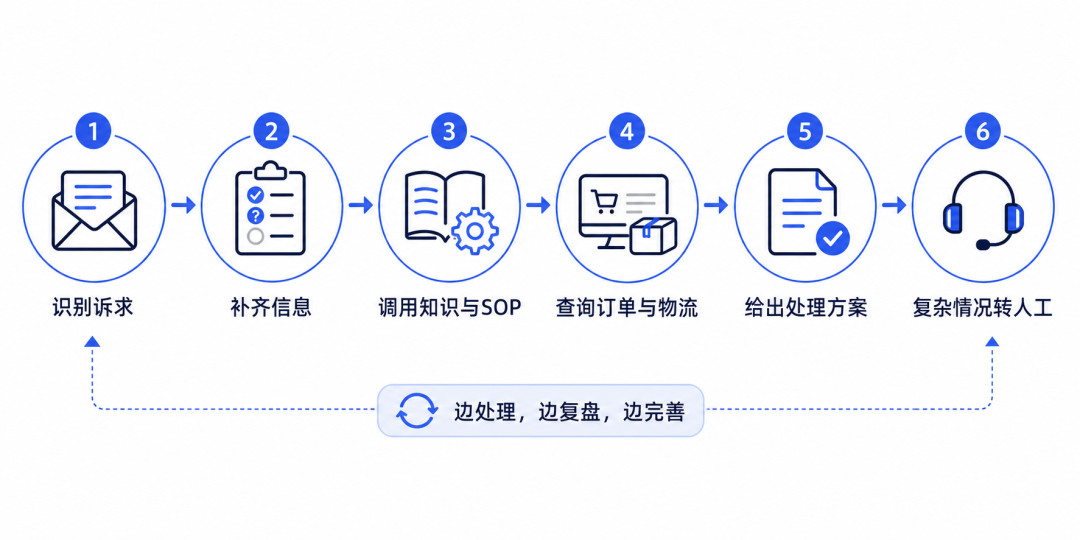
Logistics exceptions and returns or exchanges became the first priority, because the issues were frequent, the information was relatively clear, and the risk boundary was easier to draw. When a customer said a parcel had not arrived on time, agents previously had to confirm the order number, check tracking, decide whether there was an exception, determine whether to resend or refund, and then write a reply that followed Amazon communication rules. Now AI first identifies the request, collects necessary information such as the order number, product details, photos and address, then uses the knowledge base, SOPs and order-and-logistics status to draft a handling plan. Complex compensation, policy exceptions or high-risk fulfillment are still handed to a person.
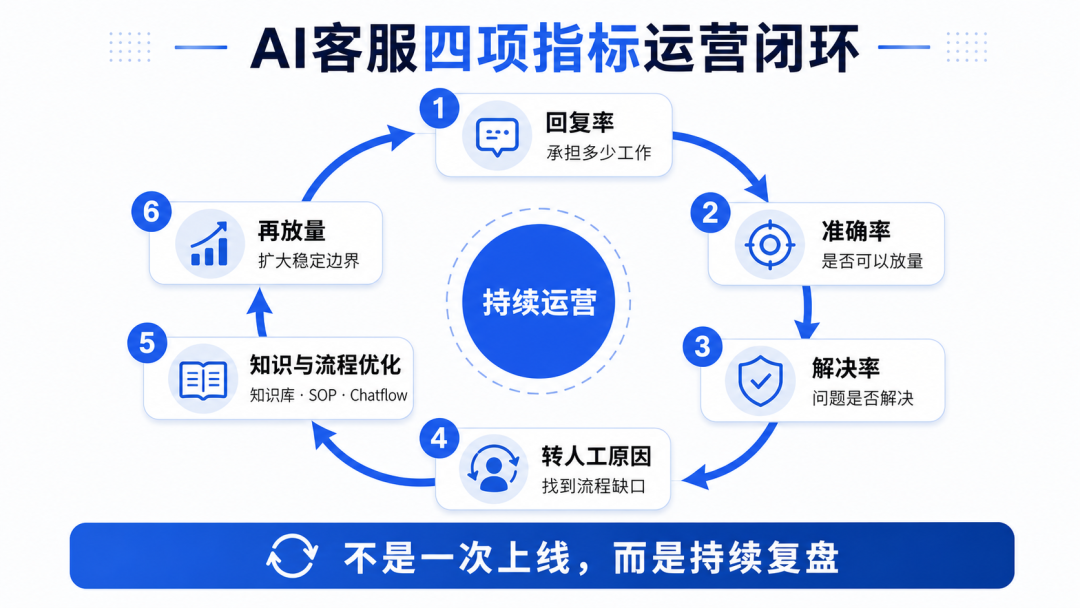
“Fixing” is not just rewriting one sentence. It means finding out why AI stopped: missing knowledge, an inability to recognize multiple intents, unread attachments, or incomplete order information. Some handoffs to people are necessary. Others are cases AI could have handled if the knowledge or process had been ready. The team then writes those gaps back into the knowledge base, SOPs and workflow, so AI can reliably take one more step.
Manage people-plus-AI capacity with shared metrics
When managers supervise human agents, they look at volume, response time and service quality. Managing AI also needs a shared definition. Early in the project, the first issue BESTQI met was not a technical one, but a metrics problem: should the denominator of the AI reply rate be tickets assigned to AI, or all valid incoming tickets? Should the unit be a ticket, or a reply? Different definitions change how results are judged.
The team settled on four core metrics: AI reply rate, to see how much real work AI is taking on; AI resolution rate, to see whether the issue was actually resolved; reply accuracy, to decide whether it is safe to expand; and the human-handoff rate, to see where AI stops and what can be improved next. Leslie said: “How many replies we send is only the baseline. We also look at resolution rate, accuracy, and whether the customer’s issue was actually handled.”
Chasing reply rate alone can push immature scenarios to AI too early. Chasing accuracy alone can leave AI stuck on the simplest questions. Looking at replies without resolution can mean many emails go out, while a person still has to finish the case. The point of these metrics is not to prove that AI is better than people. It is to help managers decide which tasks can stay with AI, which capabilities still need training, and which steps must remain with a person.
Write experience into SOPs, and adjust team roles
A great deal of experience used to depend on senior agents reminding colleagues in the moment, with corrections passed on by word of mouth. AI cannot hear those spoken reminders. Rules have to become clear writing: on which day an SOP changed, which policy applies to which product, when a case must be handed to a person, and which amounts AI must not promise.
Leslie said: “It used to be people managing people, and a lot was passed on by word of mouth. Now everyone pays more attention to how the AI can know the same things, and SOPs have to be written down clearly.” As the project moved forward, experienced domestic agents who knew the business gradually shifted toward defining business boundaries and quality standards, writing SOPs, handling complex exceptions, and calibrating the work of outsourced agents and AI. The team also trained AI trainers to turn business experience into processes that can be updated and reused. Leslie also noted that this collaboration is not naturally smooth: people who know the business may not know the technical framework, and people who know AI logic may not understand support scenarios, so ongoing translation and alignment are needed.
The result
Interim results show that AI support took on about one-third of the reply workload, reply accuracy reached 98.1% in the past month, and in high-frequency, clearly defined scenarios such as logistics exceptions and returns or exchanges, AI accounted for more than 55% of replies.
After reply efficiency and quality became more stable, BESTQI began extending AI into after-sales workflows, allowing AI, within its permission boundary, to take part in creating after-sales tickets for returns, refunds, resends and replenishment. Speaking about the change, Leslie said: “I’m thinking about more, and I want more.” Moving from managing replies to managing outcomes is the next step this people-plus-AI support team is taking.