













Teams used to judge AI mainly by how many questions it could answer, and how human it sounded. For more and more global brands, the question has changed: can AI deliver a more predictable business result inside a real service flow?
Once AI moves beyond typed Q&A — into holding the line on refunds, protecting response times and absorbing all-day peaks — a management question appears with it: do the org chart, job design and performance standard need to change as well? “Frontline of global service” is a Shulex column that collects practical judgments from cross-border support teams. This article is one piece in that series. It is not a substitute for a named customer case, and it does not turn these methods into a guarantee for every team.
Shulex works with 200+ brands worldwide, helping support teams put AI into live processes and staying with them after go-live. The industries differ, but in reviews, a number of support leaders point to a similar set of underlying agreements.
First agreement: AI should become always-on service capacity, not just a Q&A plugin
In traditional support planning, team size is usually set against everyday volume. Cross-border commerce has two visible traits: work crosses time zones, so overseas peaks often fall outside domestic office hours; and promotion peaks are steep, with inquiry volume during events such as Black Friday often several times a normal day.
Many teams first try AI as a front-end plugin that fills gaps for human agents, and the result is often limited.
A leading cross-border logistics platform that Shulex works with closely faced this kind of pressure. Parcel tracing involved carriers and service teams in different regions; language differences and multi-layer reporting made frontline execution uneven; adding temporary people at a peak also added rostering and coordination. In a review of cross-time-zone management, the support lead said: “Training overseas vendors is exhausting. We hoped for an equal exchange, but that was the ideal.”
Shulex therefore configured capabilities around concrete logistics jobs — tracking-node updates, address correction, last-mile delivery — rather than a generic chatbot. Take identity checks and “where is my order” as an example. A buyer writes to ask where a parcel is. The agent used to confirm a name and tracking number, match them to system records, and only then look up the trace. If the email was missing information, another round was needed, and a time-zone delay was spent before the actual lookup began. AI can now ask for the name and tracking number, compare them with connected records, and, after a match, return the current status. Collecting and checking information can sit with AI; people spend their time on mismatches and abnormal traces that need a decision.
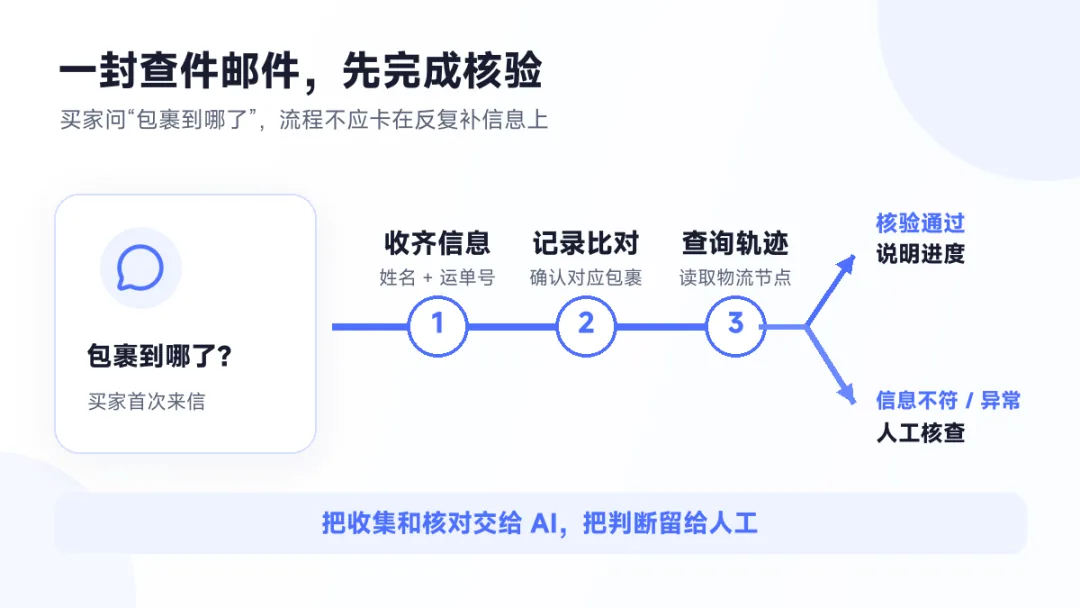
The same lead also said: “When email was handled only by people, the reply rate hovered around 90%. After AI was introduced, the 24-hour response rate on first-contact emails reached 100%. AI handled at least seventy to eighty percent of the scenarios, and follow-up by people became lighter.” Those figures come from that unnamed team’s own review. The working agreement among these managers is to let relatively well-defined AI capabilities take more than 70% of standardized incoming work first, and only then spend human attention on deeper experience. That is their method, not a promise to every operation.
Second agreement: write the business rules down, then staff a graded human-AI roster
The usual peak-season pattern is to hire in a rush before a promotion, run everyone at full stretch during it, and adjust headcount afterwards. Filling a peak with temporary people is expensive to manage, and unfamiliar staff can make quality swing.
In high-ticket bulky furniture sold across borders, after-sales work often mixes transit damage, missing pieces from multi-box shipments, and customers who cannot complete assembly. A customer-experience lead at one furniture brand said, in review: “With human agents, quality is not impossible to control, but it is very hard to manage. If we use AI and write the process and requirements clearly, we can get it to 90% to 95% of the expected result, and have it carried out reliably.”
Only when tacit judgment from experienced agents becomes explicit rules can a team build a three-layer roster: AI holds the always-on line and takes 70–80% of high-frequency, standardized contacts; senior specialists handle difficult disputes, high-value refund approvals and VIP conversations; and some agents move into an AI-trainer role, maintaining the knowledge base and the SOP. Peak seasons then do not have to start with a blind hiring surge, and everyday human coverage can stay more flexible. These percentages describe a structure these managers talk about; they still have to be implemented against each team’s rules and reviews.
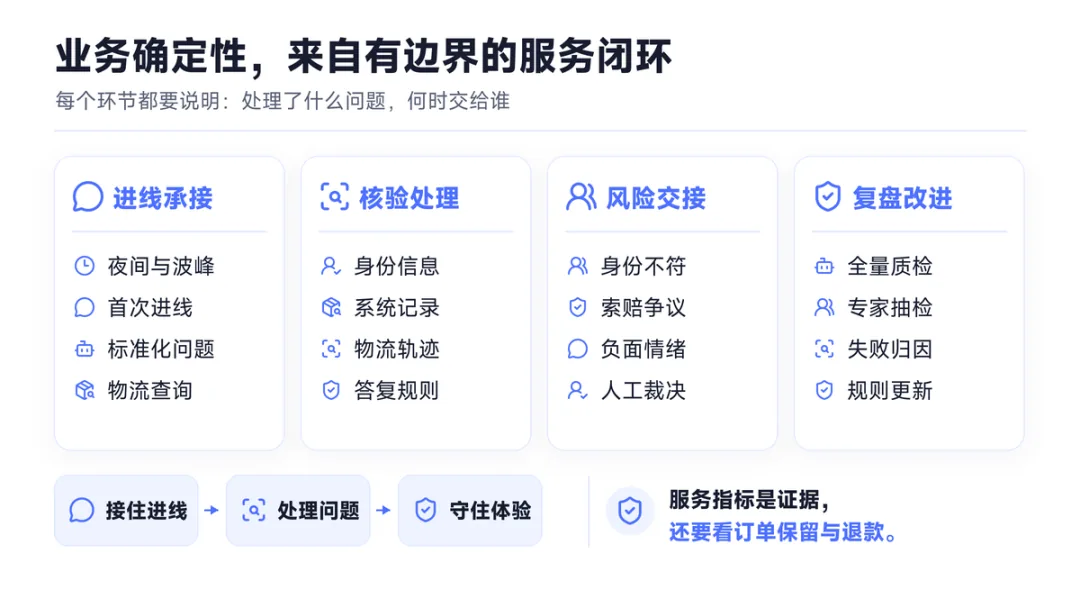
Their conclusion is that the real competition in service is organizational. Once experience is written into system rules, the boundary between people and AI can be set; letting machines take repeated work at scale, and people keep the deeper decisions, is a more stable way to deal with peak uncertainty than adding headcount alone.
Third agreement: judge AI and people by the same standard, and do not lower the quality floor
Early in an AI rollout, teams can fall into two traps: believing the work can run with no people at all, or treating poor replies as acceptable because “it’s only a machine.” Several benchmark teams working with Shulex stressed the same point: a customer will not forgive a bad experience because the other side was a machine. AI and human agents should be held to the same standard. AI is not an excuse to lower the floor.
On the safety line, platforms such as Amazon have strict rules for seller messages. Risk and policy checks need to sit inside automated replies, not only in a later cleanup.
On the experience line, AI and human replies are measured against the same satisfaction target. One support lead said: “We did not lower the satisfaction requirement for AI compared with human agents. It is the same. Whether it is AI or a person, the CSAT target is 90%.” Facts that have not been verified in the company knowledge base must not be guessed. High-risk signals such as strong negative emotion or a claims dispute should raise an alert and move to a person, with the context attached.
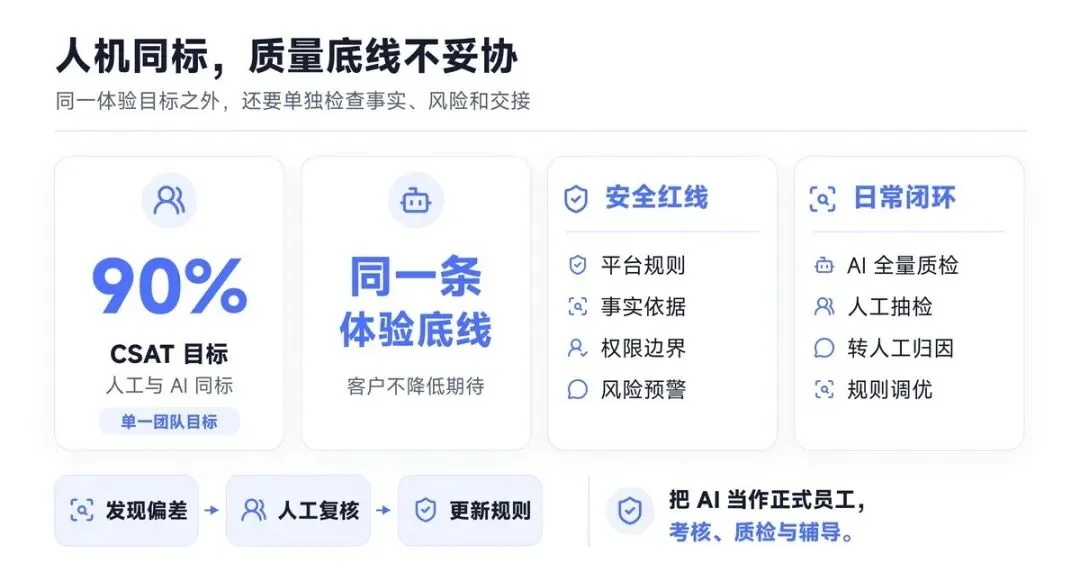
Everyday review can combine AI self-improvement, full-volume automatic QA and expert sampling, and treat each human handoff as input for a qualitative review and a rule update. The upper bound of the technology depends on the model; the floor of a live operation depends on the management standard. If AI is coached, reviewed and measured like a regular employee, brand experience is less likely to slip in the hours when machines are on duty.
From putting AI live to changing the organization
These agreements come from reviews by support leaders who are already on this path. They are not a universal scorecard. Together they point to a shift: competition in cross-border service is moving from the size of the team to the depth of human-AI collaboration and the ability of the organization to change.
If your team is reviewing cross-time-zone processes, staffing or how to put AI into production, you can look at how tickets and human-AI handoff sit in the smart helpdesk, and book a conversation around your current rules.