













On 12 November 2026, the Global Digital Innovation Expo (GDIE) was held at the New World Millennium Hong Kong Hotel. Global and Fortune 500 brands — including Huawei, Lenovo, Toyota, Dior, Gucci, Chanel, Cartier, Estée Lauder, P&G, Coca-Cola, Mannings, Watsons and Chow Tai Fook — gathered in Hong Kong. Shulex was invited as a company working on applied AI for customer experience, to discuss how AI can enter real business processes and deliver measurable results.
The theme of this edition was “CO-EVOLVING WITH AI — Igniting a New Era of Intelligent Growth.” The conversation on site was less about a demo-stage display of technology, and more about how AI becomes productivity and commercial value. Shulex shared the stage with business leaders from Pagoda Group, Carlsberg Group, L’Occitane Group, Feishu and Toyota Boshoku, among others, on how AI is being put to work in enterprise service operations.

The question on stage: how AI enters the business
Shulex co-founder and COO Chris Zhao gave a talk titled “AI-MultiHub: AI Agents Across Your Business.” He discussed how AI agents can be used in enterprise customer experience management, and how customer service can move from a traditional cost center toward a capability that supports growth.
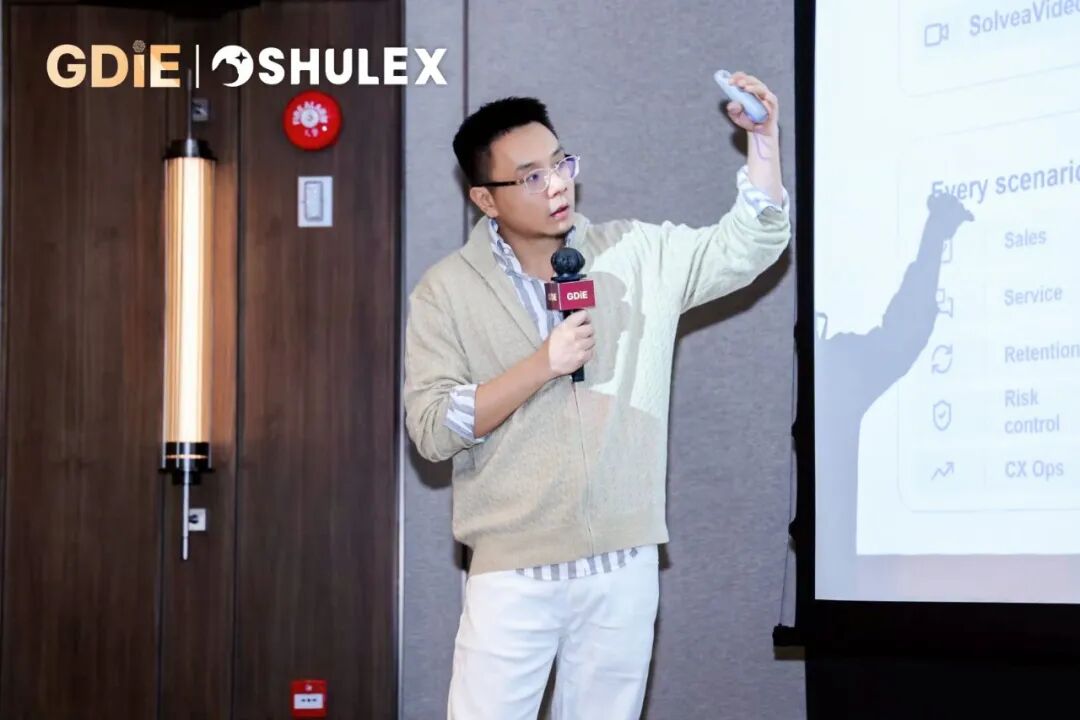
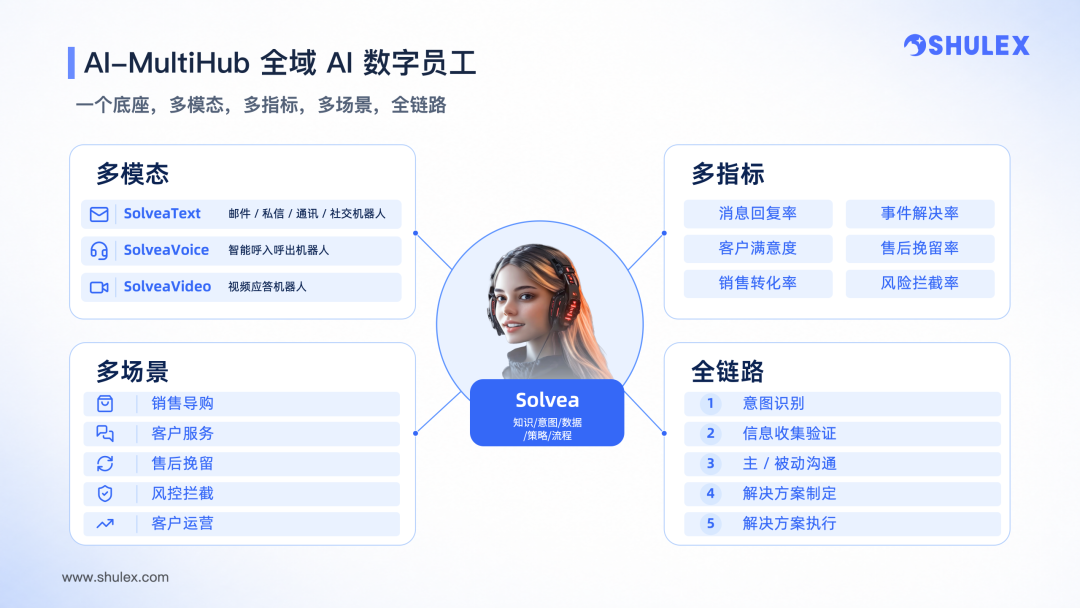
In his view, getting AI into the business is not a matter of a single tool, but of a coordinated system of AI employees. The Shulex AI-MultiHub (Solvea) brings text, voice and video AI agents into a unified service workspace, covering pre-sales recommendations, order inquiries, troubleshooting and after-sales support:
- One foundation: a shared workspace where AI and the service team can see tasks, customer data and progress.
- Multiple modalities: text, voice and video agents work together, so context can continue when a customer changes channel.
- Measurable indicators: response coverage, answer accuracy and service quality are monitored continuously.
- Multiple scenarios: rules can be organized by region, market, brand and category, across countries and platforms.
- A complete path: with connections to order, ERP, logistics and CRM systems, AI can do more than answer — it can carry out approved actions.
“We monitor AI the way we manage people — with rules and KPIs,” Chris said on stage. In Shulex’s approach, outcomes are written into the contract: a baseline is set from the customer’s real business data, targets are agreed by scenario, and AI service employees are monitored on reply rate, accuracy and quality, with knowledge, rules and processes reviewed on a cycle.
Companies want measurable value, not just another software package
Chris also said: “Companies don’t want to buy a piece of software. They want the measurable value that AI can bring.” To deliver that value, AI cannot stop at answering questions.
When a customer raises a request, AI first identifies the need, then checks facts against order, logistics or warranty data, discusses options with the customer, and — where the rules allow — carries out the action. The aim is to keep a case on one path from arrival to resolution.
The ability to act also creates risk, which is what enterprises care about most. Before a message is sent, it can be checked against model and policy rules, including platform policies, local regulations and brand requirements. Human-in-the-loop remains part of the design: agents take the first contact across channels; when AI cannot answer, or when a human judgment is the better option, the case moves smoothly to the desk. The human agent does not have to start from a blank reply, retag the case, or ask the customer to repeat the story — they review whether the proposed path is right, then hand the work back to AI.
Measurable results have to show up in real operations
Value is finally judged by numbers in real operations. The results shared on stage came from customer work that was not named in the original article, and they stay unnamed here.
In troubleshooting and replacement, a global consumer-electronics brand saw customers report that a device would not charge or power on. AI first guided troubleshooting, then checked the order and warranty, and after a plan was confirmed, triggered a replacement or reshipment in the ERP and notified the customer. On this end-to-end path, the AI resolution rate reached 70%, and efficiency improved by 90%.
For cross-market service, a home brand operating in more than 20 countries and regions had different handling rules by country, platform and bulky-item after-sales process. Shulex helped organize layered knowledge by model year, country and category, take requests from different markets and platforms into one ticketing flow, and extend coverage with multiple languages.
For shipping inquiries and returns, AI followed rules to look up tracking and spot exceptions such as loss, damage or delay. When a customer asked to return an item, it could offer a partial refund where the rules allowed, or check dates and book a pickup. AI already handled 68% of shipping inquiries, with 92% accuracy.
The same product knowledge and order data can support both pre-sales recommendations — by stock, budget, material and style — and after-sales conversations that identify the reason and SKU behind a return request. The point is not only to answer, but to help customers choose well and help the brand protect an order that already exists.
Start from the company’s own process, and review against results
Customer experience is increasingly discussed as a growth engine rather than only a cost center. For Shulex, the path is still to start from a company’s own processes, rules and metrics, connect them to real operations, and review against results.
If your team is assessing how to bring AI into core service workflows, you can start with a conversation about your current rules: book a product walkthrough.