If you're researching openclaw vs manus ai, you're probably trying to answer a practical question: do you want a self-hosted personal AI assistant you control, or a cloud-based autonomous AI agent that executes tasks for you?
That distinction matters more than specs or hype.
OpenClaw is designed as a personal AI assistant that lives on your own device and connects to the channels you already use. Manus AI, by contrast, is usually positioned as a more autonomous, task-executing AI agent experience that aims to take a goal and carry work forward with less step-by-step steering.
So this is not just a feature comparison. It is really a comparison of control vs convenience, local ownership vs managed automation, and assistant workflow vs agent workflow.
In this guide, we'll break down where each one shines, where each one falls short, and which type of user should choose which platform.
TL;DR: Comparison Table
Feature | OpenClaw | Manus AI |
Core model | Self-hosted personal AI assistant | Cloud-style autonomous AI agent |
Best for | Users who want control, privacy, and messaging-based workflows | Users who want delegation and task execution with minimal setup |
Hosting | Runs on your own machine/devices | Usually managed remotely/service-first experience |
Privacy posture | Stronger user control over data and environment | More convenience, but less direct infrastructure control |
Setup | More technical | Simpler from the user side |
Integrations | Messaging channels, tools, agent routing, automation | Task-oriented agent workflows and web execution style use cases |
Customizability | High | Medium to high, but within platform boundaries |
Ideal user | Builders, operators, technical users, privacy-conscious individuals | Founders, researchers, operators who want work done fast |
Bottom line: Choose OpenClaw if you want your own AI operating layer. Choose Manus AI if you want an AI worker that can take a task and run with it.
What Is OpenClaw?
OpenClaw is a self-hosted personal AI assistant framework built to live close to the user. Instead of being just another chatbot tab in your browser, it is designed to plug into the apps and devices you already use so you can interact with your assistant through familiar channels.
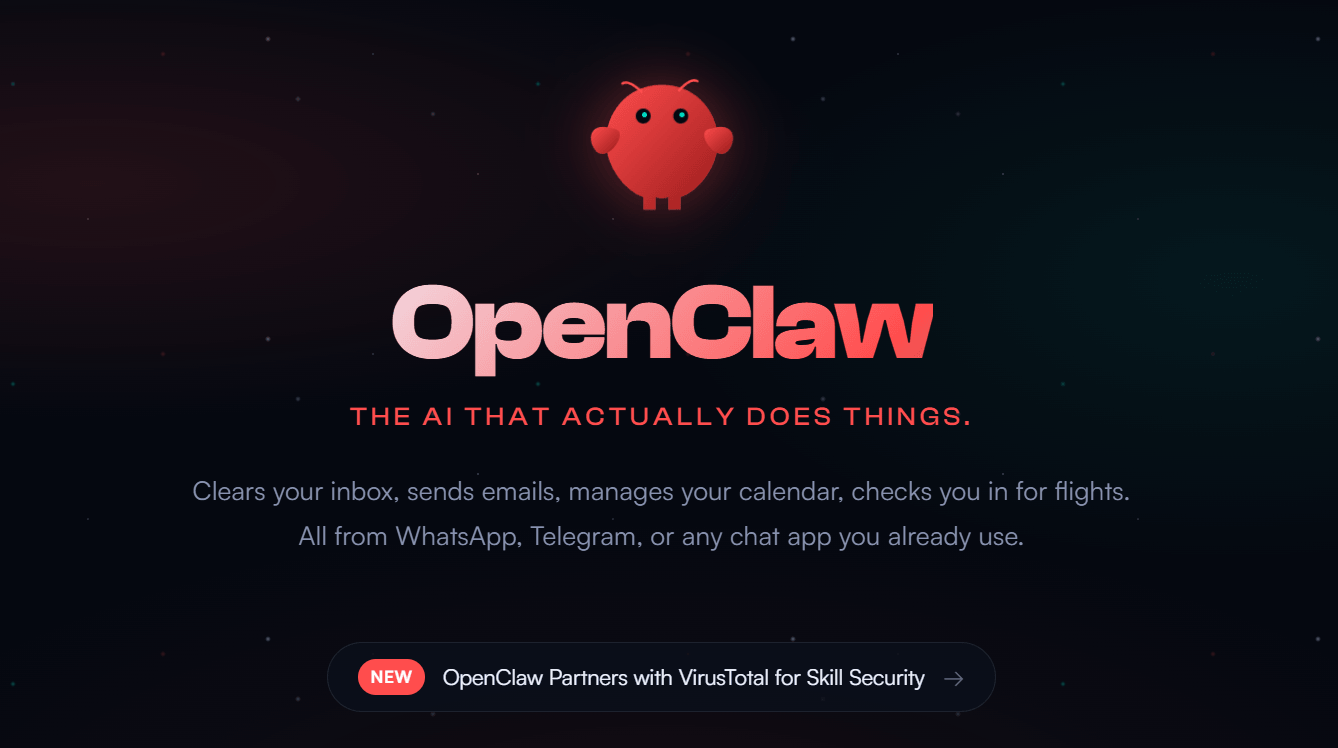
In practical terms, OpenClaw is appealing because it combines several ideas into one system:
- Persistent assistant behavior across sessions
- Messaging-first access through chat platforms and connected surfaces
- Tool use and automation for real-world tasks
- Multi-agent or isolated-session workflows for different projects and contexts
- Local ownership over files, memory, and execution environment
That makes OpenClaw feel less like a demo and more like an operating layer for a power user's digital life.
Why people choose OpenClaw
Most people do not pick OpenClaw because it is the easiest option. They pick it because they want:
- More control over where their AI runs
- Better visibility into what the agent can access
- Stronger privacy boundaries
- The ability to customize behavior deeply
- A personal assistant that can live inside their existing messaging habits
If you like the idea of having your own AI rather than merely renting access to one, OpenClaw is compelling.
What Is Manus AI?
Manus AI is generally discussed as a more autonomous AI agent product.
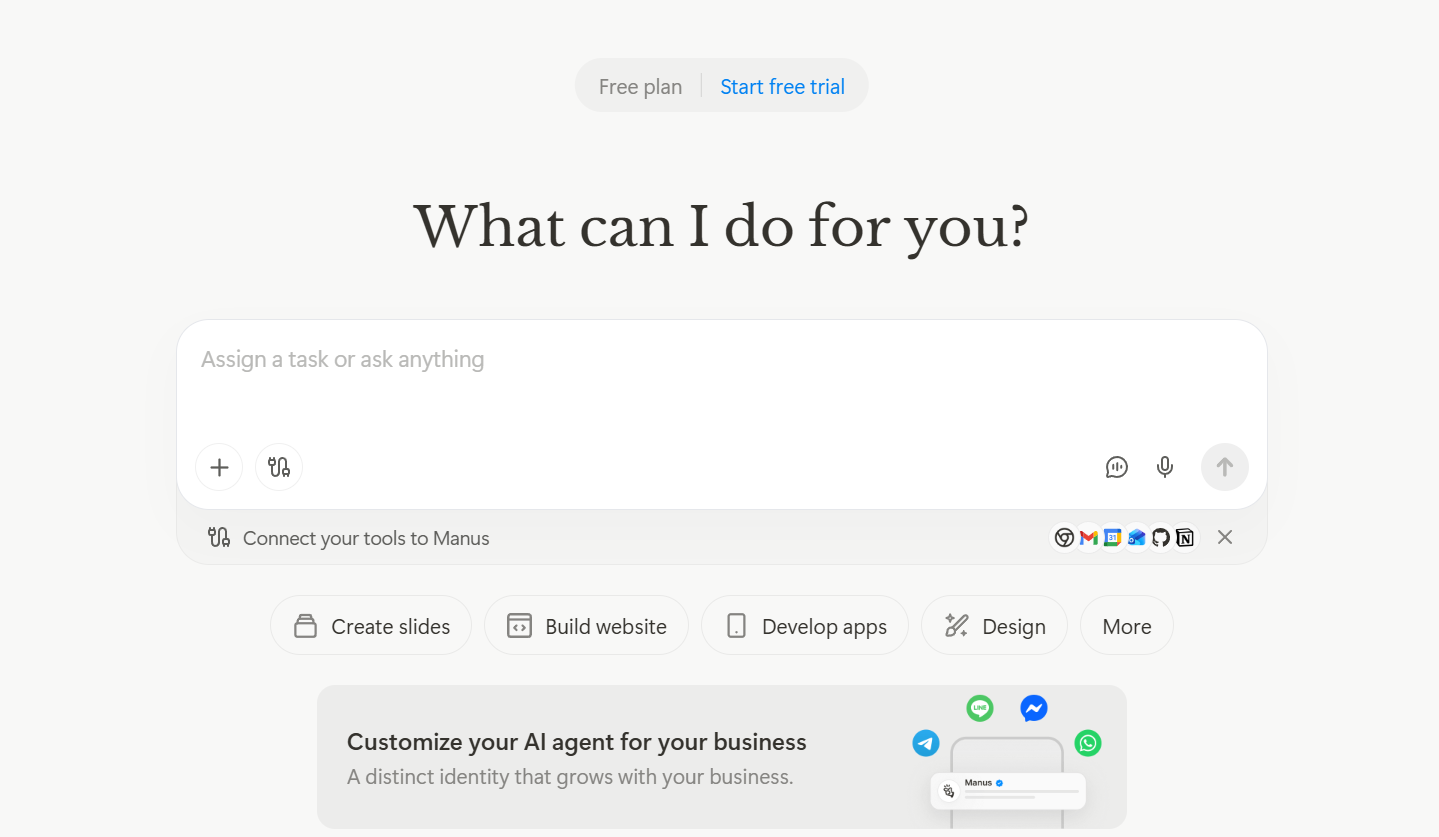
Its value proposition is not primarily “install your own assistant and wire it up however you want.” Instead, the pitch is usually closer to this:
Give the AI a task, and let it plan, browse, reason, and execute with less manual hand-holding.
That framing matters. Manus AI is attractive to users who care less about infrastructure ownership and more about getting outcomes quickly.
Examples of the kinds of expectations users often have from a Manus-style product include:
- Researching a topic across many pages
- Producing a deliverable from a higher-level prompt
- Performing multi-step online tasks
- Acting more like an autonomous digital worker than a chat assistant
Why people choose Manus AI
Users are typically drawn to Manus AI because they want:
- A faster path from request to outcome
- Less setup and configuration
- A more agentic experience
- Strong task delegation
- A product that feels closer to “AI employee” than “AI interface layer”
If OpenClaw feels like building your own mission control system, Manus AI feels more like assigning work to an operator and waiting for results.
OpenClaw vs Manus AI: The Real Difference
The biggest mistake in the OpenClaw vs Manus AI conversation is assuming they are direct substitutes.
They overlap, but they optimize for different things.
OpenClaw optimizes for ownership
OpenClaw is strongest when you care about:
- Running AI close to your own environment
- Keeping memory, tools, and files under your control
- Building a durable personal workflow
- Connecting AI to your existing channels
- Creating a system that adapts to you over time
It is especially good for people who want a long-term personal setup rather than a one-off agent run.
Manus AI optimizes for delegation
Manus AI is strongest when you care about:
- Handing over an objective instead of micromanaging steps
- Getting deliverables quickly
- Using an AI agent as a task executor
- Reducing setup overhead
- Prioritizing speed and convenience over infrastructure control
That makes Manus AI appealing for short-cycle tasks, research bursts, and execution-heavy knowledge work.
Head-to-Head Comparison
1. Privacy and Control
This is where OpenClaw usually has the clearest advantage.
When you self-host, you have more control over:
- Where conversations live
- Which files are accessible
- Which tools can run
- How memory is stored
- What permissions the assistant has
For teams or individuals handling sensitive notes, internal docs, or personal systems, that is a major benefit.
Manus AI offers the opposite tradeoff: less user-side infrastructure burden, but typically less direct control over the underlying environment. For many users, that is acceptable. For privacy-sensitive users, it is often the deciding factor.
Choose OpenClaw if privacy, local access control, and ownership are top priorities.
2. Ease of Setup
Manus AI is likely the easier choice for most people who just want to start using an AI agent quickly.
A managed or cloud-oriented experience usually means:
- Fewer moving parts
- Less configuration
- Faster onboarding
- Fewer environment issues
OpenClaw, meanwhile, rewards technical users but demands more from them. Depending on your stack and goals, setup may include:
- Local runtime configuration
- Channel connections
- Tool setup
- Workspace design
- Security decisions
That is not a bug. It is the price of flexibility.
Choose Manus AI if you want the shortest path to “it works.”
Choose OpenClaw if you are willing to invest more upfront for long-term control.
3. Autonomy vs Steerability
This is one of the most important differences.
OpenClaw
OpenClaw behaves more like a persistent assistant platform. You can absolutely automate tasks and route work to agents, but the design naturally supports a model where the assistant is embedded into your workflow and can be steered precisely.
Manus AI
Manus AI is usually understood as leaning harder into autonomous execution. You give it a goal, and it attempts to carry the work through with a stronger sense of initiative.
That leads to different user experiences:
- OpenClaw: better when you want precision, supervision, and deep workflow integration
- Manus AI: better when you want initiative, momentum, and outcome-first task execution
If you do not like babysitting AI, Manus AI may feel more exciting. If you do not like losing control, OpenClaw may feel safer and more useful.
4. Messaging and Everyday Accessibility
OpenClaw has a strong advantage if your ideal AI assistant is something you can reach from the channels you already use throughout the day.
That matters more than people think.
An assistant that is available where you already communicate can become part of your routine for:
- Capturing ideas
- Scheduling reminders
- Checking project status
- Looking up information
- Running background tasks
- Handling personal or work operations
Manus AI is often more about launching a task session than maintaining an always-there assistant layer. That does not make it worse. It just makes it different.
If you want an AI that feels like part of your daily operating system, OpenClaw is usually the better fit.
5. Customization and Extensibility
OpenClaw is the stronger choice for people who want to tinker.
You can shape the system around your workflow, tools, memory, channels, prompts, and structure. That is powerful if you are building a durable AI setup for:
- Personal operations
- Small-team internal use
- Knowledge management
- Automation pipelines
- Device-connected assistant behavior
Manus AI may still provide customization, but it typically exists within the boundaries of the product. That is fine if the product already matches what you want. It becomes limiting only if your needs are unusual.
A good rule of thumb:
- If you want to use an AI agent, Manus AI may be enough
- If you want to build your own AI environment, OpenClaw is a better fit
6. Reliability for Serious Workflows
For serious operational use, the question is not just “which one is smarter?” It is:
- Can I trust it with my workflow?
- Can I inspect what it is doing?
- Can I constrain it?
- Can I recover when something breaks?
OpenClaw tends to shine for users who want inspectability and structured control. You can define the boundaries more explicitly.
Manus AI may shine when speed of execution matters more than infrastructure introspection. If your main goal is rapid output rather than system ownership, that can be the better trade.
In other words:
- OpenClaw is often better for long-lived, controlled workflows
- Manus AI is often better for fast-turn task execution
Best Use Cases for OpenClaw
OpenClaw is a strong fit if you want to:
- Build a private personal AI assistant
- Connect AI to messaging apps and daily workflow surfaces
- Maintain your own memory and automation system
- Run an assistant close to your own files and devices
- Create isolated agents for different projects
- Customize behavior deeply over time
Example user
A technical founder wants one assistant that can live across chat channels, help manage notes, monitor tasks, create drafts, and stay under direct control.
That is very OpenClaw territory.
Best Use Cases for Manus AI
Manus AI is a strong fit if you want to:
- Delegate research and execution tasks quickly
- Use an autonomous AI worker with minimal setup
- Turn high-level instructions into deliverables
- Reduce the amount of manual prompting needed
- Move fast without managing infrastructure
Example user
A solo operator wants to assign a research brief, get a compiled output, and move on without setting up a personal assistant stack.
That is where Manus AI can feel more natural.
Pros and Cons
OpenClaw Pros
- Strong control over environment and privacy
- Messaging-first accessibility
- Deep customization potential
- Good fit for persistent assistant workflows
- Better for users who want ownership
OpenClaw Cons
- More technical setup
- More moving parts to manage
- Higher learning curve
- Best value appears over time, not instantly
Manus AI Pros
- Faster onboarding
- Stronger feeling of autonomy
- Better for delegation-style workflows
- More approachable for non-technical users
- Good for execution-heavy tasks
Manus AI Cons
- Less infrastructure control
- More dependency on platform boundaries
- May be less ideal for users who want a deeply personalized assistant layer
- Privacy-sensitive users may prefer self-hosted alternatives
Which One Should You Choose?
Choose OpenClaw if:
- You want your own AI assistant infrastructure
- Privacy and control matter a lot
- You enjoy building systems
- You want AI available through your normal channels
- You plan to invest in a long-term assistant workflow
Choose Manus AI if:
- You want to delegate work quickly
- You prefer convenience over infrastructure ownership
- You want a more autonomous agent experience
- You do not want to spend much time on setup
- Your main goal is getting outcomes fast
The simplest way to think about it
- OpenClaw = your AI operating system
- Manus AI = your AI task executor
If you want an assistant that becomes part of your digital life, choose OpenClaw. If you want an agent that takes assignments and runs, choose Manus AI. If you want to explore moreproducts, there are some other alternatives for OpenClaw and Manus.
Your AI Receptionist, Live in Minutes.
Scale your front desk with an AI that never sleeps. Solvea handles unlimited multi-channel inquiries, books appointments into your calendar automatically, and ensures zero missed opportunities around the clock.
FAQ
What is the main difference between OpenClaw and Manus AI?
The main difference is workflow philosophy. OpenClaw is a self-hosted personal assistant framework focused on ownership, customization, and messaging-based access. Manus AI is more aligned with autonomous task execution and convenience.
Is OpenClaw better than Manus AI?
Not universally. OpenClaw is better for users who want control, privacy, and a persistent assistant system. Manus AI is better for users who want quick delegation and less setup.
Is Manus AI easier to use than OpenClaw?
For most non-technical users, probably yes. Manus AI is generally easier to approach because it focuses more on the end-user experience and less on user-managed setup.
Which is better for privacy: OpenClaw or Manus AI?
OpenClaw is usually the better fit for privacy-conscious users because self-hosting gives you more control over data, storage, permissions, and execution environment.
Which is better for automation?
It depends on the type of automation. OpenClaw is stronger for custom, persistent, workflow-level automation inside your own environment. Manus AI is stronger for delegated, outcome-oriented autonomous tasks.
Conclusion
The OpenClaw vs Manus AI decision comes down to what kind of relationship you want with AI.
If you want ownership, customization, privacy, and a long-term assistant embedded into your workflow, OpenClaw is the smarter choice.
If you want speed, delegation, and a more autonomous agent that can pick up tasks and run with them, Manus AI will likely feel more effective.
Neither approach is inherently better. They serve different users.
The best choice is the one that matches the way you actually work.