The rise of autonomous AI agents has led to the development of many frameworks designed to automate complex workflows. OpenClaw has gained attention for enabling developers to build AI systems capable of planning and executing tasks autonomously.
However, OpenClaw is not always the best solution for every team. Some organizations find the setup process complicated, while others face challenges around deployment, security, and scalability. As the AI ecosystem evolves, several platforms now offer alternative approaches—ranging from developer-focused frameworks to user-friendly automation platforms.
In this article, we compare notable OpenClaw alternatives, including Claude Code, NanoBot, NanoClaw, SuperAGI and PicoClaw. We will explore their capabilities, typical use cases, and how to choose the right platform for your needs.
Comparison Table: TL;DR
Tool | Best For | Key Strength | Limitations |
OpenClaw | Experimental agents | Autonomous workflows | Complex setup |
Claude Code | Coding workflows | Strong reasoning and code generation | Limited automation integrations |
NanoBot | Lightweight agents | Simple architecture and fast deployment | Smaller ecosystem |
NanoClaw | Secure automation | Containerized isolation | Limited documentation |
SuperAGI | Enterprise agents | Multi-agent orchestration | Requires technical setup |
PicoClaw | Edge computing | Ultra-lightweight (under 10MB RAM) | Early-stage ecosystem |
Why Look for Alternatives?
Despite its flexibility, OpenClaw may not always be the most practical choice, especially for production environments.
- Security and deployment concerns: OpenClaw typically requires local deployment and infrastructure management, which can introduce security and compliance risks when handling sensitive data.
- Complex setup and maintenance: Running OpenClaw often demands significant developer expertise to manage dependencies, configurations, and updates.
- Limited business integrations: Compared with newer AI agent platforms, OpenClaw lacks built-in integrations with common tools such as CRM systems, calendars, or communication platforms.
- Scalability challenges: Deploying autonomous agents at scale may require substantial infrastructure resources and engineering effort.
Because of these limitations, many teams look for alternatives that are easier to deploy, more secure, and better suited for production environments. While OpenClaw remains valuable for research and prototyping autonomous agents, modern AI agent platforms often provide simpler setup, built-in integrations, and better scalability for real business use. Before you settle on an alternative, skim the latest [Is OpenClaw Safe?] rundown so you understand exactly which exposed-instance risks you’re trying to sidestep.
OpenClaw
OpenClaw is an experimental AI agent framework designed to facilitate the construction of autonomous systems. These systems can reason through tasks and execute multi-step workflows with minimal human oversight. It is primarily used by developers and researchers exploring autonomous AI behavior and agent orchestration.
Key Features
- Autonomous Task Planning: Agents break down high-level goals into actionable steps. This enables them to handle complex, multi-step tasks automatically.
- Modular Architecture: Developers can customize or replace individual components. This flexibility allows OpenClaw to adapt to different use cases.
- LLM Integration: The framework connects with large language models for reasoning and decision-making. This enhances the agent’s ability to understand and complete tasks.
- Memory and Orchestration: OpenClaw maintains context across tasks and coordinates agent actions. This helps manage longer workflows more effectively.
Use Cases
- Autonomous AI Experiments: Researchers use OpenClaw to test and study autonomous agent behavior.
- Agent Workflow Prototyping: Developers can quickly prototype multi-step AI automation workflows.
Claude Code
Claude Code is an agentic command-line interface tool developed by Anthropic. It is designed to help developers manage programming tasks and technical workflows directly from the terminal, allowing AI assistance to be integrated into everyday development environments and command-line workflows.
Key Features
- Code Generation and Debugging: Writes functional code and suggests corrections for errors based on natural language prompts. This helps developers quickly prototype features, resolve bugs, and improve code quality during development.
- Long-Context Reasoning: Leverages Claude's extensive context window to understand and modify large, complex codebases. This allows the tool to analyze multiple files and maintain awareness of project structure when making changes.
- Automated Documentation: Generates documentation for code segments or entire libraries. This reduces the time required to maintain technical documentation and improves project readability.
- Workflow Assistance: Manages routine tasks such as executing tests, committing changes, and handling dependencies. By assisting with these repetitive steps, it helps streamline parts of the software development workflow.
Use Cases
- Pair Programming: Acting as an intelligent assistant for both boilerplate and complex logic.
- Codebase Optimization: Identifying bugs and proposing improvements in larger projects.
- Documentation Maintenance: Keeping technical documentation up to date with less manual effort.
Overall, Claude Code serves as a developer-focused AI assistant that integrates directly into terminal-based workflows, helping engineers work more efficiently when building and maintaining software.
NanoBot
NanoBot is a lightweight AI agent framework designed for simplicity and rapid deployment. As an open-source project, it provides developers with a flexible way to build and experiment with AI agents without the complexity or heavy infrastructure required by larger platforms.
Key Features
- Lightweight Architecture: Built on a minimal codebase, making it easy to understand, customize, and maintain. This simplicity helps developers quickly learn the framework and modify it for their own use cases.
- Low Infrastructure Requirements: Operates effectively on modest hardware, reducing deployment costs and technical overhead. This makes it suitable for small projects or environments with limited computing resources.
- Fast Prototyping: Allows developers to quickly translate ideas into functional agents. By reducing setup complexity, it enables faster experimentation and iterative development.
Common Use Cases
- Small Automation Tools: Testing small-scale automation tasks without heavy system requirements.
- Lightweight Assistants: Building simple personal bots that run efficiently with limited resources.
- Automated Scripts: Integrating AI capabilities into basic terminal or web-based scripts.
Overall, NanoBot is well suited for developers who want a simple and efficient framework for building lightweight AI agents and experimenting with automation ideas.
NanoClaw
NanoClaw is an experimental AI agent platform designed for modular and flexible automation. Positioned as a more compact alternative to OpenClaw, it focuses on giving developers granular control over how agents are structured, deployed, and managed.
Key Features
- Modular Design: Allows users to interchange components to align with specific technical requirements. This modular architecture makes it easier to customize agent behavior and experiment with different system configurations.
- Containerized Isolation: Isolates agents in Docker containers for enhanced security and reliability. This approach helps ensure that individual agents run independently and reduces the risk of conflicts between components.
- Developer-Oriented: Emphasizes code readability and intuitive structure to simplify integration. This design makes it easier for developers to understand, modify, and extend the framework when building custom solutions.
Use Cases
- Custom Architectures: Building specialized agent systems tailored to unique technical challenges.
- Agent Research: Testing different modules and configurations in a controlled environment.
- Modular Automation: Assembling complex automation systems from interchangeable components.
Overall, NanoClaw is suited for developers and researchers who want a flexible platform for experimenting with modular AI agent architectures and building customized automation systems.
SuperAGI
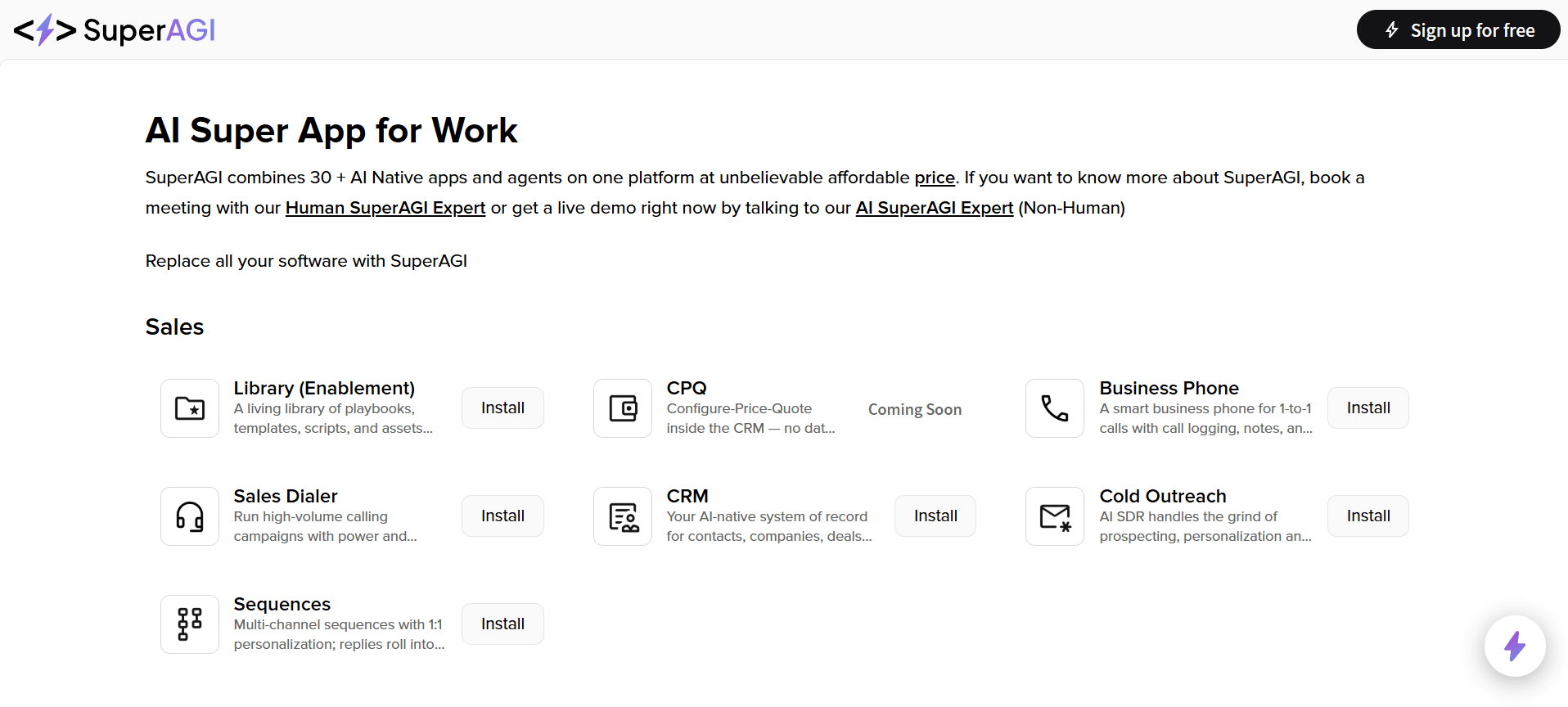
SuperAGI is an open-source platform designed for building and orchestrating autonomous AI agents at scale. It provides infrastructure for deploying agents that can plan tasks, collaborate with other agents, and operate with minimal human intervention, making it suitable for more complex automation environments.
Key Features
- Multi-Agent Orchestration: Coordinates multiple specialized agents to collaborate on shared objectives. This enables complex workflows where different agents handle distinct responsibilities within a larger system.
- Task Planning Engine: Automatically plans and prioritizes tasks to reduce the need for constant human oversight. Agents can break down goals into smaller steps and execute them sequentially.
- Memory and Learning: Allows agents to retain information from past interactions to improve performance over time. This persistent memory helps maintain context across longer workflows.
- Extensible Architecture: Built as an open-source framework that developers can customize and expand. Its active community also contributes integrations and improvements to the ecosystem.
Use Cases
- Enterprise Automation: Deploying autonomous systems to manage complex business processes.
- Large-Scale Orchestration: Coordinating multiple agents to complete diverse technical or operational tasks.
Overall, SuperAGI is suited for developers and organizations looking to build scalable autonomous agent systems with flexible customization and multi-agent coordination capabilities.
PicoClaw
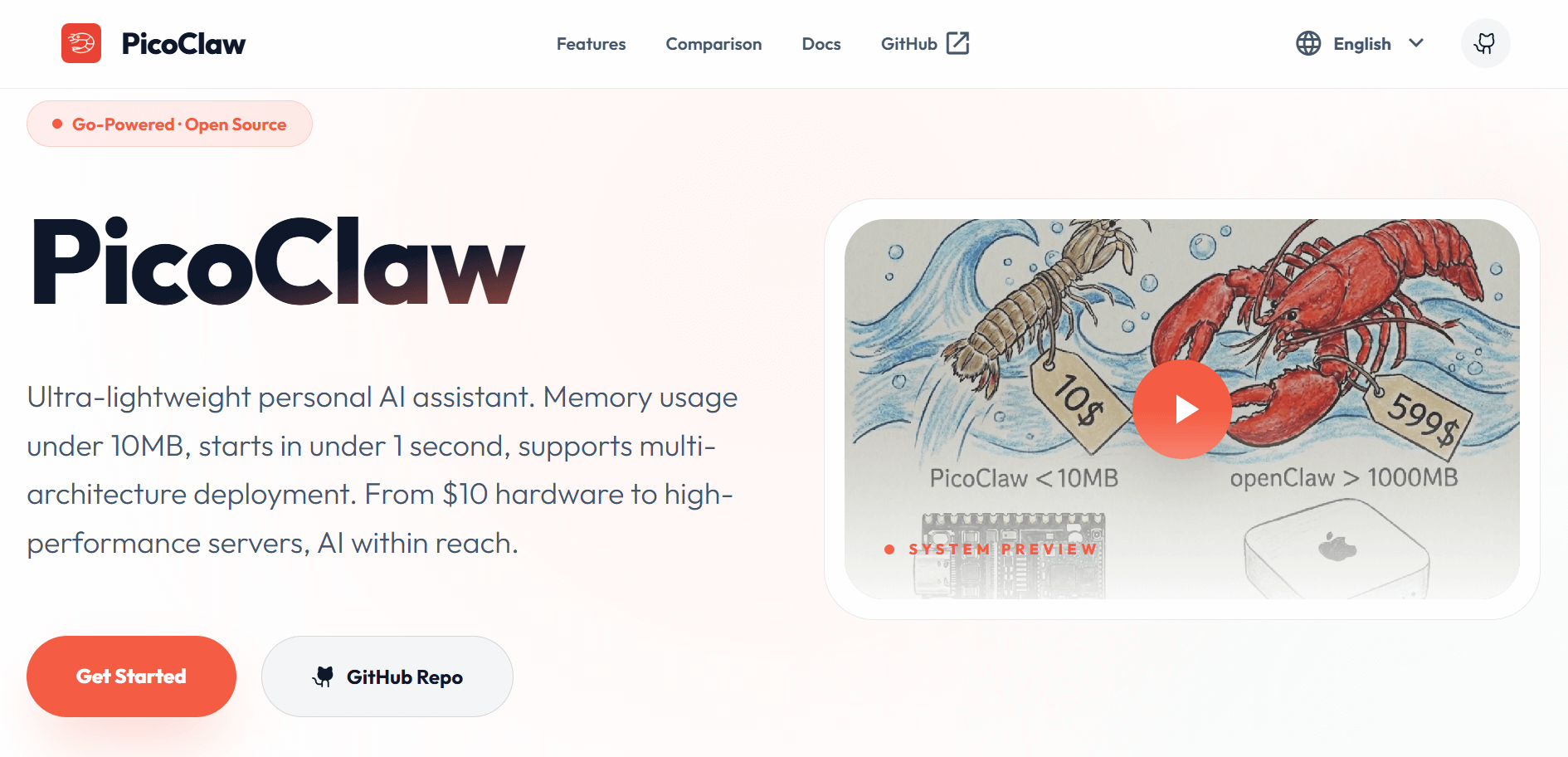
PicoClaw is an ultra-lightweight AI assistant framework built with Go, designed for extreme efficiency and edge computing. It stands out for its minimal resource footprint, capable of running on hardware with very limited memory while still providing robust automation capabilities.
Key Features
- Ultra-Lightweight Footprint: Operates with memory usage under 10MB, making it ideal for IoT devices and older hardware.
- High Performance: Built with Go, it offers lightning-fast startup times (under 1 second) and efficient execution of concurrent tasks.
- Versatile Automation: Despite its size, it can manage complex workflows including email management, calendar scheduling, and code deployment.
- Multi-Platform Deployment: Supports a wide range of operating systems and architectures, providing a consistent AI experience.
Common Use Cases
- Edge Computing: Running AI agents on local gateways or small devices where cloud connectivity might be limited.
- Personal Productivity: Lightweight background assistants for managing daily tasks without consuming significant PC resources.
- Embedded Systems: Integrating AI reasoning into specialized hardware for industrial or home automation.
Overall, PicoClaw is the premier choice for developers and users who need a highly efficient, portable, and fast AI agent that can operate in resource-constrained environments.
How to Choose the Right Alternative?
When selecting an AI agent platform, consider your technical goals, resources, and deployment environment.
1. Ease of Use
Consider the technical expertise required. Some platforms are tailored for developers, while others offer more accessible interfaces. If your team has limited engineering resources, prioritize platforms that simplify agent creation and deployment.
2. Automation Capabilities
Identify whether you need a tool for comprehensive workflow automation, a development aid, or a general-purpose assistant. Not all tools are designed for fully autonomous decision-making.
3. Customization and Flexibility
Developer-centric frameworks offer higher flexibility but require more complex setup and infrastructure management. Open-source frameworks like SuperAGI provide granular control for those needing deep customization.
4. Integration Ecosystem
For business applications, the ability to integrate with existing tools (CRM, APIs, calendars) is essential. Look for platforms that support your current technology stack to ensure efficient workflows.
5. Scalability and Deployment
If you plan to deploy agents in production, evaluate how the platform handles scaling, monitoring, and security. Some frameworks are better suited for research and may require additional engineering for reliable production use.
Conclusion
While OpenClaw is a powerful framework, the evolving AI landscape offers several alternatives like autoclaw tailored to different needs. Whether you prioritize developer productivity, secure automation, or large-scale orchestration, the right choice depends on your specific requirements. By evaluating factors like ease of use, customization, and scalability, you can select a platform that best supports your AI strategy.
Your AI Receptionist, Live in Minutes.
Scale your front desk with an AI that never sleeps. Solvea handles unlimited multi-channel inquiries, books appointments into your calendar automatically, and ensures zero missed opportunities around the clock.
FAQ
1.What is OpenClaw used for?
OpenClaw is an AI agent framework used to build autonomous systems for planning and executing multi-step tasks. It is often used for research and experimental automation.
2.What is the best OpenClaw alternative?
The best alternative depends on your needs. Claude Code is excellent for general assistance, while SuperAGI focuses on large-scale autonomous workflows. For lightweight needs, NanoBot is a strong choice.
3.Do OpenClaw alternatives require coding?
Some platforms require programming knowledge, while others offer low-code or no-code options. Many modern tools aim to lower the barrier for non-technical users.
4.Can AI agent platforms integrate with business tools?
Yes, many platforms support integrations with CRM systems, APIs, calendars, and communication tools. These are critical for practical business automation.
5.Are AI agents suitable for business use?
Yes, businesses use AI agents to automate workflows, handle customer interactions, and improve operational efficiency. They are becoming a standard part of the enterprise tech stack.