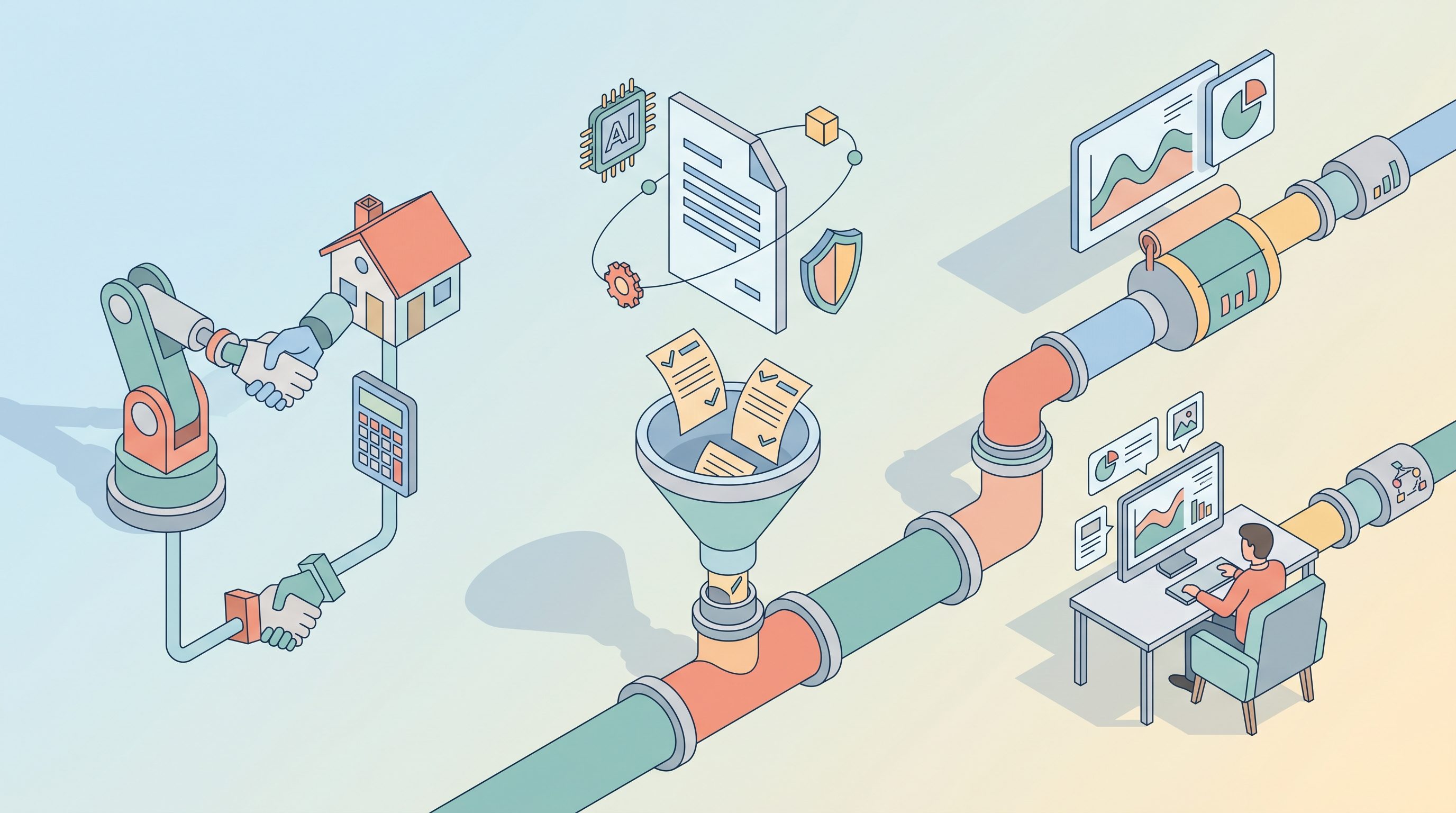
AI agents are rapidly evolving, transforming business operations from simple chatbots to sophisticated, autonomous workflow automation. These advanced AI agents execute complex tasks, coordinate various tools, and automate entire operational sequences, allowing human talent to focus on strategic endeavors.
This comprehensive review explores the leading AI agent platforms in 2026, including Solvea, Lindy, Copilot, CrewAI and AutoGen. We will examine their core functionalities, ideal use cases, and what makes each a compelling choice for modern enterprises.
What is an AI Agent?
An AI agent is a software system that leverages artificial intelligence to autonomously perform tasks and achieve specific goals. With the combination of advanced language understanding (Natural Language Processing) and decision-making capabilities, AI agents can interpret instructions, learn from interactions, and execute multi-step workflows across diverse applications and services.
The distinction between AI agents, chatbots, and automation tools is crucial. Chatbots primarily engage in conversational interactions, and automation tools follow predefined rules. AI agents, however, possess a higher degree of autonomy and intelligence. They adapt to dynamic situations, understand context, and make informed decisions to complete objectives, rather than merely responding to prompts or executing linear scripts.
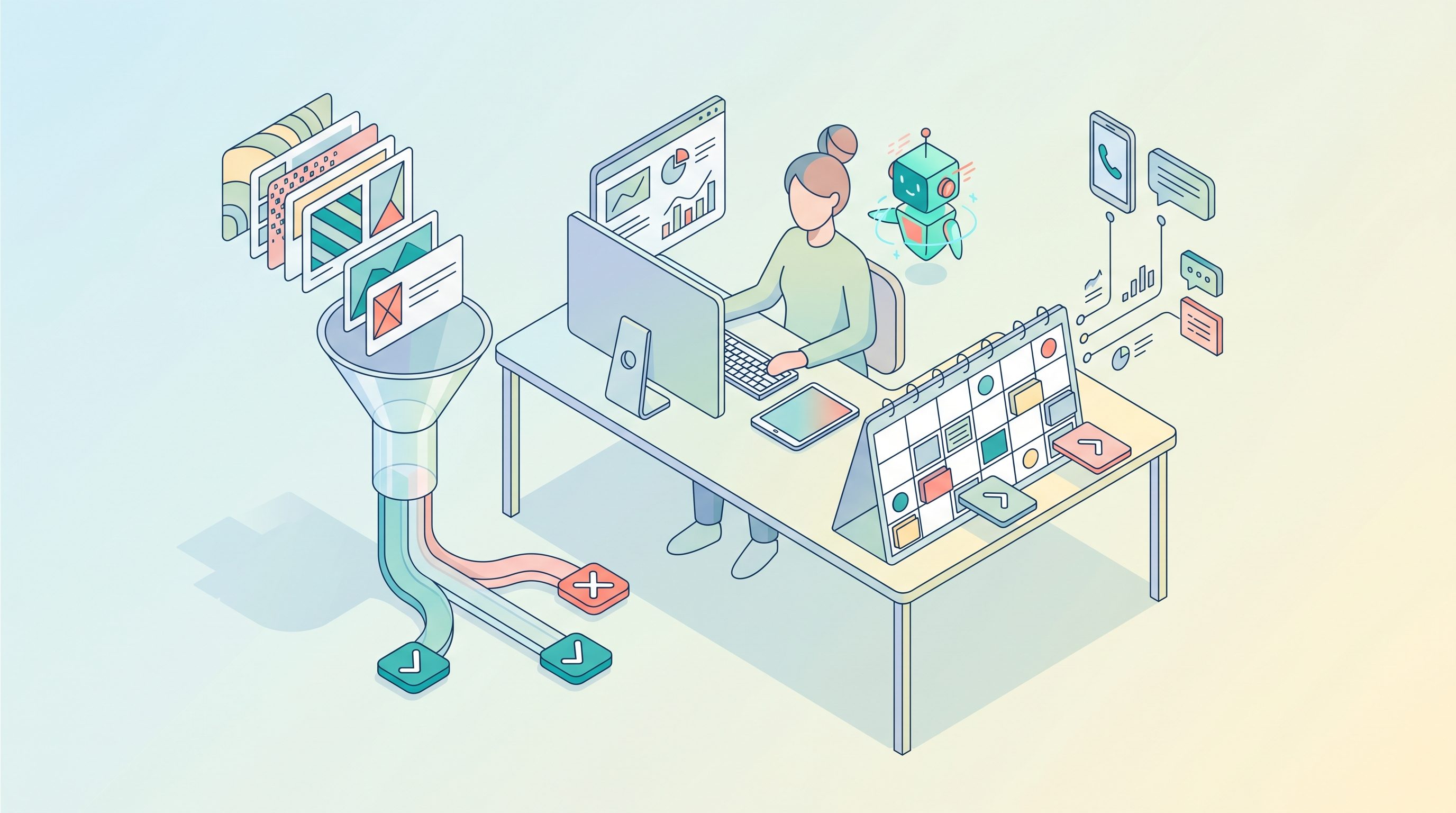
Consider the real-world business workflows that AI agents can now automate:
- Customer Support: Handling inquiries, answering interview questions, managing customer feedback, and escalating complex cases with minimal human intervention.
- Scheduling: Managing calendars, booking appointments, and sending reminders across teams.
- CRM Updates: Automatically logging interactions, updating customer profiles, and triggering follow-up tasks.
- Internal Workflows: Streamlining onboarding processes, managing project tasks, and automating data entry.
These capabilities position AI agents as digital coworkers that enhance efficiency and operational resilience.
Solvea: Best for Business Automation & Customer Experience
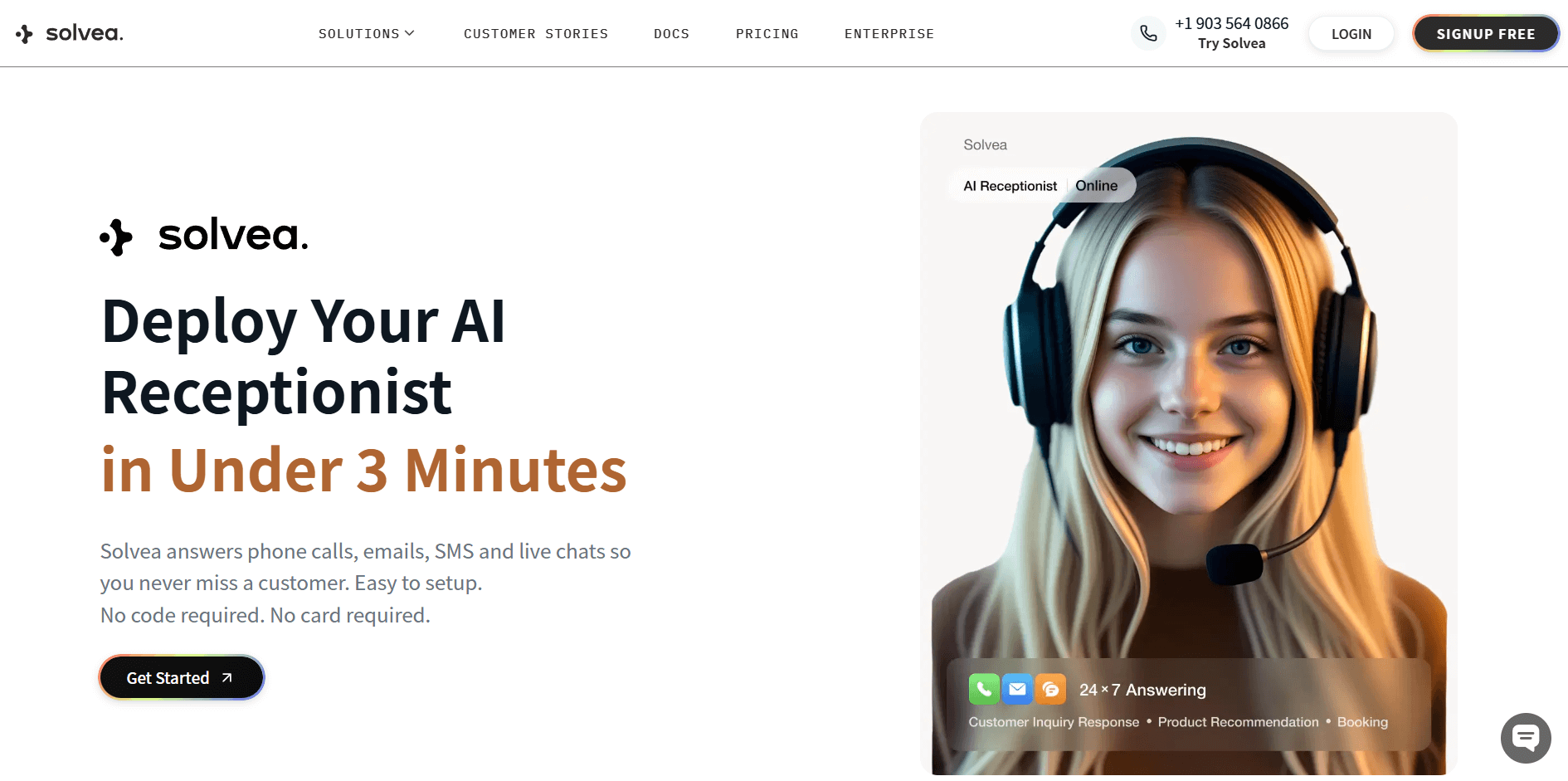
Solvea is an AI Agent Platform designed to resolve complex operational workflows and deliver high-accuracy solutions for modern business challenges. It functions as a fully autonomous digital employee, delivering 24/7 support and operational efficiency by managing the entire customer journey from initial inquiry to final resolution.
This platform is particularly well-suited for small businesses that aim to scale their support and sales operations without proportionally increasing headcount. Solvea stands out by focusing on performing the work itself, rather than merely accelerating human tasks, making it ideal for high-stakes environments like customer service and sales qualification where precise, empathetic, and resolution-driven AI is critical.
Key Capabilities:
- AI Receptionist: The AI Receptionist manages multi-channel customer interactions by providing immediate, empathetic support and guiding users through complex setup or troubleshooting processes.
- Vibe Coding Builder: The Vibe Coding Builder empowers users to customize and extend agent capabilities through intuitive, prompt-based interactions that eliminate the need for traditional software engineering.
- Knowledge Base: The platform integrates a sophisticated Knowledge Base that centralizes vast amounts of organizational data to ensure every agent response is grounded in accurate, real-time information.
- Inbox & Contact: The Inbox & Contact feature efficiently organizes all incoming communications and contact details, allowing the AI to prioritize urgent issues and maintain a seamless flow of data across the organization.
Use Cases:
- Automating customer support inquiries and resolutions.
- Processing refunds or service upgrades directly from customer requests.
- Scaling sales operations without increasing human staff.
Lindy: Best for No-code Multi-Agent Workflows
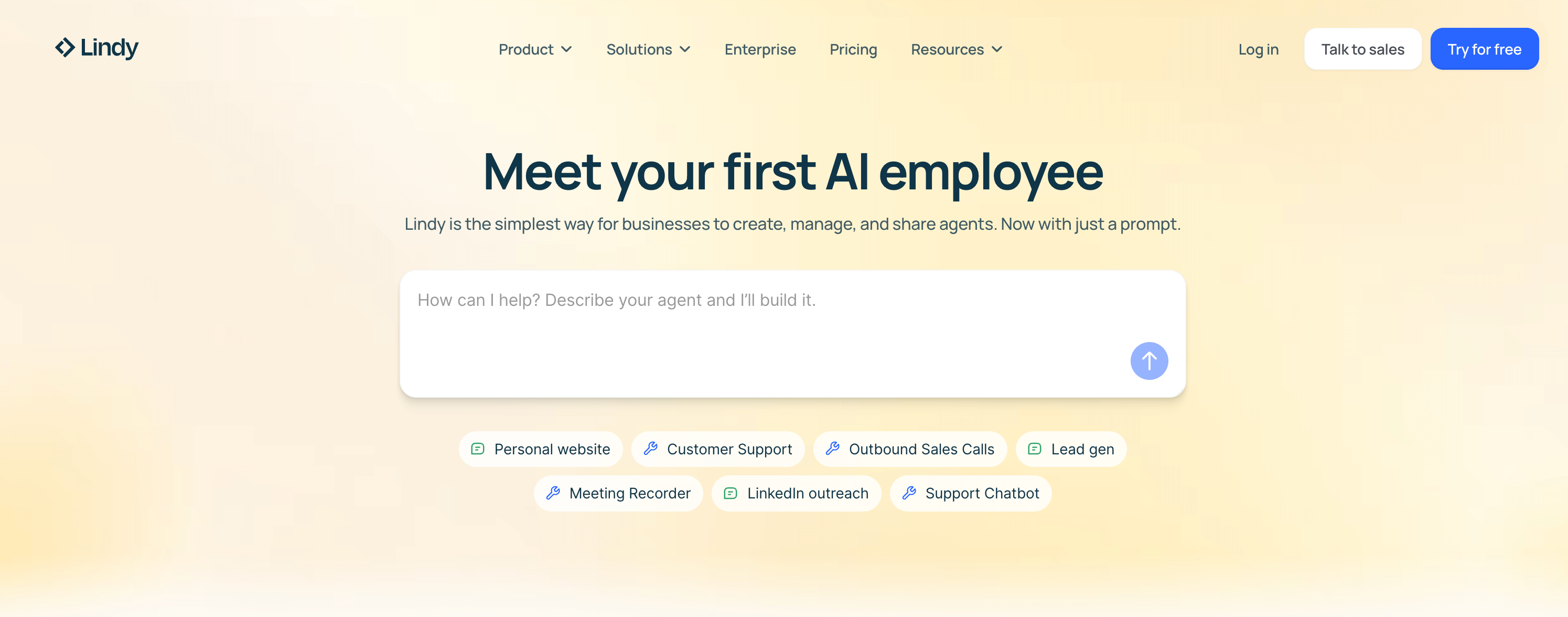
Lindy is a platform for building no-code multi-agent workflows, empowering users to automate a wide array of tasks. It is designed for founders, marketing teams, and anyone seeking to eliminate repetitive administrative burdens and enhance productivity through intelligent automation.
Lindy offers an intuitive environment where users describe their needs, and an AI agent is rapidly configured to meet those requirements without writing any code. Its user-friendly interface allows powerful automations to be built without technical background, making it accessible to a broad audience.
Key Strengths:
- Workflow Automation: Lindy provides powerful workflow automation that handles diverse tasks such as monitoring shared inboxes, updating CRM records, and summarizing meeting discussions into actionable items.
- Multi-Agent Workflows: The platform supports collaborative multi-agent workflows, allowing different AI digital employees to work together on complex, multi-stage processes like lead research and personalized outreach.
- Extensive Integrations: Lindy connects with thousands of applications through platforms like Pipedream and Apify, enabling users to seamlessly link their AI agents with almost any existing business tool.
Use Cases:
- Automating email management and shared inbox monitoring.
- Maintaining CRM data integrity and updating customer records.
- Routing critical updates to communication platforms.
Copilot: Best for Productivity Augmentation
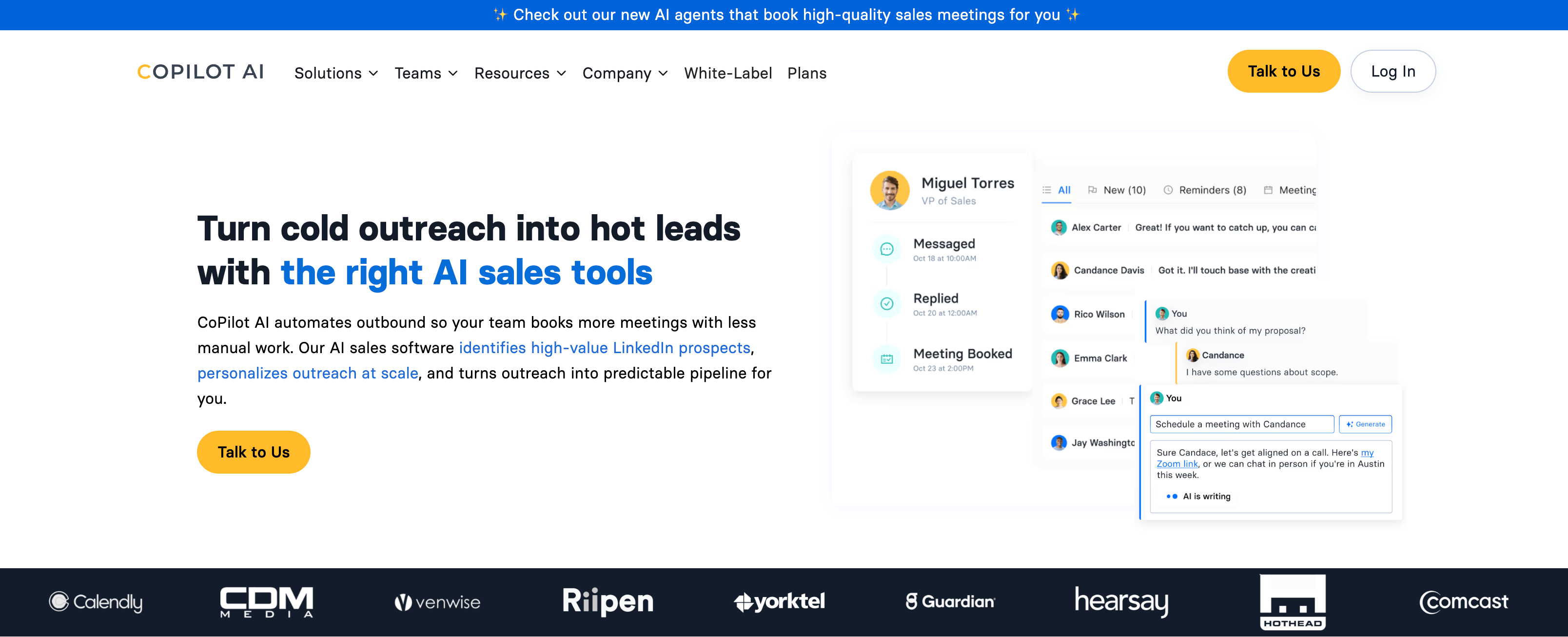
Copilot enhances productivity by deeply integrating AI capabilities directly into the Microsoft ecosystem. It is particularly beneficial for enterprises already invested in the Microsoft 365 suite, offering advanced assistance within applications like Word, Excel, PowerPoint, and Outlook.
Its core strength lies in its seamless integration with the Microsoft 365 suite, transforming how users interact with familiar applications. Copilot acts as an intelligent assistant, leveraging large language models to generate content, analyze data, and automate tasks directly within the user's workflow, thereby significantly boosting efficiency and creativity.
Key Strengths:
- Microsoft Ecosystem Integration: Copilot provides a native and seamless AI experience by being directly embedded into familiar applications like Word, Excel, PowerPoint, and Outlook.
- Document Automation: The platform excels at document automation by synthesizing data from multiple sources to draft comprehensive reports and automate the creation of complex business documents.
- Meeting Intelligence: Copilot offers real-time meeting intelligence during Teams calls, providing instant summaries and identifying key decisions and action items as they happen.
Use Cases:
- Drafting documents and presentations within Word and PowerPoint.
- Analyzing data and generating insights in Excel.
- Managing emails and scheduling meetings in Outlook.
CrewAI: Best for Developer-Focused Framework
CrewAI presents a robust, developer-focused orchestration framework built on Python. It is designed for creating teams of role-based AI agents that collaborate to achieve complex objectives, offering granular control over agent interactions and tool usage.
This framework is ideal for developers and technical teams building sophisticated, multi-step AI workflows and requiring granular control over agent interactions. It emphasizes a structured approach to AI development, allowing for the definition of clear roles, responsibilities, and communication protocols among agents to ensure efficient task execution and problem-solving.
Key Strengths:
- Role-Based AI Agents: CrewAI enables the creation of specialized role-based AI agents, allowing developers to assign distinct personas and goals to individual agents that collaborate on a single mission.
- Python Workflows: The framework is built on Python, providing technical teams with the flexibility to define intricate agent interactions, manage error handling, and integrate custom tools through code.
- Developer-Focused Orchestration: CrewAI is tailored for the orchestration of complex AI agent teams, offering the necessary infrastructure to build robust, scalable, and highly customized enterprise solutions.
Use Cases:
- Building AI teams for complex research and content generation.
- Orchestrating multi-agent systems for data analysis and reporting.
- Developing custom AI workflows for specific business processes.
AutoGen: Best for Custom Multi-Agent Systems
AutoGen, an open-source framework developed by Microsoft, is designed for building advanced multi-agent conversations and LLM applications. It caters to advanced developers and researchers pushing the boundaries of AI collaboration and requiring maximum flexibility in designing intelligent systems.
This framework empowers developers to create custom, conversational AI agents that can interact with each other, execute code, and utilize external tools to solve complex problems. Its open-source nature fosters innovation and allows for deep customization, making it a powerful tool for research and the development of highly adaptive AI systems.
Key Strengths:
- Multi-Agent Conversations: AutoGen facilitates sophisticated multi-agent conversations where multiple agents can engage in dialogue, provide feedback to one another, and collaborate to solve complex problems.
- Open-Source Flexibility: As an open-source framework, AutoGen offers unparalleled flexibility, allowing developers to modify and customize the core logic to suit specific research or development needs.
- Advanced Customization: The platform supports highly customized agent behaviors and non-linear interaction patterns, making it ideal for solving ambiguous problems that require diverse perspectives and iterative refinement.
Use Cases:
- Developing advanced multi-agent systems for research and development.
- Creating AI agents that can engage in complex dialogues and problem-solving.
- Building highly customized AI applications with flexible agent behaviors.
AI Agents Comparison Table
AI Agent | Best For | Pricing | Key Features |
Solvea | Business Automation & Customer Experience | Custom | AI Receptionist, Vibe Coding Builder, Knowledge Base, Inbox & Contact |
Lindy | No-code Multi-Agent Workflows | Free tier + Paid plans | Visual Editor, Extensive Integrations, Multi-Agent Orchestration |
Copilot | Productivity Augmentation | $30/user/month | Deep Office 365 Integration, Meeting Intelligence, Document Automation |
CrewAI | Developer-Focused Orchestration | Free tier + Paid plans | Role-Based Agents, Python Framework, Advanced Orchestration |
AutoGen | Custom Multi-Agent Systems | Custom | Multi-Agent Conversations, Open-Source Flexibility, Advanced Customization |
Your AI Receptionist, Live in Minutes.
Scale your front desk with an AI that never sleeps. Solvea handles unlimited multi-channel inquiries, books appointments into your calendar automatically, and ensures zero missed opportunities around the clock.
Conclusion
AI agents in 2026 represent a fundamental shift from assistive AI to autonomous execution. Rather than simply enhancing human productivity, modern AI agents are increasingly capable of owning entire workflows—making decisions, coordinating tools, and delivering outcomes with minimal supervision. This evolution positions AI agents not as features, but as core operational infrastructure.
Choosing the right AI agent platform depends less on model performance and more on alignment with business maturity and workflow complexity. Platforms like Solvea excel in end-to-end business execution, Lindy lowers the barrier to automation through no-code orchestration, Copilot enhances productivity within established ecosystems, while CrewAI and AutoGen empower developers to build deeply customized multi-agent systems.
Ultimately, businesses should choose AI agents based on their unique workflow complexity and technical needs. In 2026, the pivotal question is not whether to adopt AI agents, but which ones you will integrate into your team to drive growth and innovation.