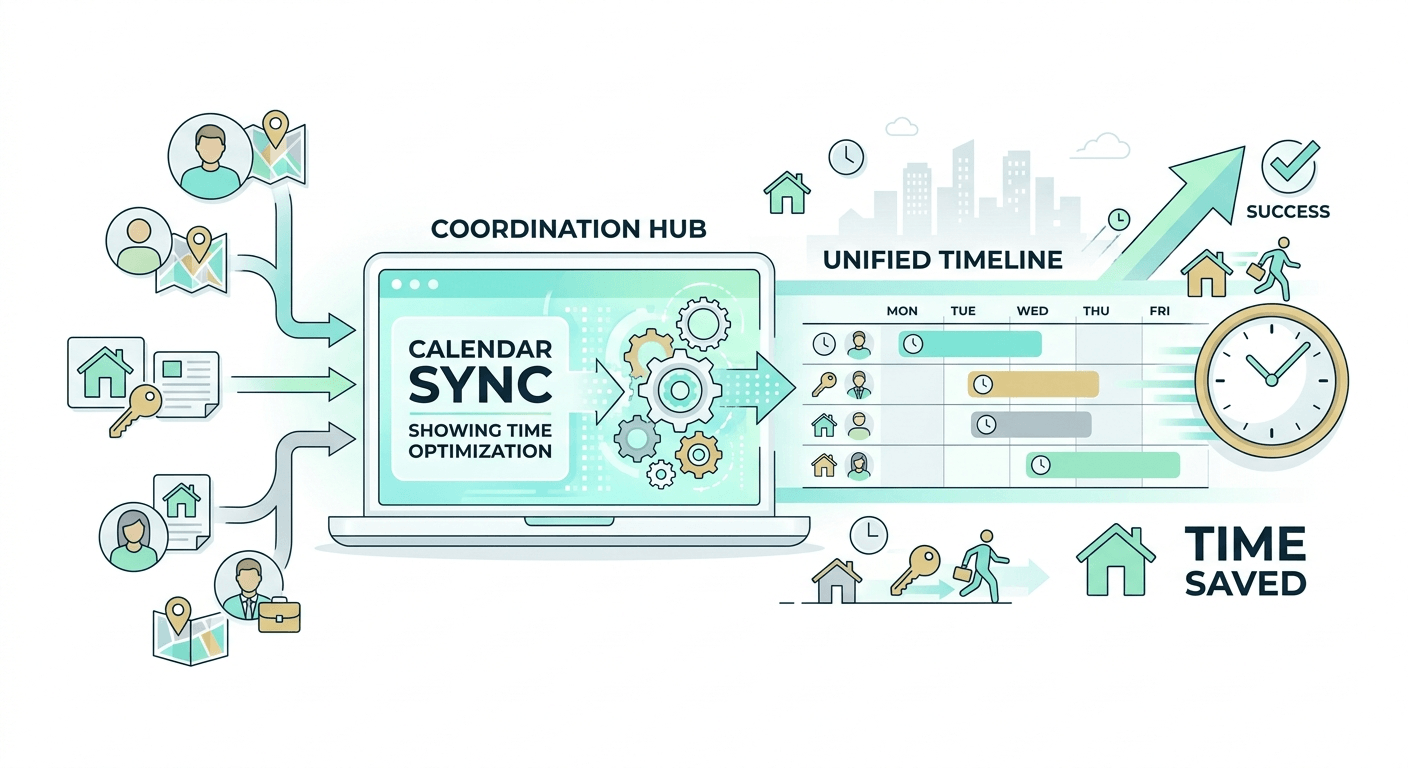
Your calendar looks full, your team is busy, and revenue is coming in. Yet something always feels slightly off—a gap that shouldn't be there, an apology you didn't plan to make, a staff member working overtime while another stands idle. The culprit is almost never obvious on a profit-and-loss statement. It's bad scheduling, and its costs are hiding in plain sight.
For service businesses—salons, medical practices, home service contractors, fitness studios—scheduling is the operational heartbeat. When it misfires, every downstream process takes a hit: customer satisfaction, staff morale, cash flow, and ultimately your reputation. Most owners focus on the direct cost of a missed appointment ($0 revenue) without accounting for the multiplier effects that compound across weeks and months.
In reality, this calendar friction triggers a dangerous mix of cumulative revenue leakage, operational inefficiency, and long-term customer churn. These drains hide behind standard line items like wasted marketing spend on unconverted off-hour leads, idle payroll capacity, and heavy administrative overhead.
This article maps the full financial and operational damage that poor scheduling quietly inflicts—and lays out practical ways to stop the drain before it becomes structural.
TL;DR
Field | Detail |
What it is | The cumulative financial and operational damage caused by scheduling inefficiencies |
Why it matters | Scheduling errors quietly leak revenue, inflate labor costs, and erode customer trust — most of it invisible on a P&L |
Hidden costs | Lost revenue, overtime bloat, customer churn, staff burnout, admin time |
Who it hits hardest | Service businesses with appointment-heavy models: salons, clinics, home services |
How Solvea helps | AI receptionist that captures, confirms, and reminds—so fewer bookings fall through the cracks |
What "Bad Scheduling" Actually Means
Bad scheduling is not just a missed appointment. It is any recurring pattern where your schedule fails to match capacity to demand accurately, communicate that capacity to customers and staff reliably, or recover gracefully when plans change.
In practice it shows up as:
- Double bookings: Two customers assigned the same slot, requiring last-minute scrambling or refusals
- Understaffing during peaks: Long wait times, rushed service, negative reviews
- Overstaffing during slow periods: Payroll burns while staff stands idle
- No confirmation system: Customers forget appointments, no-shows accumulate
- Manual re-scheduling loops: Staff spending 30–60 minutes on a single rescheduled appointment
- Delayed or no reminders: Customers who would have shown up with a nudge simply don't
Each of these failure modes carries its own price tag. Most businesses experience several simultaneously.
The 5 Hidden Costs of Bad Scheduling
1. Direct Revenue Loss From No-Shows and Gaps
The most visible hidden cost: appointments that simply don't happen. A slot that goes unfilled generates $0 while your overhead continues. The annualized cost depends on your average ticket and weekly no-show volume — even a few unfilled slots per week, multiplied across 50 working weeks, often add up to a meaningful share of profit.
The compounding factor: businesses with manual or inconsistent reminder systems tend to report higher no-show rates than those using automated confirmations. Each no-show is not a one-time event; it's a structural leak that repeats every week until the system is fixed.
2. Overtime Bloat and Wasted Labor Hours
When demand is misforecast, two things happen simultaneously: some staff members run into overtime while others have empty hours. Overtime is paid at a premium, so the labor budget is hit twice — once for the idle hours that did nothing, and again at a 1.5x rate to cover the gap somebody else has to plug.
Even a small per-shift productivity loss — half an hour of misaligned breaks or sloppy handoffs across a dozen-plus staff — accumulates into hundreds of paid-but-unproductive hours over a year. The amount rarely shows up as a line item labeled "bad scheduling." It's distributed across payroll, overtime reports, and staff churn.
3. Customer Trust Erosion and Churn
A customer who experiences one bad scheduling interaction — a double booking, a long unexplained wait, or a missing confirmation that made them unsure whether their appointment was real — is materially less likely to rebook than one who had a smooth experience. The mechanism has been documented in service-industry retention research going back to Reichheld and Sasser's classic 1990 work: in service businesses, small improvements in retention compound into outsized profit gains, because each lost customer is also a lost stream of future visits, not just one transaction.
Scheduling is often the first and last touchpoint in a service relationship. A chaotic booking experience — whether it's a busy phone line, a missed confirmation, or a surprise rescheduling message — signals operational unreliability before a customer has even walked through the door.
4. Manager and Staff Burnout From Administrative Overhead
Managers at businesses with weak scheduling systems lose meaningful chunks of every week to resolving conflicts, filling gaps, and fielding last-minute changes. Time spent firefighting the calendar is time not spent coaching staff, improving service quality, or growing the business.
For staff, inconsistent scheduling — unpredictable shifts, last-minute changes, no visibility into the upcoming week — is consistently cited in industry surveys as a driver of disengagement and turnover. Replacement cost varies widely by role and tenure, but recruiting, onboarding, and productivity ramp-up together represent a substantial fraction of an employee's annual compensation — easily enough to make even modest turnover gains compound into real money.
Poor scheduling is not just an operations problem. It is a people problem that compounds into a hiring problem.
5. Cascading Costs of Rescheduling
Every rescheduled appointment triggers a chain of smaller costs that are easy to overlook individually but add up fast: the staff time to communicate the change, the system update, the potential discount or apology credit offered to the inconvenienced customer, and the real possibility that the customer simply doesn't rebook at all.
The per-reschedule cost depends on whether the customer rebooks at all, how much staff time the back-and-forth consumes, and whether you offer an apology discount. Multiply even a modest per-reschedule cost by ten reschedules per week and 50 weeks, and a problem most owners classify as "just part of running the business" turns into a five-figure annual leak.
Where Service Businesses Feel It Most
Not all businesses are equally exposed. Appointment-heavy service models face the highest concentration of scheduling risk because:
- Revenue is directly tied to occupied time slots (unlike product sales, you cannot stockpile an empty appointment)
- Customers are physically traveling to you or you to them, making last-minute changes expensive for both parties
- Labor cost is largely fixed regardless of whether appointments fill
Business Type | Primary Scheduling Risk | Financial Impact Pattern |
Medical / dental practice | No-shows, last-minute cancellations | Each unfilled slot = full overhead cost, $0 revenue |
Salon / spa | Double bookings, walk-in overflow | Customer complaints, overtime pay, lost loyalty |
Home service (plumbing, HVAC) | Routing inefficiency, idle crews | Crew time gets paid whether driving, waiting, or working — routing slack is pure margin loss |
Fitness studio | Underbooked classes, instructor overpay | Fixed instructor cost spread over declining headcount |
Veterinary / therapy practice | Long no-show chains, staff over-scheduling | Admin burnout, patient dissatisfaction, reputation damage |
For a deeper playbook on closing these leaks, see our guide to 10 ways to reduce no-show appointments in your service business.
How to Fix Bad Scheduling: 5 Practical Steps
1. Implement Automated Reminders at Multiple Touchpoints
For most service businesses, automated multi-touch reminders are the highest-return scheduling intervention to put in place first — sent on a sensible cadence (commonly 2–3 days before, 1 day before, and a few hours before). In hospital outpatient settings, where this has been studied most rigorously, a 2026 meta-analysis of ten randomized controlled trials (Al-Turbag et al., J Hosp Manag Health Policy) found reminders lift appointment attendance by about 11% on average (risk ratio 1.11), with SMS and phone reminders performing roughly the same. The specific 11% figure is healthcare-scoped and shouldn't be transplanted onto medspas, salons, or home services, but the underlying mechanism — multiple touchpoints reduce drop-off, and the channel matters less than the cadence — generalizes. The cost of a reminder system is typically recovered within the first month of recovered bookings.
2. Use Demand Forecasting Instead of Templates
Most businesses build next week's schedule by copying last week's. Historical demand data—booked vs. actual attendance by day and time, average no-show rates by service type, seasonal patterns—should inform staffing levels before the schedule is published, not after gaps appear.
3. Centralize Scheduling Into One System
Fragmented scheduling—phone calls logged on sticky notes, online bookings in one calendar, walk-ins in another—makes double-bookings nearly inevitable and makes demand visibility impossible. A single source of truth for all appointments, accessible in real time by every staff member, eliminates the class of errors that comes from working from inconsistent information.
4. Establish a Clear Rescheduling Policy
Ad hoc rescheduling burns time and sets no expectations. A written policy—how far in advance customers can reschedule without a fee, what the cancellation window is, what constitutes a no-show—removes ambiguity for both staff and customers, reduces negotiation overhead, and gives you defensible ground when disputes arise.
5. Track the Metrics That Expose Hidden Costs
If you are not measuring it, you cannot fix it. Key scheduling health metrics to track weekly:
- No-show rate — what looks "normal" varies widely by sector; the right benchmark is your own trend, not an industry-wide number
- Utilization rate (revenue-generating slots ÷ total available slots)
- Average reschedule cycle time (how long it takes to confirm a rescheduled appointment)
- Overtime hours as % of total scheduled hours — flag this when it starts trending up week over week, regardless of the absolute level
From Manual Scheduling to Automated Answers: How AI Handles the Gap
Even businesses that solve the internal scheduling process often lose bookings at the front door: calls that come in after hours, texts that go unanswered, voicemails that wait until Monday morning. Every unanswered inquiry is a customer who found another provider while you were unavailable.
Solvea addresses this specific gap with an AI receptionist that handles inbound booking requests, sends confirmation and reminder messages, and answers common scheduling questions—across phone, chat, and email—without requiring a staff member to be available. You configure it once with your scheduling rules, service menu, and availability; the AI applies them consistently every time a customer reaches out.
The result is fewer missed bookings, lower no-show rates from consistent reminders, and less administrative load on staff who would otherwise manage the intake manually.
Your AI Receptionist, Live in Minutes.
Scale your front desk with an AI that never sleeps. Solvea handles unlimited multi-channel inquiries, books appointments into your calendar automatically, and ensures zero missed opportunities around the clock.
Frequently Asked Questions
How much does bad scheduling actually cost a small service business per year? The honest answer is "it depends on your average ticket and how often slots go unfilled," but the back-of-envelope is straightforward. A business with 5 no-shows per week at an average service value of $75 loses $19,500 a year from that single failure mode alone — before counting overtime, rescheduling labor, or customer churn. Plug in your own ticket and no-show rate to size it up; for most appointment-heavy service businesses, the answer is "more than you'd expect."
Is an automated reminder system worth the cost? Almost universally yes. Most scheduling platforms with automated reminders cost $50–200 per month. A single recovered appointment typically covers the monthly cost. Businesses with high-value appointments (medical, legal, home services) often recover the tool cost within the first week.
What's the difference between a no-show and a late cancellation? A no-show is when a customer does not arrive and does not contact you. A late cancellation is when they cancel inside your defined window (typically 24–48 hours before). Both leave gaps, but late cancellations at least give you a chance to rebook the slot. Reminders are well-evidenced to reduce silent no-shows; what they often do for cancellations is convert them from no-show form into advance-notice form — which is the version you can actually do something with.
How do I calculate my business's no-show rate? Divide the number of no-shows in a given period by the total appointments scheduled in that period, then multiply by 100. Example: 8 no-shows out of 100 scheduled appointments = 8% no-show rate. Benchmarks vary widely by sector — in US medical groups, MGMA's 2025 reporting showed single-specialty no-show rates rebounding to 6.81% in 2023 after a pandemic dip. Personal services like salons and fitness studios commonly run materially higher, especially without reminder systems in place, but the published figures vary widely. Tracking your own trend over time is more useful than chasing a sector benchmark.
Does Solvea replace my existing booking system? No. Solvea integrates with your existing scheduling setup as an AI layer that handles inbound communication, sends reminders, and answers customer questions. It works alongside your current calendar rather than replacing it.
What scheduling metrics should I track to spot hidden costs early? Start with four: no-show rate, slot utilization rate, overtime hours as a percentage of total scheduled hours, and average time spent on scheduling administration per week. These four metrics surface the most common and costly scheduling failure patterns before they compound into larger problems.