







OpenAI has released GPT-5.4, its latest frontier model designed for advanced reasoning and professional workflows. This model consolidates improvements in reasoning, coding, and agentic capabilities into a single system suitable for complex business tasks, software development, and automation. Understanding GPT-5.4's capabilities and limitations is essential for developers and organizations considering its adoption.
What Is GPT-5.4?
GPT-5.4 is a large language model developed by OpenAI, optimized for professional and enterprise-level applications. Unlike earlier models, it emphasizes tool integration, advanced problem-solving, and complex reasoning across multiple domains. The model is designed to perform sophisticated tasks including writing, coding, reasoning, and analyzing large volumes of information. Its architecture prioritizes professional workflows, making it suitable for organizations that need a versatile AI system capable of handling diverse challenges beyond simple text generation.
Key Features of GPT-5.4
GPT-5.4 introduces several transformative capabilities that distinguish it from earlier models. These features work together to enable new possibilities for AI-driven automation, analysis, and problem-solving across professional domains.
The model's design philosophy centers on three core pillars: advanced reasoning that enables complex problem-solving, seamless integration with external tools and systems, and efficient processing of large amounts of information. By combining these elements, GPT-5.4 delivers capabilities that were previously unavailable in a single AI system.
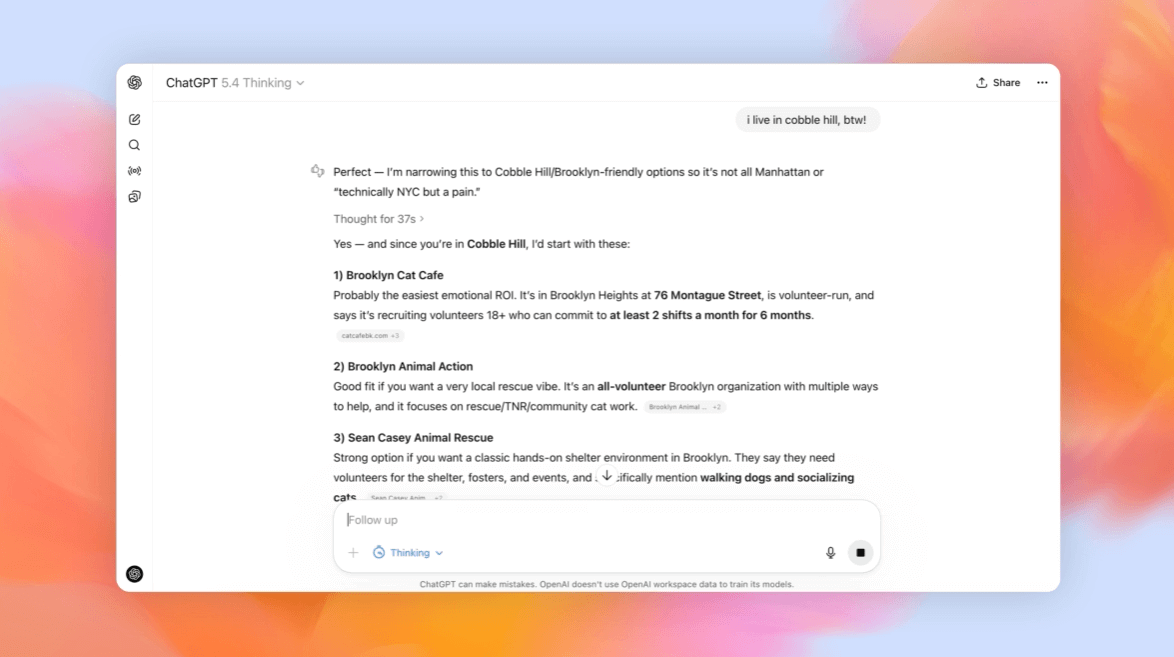
Advanced Reasoning Capabilities: OpenAI has introduced GPT-5.4 Thinking, a specialized reasoning-focused variant that allocates additional computational resources to the reasoning process. This variant excels at data analysis, coding challenges, and complex problem-solving scenarios where careful analytical thinking is essential.
Large Context Window: The model processes vast amounts of information in a single interaction, eliminating the need to fragment large tasks into smaller chunks. Users can feed entire codebases, research documents, or datasets into GPT-5.4 and receive coherent, contextually aware analysis.
Native Computer-Use Capabilities: GPT-5.4 can interact directly with software environments, applications, and websites, enabling autonomous multi-step task execution across different platforms. Rather than being limited to text-based interactions, AI agents can navigate web interfaces, interact with software tools, and coordinate actions across multiple systems.
Improved Performance and Efficiency: The model achieves superior benchmark performance while consuming fewer tokens than previous generations, improving both capability and cost-effectiveness. This dual improvement translates to faster response times and reduced operational costs for large-scale deployments.
Tool Integration and Agent Workflows: GPT-5.4 is optimized for seamless integration with external tools, APIs, databases, and services, enabling developers to build sophisticated intelligent agents. The model's architecture supports complex workflows where the AI system can decide which tools to use and coordinate multiple tool interactions to achieve specific objectives.
These capabilities collectively represent a significant leap forward in what AI systems can accomplish. Organizations can now leverage a single model for tasks that previously required multiple specialized tools or manual intervention.
Common Use Cases of GPT-5.4
GPT-5.4's versatile capabilities make it suitable for diverse professional applications across industries. The model has proven particularly valuable in several key domains where its combination of reasoning, context awareness, and tool integration provides measurable benefits.
Software Development and Debugging: GPT-5.4 assists with code writing, debugging complex issues, and refactoring codebases. The model's advanced reasoning helps developers identify subtle bugs and suggest architectural improvements.
Document Analysis and Research: GPT-5.4 processes lengthy documents, research papers, and reports to extract key insights and summarize findings. The large context window makes comprehensive analysis practical, allowing researchers to feed entire datasets into the model.
Data Analysis and Knowledge Work: GPT-5.4 interprets data, performs statistical analysis, and derives actionable insights from complex datasets. Organizations are using the model to support data-driven decision-making and uncover patterns in large information volumes.
Workflow Automation: GPT-5.4 enables building automation systems that handle routine tasks and execute complex business processes with minimal human intervention. These systems can adapt to changing conditions and handle exceptions intelligently.
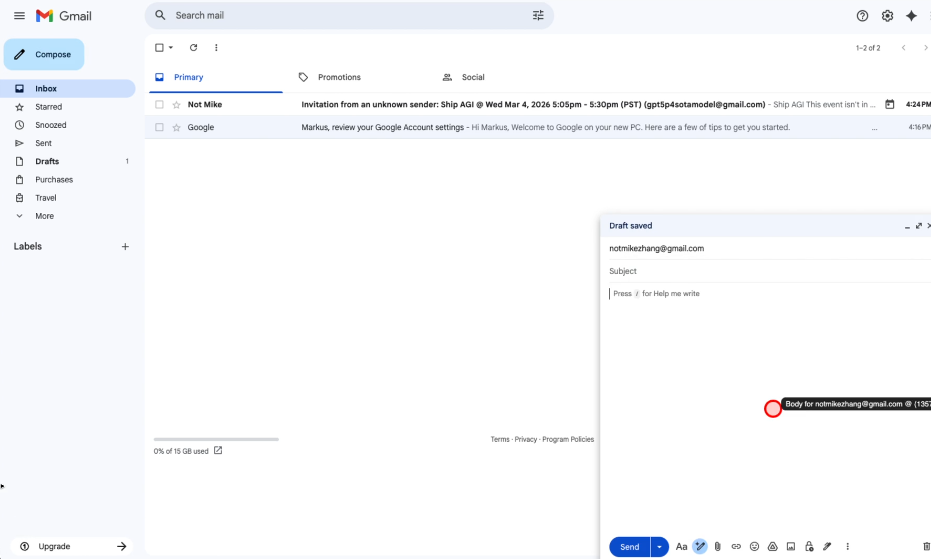
AI Assistants and Intelligent Agents: Developers are creating sophisticated AI assistants that provide personalized support, handle customer interactions, and manage information retrieval. These applications leverage GPT-5.4's combination of capabilities to deliver more responsive AI systems. For example, you can use it as a AI assistant for email management.
GPT-5.4 vs Previous GPT Models
GPT-5.4 represents significant evolution from earlier models in the GPT series. The improvements span multiple dimensions, from reasoning capabilities to system integration, making it substantially more capable for professional applications.
Understanding these advancements is important for organizations considering whether to upgrade their AI infrastructure. The differences aren't merely incremental improvements—they represent fundamental shifts in what AI systems can accomplish.
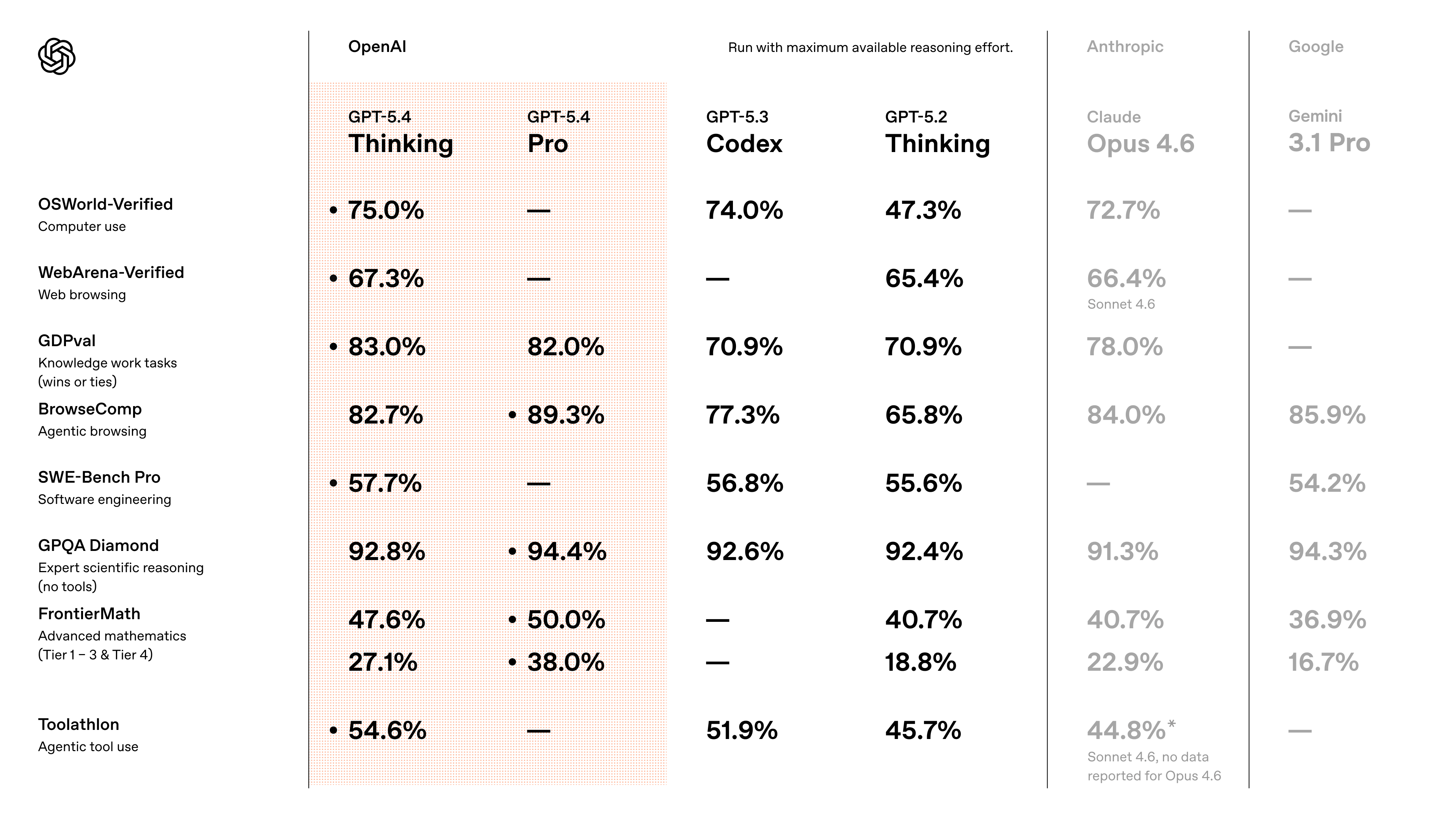
- Stronger Reasoning Capabilities: GPT-5.4 Thinking introduces a dedicated reasoning mode that allows the model to work through problems methodically. Earlier models lacked explicit reasoning capability and often produced answers without transparent problem-solving processes.
- Larger Context Handling: GPT-5.4's expanded context window is substantially larger than previous models, enabling comprehensive information processing in single interactions. Users no longer need to break down large documents or projects into smaller chunks, a limitation that constrained earlier models.
- Better Tool and Workflow Integration: Earlier models had limited tool use capabilities and required significant workarounds; GPT-5.4 is purpose-built for seamless integration and complex agent workflows. This architectural difference makes GPT-5.4 fundamentally more suitable for production automation systems.
- Improved Efficiency and Performance: GPT-5.4 achieves superior benchmark performance while using fewer tokens than previous generations, improving both capability and cost-effectiveness. This efficiency gain is particularly significant for organizations running large-scale deployments.
- Native Computer-Use Capabilities: Earlier models could only interact through text-based interfaces; GPT-5.4 can directly interact with software environments, applications, and websites. This fundamental difference expands automation possibilities from text generation into direct system interaction.
These improvements collectively position GPT-5.4 as significantly more suitable for professional workloads and advanced AI systems. Organizations can tackle more complex problems with greater efficiency and reliability than was previously possible.
Limitations to Be Aware Of
Despite considerable capabilities, GPT-5.4 has important limitations that users should understand before deployment. Organizations must carefully consider these constraints when planning AI integration strategies.
- Occasional Inaccuracies: Like all language models, GPT-5.4 can occasionally generate incorrect or misleading information that requires verification in high-stakes applications. This limitation is particularly important in domains where accuracy is critical, such as medical, legal, or financial applications.
- Feature Integration Requirements: Advanced features like computer-use and tool integration require proper setup and don't work in isolation, demanding appropriate technical infrastructure. Organizations need to ensure they have the necessary technical resources and knowledge to properly integrate these features.
- Need for Human Oversight: In applications with significant consequences such as healthcare, legal matters, and financial decisions, human oversight remains essential and cannot be eliminated. AI systems should augment human decision-making rather than replace it entirely.
- Dependency on Quality Inputs: The quality of GPT-5.4's outputs is significantly influenced by input quality, with poorly formulated prompts resulting in suboptimal responses. Users need to invest time in crafting clear, well-structured prompts and providing complete context.
Organizations should carefully evaluate these limitations in the context of their specific use cases. Implementing appropriate safeguards and oversight mechanisms ensures responsible and effective deployment.
Conclusion
GPT-5.4 represents a significant advancement in AI capabilities, bringing together improvements in reasoning, coding, and agentic workflows that fundamentally expand what AI systems can accomplish in professional environments. Organizations should approach deployment thoughtfully, ensuring proper integration, maintaining human oversight where appropriate, and continuously evaluating outcomes to ensure the technology serves its intended purpose effectively.
FAQ About GPT-5.4
1.What is GPT-5.4 used for?
GPT-5.4 is designed to support complex professional tasks including writing, coding, data analysis, document processing, and workflow automation. It excels at handling multi-step problems requiring sophisticated reasoning and is used to build AI assistants and intelligent agents that interact with external systems and tools.
2.What is GPT-5.4 Thinking?
GPT-5.4 Thinking is a specialized reasoning-focused variant optimized for complex, multi-step problem solving and analytical tasks. This version allocates additional computational resources to the reasoning process, allowing it to work through difficult problems methodically and arrive at more accurate solutions.
3.How is GPT-5.4 different from earlier GPT models?
GPT-5.4 introduces stronger reasoning capabilities through the dedicated Thinking variant, improved efficiency with fewer tokens required per task, larger context window for processing more information, better support for tool integration and automation workflows, and native computer-use capabilities allowing interaction with software environments.
4.Can GPT-5.4 interact with software or tools?
Yes. GPT-5.4 is specifically designed to support computer-use capabilities and tool integrations, allowing AI systems to interact directly with software environments, applications, and external services. The model can navigate interfaces, execute commands, and coordinate actions across multiple systems while maintaining context and working toward defined objectives.