Running a business alone means doing everything. Marketing, product, customer support, finance, legal, operations — all of it, with one person's time and energy.
OpenClaw doesn't add more hours to your day. It's use cases remove the work that was never worth your hours to begin with. This guide covers the specific setup that works for solo founders: which automations to prioritize, how to structure a multi-agent team, and what the community has actually deployed in production.
TL;DR — Solo Founder Automation Stack
Function | Automation | Time saved/week |
Research | Competitor analysis, market monitoring | 3–5 hrs |
Content | Social posts, newsletter, SEO drafts | 8–12 hrs |
Outreach | Lead enrichment, DM sequences | 4–6 hrs |
Ops | Meeting notes, invoices, onboarding | 3–4 hrs |
Finance | Expense tracking, report generation | 1–2 hrs |
The Solo Founder Reality
The challenge isn't finding automation tools. It's that most automation tools require more setup time than they save — at least in the first month. OpenClaw's learning curve is real.
Gartner forecasts that 65%+ of small businesses will adopt agentic tools by end-2026 for operations automation, according to Solo Business Hub's February 2026 analysis. Early adopters report 20–50 hours per week saved on research, outreach, monitoring, and content — translating to 5,000–30,000+/month in unlocked capacity.
But the community data points to a consistent pattern: founders who push through the first two weeks of setup end up running operations that would have required a $3,000–$5,000/month virtual assistant budget to match. The time investment front-loads; the payoff compounds.
The Four-Agent Founder Stack
The multi-agent setup shared on OpenClaw's community showcase by a solo founder running a SaaS business has become a widely referenced template in the community. Four agents, each with a named persona and specific role, all accessible through a single Telegram chat.
Milo (Orchestrator) — Strategy, planning, big-picture decisions. Receives all incoming requests, routes to specialists, consolidates outputs. Uses Claude for reasoning. Described as 'confident and charismatic.'
Josh (Business) — Metrics, pricing, financial analysis, growth strategy. Monitors key business numbers, flags anomalies, produces weekly dashboards. 'Pragmatic and numbers-driven.'
Angela (Marketing) — Content ideas, competitor research, trend monitoring, social media. Generates content briefs, monitors competitor activity. Uses Gemini for research breadth. 'Extroverted, funny and full of ideas.'
Bob (Dev) — Code review, architecture decisions, dependency management, deployment monitoring. Uses Codex for technical tasks. Runs daily security scans automatically.
All four connect to a single Telegram chat through the orchestrator. Weekly summaries from each agent consolidate into a Friday briefing you read in 10 minutes.
Once you're running four agents simultaneously, visibility becomes the new challenge. Bhanu Teja P, the solo founder behind SiteGPT ($13K MRR), built an "Agent Mission Control" dashboard to manage his OpenClaw agent swarm — tracking real-time task status, agent activity, API spend, and logs across multiple agents simultaneously. An open-source version exists at manish-raana/openclaw-mission-control (built with Convex and React) if the built-in OpenClaw dashboard isn't enough for your setup.
For the technical configuration of multi-agent setups — bindings, workspaces, and session management — see our full OpenClaw multi-agent setup guide.
Automations That Move the Needle
Not all automations are equal. The community has learned through deployment which ones actually change what a solo founder can accomplish.
Competitor intelligence runs weekly — tracking product changes, pricing updates, new features, job postings, and press coverage for 5–10 competitors. The output is a structured report you spend 15 minutes reviewing, not 3 hours building.
Meeting preparation runs before every calendar event. OpenClaw researches attendees, surfaces relevant context from previous conversations, checks recent news about their company, and delivers a 2-minute briefing to your phone before the call. According to one founder's showcase post, this single automation changed the quality of their customer conversations more than any other. For the full morning briefing setup including meeting prep configuration, see our OpenClaw morning briefing guide.
Invoice generation connects to your time tracking or project management tool and produces client invoices formatted to your template. Send to client, log in accounting system, follow up if unpaid after 14 days. Zero manual steps.
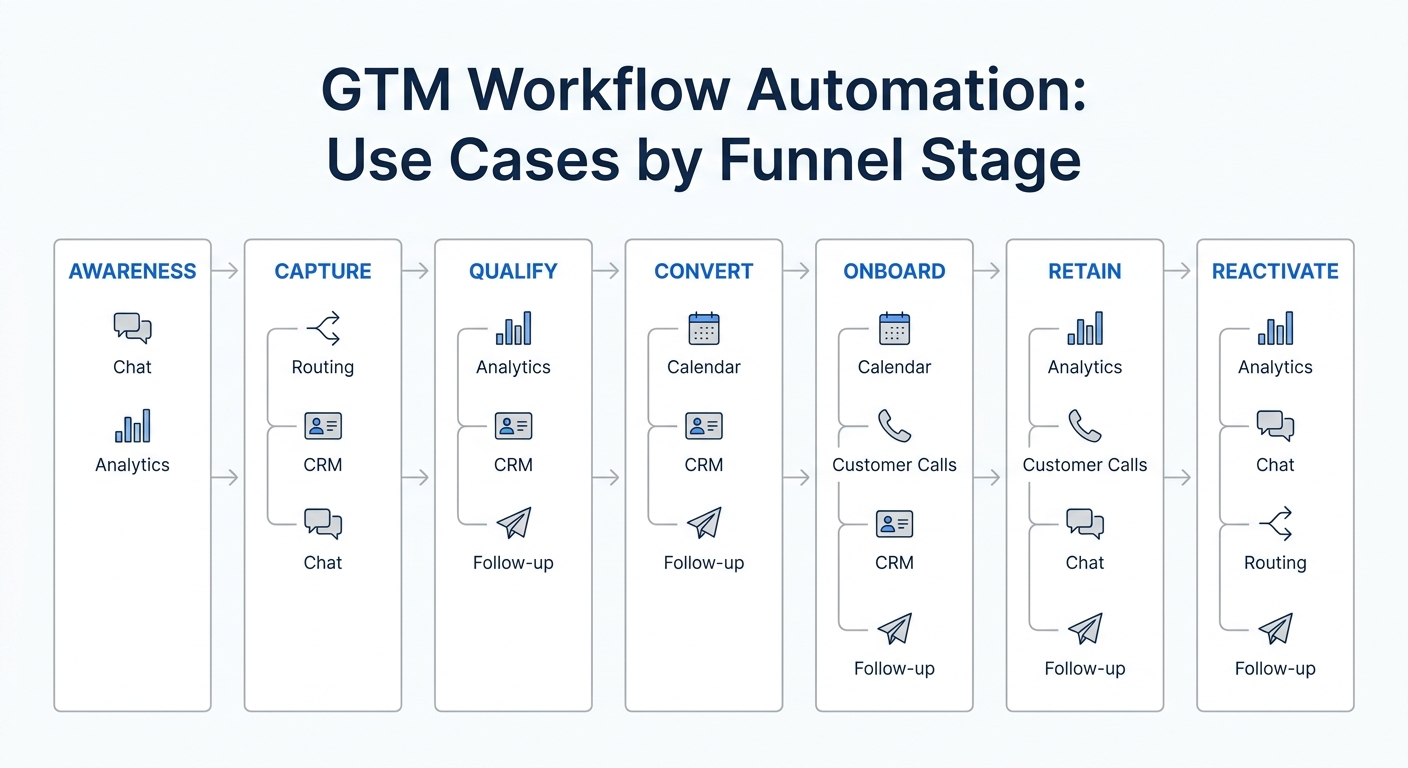
Customer onboarding triggers on new signup → welcome sequence → product setup checklist → check-in at day 3 and day 7 → flag to you if engagement drops below threshold. Runs for every new user, whether you have 3 or 300. For the full CRM and relationship management setup, see our guide to OpenClaw as a personal CRM.
The Content Engine
Solo founders consistently report that content creation is where they feel most time-constrained. A single founder can't produce the volume that builds an audience without either burning out or outsourcing.
OpenClaw's content automation doesn't replace your voice — it eliminates the distribution, reformatting, and research work surrounding it. You write or record one piece of core content per week. OpenClaw distributes it across platforms in platform-native formats, monitors what performed, and drafts the next newsletter outline so your writing session starts with a structured foundation, not a blank page.
According to TLDL.io's community survey, this approach saves 8–12 hours per week for active content creators — time that goes back into product and customer work.
Financial Operations
The unglamorous automations save the most headaches.
Expense tracking via receipt scanning: photograph a receipt, send via Telegram, OpenClaw logs it. No manual entry. According to Contabo's OpenClaw business guide, this eliminates 1–2 hours of monthly bookkeeping for most solopreneurs.
Weekly financial dashboards: every Monday morning, a summary of last week's revenue, expenses, outstanding invoices, and burn rate, delivered before you start work. No spreadsheet required.
Tax preparation support: at month end, OpenClaw categorizes expenses, flags uncategorized items for manual review, and exports a structured summary your accountant can use. Not a replacement for an accountant — a preparation tool that reduces their time and your bill.
Wondering how AI like this can help your business? Solvea uses the latest AI to answer your customer calls, emails, and chats — 24/7, no setup required. See how it works |
Your AI Receptionist, Live in Minutes.
Scale your front desk with an AI that never sleeps. Solvea handles unlimited multi-channel inquiries, books appointments into your calendar automatically, and ensures zero missed opportunities around the clock.
Frequently Asked Questions
What's the best OpenClaw setup for a solo founder?
The community-validated starting point is the four-agent stack: an orchestrator (Claude), a dev agent (Codex), a marketing agent (Gemini), and a business agent. All accessible via one Telegram chat. Shared memory stores project context; each agent maintains its own conversation history. Start with a single agent and the morning briefing, then add the multi-agent structure once you understand the basics.
How much does it cost to run OpenClaw as a solo founder?
The OpenClaw software is free. API costs depend on usage — most solo founders running moderate automation report $15–$40/month using a mixed model stack (cheaper models for routine tasks, stronger models for complex reasoning). The four-agent setup can run for under $30/month using Grok 4.1 Fast as the primary model with Claude as a premium fallback.
How long does it take to set up OpenClaw for a business?
Expect 2–4 hours for the initial setup and first working automation, and 2–3 weeks before your setup feels stable and genuinely useful. The learning curve is front-loaded. Founders who report the highest value consistently pushed through the first two weeks of configuration rather than stopping after the first working demo.
The Bottom Line
Solo founders who get the most from OpenClaw share one trait: they treat it as infrastructure, not a tool. Tools you use when you remember. Infrastructure runs whether you're thinking about it or not. To keep the cost of running four agents manageable, our guide to the best affordable LLMs for OpenClaw covers the cheapest capable models and routing strategies.
The four-agent stack, the overnight outreach, the weekly competitor report, the automatic invoice — none of these require your attention after setup. They run, they produce output, you review what matters and ignore what doesn't.
That's the solo founder leverage equation: your time goes to decisions and relationships; the agents handle everything else.