Rising labor costs and staff shortages are pushing many medical practices to the limit. Front-desk teams often struggle to keep up with calls, scheduling changes, and patient questions that require responses outside business hours.
AI medical receptionists sit right in the middle of this problem. They answer calls and messages 24/7, help patients schedule or confirm visits, route urgent issues to staff, and keep the front desk from burning out.
In this guide, we break down 10 of the best virtual medical receptionists in 2026. You will see full‑stack clinical platforms like DeepCura, medspa‑focused tools like Solvea, dental receptionists like Arini, and communication hubs like Weave and Klara. Let's find the right fit for your practice.
How We Choose the Best AI Medical Receptionist
Selecting an AI medical receptionist is a high-stakes decision. To produce a balanced, real-world evaluation, we reviewed vendor documentation, public case studies, and verified user reviews on G2, Capterra, Trustpilot, and Reddit. We filtered out tools with thin, unverifiable, or marketing-only information. This framework was designed to reflect what matters most in a live clinical environment:
Evaluation Criterion | Weight | What We Looked For |
Clinical focus & patient safety | 25% | Purpose-built for healthcare; clear guardrails around medical advice; reliable escalation for urgent or complex cases |
Scheduling & EHR integration | 20% | Reliable two-way sync with calendars and practice management systems; ability to book, move, and cancel visits safely |
Voice & messaging quality | 15% | Natural conversation, low latency, and support for phone, SMS, and chat so patients do not feel like they are talking to a script |
Compliance & security | 20% | BAA availability, AES-256 encryption, SOC 2 audits, and clear policies for PHI storage and model training |
Proven outcomes & user reviews | 10% | Evidence of reduced no-shows, higher answer rates, or saved staff hours — verified via G2, Capterra, Trustpilot, and Reddit |
Ease of setup & ongoing support | 5% | Straightforward onboarding, responsive support, and admin tools that non-technical staff can use |
Pricing transparency | 3% | Clear pricing tiers with no hidden fees; free trial or demo availability |
TL;DR: Best AI Medical Receptionists in 2026 Comparison Table at a Glance
If you want a quick overview before reading the details, this table shows the main strengths, pricing starting points, and compliance posture for each tool. Use it to shortlist two or three options to trial.
Tool | Best For | Key Advantages | Starting Price | Compliance |
DeepCura | Full-stack clinical workflows | AI receptionist + scribe + billing; deep EHR links | $129/month | HIPAA, CASA Certified |
Sully.ai | Integrated clinical automation | Network of AI "staff" (receptionist, nurse, coder); scalable | $49/month | HIPAA |
Solvea | MedSpa & aesthetic clinics | MedSpa journeys, packages, memberships; omni-channel + analytics | $30/month | SOC2, GDPR, ISO27001 |
Arini | Dental practices | Dental-specific flows, referrals, sub-300ms latency | Custom | HIPAA, AES-256 |
Hyro | Enterprise health systems | Deployed in large systems; robust call-center automation | Custom | HIPAA |
Weave | High-volume phone + text | Phone + SMS + payments; strong small-practice adoption | $279/month | HIPAA |
Klara | Unified patient communication | Central inbox for patient messages across channels | Custom | HIPAA |
Emitrr | Multi-channel patient engagement | Phone, SMS, and WhatsApp flows tuned for clinics | $42/month | HIPAA, HITECH |
Luma Health | Smart patient engagement | Intake, reminders, waitlists; EHR-integrated automations | $250/month | HIPAA, HITRUST CSF, ISO 27001 |
Smith.ai | Hybrid human–AI support | AI plus live agents for complex calls | $95/month | SOC2, HIPAA, GDPR |
1. DeepCura: Best for Full-Stack Clinical Workflow
Best for: Multi-specialty clinics and group practices that want one platform to handle AI reception, documentation, and back-office workflows, not just phone calls.
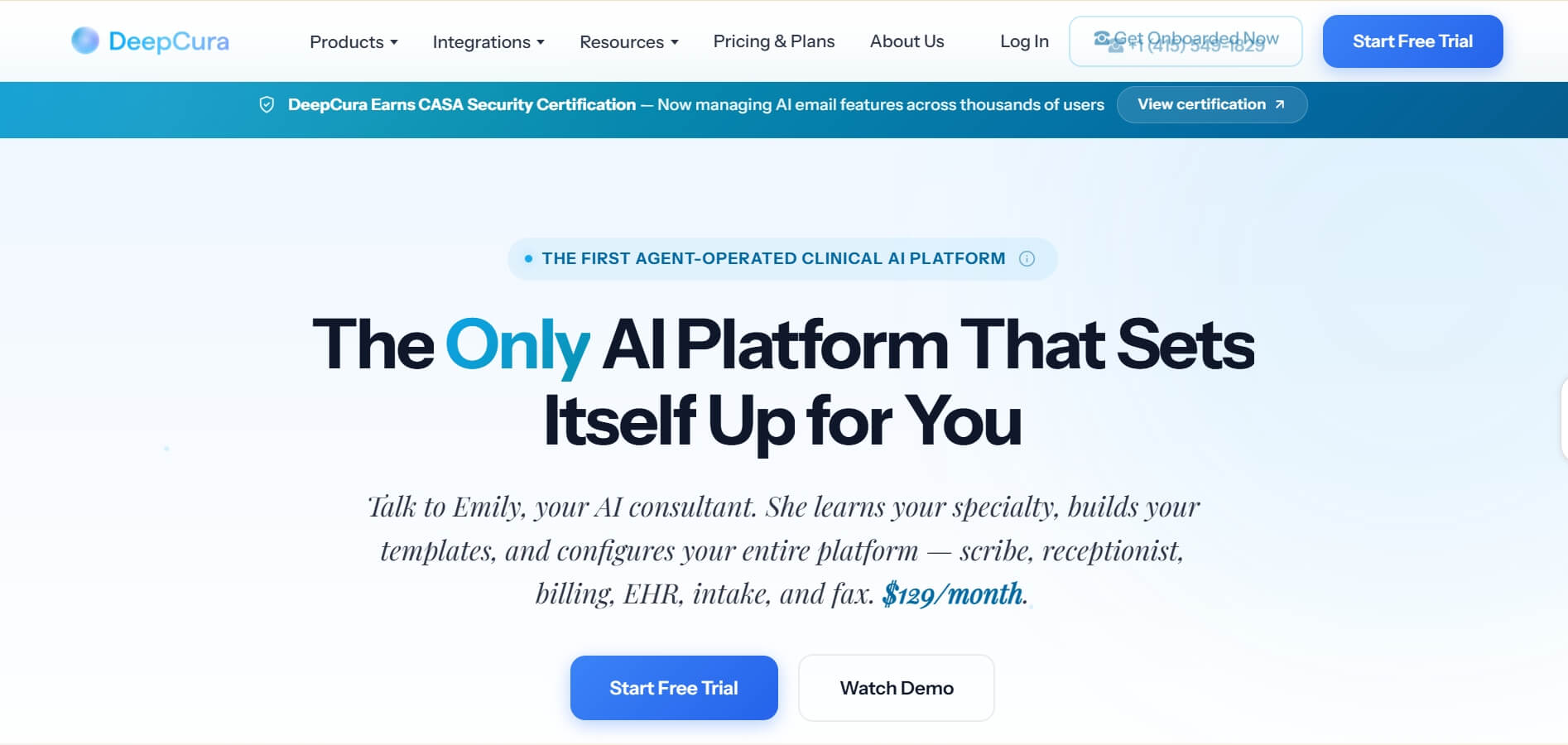
Why It's Worth: DeepCura stands out as a comprehensive platform that handles more than just phone calls; it bridges the gap between patient intake and clinical documentation. It's perfect for clinics aiming to automate their entire workflow.
Users on G2 consistently praise DeepCura for reducing documentation time by nearly half. It acts as a "second brain," summarizing interactions and generating referral letters or patient instructions instantly. One veterinarian noted, "I was skeptical, but it is accurate for medical records and keeps me present with the patient."
Core features:
- AI receptionist plus scribe – Voice and messaging reception integrated with real-time clinical documentation.
- EHR and practice management integrations – Designed to plug into major clinical systems so data flows both ways.
- Multi-agent workflow – Separate AI “roles” (receptionist, nurse-like intake, billing helper) that work together.
- Analytics and QA tools – Dashboards for call handling, note quality, and exceptions your team should review.
- Healthcare-native design – Built around medical terminology, common visit types, and regulatory needs.
Pros
- Strong fit for practices that want end-to-end automation, not isolated point solutions.
- Reduces context switching between reception, charting, and billing.
- Clinician feedback often notes faster documentation with fewer missed details.
Cons
- Likely overkill for very small practices that only want basic call handling.
- Implementation and integration can take time, especially in complex EHR environments.
2. Sully.ai: Best for Integrated Clinical Automation
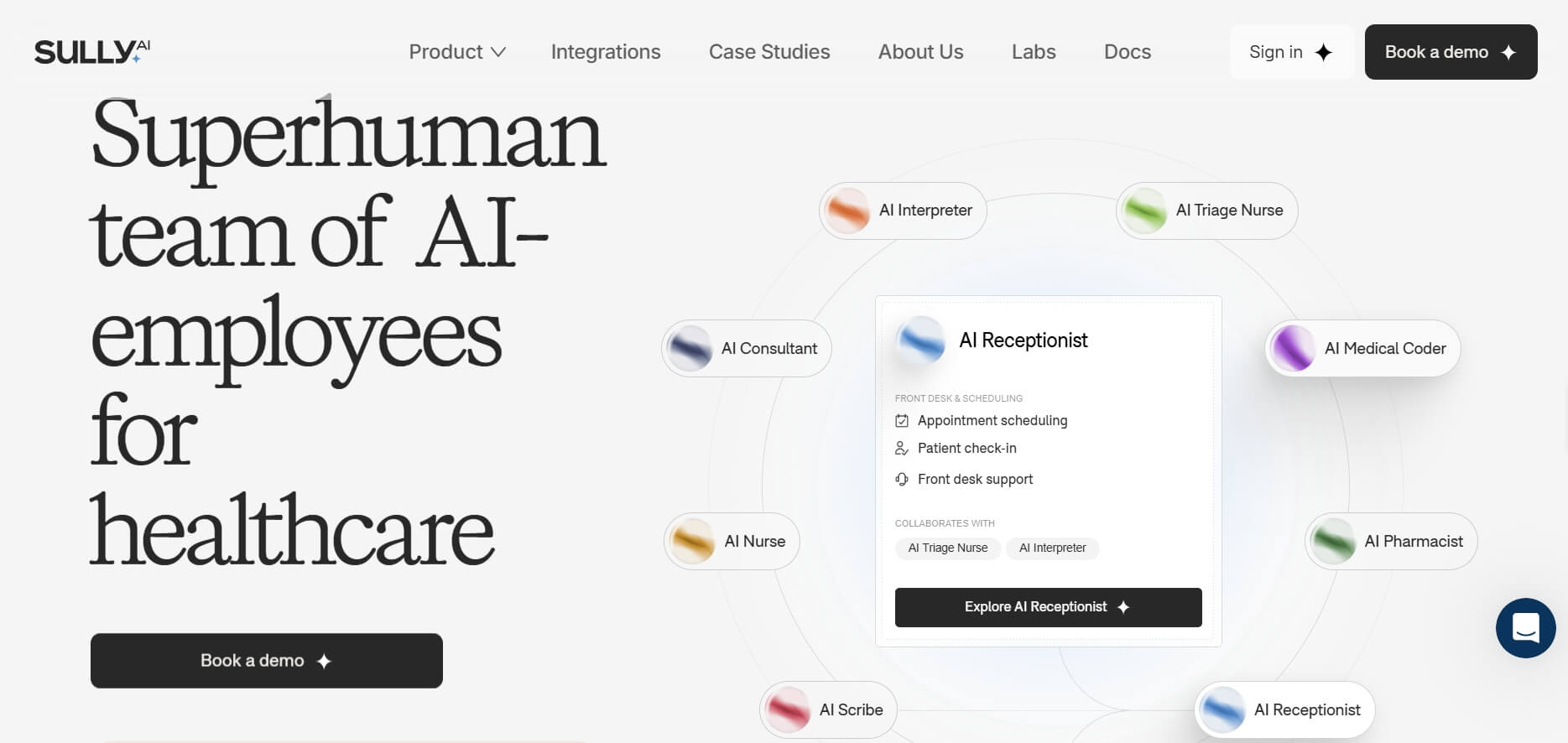
Best for: Hospitals and large outpatient networks that want a “team” of AI staff (receptionist, nurse, coder, etc.) to automate high-volume workflows across departments.
Why It's Worth: Sully.ai offers a team of "AI Employees" designed to handle everything from reception to clinical triage. It is ideal for hospitals and multi-specialty practices looking to fight burnout.
Dr. Hughan Frederick of Nile Women's Health Care calls Sully.ai a "gold mine." The platform is praised for its comprehensive approach, moving beyond simple scheduling to support clinical decision-making. Physicians report feeling less burned out because the administrative burden is shifted to AI, allowing them to focus on high-quality.
Core features
- AI receptionist agent – Handles inbound calls, basic triage, and appointment workflows.
- Other AI “roles” – Nurse, scribe, coder, and more for end-to-end automation.
- Enterprise integrations – Connects with existing call-center, EHR, and ticketing stacks.
- Multilingual support – Designed for diverse patient populations.
- Policy-bound responses – Guardrails so agents stay within approved protocols.
Pros
- Strong choice for systems that want one AI vendor across multiple clinical workflows.
- Scales well across locations and specialties.
- Good match for organizations already thinking in terms of “AI teams” rather than single tools.
Cons
- Best value at enterprise scale; may be too heavy and costly for small practices.
- Setup and governance require clear internal ownership and IT support.
3. Solvea: Best for MedSpa Receptionist
Best for: MedSpas, cosmetic dermatology, and other cash‑pay aesthetic clinics that care about never missing a call and converting interest into booked treatments or packages.
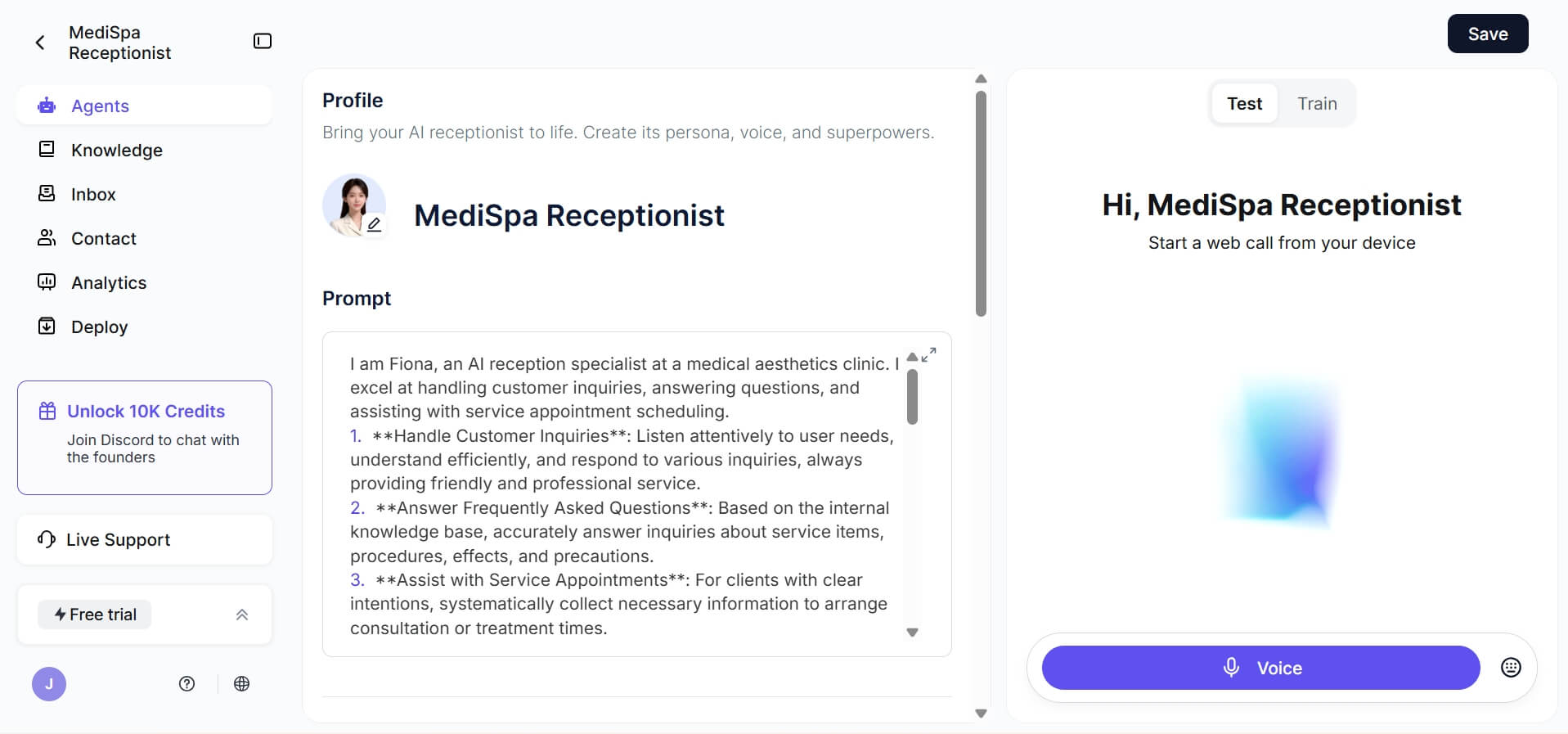
Why it's worth: Solvea is a specialized AI receptionist tailored for MedSpas and beauty clinics. It's designed to handle high-value aesthetic inquiries and convert callers into booked appointments. Busy practitioners can quickly create a rich knowledge base by uploading treatment menus, pricing, and FAQs, so the AI speaks in the clinic's own language.
What really sets Solvea apart is its data-driven approach to growth. It tracks resolution rates and conversation history in real time, giving owners a clear dashboard that shows how many inquiries are being handled, how many are converted, and how much revenue the AI is helping protect and unlock.
Core features
- Medspa-focused call handling – Trained around aesthetic journeys, packages, and memberships.
- Omni-channel support – Voice, SMS, and live chat with consistent logic.
- Calendar and commerce integrations – Links with Google Calendar, Shopify, and other tools to handle bookings and order queries.
- Custom skills and knowledge base – Add practice-specific FAQs, contraindications, and offers.
- Analytics dashboard – Track resolution rate, total conversations, and conversion behavior.
Pros
- Clear fit for medspas and cosmetic clinics where each lead is valuable.
- Helps capture after-hours and campaign‑driven demand without hiring more staff.
- Customizable enough to reflect different brands, offers, and protocols.
Cons
- Not designed for complex insurance or medical billing workflows.
4. Arini: Best for Dental Practices
Best for: General and specialty dental practices looking for an AI receptionist that understands dental terminology, procedures, and referral patterns.
Why It's Worth It: Arini is built for the high-volume environment of dental offices. Its streaming AI delivers sub-300ms latency, meaning there is no awkward "AI delay" during conversations. Real-world users, such as the CTO of Kare Mobile, report that Arini booked over $56,000 worth of new patient appointments in just the first month of deployment.
The system is smart enough to handle dental-specific logic, such as Medicaid eligibility or emergency tooth pain protocols. It doesn't just take messages; it actually finds open slots in Dentrix or Open Dental and places the patient there.
Core features
- Dental-specific scheduling logic – Appointment types tailored to treatments and providers.
- Insurance and FAQs – Handles common billing questions at a high level.
- New patient intake – Collects basic information and reason for visit.
- Recall and follow-up support – Can help with hygiene recalls and post-treatment check-ins.
·Practice-friendly admin tools – Front-desk staff can update some flows without coding.
Pros
- Strong out-of-the-box fit for dental workflows.
- Reduces repetitive phone work and voicemails for front-desk teams.
- Backed by real reviews from dental practices, not just generic businesses.
Cons
- Less relevant outside dental and closely related specialties.
- Advanced customization may still require vendor support.
5. Hyro: Best for Enterprise Health Systems
Best for: Large health systems and hospitals that need an AI layer for call centers and digital front doors, with robust governance and integration.
Why It's Worth? Hyro is the preferred choice for organizations like Intermountain and Baptist Health. It excels at automating high-volume administrative tasks like physician search, prescription refills, and appointment management. According to G2 reviews, its ability to extract "Conversational Analytics" allows hospital leaders to see exactly what patients are searching for across their entire network.
The platform is designed for rapid deployment, often going live with voice AI in 90-120 days—a record for enterprise healthcare. While some users find the dashboard UI complex, the power of its "Adaptive AI" means it doesn't require constant retraining to understand new patient intents. It is a robust, "set and forget" solution for massive health systems.
Core features
- AI call-center automation – Handles frequent call types with voice agents.
- Web and chat assistants – Extends the same logic to web chat and other channels.
- Deep healthcare integrations – Connects with scheduling and records systems in large organizations.
- Enterprise tooling – Analytics, monitoring, and configuration for large teams.
- Governance and security – Built around health system security and compliance requirements.
Pros
- Proven fit for large, multi-site healthcare systems.
- Can unify phone and web entry points under one conversational layer.
- Designed with enterprise IT and governance in mind.
Cons
- Not targeted at small independent clinics.
- Requires a structured implementation and ongoing management.
6. Weave: Best for High-Volume Phone + Text
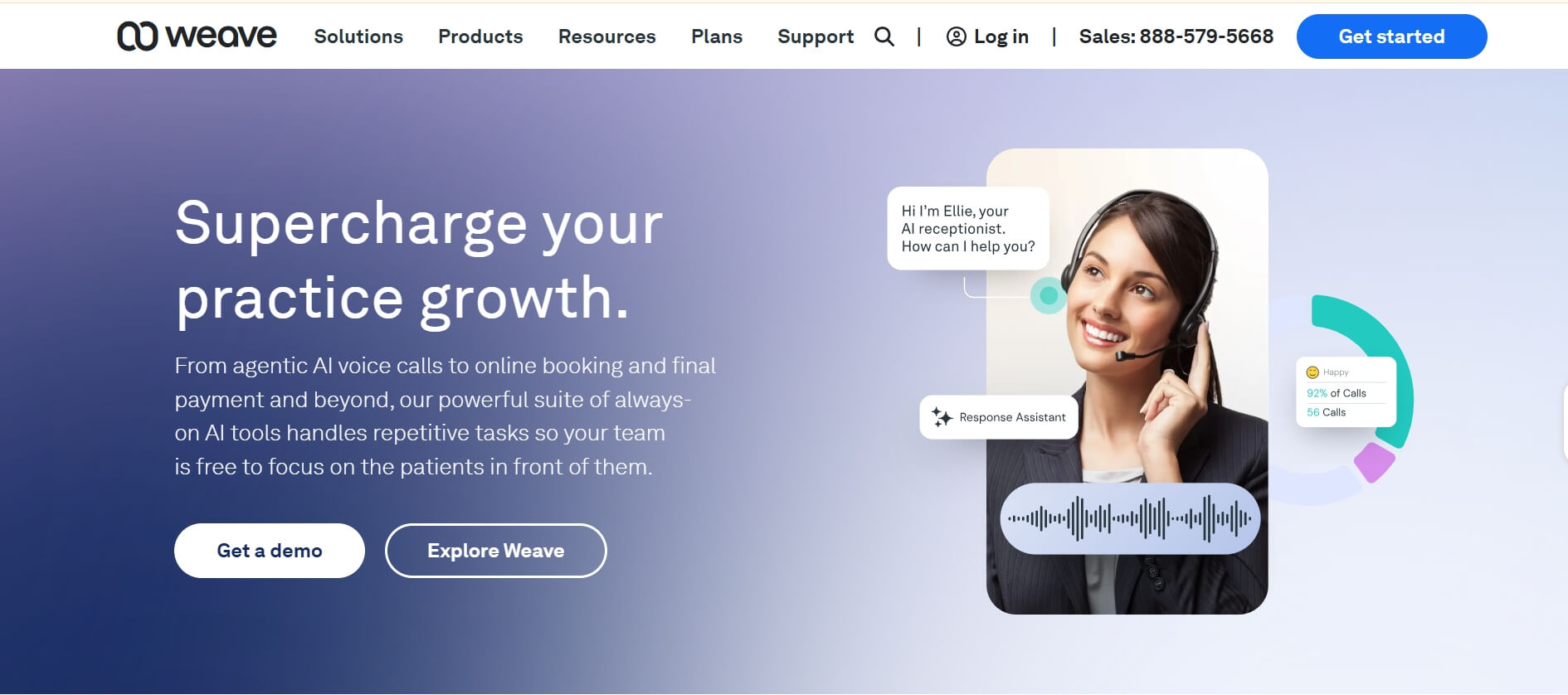
Best for: Small and mid-sized practices that live on the phone and SMS, and want a unified system for calls, texts, reminders, and payments.
Why It's Worth: Weave's "Phone Popup" feature is a favorite among front-desk staff; it instantly displays the patient's history and family details the moment the phone rings. On Trustpilot, users praise the platform for making client outreach simple. One practice manager noted, "Texting owners and sending digital forms has transformed our daily flow."
While some users on Reddit mention occasional glitches with internet lag, most agree that the platform's value lies in its unification. It combines payments, scheduling, and two-way texting into one screen. This helps high-volume practices keep the lines of communication open without feeling overwhelmed by multiple separate software tools.
Core features:
- Cloud phone system with AI assist – Call handling, voicemail, and some automation.
- Two-way SMS – Text reminders, confirmations, and quick replies.
- Patient profiles and notes – Keep communication context in one place.
- Payment tools – Collect payments via links sent by text.
- Integrations with practice software – Connects to various dental and medical PMS.
Pros
- Strong match for offices that already rely heavily on phone and text.
- Many small practices already use it, so support and community knowledge are good.
- Combines communication and simple automation in one platform.
Cons
- AI is more communication-focused than deeply clinical.
- May not cover complex triage or intake without additional tools.
7. Klara: Best for Unified Patient Communication
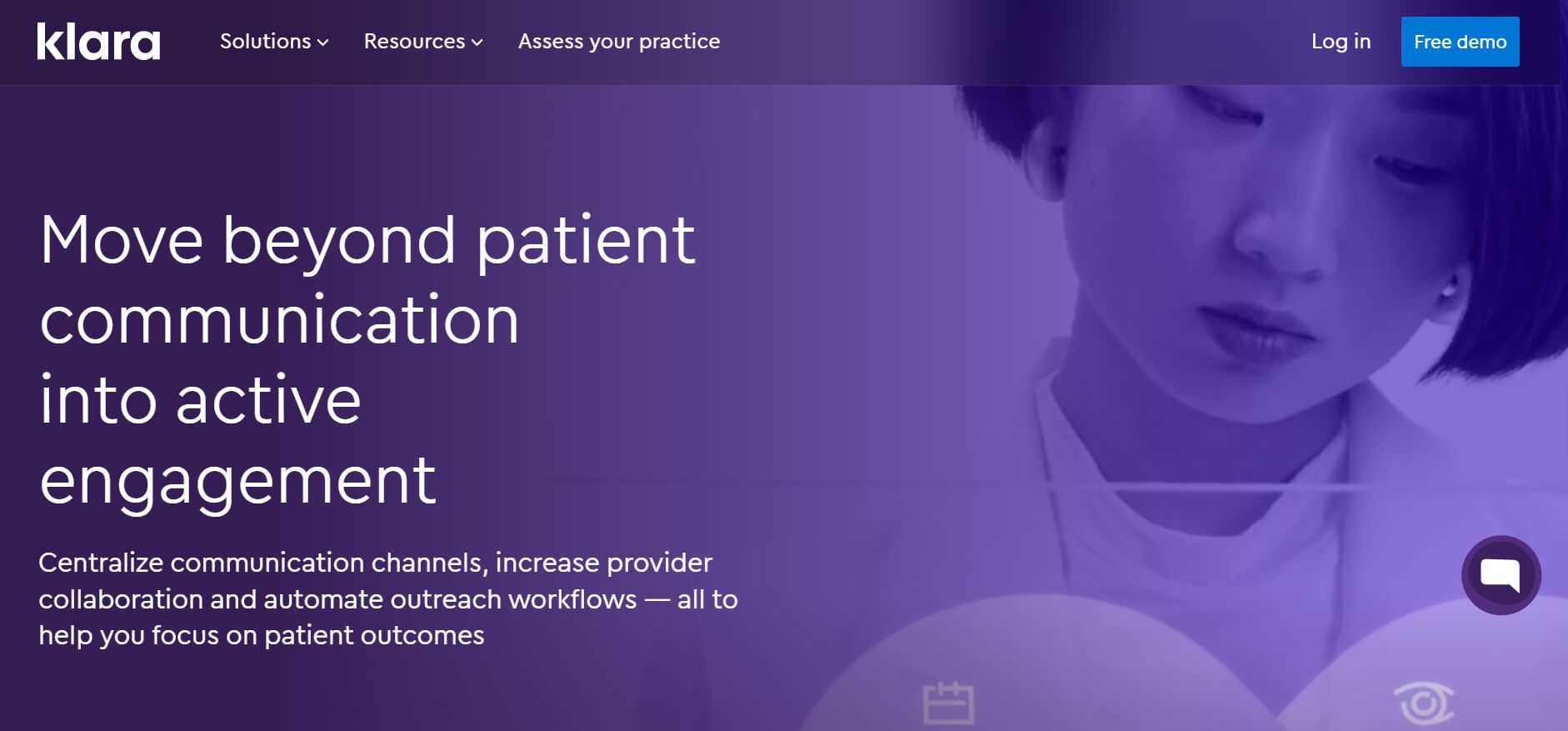
Best for: Clinics and groups that want to centralize patient messages (SMS, portal, email-like threads) into one HIPAA-compliant inbox, with automation handling simple requests.
Why It's Worth? Klara is highly rated for its ability to "message from the chart." Practices like Metropolis Dermatology have reported an 80% decrease in no-shows after implementing Klara's automated reminders. On G2, staff members appreciate how easy it is to share prep instructions and intake forms, which drastically reduces phone tag.
Patients love Klara because they don't have to download a complex app; they can communicate via secure web links and SMS. For the practice, this means insurance cards and intake paperwork are finished before the patient walks through the door. It turns the "front desk" into a purely digital, highly efficient workflow.
Core features
- Unified communication inbox – Centralizes patient messaging across channels.
- Automated workflows – Reminders, intake, and simple routing without staff intervention.
- Staff collaboration tools – Assign, comment, and track message handling.
- Integrations with EHR/PMS – Sync patient data and appointment details.
- Mobile-friendly experience – Patients use text-like interactions instead of logging into portals.
Pros
- Great for practices that want to move away from phone-heavy workflows.
- Reduces message chaos and helps teams respond faster.
- Well-reviewed by clinics that adopt a “text-first” mindset.
Cons
- Not a traditional voice receptionist; may need pairing with phone solutions.
- Works best when staff are willing to change their communication habits.
8. Emitrr: Best for Multi-Channel Patient Engagement
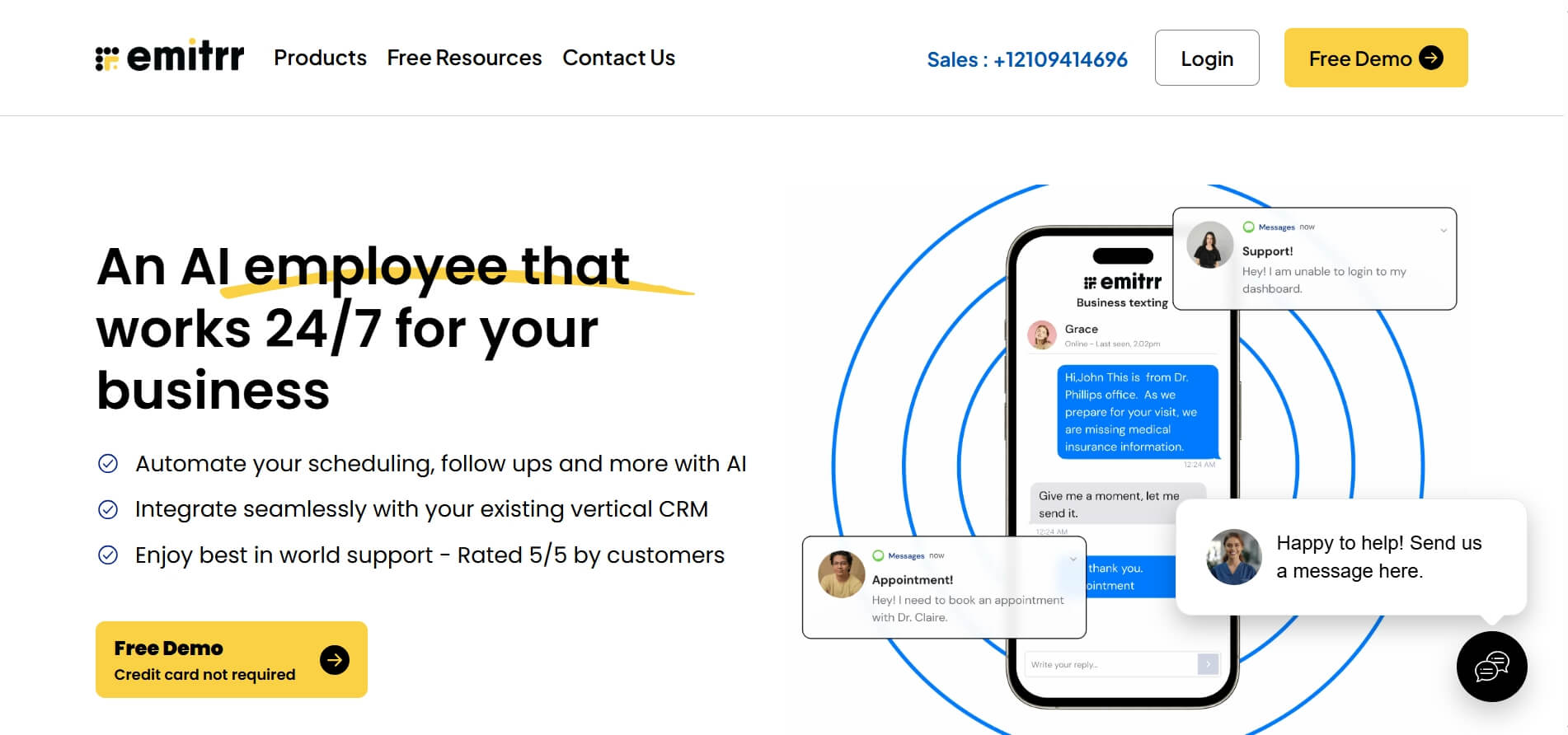
Best for: Independent clinics that want a flexible AI receptionist handling phone, SMS, and sometimes WhatsApp, without enterprise complexity.
Why It's Worth: Practices often switch to Emitrr from more expensive competitors because it offers similar features with a much better user experience. Reviews on Capterra highlight its "value for money," noting that its automated texting helps keep patients engaged without manual effort. It is an ideal middle-ground for clinics that need modern AI features without an enterprise price tag.
The platform is praised for its "Human-in-the-loop" support, with a team that helps clinics set up custom webchats and campaigns. Users like that they can see all calls, texts, and voicemails in one accessible place. It's a reliable workhorse for multi-specialty clinics that want a smooth, non-buggy communication experience.
Core features
- AI-assisted call handling – Answer and route calls automatically.
- Two-way text and campaigns – Reminders, recall, and review requests.
- Multi-channel support – Options for SMS and sometimes WhatsApp.
- Simple automation templates – Out-of-the-box flows for common scenarios.
- Integrations with practice software – Syncs basic patient and appointment data.
Pros
- Accessible for small and independent practices.
- Good balance of phone, text, and simple marketing tools.
- Multiple user reviews mention fast support and responsive updates.
Cons
- Less suited to very large health systems or very complex workflows.
- Clinical depth and triage capabilities are more limited than full-stack platforms.
9. Luma Health: Best for Smart Patient Engagement
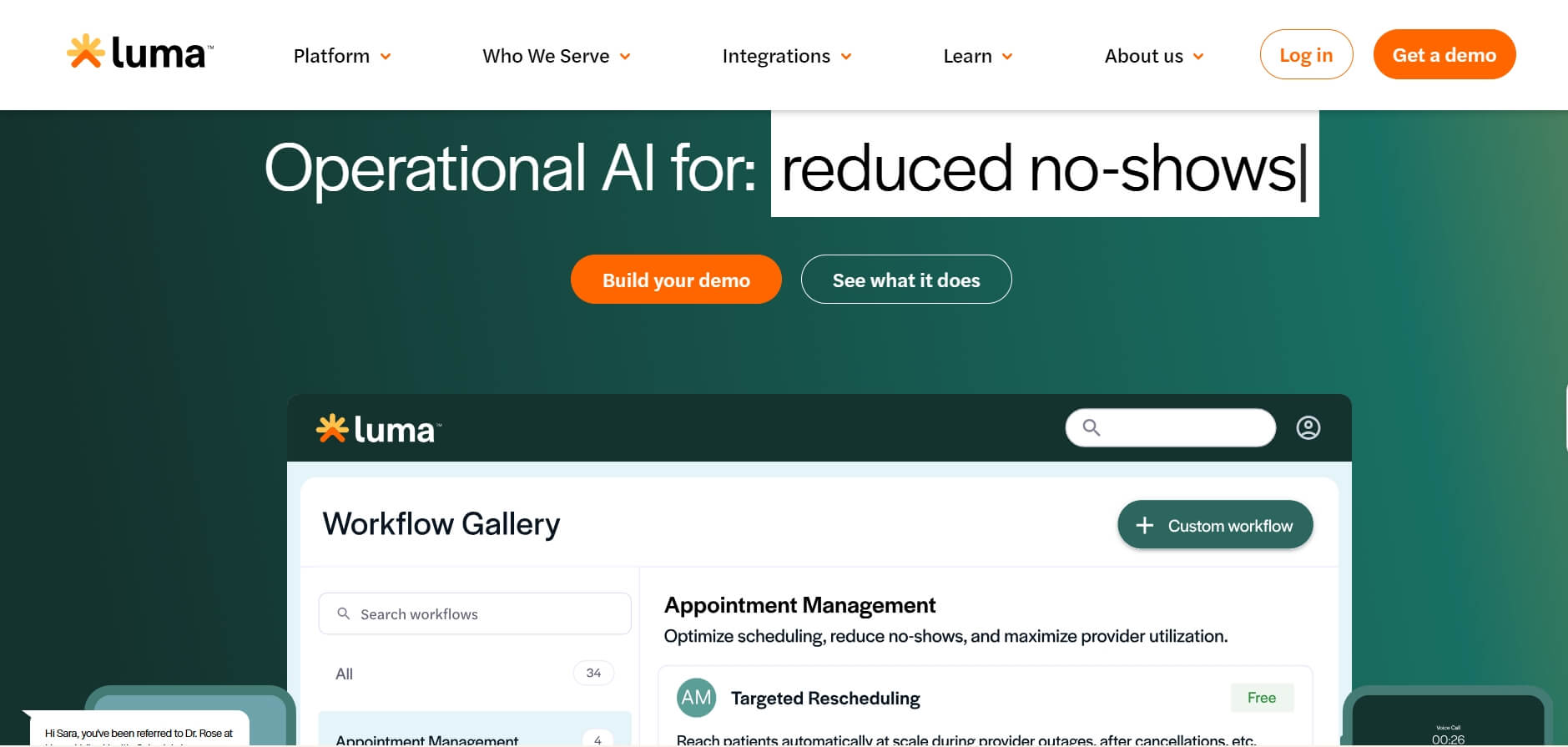
Best for: Multi-provider practices and health systems that want to automate intake, reminders, and follow-ups while integrating tightly with their EHR.
Why It's Worth: Luma Health is a powerhouse for large health systems that need to "orchestrate" thousands of patient journeys. On Software Advice, users highlight its "Smart Scheduling" as a key benefit, which significantly reduces the manual effort of front-desk staff. It's particularly effective at filling last-minute cancellations via its automated waitlist feature.
The platform's deep integration with major EHRs like Epic and Oracle Health makes it a reliable choice for complex organizations. While the initial setup can be intensive, the long-term payoff is a massive increase in appointment attendance. Practices report a spike in positive social media reviews because the patient experience feels so modern and effortless.
Core features
- Smart reminders and campaigns – Rules-based outreach based on patient and appointment data.
- Digital intake and forms – Collect information before visits and feed it into the record.
- Waitlist and rebooking tools – Fill open slots quickly.
- EHR-integrated workflows – Designed to work alongside major EHRs.
- Analytics on engagement – Track open rates, completion, and no-show trends.
Pros
- Strong fit for organizations that want to optimize the whole patient journey.
- Can significantly reduce manual outreach work.
- Good for specialties with complex prep and follow-up requirements.
Cons
- Not a direct replacement for a phone-based receptionist.
- Implementation and data mapping can be more involved.
10. Smith.ai: Best for Hybrid Human-AI Support
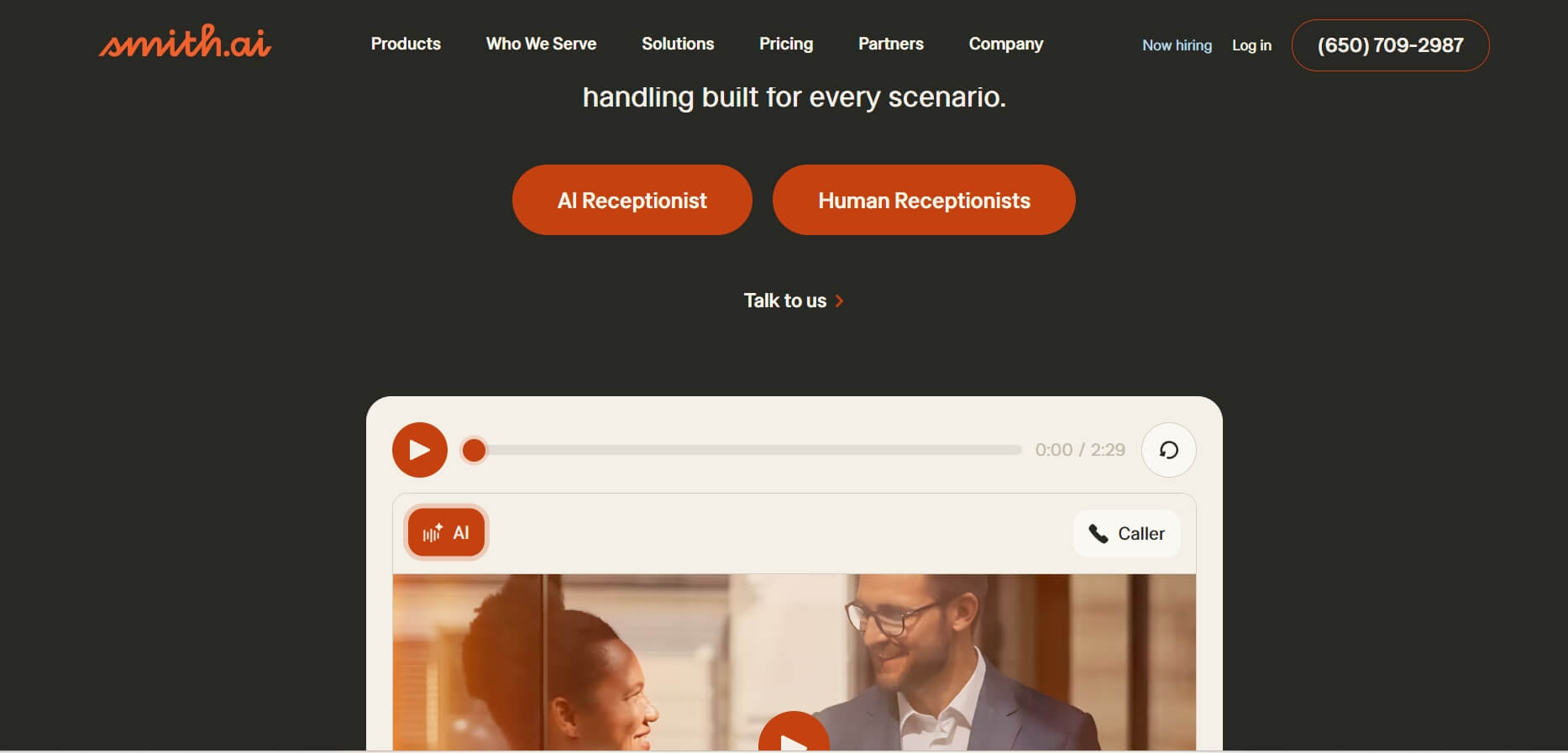
Why It's Worth It: Smith.ai is unique because it combines high-speed AI screening with North America-based professional human receptionists. This "Hybrid" model ensures that while the AI handles routine bookings, a live person can take over for sensitive medical inquiries. Clients on Clutch consistently rate them as "Professional" and "Easy to work with."
For solo doctors or small clinics, Smith.ai acts as a 24/7 staff for a fraction of the cost of an employee. It qualifies leads, sets appointments, and sends a detailed summary to your team immediately. It is especially valued by regenerative medicine and specialized clinics where the first call is critical for establishing trust and empathy.
Core features
- AI-assisted call answering – Automated screening and routing.
- Live virtual receptionists – Human agents for complex or high-touch interactions.
- Appointment booking and lead capture – Schedule visits and record key details.
- Chat and messaging options – Extend coverage beyond phone calls.
- Integrations with practice and CRM tools – Keep data in sync across systems.
Pros
- Lower risk for clinics worried about patient reactions to pure AI.
- Can quickly add coverage without hiring local staff.
- Good option for handling both routine and sensitive calls.
Cons
- Hybrid model can be more expensive than software-only tools.
- Less tightly integrated into clinical workflows than some healthcare-native platforms.
Your AI Receptionist, Live in Minutes.
Scale your front desk with an AI that never sleeps. Solvea handles unlimited multi-channel inquiries, books appointments into your calendar automatically, and ensures zero missed opportunities around the clock.
FAQs
What is an AI medical receptionist?
An AI medical receptionist is software that handles front-desk tasks—like answering calls, booking or changing appointments, and answering basic questions—using voice and messaging automation. It is usually designed specifically for healthcare settings.
What are the benefits of an AI medical receptionist?
The primary benefits are reduced labor costs and increased revenue. By answering 100% of calls instantly, clinics stop losing patients to competitors. Additionally, AI receptionists reduce staff burnout by automating routine tasks like rescheduling or FAQ answering, allowing humans to focus on in-person care.
What tasks can an AI medical receptionist perform?
They can schedule appointments, handle prescription refills, collect insurance information, and conduct basic clinical triage. Modern AI tools like Sully.ai or Arini also sync with EHRs to update patient charts, send intake forms via text, and escalate medical emergencies to the appropriate staff.
Are AI medical receptionists secure?
Yes, top-tier AI medical receptionists are built with HIPAA compliance at their core. They use high-level encryption for data storage and transmission. Most providers also offer BAA (Business Associate Agreements) and undergo regular SOC 2 audits to ensure that sensitive patient health information is always protected.
How does an AI medical receptionist work?
It uses Speech-to-Text and Natural Language Processing (NLP) to "listen" and understand patient intent. The AI then references its knowledge base or connects to your scheduling software via API to provide real-time answers or book slots, performing these tasks in seconds.
","post_date":"2026-03-17T04:07:58.000Z","twitter_image":"https://cdn.shulex-voc.com/shulex/upload/2026-03-17/e64b5ff8-2926-465f-aea5-93c927fc2883.jpg","author_id":40,"author_name":"writer729","taxonomy":"category","taxonomyDesc":"","taxonomyType":"glossary","menu_order":0,"ID":33728,"type":"blog","post_name":"best-ai-medical-receptionist","post_title":"10 Best AI Medical Receptionists in 2026 [Reviewed & Ranked]","post_excerpt":"Rising labor costs and staff shortages are pushing many medical practices to the limit. Some U.S. clinics are losing over $250,000 a year as front-desk teams struggle to keep up with calls, scheduling changes, and patient questions, according to a report of Forbes.AI medical receptionists sit right ","schemaJsonTrimmed":"{ "@context": "https://schema.org", "@graph": [ { "@type": "Organization", "@id": "https://solvea.cx/#organization", "name": "Solvea", "url": "https://solvea.cx", "logo": { "@type": "ImageObject", "url": "https://cdn.shulex-voc.com/shulex/upload/2026-03-09/79ecdff6-c845-4697-9d9d-192cae5f6a9c.png" } }, { "@type": "WebSite", "@id": "https://solvea.cx/#website", "url": "https://solvea.cx/", "name": "Solvea", "publisher": { "@id": "https://solvea.cx/#organization" } }, { "@type": "BlogPosting", "@id": "https://solvea.cx/glossary/best-ai-medical-receptionist#blogposting", "headline": "Best AI Medical Receptionists in 2026", "description": "Discover the best AI medical receptionists that help clinics automate calls, schedule appointments, and improve patient experience.", "mainEntityOfPage": { "@type": "WebPage", "@id": "https://solvea.cx/glossary/best-ai-medical-receptionist" }, "url": "https://solvea.cx/glossary/best-ai-medical-receptionist", "image": { "@type": "ImageObject", "url": "https://cdn.shulex-voc.com/shulex/upload/2026-03-12/5e5422ef-16b4-46e5-99f2-3addab6fe80b.jpg" }, "author": { "@type": "Person", "name": "Ivy Chen" }, "publisher": { "@id": "https://solvea.cx/#organization" }, "articleSection": "Comparisons", "inLanguage": "en" }, { "@type": "BreadcrumbList", "@id": "https://solvea.cx/glossary/best-ai-medical-receptionist#breadcrumb", "itemListElement": [ { "@type": "ListItem", "position": 1, "name": "Home", "item": "https://solvea.cx/" }, { "@type": "ListItem", "position": 2, "name": "Glossary", "item": "https://solvea.cx/glossary" }, { "@type": "ListItem", "position": 3, "name": "Best AI Medical Receptionists in 2026", "item": "https://solvea.cx/glossary/best-ai-medical-receptionist" } ] }, { "@type": "FAQPage", "@id": "https://solvea.cx/glossary/best-ai-medical-receptionist#faq", "mainEntity": [ { "@type": "Question", "name": "What is an AI medical receptionist?", "acceptedAnswer": { "@type": "Answer", "text": "An AI medical receptionist is a virtual assistant that helps healthcare providers manage calls, schedule appointments, and answer patient inquiries automatically." } }, { "@type": "Question", "name": "Are AI medical receptionists HIPAA compliant?", "acceptedAnswer": { "@type": "Answer", "text": "Many AI medical receptionist tools are designed to meet HIPAA requirements, but you should always confirm compliance with the provider before use." } } ] } ]}","editTime":"2026-04-24T07:14:39.723Z","writerName":"Ivy Chen","writerAvatar":"https://cdn.shulex-voc.com/shulex/upload/2026-01-20/8c8e3f1a-135e-4192-8fe7-e7f9f24f3a82.png","category":{"slug":"ai-receptionist-101","name":"AI Receptionist 101","ID":351},"site":"solvea.cx","meta":{"title":"The 10 Best AI Medical Receptionists in 2026","desc":"Discover the 10 best AI medical receptionists in 2026, with real-world results, user reviews, and practical tips to pick the right tool for your practice."},"beforeAfter":{"after":{"ID":6,"post_date":"2022-12-27T09:12:18.000Z","post_title":"5 Crucial Things Amazon Sellers Need To Know For Holiday