A consultation booking is the highest-value call your receptionist handles. A client calling to book a consultation has already decided they're interested — they just need someone to make the process easy and give them a reason to commit. A poorly handled call doesn't just lose that booking; it loses a client who was ready to spend money.
Most med spa receptionists aren't trained to treat consultation calls as sales conversations. They're trained to answer questions and fill appointment slots. The difference between those two approaches shows up in whether the client books at all — and whether a consultation converts to treatment. The client experience starts on that first call — the receptionist's tone, confidence, and ability to handle basic objections determines whether the client books or hangs up and calls the next spa on their list.
This guide covers exactly what to teach, in what order, and what to give your receptionist to practice with so the training sticks.
TL;DR
| Field | Summary |
|---|---|
| What consultation booking training covers | Call scripts, service knowledge, objection handling, deposit collection, and CRM documentation |
| Time to competence | 2–3 weeks with daily role-play practice; 1 week with experienced hires |
| Biggest training gap | Receptionists who know the scripts but can't handle objections without escalating |
| Who it's for | Med spa owners and managers who onboard or retrain front desk staff |
| Automation role | AI handles overflow and after-hours consultation inquiries; humans close high-intent callers |
What Your Receptionist Needs to Know Before Taking Booking Calls
Training on consultation booking fails when it starts with scripts before it builds foundations. A receptionist who doesn't understand the service will panic when a client asks a question the script doesn't cover.
Before scripted practice, your receptionist needs to complete these foundations:
Service menu fluency — For each service you offer consultations for, the receptionist should know: - What it treats (general, not clinical depth) - How long the consultation typically takes - What the client should bring or prepare - What the next step after the consultation is (same-day treatment, follow-up appointment, treatment plan) - Whether a deposit is required to hold the consultation slot
Policy knowledge — Cancellation policy, deposit requirements, what happens to the deposit if the client cancels, and how to handle a client who asks to reschedule.
CRM and booking software access — The receptionist should be comfortable creating a client profile, adding appointment notes, and processing a deposit before they take a live call.
Build a one-page cheat sheet covering these basics for each service type. This isn't the script — it's the background knowledge the script draws from.
How to Train a Med Spa Receptionist on Consultation Booking: Step-by-Step
Step 1: Teach the Consultation Booking Call Structure
Every consultation booking call has the same five-part structure. Train this structure before any specific script:
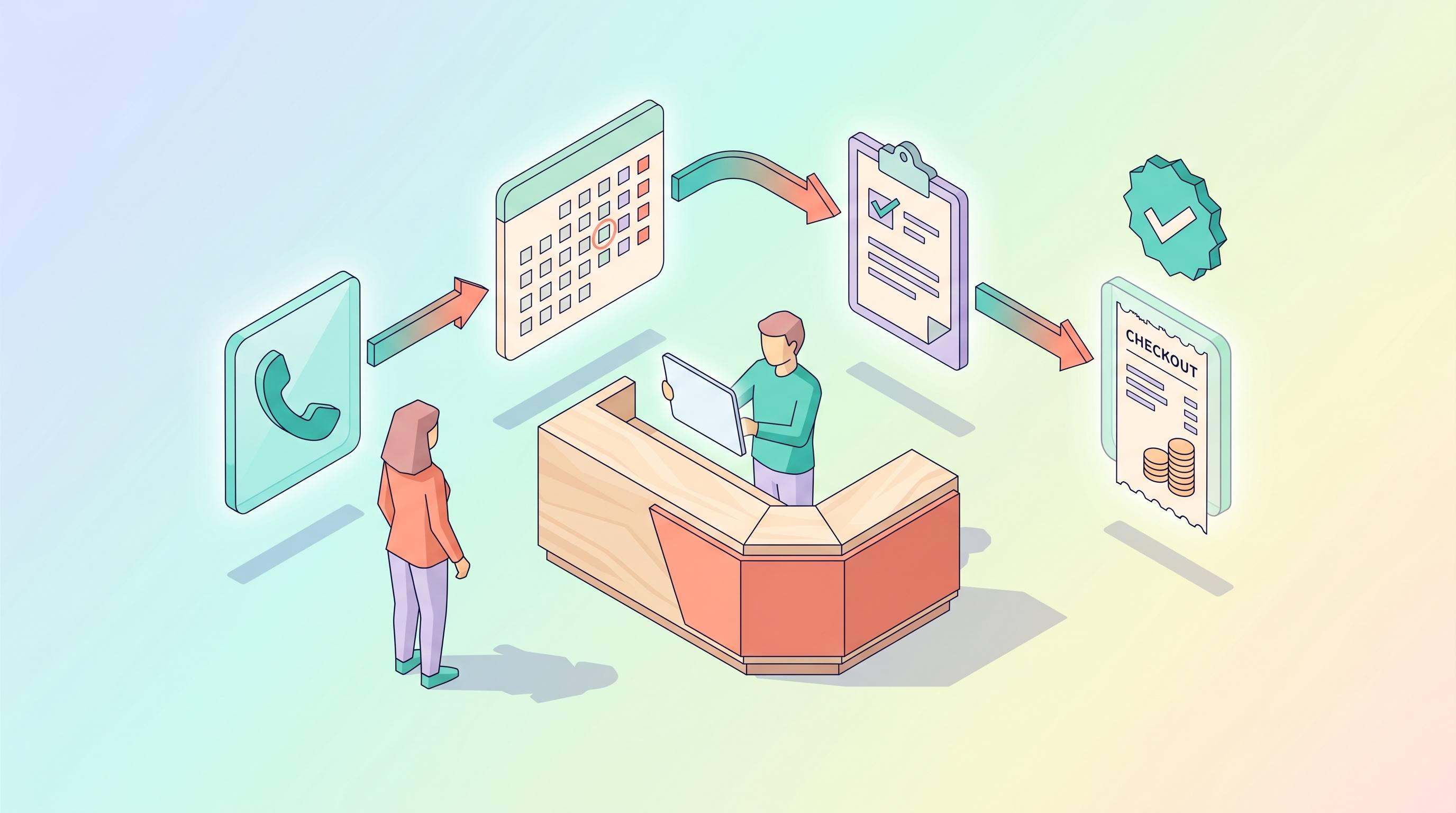
1. Warm greeting + clinic name — Answer with your name and clinic name. Not just "hello." 2. Identify the client's interest — Ask an open question, not a yes/no. "What brings you in today?" or "What are you hoping to address?" 3. Brief, confident service overview — Confirm they've reached the right place. Cover what the consultation includes, how long it takes, and what happens next. Keep it under 60 seconds. 4. Move toward booking — "I'd love to get you scheduled. Do mornings or afternoons work better for you?" 5. Confirm, deposit, close — Confirm date, time, and provider. Collect deposit if required. Read back the appointment details. Confirm contact info for reminders.
The most common training failure: receptionists who get to step 3 and then wait for the client to ask to book. Teach them that step 4 is their job — the client called to book, the receptionist's role is to make that easy.
Step 2: Build the Call Script for Each Service Type
A good call script is not a word-for-word transcript the receptionist reads from. It's a scaffolding of key phrases and transitions they've internalized. Train your receptionist to know what each section of the call needs to accomplish, and give them two or three ways to say each thing so they don't sound robotic.
Sample script for an injectables consultation inquiry:
"Hi, this is [Name] at [Clinic Name]. How can I help you today?"
[Client: "I'm interested in learning more about Botox."]
"Absolutely — we'd love to help with that. Our consultations for injectables are about 30 minutes. You'll meet with one of our providers, go over your goals, and they'll walk you through exactly what would work best for you. There's no obligation to book a treatment at the consultation itself."
[Client: "That sounds good. How much does it cost?"]
"The consultation itself is [complimentary / $X, applied toward treatment]. We hold consultation spots with a $[X] deposit — that goes directly toward your treatment if you move forward. Does morning or afternoon generally work better for you?"
The key transitions to train: moving from service overview to asking for booking (step 3 → 4), handling the "how much does it cost" question without ending the call, and collecting the deposit smoothly.
Step 3: Train Objection Handling Separately
Objection handling is where receptionists without sales training freeze or over-apologize. The three most common objections on consultation calls are:
"I'm just looking around / not ready to commit" Train response: "Totally understandable — the consultation is actually a great first step. There's no commitment involved; you just meet with the provider and see what makes sense. We can always cancel or reschedule if something comes up."
"How much does [treatment] cost?" Train response: Give a realistic range, immediately followed by the consultation offer. "Botox typically runs $[X–Y] depending on the areas, and the consultation will give you an exact quote for your goals. Shall we get you on the calendar?"
"I need to check my schedule / talk to my partner" Train response: "Of course — I can hold a tentative spot for 24 hours while you confirm. That way you don't lose the slot. What day was you thinking?"
The principle: every objection is answered with an acknowledge + redirect + offer. Never close with "okay, feel free to call back." Close with a specific next step.
Step 4: Practice with Role-Play Before Live Calls
No amount of reading scripts prepares a receptionist for live calls. Role-play is mandatory, not optional. Schedule dedicated practice time:
- Days 1–3: Manager plays the client, receptionist practices the five-part call structure. No objections yet — just structure and tone.
- Days 4–7: Add objections, one at a time. Start with the most common ("how much does it cost") and work through the full objection set.
- Week 2: Full calls with varied scenarios — enthusiastic clients, skeptical clients, clients who ghost mid-call. Debrief after each role-play on what worked and what to improve.
- Week 3: Receptionist takes live calls with manager available for escalation. Review recordings (with consent) weekly.
One specific practice drill: cold-call your own clinic during training and record the interaction. The recording often reveals tone issues (flat affect, excessive filler words, upspeak on confirmation of details) that aren't visible in face-to-face role-play.
Step 5: Build Documentation Habits Alongside Call Skills
A receptionist who takes perfect consultation calls but doesn't document them creates follow-up problems. Train documentation as part of the booking flow, not as an afterthought:
- After every consultation booking: create or update the client profile with: interest area, service inquired about, any concerns mentioned on the call, and the consultation date/time
- Log any deposit payment immediately with the payment method and amount
- Note any special instructions from the call (client is coming in after a specific prior treatment, client has allergy or sensitivity to flag)
- Set a reminder for the 48h confirmation call or automated reminder
This takes about 90 seconds per call. Receptionists who don't build this habit will struggle when a client calls back and there's no record of what was discussed.
Step 6: Connect the Training to Your AI Backup System
The best receptionist training programs don't try to staff every inquiry by hand. They train receptionists for high-value calls and use AI to handle the volume that would otherwise overwhelm them.
With Solvea, your med spa's AI receptionist handles after-hours consultation inquiries, overflow calls during peak periods, and routine rescheduling — so your trained receptionist can give full attention to in-person clients and live high-intent calls. When a client books a consultation through Solvea, the appointment appears in your booking system exactly as if a human took the call, with the client profile and deposit logged.
To set this up: 1. Upload your consultation services, pricing ranges, and booking policy to Solvea → Knowledge Base 2. Forward after-hours and overflow calls to your Solvea number 3. Review any escalations flagged by Solvea each morning — these are the calls that need human follow-up

Common Receptionist Training Mistakes
❌ Starting with scripts before building service knowledge ✓ Build the one-page service cheat sheet first. Scripts that rely on knowledge the receptionist doesn't have will break in live calls.
❌ Treating objection handling as advanced training ✓ Clients raise objections on the first call. Objection handling is not advanced — it's mandatory from day one.
❌ No structured role-play time ✓ Schedule specific practice windows. Role-play that happens "whenever there's time" doesn't happen.
❌ No call review process ✓ Review recordings weekly. Live call performance drifts without feedback.
❌ Treating after-hours calls as lost leads ✓ Clients who call after hours and reach voicemail often don't call back. AI handles these calls so you don't lose them.
Your AI Receptionist, Live in Minutes.
Scale your front desk with an AI that never sleeps. Solvea handles unlimited multi-channel inquiries, books appointments into your calendar automatically, and ensures zero missed opportunities around the clock.
FAQ
How long does it take to train a med spa receptionist on consultation booking?
Most receptionist trainees reach baseline competence — comfortable with the call structure and top three objections — in 2–3 weeks of daily practice. Experienced hires with customer service backgrounds often reach competence in one week. Full fluency, where the receptionist can handle edge cases without escalation, typically takes 4–6 weeks of live call experience.
What should a consultation call script include?
A consultation booking script should cover: greeting with clinic name, identifying the client's interest, a confident service overview (under 60 seconds), moving toward booking with an open scheduling question, collecting a deposit, and confirming appointment details. The script should be a scaffold, not a transcript — the receptionist needs to be able to vary the language while keeping the structure.
How do you handle a receptionist who freezes on objections?
Practice the objection one at a time until it becomes automatic before adding the next one. The most common freeze happens on "how much does it cost?" — train receptionists to give a range and immediately redirect to the consultation offer. Once that transition is comfortable, add the next objection.
Should a med spa receptionist have medical knowledge?
No clinical depth is required, but they need enough service knowledge to answer the questions clients ask on first contact: what the service treats, how long the consultation takes, what happens after the consultation, and basic preparation instructions. This is covered in the one-page service cheat sheet, not medical training.
How do I measure if receptionist training is working?
Track the consultation booking rate (calls that result in a booked appointment) before and after training. Booking rates on incoming consultation calls vary. Without structured training, receptionists often miss conversions on calls where the client was interested but the conversation didn't move toward booking. With training, the rate improves. Track the rate before training begins to establish your baseline, then measure weekly. Also track time-to-answer and callback completion rate for voicemails.