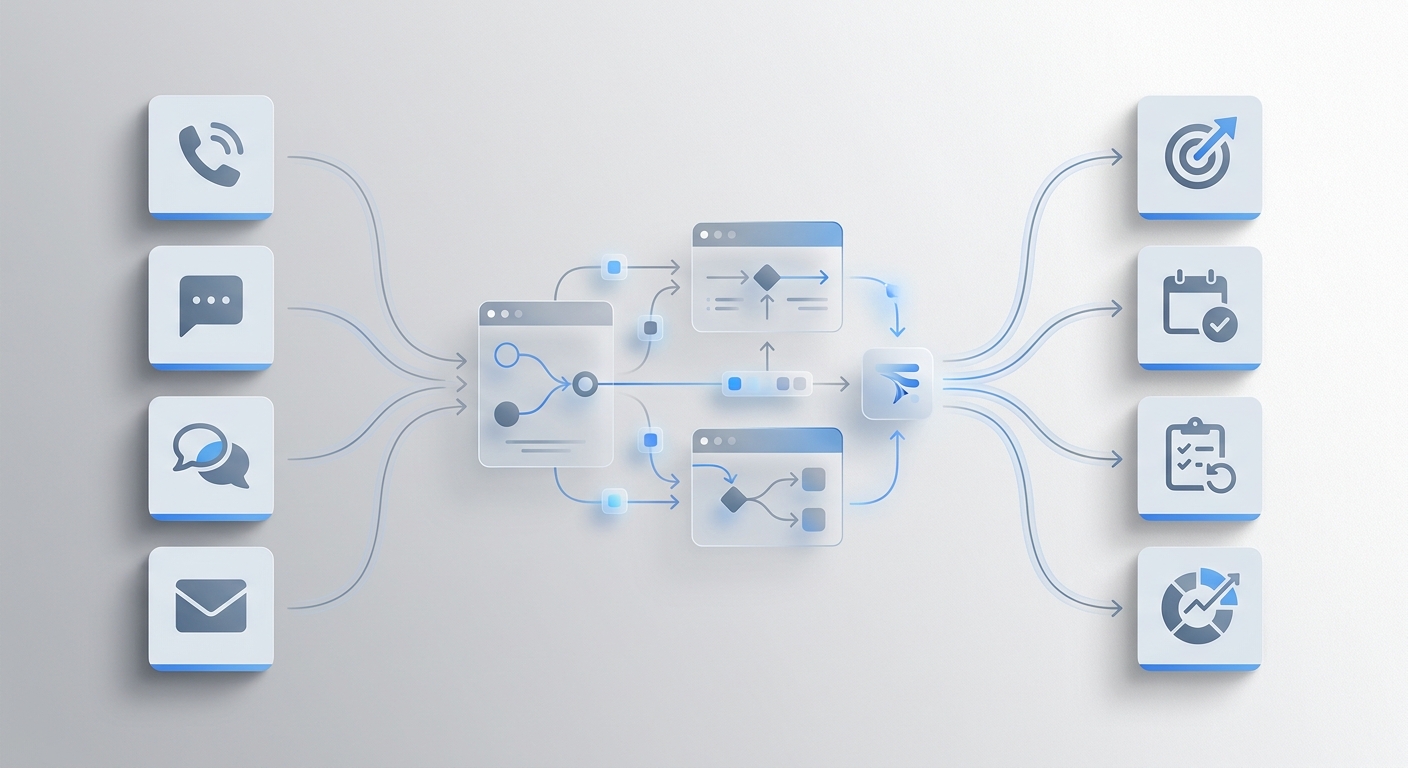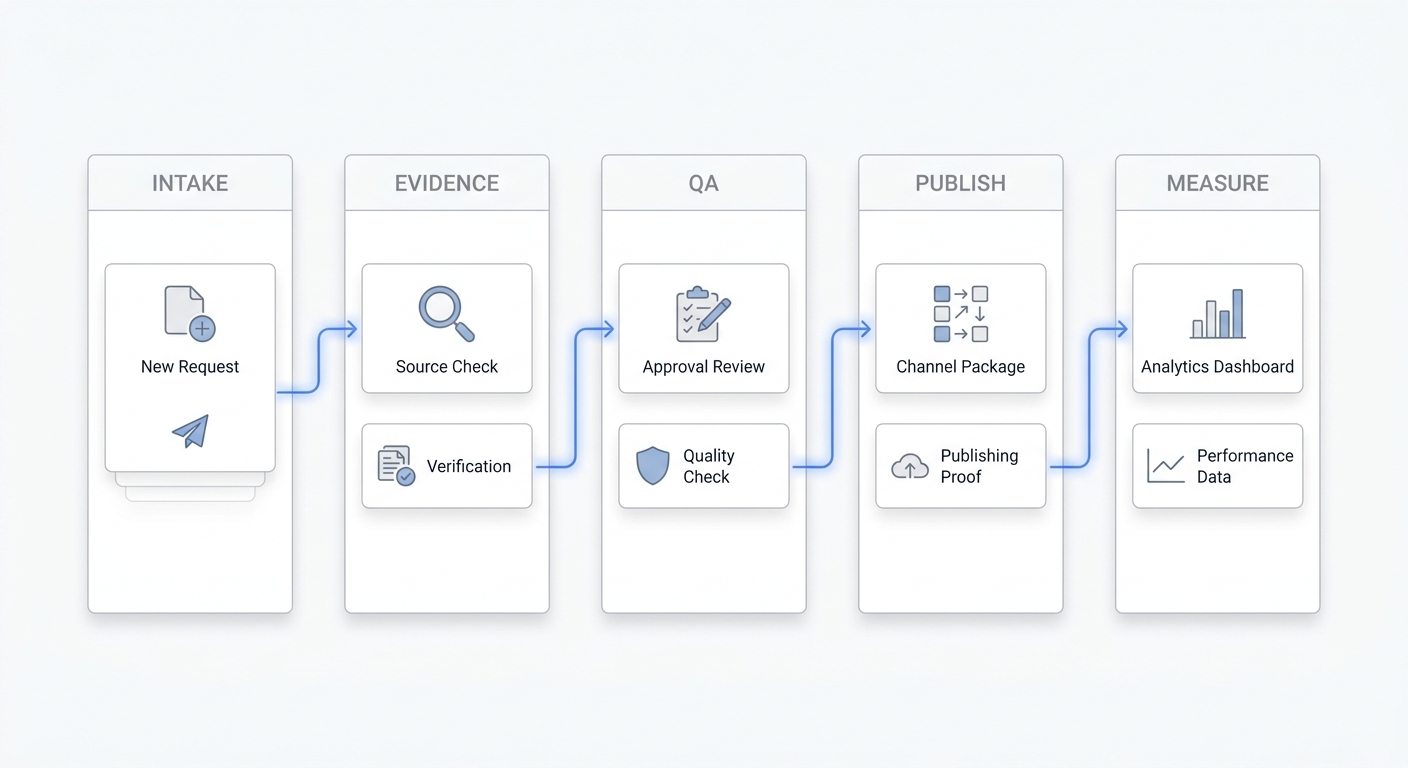
After-hours calls are often where good leads disappear. A customer reaches out at night, gets voicemail, and never calls back. That is a real revenue leak, not just a missed phone call.
But when it comes to solving this, the question isn't just "should I answer the phone?" It's whether you should continue paying for a high-cost answering service or upgrade to an AI receptionist that automatically books, qualifies, and syncs leads. Many businesses aren't choosing between "human or AI receptionist"; they are choosing between an expensive overhead and a scalable growth engine.
This article breaks down the differences between AI receptionist vs answering service through speed, conversion, handling complexity, customer trust, cost, and real user experience, so you can decide whether 2026 is the right time to switch and how to choose the best option.
TL;DR: AI Receptionist vs Answering Service at a Glance
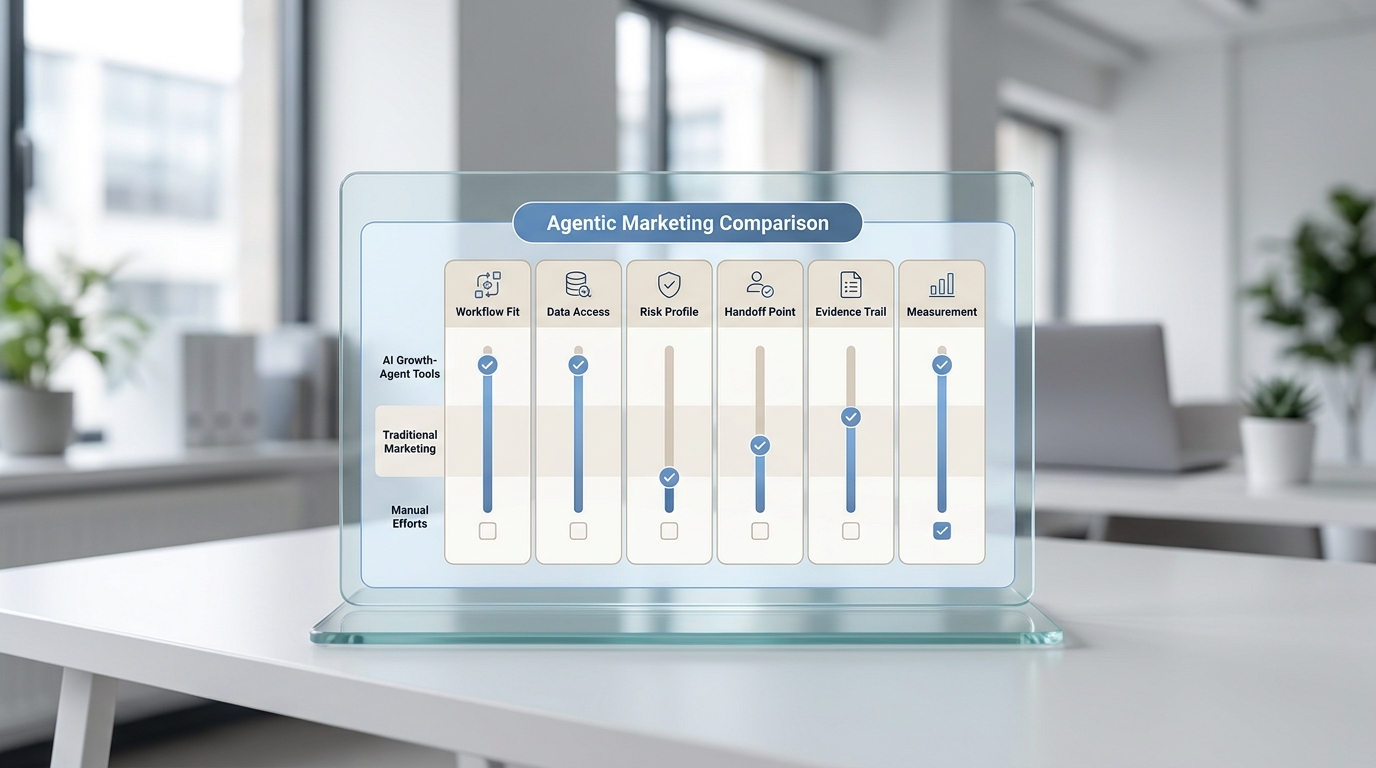
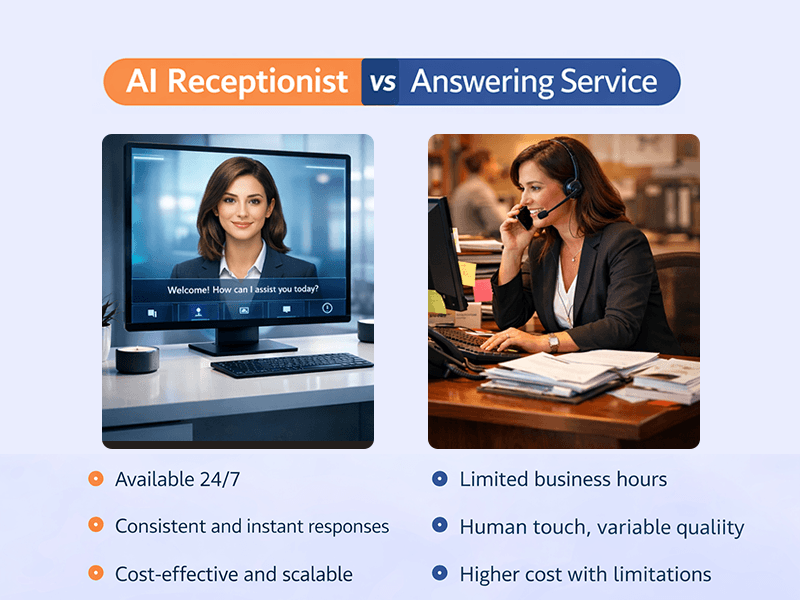
AI receptionists are a better fit for businesses that need 24/7 call handling, appointment booking, lead qualification, and CRM software integration. Answering services are better for businesses that need human empathy, complex complaint handling, and strong live-agent experience.
Dimension | AI Receptionist | Answering Service |
Response speed | Instant or near-instant | Depends on the queue and live agent availability |
Lead conversion | Strong for booking and qualification | Usually limited to message taking and basic routing |
Complex issues | Best for structured questions | Better for emotional or unusual situations |
24/7 availability | Always on | Depends on staffing and service hours |
Cost | Usually, a predictable monthly pricing model | Often variable, based on minutes, calls, or tiers |
Best fit | Appointment-driven and lead-driven businesses | High-touch, emotionally sensitive service calls |
What is AI Receptionist
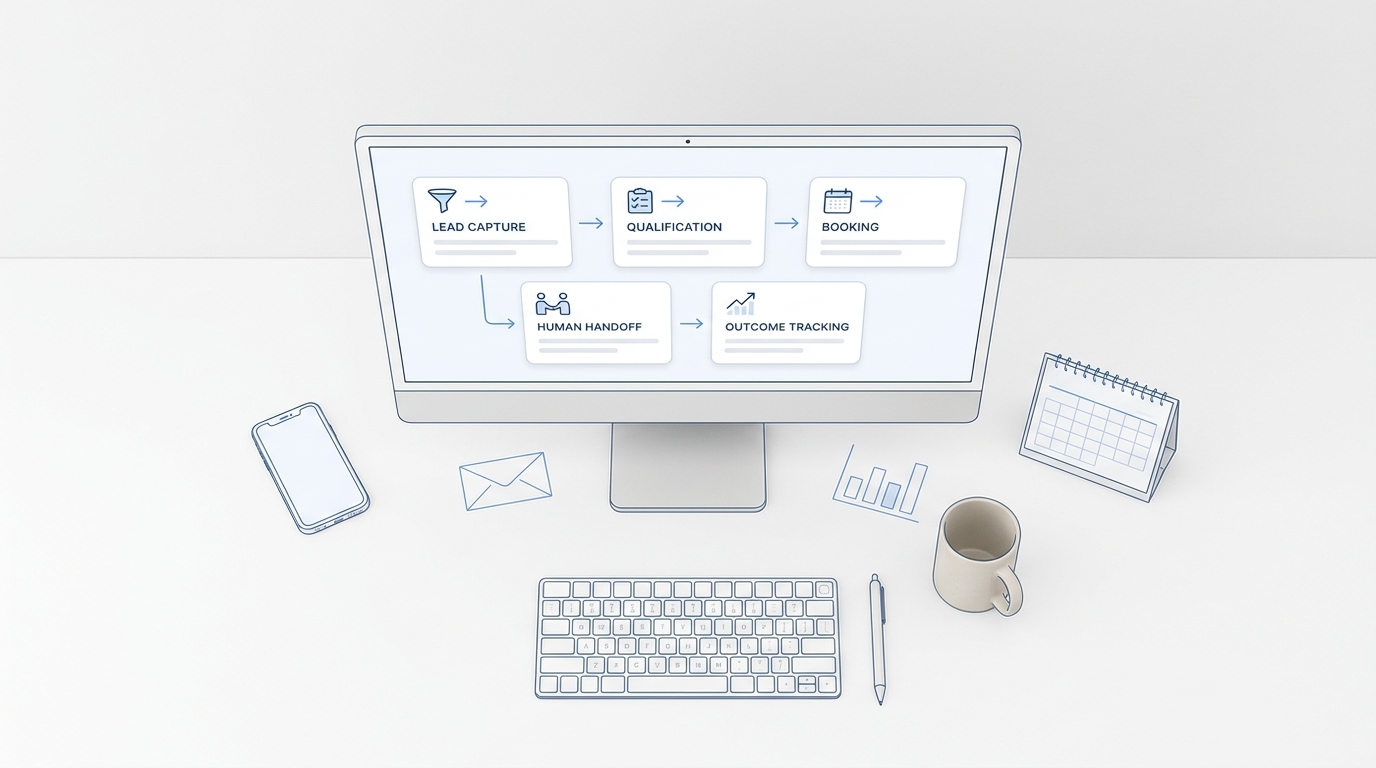
An AI receptionist is a virtual front desk system that answers calls automatically, handles common questions, books appointments, captures lead details, and can often connect with tools like calendars and CRMs. It acts more like sales and customer support than a simple phone answering tool.
What is Answering Service
An answering service is usually a team of live agents who answer calls, take messages, transfer calls, or handle basic routing based on a script. It is a human-led service designed to keep the phone line covered when the business cannot answer directly. This model is strong when calls require empathy, flexible judgment, or a more personal touch.
Why Businesses are Switching from Answering Services to AI Receptionist
Businesses are switching because the economics and the customer experience have changed. Phone leads now expect faster replies, cleaner handoffs, and fewer delays.
- Cost Predictability: Human answering service costs are easy to hit an all-time high. These services are usually charged by the minute, leading to unpredictable bills during busy months.
- Response Latency: AI never puts a customer on hold. In a world of instant gratification, a "first ring" answer is the ultimate competitive advantage.
- Automation of the "Next Step": Now, most AI receptionists don't just take messages or answer common questions; it closes the gap by sending a booking link or qualifying a lead instantly.
- Consistent Brand Voice: An AI follows your instructions 100% of the time, whereas human agents in a call center may sound tired, distracted, or vary in their adherence to your brand tone.
It is important to note that the switch isn't universal. If your business deals with high-sensitivity scenarios—such as a suicide hotline or a specialized medical call center - the human element remains an essential advantage. For everything else, efficiency wins.
AI receptionist vs Answering Service: In-depth Comparison
The best way to compare AI receptionist vs call answering service is by business impact, not just features. The question is not only what each service can do, but what happens after the phone rings.
Speed to Lead of AI receptionist vs Answering Service
Speed is the single most important factor in modern lead conversion. New 2026 research from GREETNOW reveals that responding to leads in under 1 minute increases conversions by 391%.
AI receptionists operate at machine speed. There is no "transferring" or "queuing." The moment the digital line opens, the AI is ready. In contrast, an answering service is limited by the "Seat-to-Call" ratio. If a call center has a spike in volume, your potential client is left on hold, or worse, the call is dropped. For high-intent leads, a 30-second delay is often the difference between a booked consultation and a "never mind."
Factor | AI Receptionist | Answering Service |
First response time | Instant (Ring 1) | Can vary by queue and agent availability |
After-hours coverage | Stable and instant | Depends on the staffing model |
Lead drop-off risk | Lower | Higher during wait time |
Booking speed | Fast | Slower if manual steps are needed |
Lead Conversion of AI receptionist vs Answering Service
Conversion is the art of moving a caller from "curious" to "committed." AI receptionists are built for the "Close." They can check your Google Calendar in real-time and secure a slot immediately.
Answering services are historically passive. Most live agents are trained to "take a message and have someone call you back." This creates a "double-touch" requirement—you or your staff still have to call the lead back later. By the time you do, that lead may have already moved on. If your business is service-based, like plumbing, legal, or a dental practice, an AI receptionist is significantly more effective.
Factor | AI Receptionist | Answering Service |
Booking flow | Automated and guided | Often manual or partial |
Lead capture | Structured and consistent | Depends on the agent |
CRM sync | Often built in | Usually requires more manual work |
Funnel outcome | Better for action-driven calls | Better for message-taking |
Handling Complexity of an AI receptionist vs Answering Service
AI works best when the call is structured. It can answer common questions like business hours, pricing basics, appointment booking, location, and FAQs with consistency.
However, human answering is still the masters of unstructured complexity. If a caller is crying, angry, or using highly metaphorical language to describe a unique problem, a live agent can pivot emotionally.
Factor | AI Receptionist | Answering Service |
Structured questions | Strong | Strong |
Emotional calls | Limited | Strong |
Complex routing | Good for defined rules | Better for flexible judgment |
Best use case | Routine call handling | Sensitive or unusual cases |
Lead Qualification of AI receptionist vs Answering Service
Lead qualification is where AI often creates the biggest business value. An AI receptionist can apply rules to screen leads by budget, location, service type, urgency, or preferred time, then send the result into a CRM or booking flow.
A human answering service can also qualify leads, but the process is harder to standardize. Different agents may ask different questions, record details differently, or miss important fields. That is why AI is often more reliable for businesses that want to turn phone traffic into a measurable sales funnel.
Factor | AI Receptionist | Answering Service |
Qualification rules | Can be predefined | Depends on agent training |
Consistency | High | Variable |
CRM integration | Often automated | Often manual |
Lead funnel value | Strong | Moderate |
Customer Trust of AI receptionist vs Answering Service
Trust is not only about whether the caller speaks to a human. It is about whether the caller gets accurate answers, a smooth process, and a clear next step.
AI builds trust through speed, consistency, and process control. A live answering service builds trust through human warmth, empathy, and flexible communication. The real question is not "Do customers trust AI?" It is whether the system makes them feel heard and helps them solve their problem without friction.
Factor | AI Receptionist | Answering Service |
Response consistency | Strong | Depends on the agent |
Human empathy | Limited | Strong |
Accuracy of workflow | Strong if configured well | Variable |
Trust driver | Speed and reliability | Voice and emotional tone |
The Real Cost of AI receptionist vs Answering Service
AI Receptionist Pricing
AI receptionist pricing is often monthly subscription-based, but some providers also use minute-based or call-based pricing models. A business should also watch for extra charges such as overage minutes, phone line fees, integrations, and setup fees.
The advantage of AI is predictability. Once the automated system is set up, the marginal cost of scaling is usually lower than adding more human coverage. To make AI receptionist pricing easier to compare, here we selected 3 representative products based on different models.
AI Product | Pricing Model | Approximate Annual Cost |
Monthly subscription ($30/month) | $360/year | |
Smith.ai AI Receptionist | Per-call ($1.90/call~$1.60/call, 60 calls~900 calls/month) | $1140~$9600/year |
Retell AI | Per-minute ($0.07-$0.31/min, 20 calls/month) | $84~$372 (100 minutes/year) |
Answering Service Pricing
Answering services usually charge by minute, by call, or by package tier. The pricing can look simple at first, but it often grows once you add after-hours coverage, holiday coverage, overflow handling, or higher call volume.
This is where businesses often feel cost pressure over time. A plan that looks affordable at low volume can become much more expensive as call volume increases. The following are three representative live answering service pricing models.
Product | Pricing Model | Approximate Annual Cost |
Ruby | Per-minute ($250/month~$1725/month, 50~500minutes/month) | $3000~$20700/year |
Smith.ai human-service | Per-call ($300/month~$2100/month, 30~300calls/month) | $3600~$25200/year |
PATLive | Tiered package ($75/month~$1170/month) | $900~$14040/year |
Costs of AI Receptionist vs Answering Service
The cost between a digital receptionist vs a telephone answering service is no longer marginal; it is transformative. For a growing small business, switching to AI can reduce annual operational expenses by thousands of dollars while simultaneously extending coverage to 24/7.
At low volumes, the cost difference might pay for a few software subscriptions; however, at medium to high volumes, the "Human Premium" becomes a significant drag on ROI. AI receptionists like Solvea provide a flat-cost moat, ensuring that as your lead volume triples, your expenses remain static. In contrast, an answering service treats your growth as an additional expense, charging you more for every successful marketing campaign you run.
Metric | AI Receptionist (e.g., Solvea) | Live Answering Service |
Entry-Level Cost | ~$360 / year | ~$900 - $3,600 / year |
High-Volume Cost | Static or Low Increase | $14,000 - $25,000+ / year |
24/7/365 Surcharges | None (Included) | High (Holiday/After-hours fees) |
Scalability ROI | High (Profit grows, cost stays flat) | Low (Cost grows with volume) |
Real User Experiences: What Happens After Switching to AI
Real-world results often become obvious in the first few weeks after switching to an AI receptionist. The biggest change is not just faster answering, but a smoother path from first call to booked appointment. Businesses that rely on after-hours calls often see the clearest difference because missed calls and slow callbacks are where leads are most likely to disappear.
Scenario: A Potential Client Calls a Law Firm or Home Service Provider for an Urgent Quote at 7:30 PM.
Using a Traditional Answering Service (The "Callback Loop"):
- The Wait: The customer calls. The line rings six times before being routed to a call center agent who is currently handling three other calls.
- The Greeting: "Thank you for calling [Business Name]. This is an answering service. How can I help you?"
- The Inquiry: Customer: "Hi, I have an urgent issue and need to know the product pricing and if someone can come out tomorrow."
- The Script: Operator: "I can certainly take that down for you. What is your name and the best number to reach you at?"
- The Friction: Customer provides details and asks again about the schedule. Operator: "I don't have access to the master calendar, but I will flag this as urgent for the office manager. They will call you back during business hours tomorrow morning."
- The Result: No resolution. The call ends. The customer, still feeling the urgency, goes back to Google and calls the next business on the list. By the time your staff calls back the next day, the lead has already booked with a competitor.
Using an AI Receptionist (The "Instant Conversion"):
- The Wait: The customer calls. The AI answers on the first ring, providing an immediate sense of professional presence.
- The Greeting: "Hi! You've reached [Business Name]. I can help you with quotes, scheduling, or basic questions. What can I do for you today?"
- The Inquiry: Customer: "I need an urgent quote, and I'm looking for someone to come by tomorrow afternoon."
- The Resolution: AI: "I can help with that. First, are you a new or returning client? [Customer answers]. Great. I see our standard quote fee is $50, which is credited toward your service. For tomorrow, I have openings at 1:00 PM and 3:30 PM. Would you like to secure one of those?"
- The Closing: Customer chooses 1:00 PM. The AI asks for the address and contact info, then says: "You're all set. I've just blocked that time for you and sent a confirmation text with a calendar invite. Our technician, Mike, will see you tomorrow."
- The Result: Appointment Booked. The lead is captured, the CRM is updated, and the customer stops searching because their problem is solved.
As shown in the comparison, the answering service creates a "Phone Tag" cycle that relies on your staff's future availability to close the deal. The AI Receptionist creates a seamless flow, converting the caller into a customer in a single interaction. In a competitive market, the business that removes the most friction wins the lead every time.
How AI Receptionists Like Solvea Improve Lead Conversion
Solvea is designed for business owners who want to cover their front desk 24/7 without the headache of a massive technical project. It works as a single, smart AI receptionist that manages your calls, emails, and web chats in one place.
Instead of dealing with scattered notes or missed messages, Solvea keeps everything organized. It automatically syncs with your CRM tools to handle bookings and follow-ups, making it the best choice for small businesses that want to save time and stop losing high-value clients on a budget.
See how it all comes together in practice:
- Fast Setup with "Vibe Coding": You can get started in minutes by using industry-specific templates or just describing how you want the AI receptionist to work.
- Calendar and CRM Sync: It writes bookings and notes directly into your Google Calendar or CRM, ensuring your team is always up to date.
- Advanced Problem Solving: Beyond simple questions, the AI uses your scripts to handle more complex situations and edge cases.
- Affordable Pricing: Transparent and budget-friendly flat rate of just $30 per month, without the fear of fluctuating costs or hidden fees.
- Safe and Secure: The platform uses enterprise-grade security (SOC2 and GDPR compliant) and can talk to clients in multiple languages.
Your AI Receptionist, Live in Minutes.
Scale your front desk with an AI that never sleeps. Solvea handles unlimited multi-channel inquiries, books appointments into your calendar automatically, and ensures zero missed opportunities around the clock.
FAQs
Which one converts more leads: AI receptionist or answering service?
AI receptionists typically convert more leads for appointment-based businesses. Because they can book directly into your calendar the moment the customer is interested, they eliminate the "follow-up gap" where most leads are lost in traditional answering service models.
What types of calls are AI receptionists best at handling?
AI receptionists are best at handling structured calls such as booking requests, business hours questions, pricing basics, lead capture, service routing, and FAQ-style conversations. They are strongest when the call follows a predictable workflow.
How does the cost of AI compare to a live answering service for a small business?
For small businesses, AI is often easier to budget because it usually uses fixed monthly pricing or usage-based pricing with a lower marginal cost. Live answering services may seem flexible at first, but the total cost can rise faster with volume, after-hours coverage, and staffing needs.
Can an AI receptionist handle emotional or high-stakes client calls?
While AI has improved, it lacks genuine human empathy. For high-stakes scenarios (like emergency medical dispatch or sensitive legal crises), a human is better. However, for 95% of standard business interactions, AI's speed and accuracy actually build more trust than a slow human response.
Is an AI receptionist better at filtering spam than an answering service?
Yes. AI systems can identify and deflect robocalls and spam in milliseconds. With human service, you often end up paying the "per minute" rate for the agent to talk to a telemarketer, which wastes your budget.
What happened after switching from a human answering service to AI receptionist?
Most businesses can see a "cleaner" CRM and a higher volume of appointments booked. The biggest change is the lack of "phone tag"—since the AI completes the booking or qualification on the first call, the owner doesn't have to spend hours returning missed calls.