Your technician is on a rooftop swapping out a condenser coil when the phone rings. Nobody picks up. The homeowner — whose AC just quit during a heat wave — calls the next HVAC company in their search results and books with them instead.
That's not a hypothetical. HVAC companies miss roughly 27% of their inbound calls because their team is out in the field where phones don't get answered. During peak season, that number climbs. And in HVAC, a missed call rarely means just one lost tune-up — it can mean a lost equipment replacement worth $8,000 or more.
AI receptionists fix this by picking up every call, 24/7, qualifying the job, and booking it directly into your calendar. We evaluated 10+ tools against criteria that actually matter for HVAC operations: emergency triage capability, integration with ServiceTitan and Housecall Pro, seasonal surge handling, and pricing transparency. The seven below made the cut.
TL;DR: AI Receptionists for HVAC Companies at a Glance
Tool | Best For | Starting Price | Key Advantage |
Owner-operated HVAC shops wanting zero billing surprises | Free / $30/month | Flat-rate pricing — no per-call charges during summer surge | |
Mid-size HVAC companies on ServiceTitan | $449/month | 92% booking rate, built for trades, ServiceTitan official partner | |
Multi-location HVAC enterprises | Custom pricing | Handles 70% of call volume autonomously, deep ServiceTitan sync | |
HVAC businesses needing live agents for complex jobs | $300/month (30 calls) | North American human receptionists 24/7 with AI screening | |
Contractors wanting proven 24/7 human backup | Custom pricing | Forbes Best Answering Service 2025, HVAC-specific scripts | |
Solo HVAC contractors on a tight budget | $49/month | Unlimited minutes, no phone system required | |
HVAC shops drowning in repeat FAQ calls | $79/month | Reduces call volume entirely — not just answers calls |
1. Solvea: Best for Owner-Operated HVAC Shops
When you run a 2–5 person HVAC company, every dollar counts — especially when July hits and your call volume triples overnight. The tools that charge per call or per minute punish you exactly when you need them most.
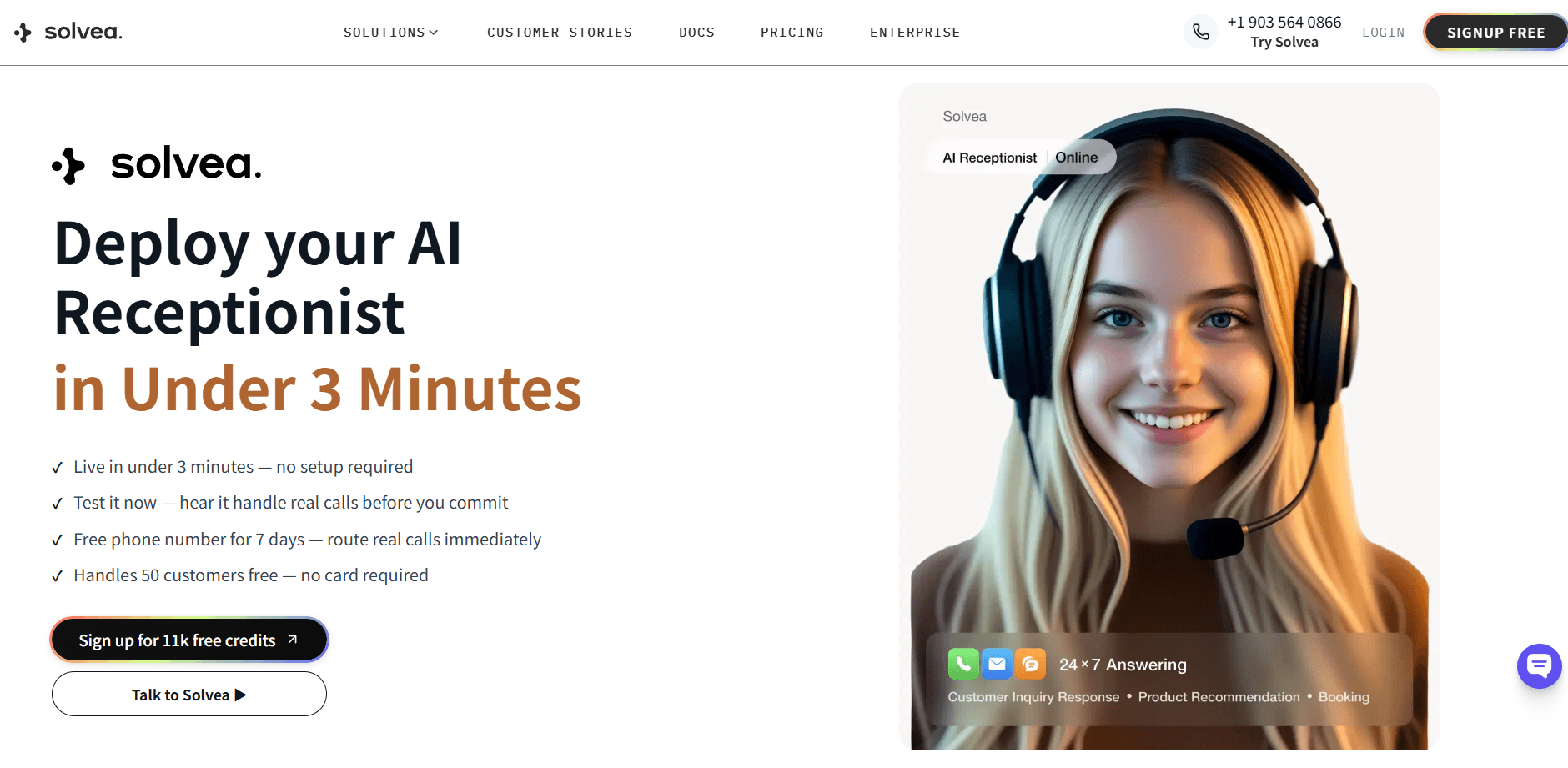
Solvea is an AI receptionist that handles voice calls, SMS, live chat, and email from a single agent, on a flat monthly rate. For an HVAC owner fielding calls across multiple channels — homeowners texting about their AC, facilities managers emailing about service agreements — having one AI that covers all four is a real operational advantage. Setup takes under 3 minutes with no coding required.
Why it's on this list
Solvea's flat pricing is its most HVAC-relevant strength. During a summer heat emergency, you don't want a bill that scales with the number of panicked homeowners calling about their failed central air unit. The free plan covers 50 conversations and 3 agents — enough to test it on real calls before committing. The $30/month Basic plan gives you 30,000 credits with voice, SMS, chat, and email all included.
Pros
- Flat monthly rate — no per-call or per-minute overages when seasonal call volume spikes in July or January
- Covers voice, SMS, chat, and email from one agent — useful for HVAC shops that get job requests through multiple channels
- Free plan available with no credit card, letting you test it on real HVAC call scenarios before paying
- Setup in under 3 minutes — no IT team needed, deployable by an owner-operator between service calls
Cons
- No native integration with ServiceTitan, Housecall Pro, or Jobber — appointment data won't sync automatically to your field service management software
- Not purpose-built for HVAC emergency triage — you'll need to configure the AI with your own diagnostic scripts and emergency escalation rules
- Free plan caps at 50 conversations/month, which may not cover a busy HVAC shop during peak season
Pricing
- Free: $0/month — 50 conversations, 3 agents, 1 phone number, voice + SMS + chat + email
- Basic: $30/month — 30,000 credits, 10 agents, full channel coverage
Bottom line
Solvea is best for HVAC owner-operators who want multi-channel AI coverage without watching a per-call meter during their busiest months — and who are comfortable configuring their own service scripts.
2. Sameday AI: Best for Mid-Size HVAC Companies on ServiceTitan
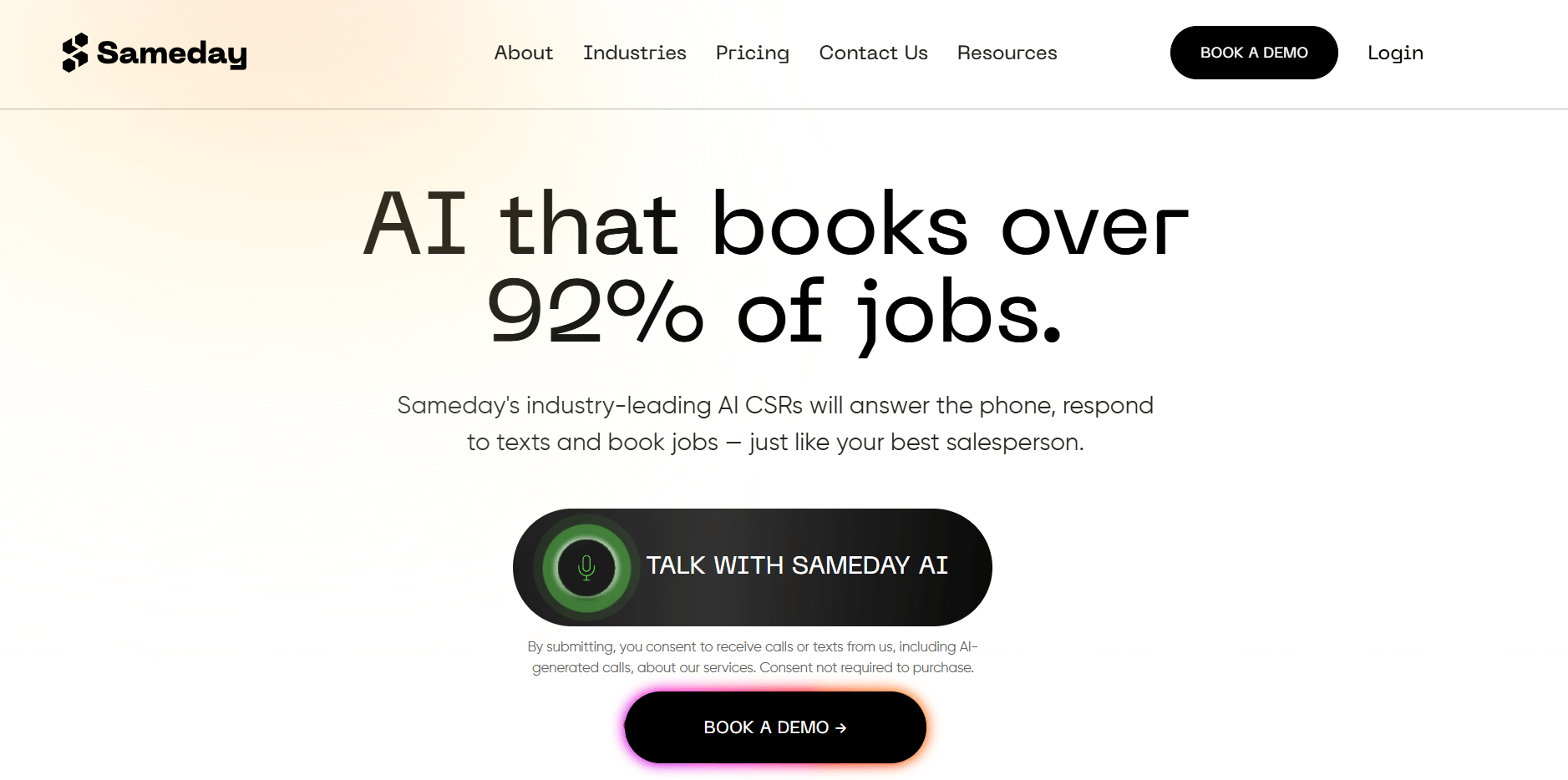
Most AI answering tools treat HVAC like any other small business. Sameday was built specifically for the trades.
Sameday AI is an AI phone answering system designed for home service companies — HVAC, plumbing, roofing, pest control. It answers calls, responds to texts, books jobs, and dispatches directly into ServiceTitan, Housecall Pro, Jobber, and Service Fusion. It's an official ServiceTitan partner, which means the integration is deep and maintained.
Why it's on this list
The numbers are hard to argue with. Sameday reports a 92% booking rate across its trade customers, has answered 2 million+ calls in the trades, and has driven $1.25 billion in revenue for its customers. Way Cool Plumbing & Air — a real HVAC and plumbing company — ran 4,000 calls through Sameday in four months and cited significant improvements in customer retention. For HVAC operations that need an AI that actually understands seasonal urgency, equipment terminology, and job dispatching, Sameday is the category leader.
Pros
- Purpose-built for HVAC and trades: understands the difference between an emergency no-heat call and a routine filter replacement scheduling request
- Official ServiceTitan partner — books jobs, assigns tags, manages capacity, and dispatches techs directly to your board
- Handles both inbound calls and outbound campaigns (Angi lead follow-up, maintenance reminders)
- Stress-tested for seasonal surge: multiple call handling with four-layer fallback infrastructure
Cons
- Minimum $449/month makes it a significant commitment for HVAC shops with fewer than 50 calls per month
- Requires a demo to get started — no self-serve signup
- Voice cloning and multilingual support only available on Scale plan ($789/month) and above
Pricing
- Launch: $449/month — 500 minutes included, 3 locations, ServiceTitan integration
- Scale: $789/month — 1,000 minutes, unlimited locations, voice cloning
- Enterprise: Custom — multilingual, advanced analytics, custom integrations
- No long-term contracts
Bottom line
Sameday is best for HVAC companies doing $1M+ in annual revenue who need an AI call center that natively speaks ServiceTitan and can handle the full volume of a busy peak season.
3. Avoca AI: Best for Multi-Location HVAC Enterprises
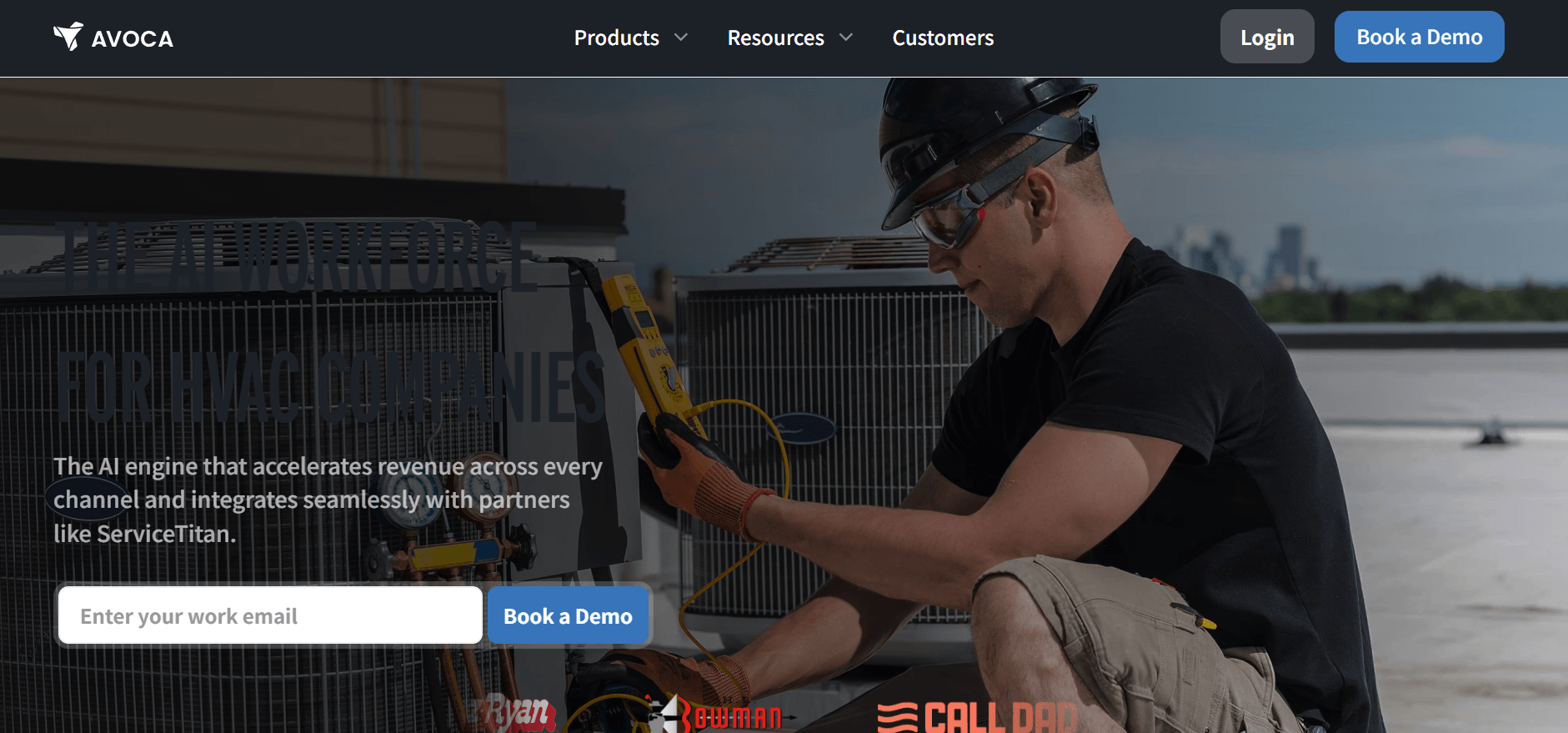
Some HVAC operations have grown past the point where any one-size-fits-all tool fits. Multiple service areas, dozens of technicians, and hundreds of daily calls require a different category of AI.
Avoca AI is an omnichannel AI workforce platform built specifically for home service businesses. It handles inbound calls, texts, and chats 24/7, runs outbound drip campaigns, and provides real-time coaching dashboards for human CSRs. HL Bowman — an HVAC company — uses Avoca to handle 70% of their entire call volume autonomously while booking at a higher rate than their human team ever did. Aire Serv, another HVAC operator, went from 58 after-hours bookings to 208 after deploying Avoca, with a 92% after-hours booking rate.
Why it's on this list
The case studies are enterprise-grade. Avoca helped Top Flight Electric boost their booking rate from 10% to 70% and add $170,000 in new revenue, while also freeing them to hire four additional technicians. For a large HVAC operation where after-hours call volume alone could fund a new hire, Avoca's ROI case is compelling.
Pros
- Handles 70%+ of call volume autonomously — reduces CSR headcount pressure at HVAC companies with high inbound volume
- Deep ServiceTitan integration: real-time sync of customer records, job data, and performance metrics
- Outbound drip campaigns for maintenance scheduling and happy calls — keeps your HVAC maintenance agreement pipeline active year-round
- Built-in CSR coaching dashboards for training human agents on real calls
Cons
- Custom pricing only — no published rates; requires a demo before you can evaluate cost
- Enterprise-oriented: overkill and likely too expensive for HVAC companies with fewer than 10 CSRs or 200 daily calls
- No self-serve onboarding; implementation requires hands-on setup with Avoca's team
Pricing
- Custom pricing — contact Avoca for a quote based on call volume and team size
Bottom line
Avoca is best for established HVAC companies with multiple locations, high call volume, and a desire to scale without proportionally growing their customer service staff.
4. Smith.ai: Best for HVAC Businesses That Need Live Agents for Complex Jobs
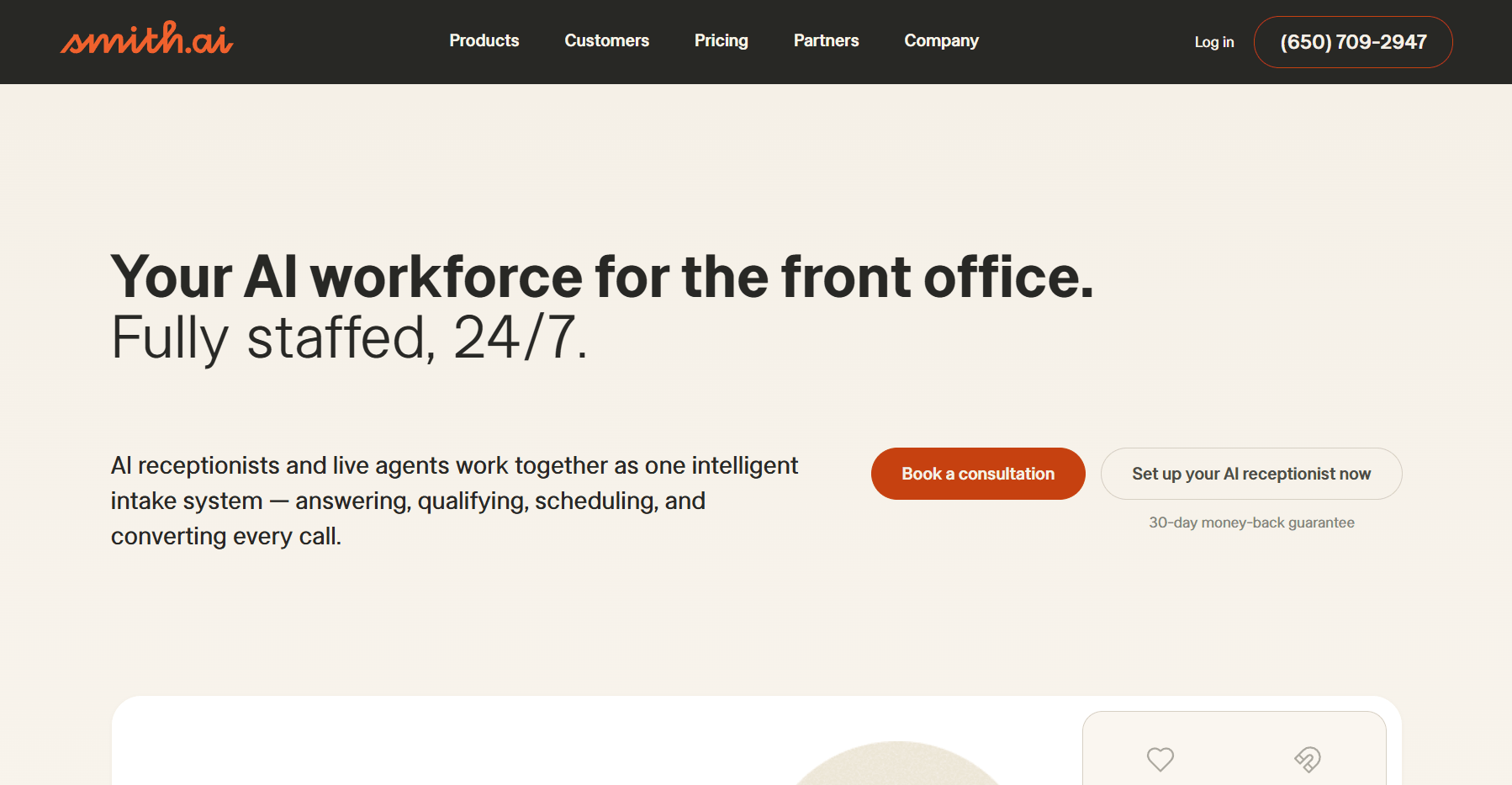
Some HVAC calls can't be handled by AI alone. A homeowner describing a heat exchanger failure in technical terms. A commercial facilities manager negotiating a service contract. An elderly customer who keeps asking to speak with a person.
Smith.ai combines AI screening with live North American receptionists who answer 24/7. The AI handles initial qualification while human agents step in when conversations need a personal touch. For HVAC companies that handle a mix of straightforward residential bookings and complex commercial service inquiries, this hybrid model eliminates the gaps that pure-AI tools leave.
Why it's on this list
Smith.ai has handled calls for thousands of home service businesses and built out HVAC-relevant integrations including Housecall Pro and Jobber. The 30-day money-back guarantee is a real safety net for HVAC operators testing a new system before their peak season. Every plan includes lead qualification, new client intake, and 24/7 live staffing at no extra charge.
Pros
- Live North American receptionists available 24/7 — handles HVAC calls where the caller insists on talking to a human
- Lead qualification included in all plans: receptionists ask your custom intake questions (system type, service area, urgency level) before confirming a booking
- 30-day money-back guarantee on all plans
- Appointment booking add-on works with Calendly, Acuity, and other scheduling tools
Cons
- Significantly more expensive than AI-only alternatives: $300/month for just 30 calls means a busy HVAC shop could quickly exceed their plan
- Per-call overage charges (8.50–11.50/call depending on plan) can add up fast during summer surge
- Not HVAC-specific — receptionists work across industries, so HVAC terminology and emergency triage training depends entirely on the scripts you provide during onboarding
Pricing
- Starter: 300/month — 30 calls, 11.50/call overage
- Basic: 810/month — 90 calls, 10.50/call overage
- Pro: 2,100/month — 300 calls, 8.50/call overage
- No long-term contracts; 30-day money-back guarantee
Bottom line
Smith.ai is best for HVAC companies handling high-value commercial accounts or complex residential jobs where a live human agent adds a meaningful close rate improvement over pure AI.
5. AnswerForce: Best for HVAC Businesses That Want Proven Human Backup
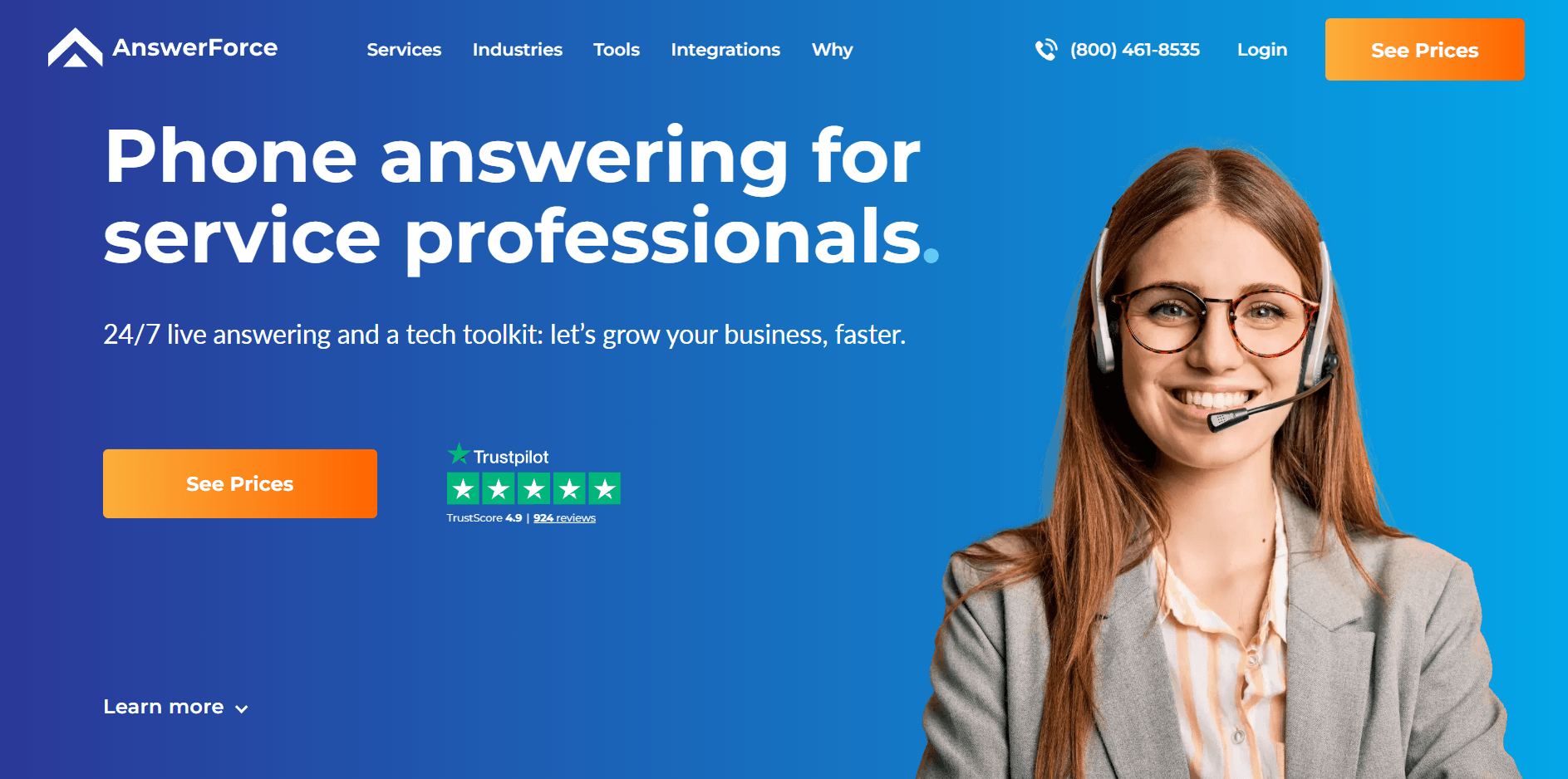
Some HVAC owners tried AI and got burned. Calls mishandled, emergencies missed, customers who called back furious. The trust isn't there yet for a fully autonomous system.
AnswerForce takes a human-first approach with AI assistance. Live receptionists answer every call, 24/7, with HVAC and trade-specific call scripts built from years of serving contractors. They handle appointment scheduling, emergency dispatch protocols, bilingual answering, and service area qualification. Forbes named them Best Answering Service in 2025, and they hold a 4.9/5 rating on Trustpilot across 917 reviews.
Why it's on this list
AnswerForce has specific experience in HVAC and home services — not just generic small business answering. Their live receptionists are trained to recognize emergency keywords ("no heat," "water leak," "carbon monoxide") and escalate appropriately. For HVAC companies that handle after-hours emergency dispatch, having human judgment in the loop is often worth the premium cost.
Pros
- Live human receptionists with HVAC and contractor-specific training and call scripts
- Emergency dispatch protocols for after-hours urgent calls — routes true emergencies to your on-call tech
- Bilingual answering (English/Spanish) for HVAC companies serving multilingual service areas
- Direct integrations with ServiceTitan and Housecall Pro for appointment sync
Cons
- Pricing is not publicly listed — requires a sign-up conversation, making it harder to budget ahead of peak season
- Per-minute billing model means costs scale with call length; a detailed HVAC intake call can add up fast
- Quality of service can vary by rep — human operators don't deliver the same experience on every call
Pricing
- Custom pricing — contact AnswerForce for a quote based on call volume and service requirements
- Plans typically include a monthly base fee plus per-minute usage charges
Bottom line
AnswerForce is best for established HVAC contractors who want trained human receptionists with HVAC-specific emergency protocols, and who are willing to pay a premium for the reliability of live agents.
6. Rosie: Best for Solo HVAC Contractors on a Budget
You're a one-person HVAC operation. Or maybe two techs. You can't afford $400/month for a call answering system, but you also can't keep losing jobs to voicemail while you're in a crawlspace replacing a blower motor.
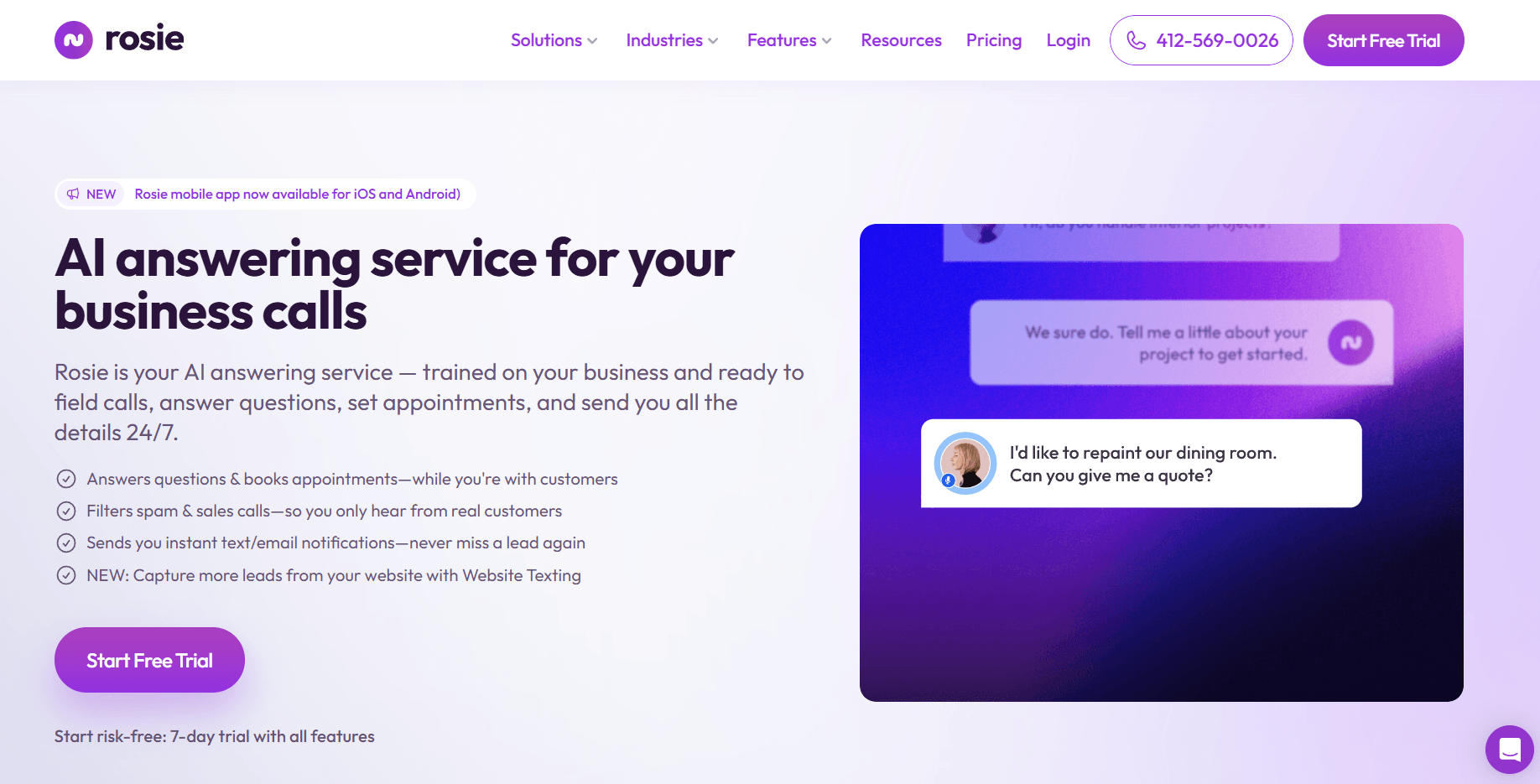
Rosie is a standalone AI answering service that costs $49/month and includes unlimited minutes. You connect it to your existing phone line — no new phone system required — and it picks up when you can't. It answers common questions, takes messages with structured details, and sends you instant notifications with AI-generated call summaries. For solo HVAC operators or small two-tech shops, it stops the bleeding without adding a significant overhead line.
Why it's on this list
Rosie was built specifically for small businesses that were losing calls to voicemail but couldn't justify the cost of traditional answering services. You can train it on your website or custom FAQ — including HVAC-specific questions like service area, brands you work on, and whether you handle commercial jobs. The unlimited minutes mean no surprise charges during your busiest weeks.
Pros
- $49/month with unlimited minutes — no per-call or per-minute overages during summer surge
- Connects to your existing phone number; no phone system migration required
- 7-day free trial with no credit card needed
- Custom FAQ training covers HVAC-specific questions (service area, unit brands, emergency availability)
Cons
- Base plan (49/month) does not include call transfers or appointment booking — those require the Scale plan (149/month)
- No native ServiceTitan, Housecall Pro, or Jobber integration on any plan
- Only available in the US and Canada
- Not purpose-built for HVAC — you'll configure all trade-specific intake logic yourself
Pricing
- Professional: $49/month — answering, message-taking, instant notifications (unlimited minutes)
- Scale: $149/month — adds call transfers, appointment links, in-call SMS
- Growth: $299/month — adds custom training files for complex HVAC intake scenarios
Bottom line
Rosie is best for solo HVAC contractors or two-tech shops who need affordable AI call coverage to catch jobs while they're on-site, without switching their phone system or committing to a high monthly minimum.
Your AI Receptionist, Live in Minutes.
Scale your front desk with an AI that never sleeps. Solvea handles unlimited multi-channel inquiries, books appointments into your calendar automatically, and ensures zero missed opportunities around the clock.
7. Goodcall: Best for HVAC Shops Drowning in Repeat FAQ Calls
Not every HVAC call is a new job. A significant portion are existing customers asking the same questions: "When's my next service?" "Do you still cover my area?" "What's your emergency fee?" These calls consume your front desk time without generating revenue.
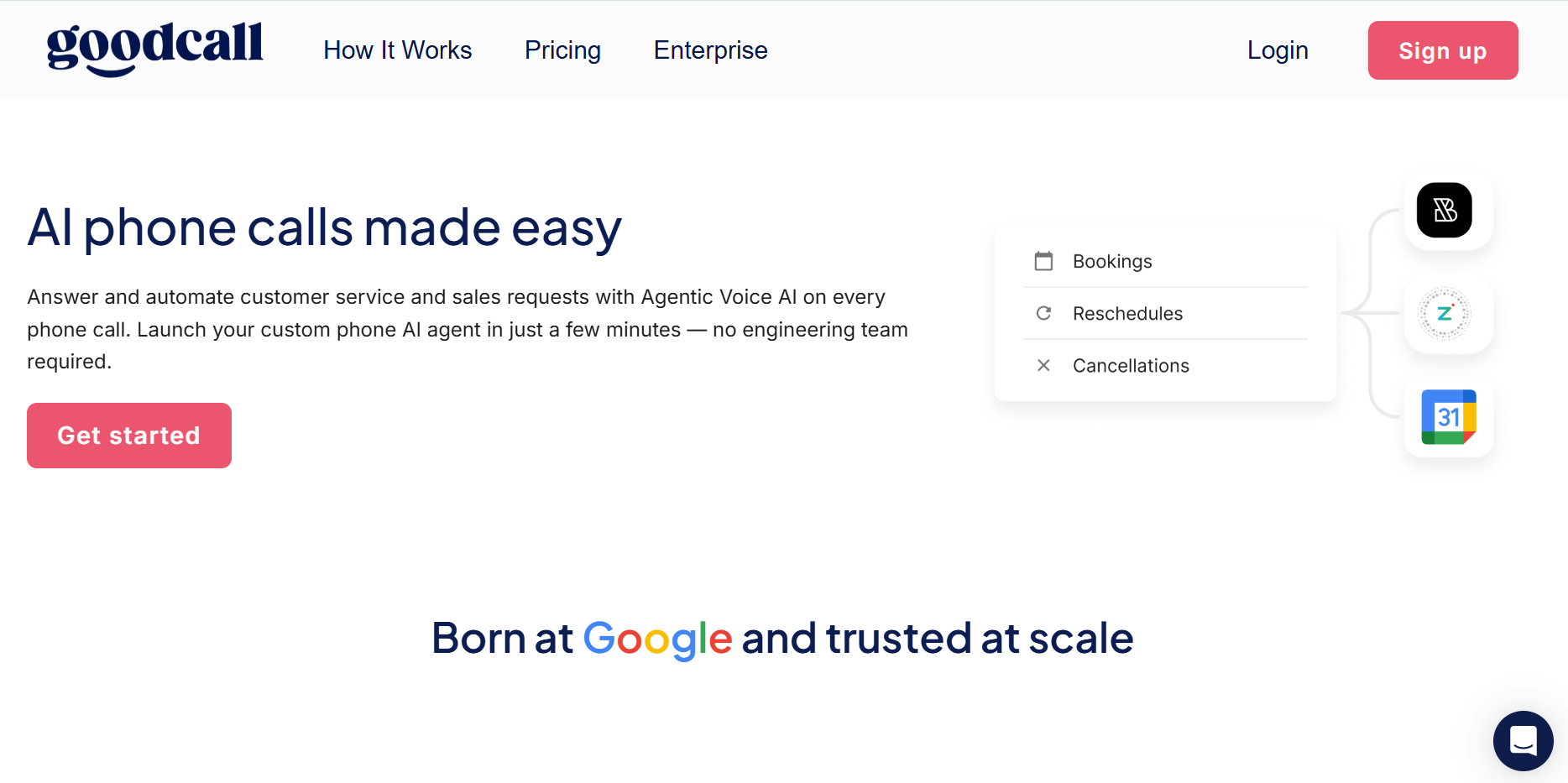
Goodcall takes a different approach: instead of just answering calls, it aims to resolve them entirely. Callers get answers on the spot for trained questions, leaving messages that are pre-structured with the exact details your team needs. For HVAC offices where a handful of FAQ questions account for 40%+ of call volume, this deflection approach reduces interruptions while still capturing every lead.
Why it's on this list
Goodcall's structured lead capture is its strongest asset for HVAC. You define exactly what information callers need to provide — system type, service address, nature of the problem — so every message that comes through is already organized and actionable. The 14-day free trial lets you test this against your actual HVAC call mix before committing.
Pros
- Structured lead capture: you define the intake questions (system type, address, issue description) so every message is pre-organized for your dispatch board
- Unlimited call minutes on all plans — no per-call charges during peak season
- 14-day free trial — test against real HVAC calls before paying
- Call deflection model reduces front desk interruptions for routine FAQ calls
Cons
- Caps on unique customers per month: Starter plan allows 100 unique customers, then $0.50 per additional customer — a busy HVAC company in a large service area can hit this limit
- No native CRM or FSM integrations — connects to ServiceTitan or Housecall Pro only via Zapier, not natively
- No SMS support — can only handle voice calls
- No mobile app for managing the service from the field
Pricing
- Starter: 79/month per agent — 100 unique customers/month, 0.50 each additional
- Growth: 129/month per agent — 250 unique customers/month, 0.50 each additional
- Scale: 249/month per agent — 500 unique customers/month, 0.50 each additional
- 14-day free trial; no phone system included
Bottom line
Goodcall is best for HVAC offices with a high ratio of repeat customer FAQ calls that want to reduce interruptions while making sure every new lead is captured in a structured, dispatch-ready format.
How to Choose the Right AI Receptionist for Your HVAC Company
The right tool depends less on features lists and more on how your specific HVAC business takes and handles calls.
Start with your call volume and billing model fit. If your monthly call count is unpredictable — spiking in July and December, flat in October — prioritize flat-rate monthly pricing over per-call or per-minute plans. A heat wave that triples your call volume shouldn't also triple your receptionist bill. Solvea and Rosie both offer flat rates. Sameday charges by the minute, which is predictable if you can estimate your usage but risky during abnormal surges.
Consider how much of your call intake needs to be HVAC-specific. Generic AI answering tools can answer calls and take messages, but they won't ask a caller whether their system is a heat pump or gas furnace, recognize that "no heat" means dispatch-now versus "maintenance due" means schedule-next-week, or know to ask for the system's age and model when a replacement quote might be involved. Sameday and Avoca have this built in. With Solvea, Rosie, or Goodcall, you'll configure it yourself.
Think about your field service software ecosystem. If your dispatchers live in ServiceTitan or Housecall Pro, the biggest time-saver is an AI that books directly into those platforms. Sameday and Avoca have official integrations. Smith.ai and AnswerForce have Housecall Pro connections. Rosie and Goodcall connect only via Zapier or don't integrate natively — meaning someone on your team will still need to manually enter the booking.
Weigh whether you need live human agents. For most routine HVAC calls — scheduling, service area questions, pricing inquiries — AI handles them without issue. But for commercial accounts with specific contract terms, customers who explicitly refuse to talk to a bot, or after-hours emergencies where judgment matters, a hybrid AI + human service like Smith.ai or AnswerForce reduces the risk of a mishandled call.
Match the tool to your current stage. A solo operator with 30 calls a week has different needs than a 20-tech company managing 300 calls a day. Rosie costs $49/month and requires zero infrastructure changes — it's the right starting point for small shops. Sameday and Avoca are built for companies where AI is replacing or supplementing a full in-house CSR team.
FAQ
What is the best AI receptionist for a small HVAC business?
For most small HVAC operators — one to five techs, under 500K annual revenue — Solvea or Rosie are the most practical starting points. Solvea covers voice, SMS, chat, and email at 30/month with no per-call charges. Rosie starts at $49/month with unlimited minutes and connects to your existing phone line. Both let you catch missed calls without committing to a high monthly minimum or switching your phone system.
Can an AI receptionist handle HVAC emergency calls after hours?
Yes, but how well depends on the tool. Sameday AI and Avoca are purpose-built for this — they recognize HVAC emergency language ("no heat," "AC not working in 95-degree weather"), triage urgency, and can dispatch directly to your on-call tech via ServiceTitan. General-purpose tools like Rosie and Goodcall can take a message and notify you immediately, but the triage intelligence is only as good as the scripts you configure. AnswerForce uses live human agents for after-hours emergency dispatch, which adds human judgment to the escalation decision.
How much does an AI receptionist cost for an HVAC company?
Expect to pay between 30 and 800 per month depending on your call volume and feature needs. Flat-rate options range from Solvea (30/month) and Rosie (49/month) for small shops, up to Sameday's Launch plan at $449/month for mid-size HVAC operations. Enterprise tools like Avoca use custom pricing. Human-hybrid services (Smith.ai, AnswerForce) can run significantly higher once you factor in overage charges during peak season.
The Bottom Line
HVAC companies lose jobs not because they don't answer the phone, but because they're physically unable to. The right AI receptionist solves that — but the field has split into tools built specifically for trades and tools built for general small business that happen to work for HVAC.
For most owner-operated HVAC shops, Solvea is the most practical entry point: multi-channel coverage, flat-rate pricing, zero IT overhead, and a free plan to test before committing. If you're on ServiceTitan and need HVAC-native intelligence, Sameday AI is the category leader. For large multi-location operations, Avoca is the only tool that operates at enterprise scale without requiring you to build a bigger CSR team to match it.
Every missed call is a missed booking. Solvea's AI receptionist answers calls, books appointments, and handles FAQs around the clock. See how it works →