If you are comparing AI phone answering and IVR, you are probably not looking for a history lesson. You are trying to decide which kind of front-door phone experience makes more sense for your business right now. The confusing part is that both systems can answer calls, route people, and reduce some manual work, but they do it in very different ways.
That is why AI phone answering vs IVR is not really a “new vs old” argument. It is a workflow comparison. One approach relies on fixed options and predictable paths. The other is more flexible and can interpret what callers say in natural language.
By the end of this guide, you will understand where IVR still works well, where AI phone answering does better, and how to decide which fits your call flow.
TL;DR
If your calls are... | Usually the better fit is... |
simple and predictable | IVR |
varied but still structured | either can work, depending on routing needs |
conversational, high-variation, or context-heavy | AI phone answering |
IVR works best when the caller journey maps cleanly to fixed options. AI phone answering becomes more useful when the business needs flexible intake, natural-language handling, and smarter routing.
What Is IVR?
IVR, or interactive voice response, is the classic menu‑based phone experience. The caller hears options like “Press 1 for sales, press 2 for support” and chooses one by keypad or voice input. That structure is useful because it is predictable and easy to control. If your business handles a small number of call types — for example, routing between three departments — IVR may still be enough.
Twilio’s IVR overview describes IVR for what it is: a structured navigation system. It does not try to understand the caller in a broad conversational way. It guides them through preset paths. The strength of IVR is consistency. The weakness is rigidity. Once a caller’s need falls outside the menu options, the system either gets stuck, repeats the menu, or dumps the caller to a human — often with no context.
What Is AI Phone Answering?
AI phone answering takes a more flexible approach. Instead of forcing every caller into a small menu tree, it lets people describe what they want in natural language. The system then interprets the request, asks follow‑up questions if needed, and moves the interaction toward the right next step.
For example, a caller might say: “I need to reschedule my appointment because my flight was cancelled.” An AI phone answering system understands the intent (reschedule), extracts the reason (flight cancellation), and can either book a new time or escalate with full context. An IVR would have no way to handle that sentence.
This makes AI phone answering a better fit for businesses where customers ask for similar things in very different words, or where first‑contact handling depends on more context than a single menu choice can capture.
AI Phone Answering vs IVR: Side-by-Side Comparison
Category | IVR | AI phone answering |
Caller input | fixed menu choices | natural language |
Routing style | predefined paths | context-aware routing |
Flexibility | lower | higher |
Best fit | simple, repeatable call flows | varied or more conversational call flows |
Operational strength | control and predictability | adaptability and richer intake |
Where IVR Wins
IVR usually works well when the business has a small number of predictable call types and does not need rich first‑contact intake. If the main job is sending callers to the right department, checking basic information (balance, order status), or handling a stable set of options, IVR can be efficient and enough.
Specific scenarios where IVR is still a strong choice:
- A small dental office that only needs to route callers to “appointments,” “billing,” and “emergencies”
- A utility company with a fixed set of options: “report outage,” “pay bill,” “speak to agent”
- After‑hours call routing where the only requirement is to play a recorded message and offer a callback option
IVR is also easier to control tightly. For businesses that care most about consistency and simplicity — and where customer frustration with menus has not been a problem — that can be a real advantage. IVR can be the safer choice when the business already knows the exact categories callers need and does not want much interpretation happening at the first step.
Where AI Phone Answering Wins
AI becomes more useful when callers describe needs in messy, varied, or conversational ways. It also helps when the business wants to collect context before handoff instead of forcing the caller to fit a fixed menu. In those cases, flexibility becomes operationally valuable, not just technically impressive. It can reduce the need for callers to restart the interaction simply because they did not phrase the issue the way the menu expected.
Specific scenarios where AI phone answering clearly outperforms IVR:
- A medical practice where patients call to book, cancel, reschedule, ask about symptoms, request prescription refills, or check insurance — all in natural language
- A home services business (plumbing, HVAC, electrical) where callers describe problems in very different words: “My water heater is making a noise” vs “The hot water stopped working”
- A law firm where initial intake matters: the AI can ask qualification questions (case type, timeline, location) before transferring to the right attorney
- Any business with after‑hours calls that need real resolution, not just a voicemail or a menu
AI changes the first step by focusing more on intent than on menu choice. For businesses currently losing calls to IVR frustration — industry data suggests 25‑40% of callers zero out of IVR systems — switching to AI phone answering can directly recover lost opportunities.
Which Should You Choose?
For many businesses, the easiest decision rule is call complexity. Here is how to decide based on the variety of your incoming calls and the level of intake you need.
Low complexity: 2‑4 predictable call types, callers already know which option they need
- Recommended approach: IVR is likely sufficient.
- What this looks like: Callers mostly need to reach sales, support, or billing. They already know which department they want before they call. Basic menu routing works without much friction.
- When to be careful: If you start seeing callers zero out of the menu or complain about long paths, even low‑complexity calls may benefit from a simpler AI front desk.
Medium complexity: 5‑7 call types, some overlap or caller confusion
- Recommended approach: Consider AI phone answering, or an IVR + AI hybrid.
- What this looks like: Callers sometimes ask for “appointments,” sometimes “pricing,” sometimes “technical help.” They may not know which menu option fits their need. A hybrid setup routes straightforward calls (e.g., “hours and directions”) to IVR, and sends complex or conversational calls to an AI phone answering system.
- Why hybrid works: You keep the predictability of IVR for simple routing while giving callers a natural language option when they get stuck.
High complexity: varied language, complex requests, need for intake before routing
- Recommended approach: AI phone answering is the clear choice.
- What this looks like: A medical practice where patients call to book, cancel, reschedule, ask about symptoms, request prescription refills, or check insurance — all in natural language. Or a home services business where callers describe problems in very different words (“My water heater is making a noise” vs “The hot water stopped working”). Or a law firm where initial intake (case type, timeline, location) affects who the caller should speak to.
- Why AI wins here: Fixed menus cannot capture the context needed for good routing or first‑contact resolution. AI phone answering collects that context conversationally and either resolves the call or transfers it with a complete summary.
The hybrid approach (practical for many businesses)
You do not have to choose one system exclusively. Keep a simple IVR for basic routing — “Press 1 for sales, press 2 for support” — then use AI phone answering for the departments where calls are more complex. For example, sales calls go to an AI that qualifies leads and books meetings, while basic support calls stay on IVR. This allows a gradual transition and gives you data on where AI delivers the most value.
How Solvea Fits Into AI Phone Answering
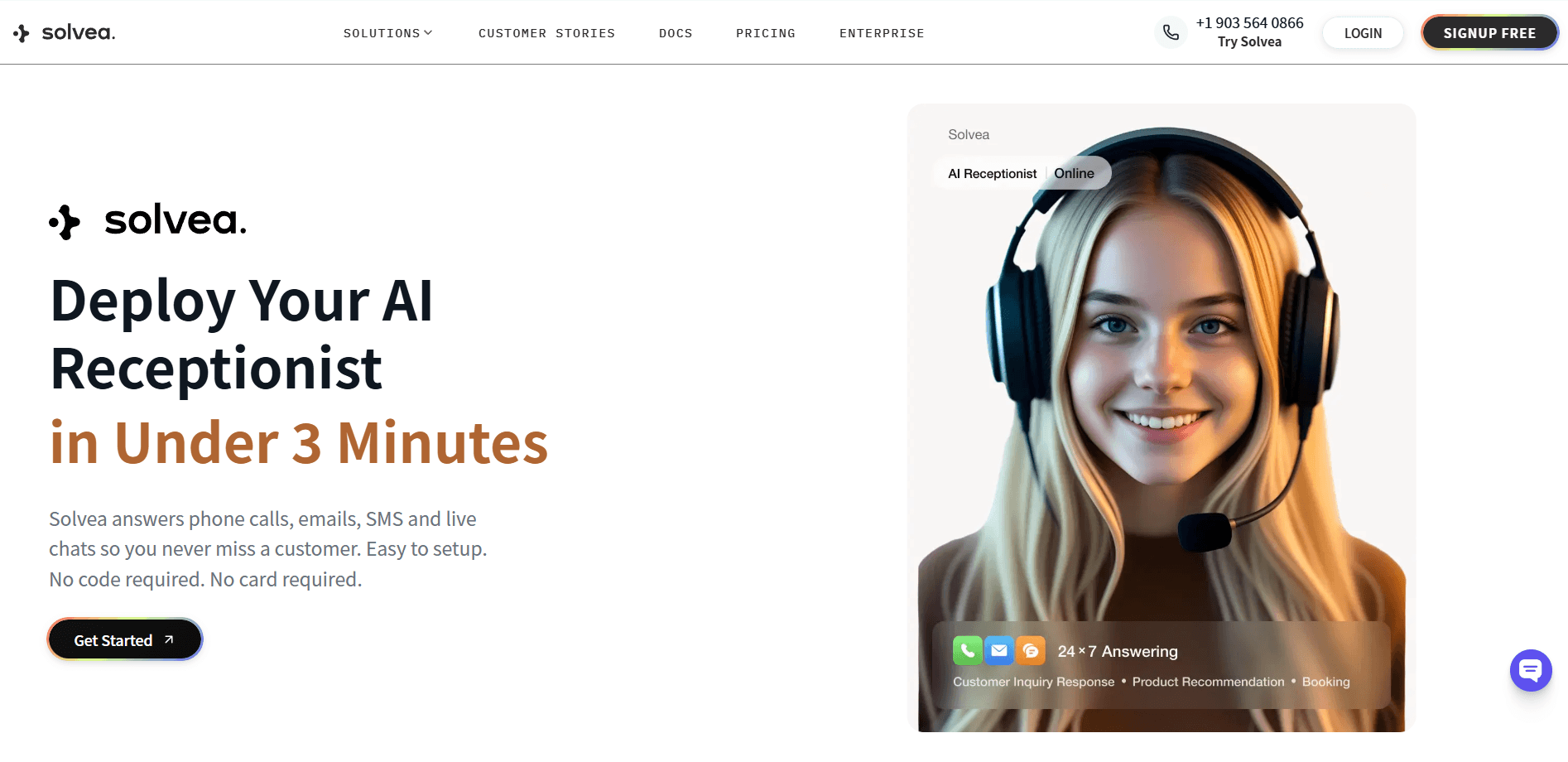
Solvea is an AI receptionist built for phone calls, live chat, and email from a single platform. For businesses moving from IVR to AI phone answering, Solvea provides a no‑code alternative that deploys in under three minutes.
What Solvea does differently from IVR:
- Answers every call on the first ring with natural conversation, not menu options
- Books appointments, answers FAQs, qualifies leads, and transfers callers with full context
- Integrates with calendars (Google Calendar, Calendly), CRMs (HubSpot, Salesforce), and communication tools (Slack)
- Offers a free phone number for seven days to test live calls before committing
Solvea is not an IVR replacement for every use case. For simple, high‑volume routing where callers already know exactly which department they need, a basic IVR may still be sufficient. But for businesses that want to resolve calls — not just route them — Solvea provides a practical, ready‑to‑use AI phone answering solution.
And if you are evaluating this more operationally, it also helps to understand how an AI receptionist works beyond the voice layer itself.
Your AI Receptionist, Live in Minutes.
Scale your front desk with an AI that never sleeps. Solvea handles unlimited multi-channel inquiries, books appointments into your calendar automatically, and ensures zero missed opportunities around the clock.
FAQ
Is AI phone answering the same as IVR?
No. IVR usually follows fixed menu logic, while AI phone answering can interpret natural-language requests and adapt more flexibly to caller intent.
When is IVR still a good fit?
IVR still works well when the call flow is simple, predictable, and easy to map into a small set of options.
When is AI phone answering better?
AI phone answering is usually better when callers use varied language, when first-contact intake matters, and when routing depends on more context.
What is the cost difference between IVR and AI phone answering?
Traditional on‑premise IVR has lower monthly fees but higher setup and maintenance costs. Cloud IVR is cheaper. AI phone answering typically charges per minute or per call, with higher per‑call intelligence but potentially lower overall cost if containment rates are high.
Can I run IVR and AI phone answering together?
Yes. Many businesses use IVR for initial routing (“Press 1 for sales”) and then hand off to an AI phone answering system for the actual conversation. This hybrid approach combines the predictability of IVR with the flexibility of AI.
Conclusion
IVR and AI phone answering both have a place. IVR is strong when the workflow is simple, stable, and easy to structure. AI phone answering is stronger when the business needs more flexible intake, more natural handling, and more adaptive routing.
The best choice usually depends less on hype and more on how complicated your first-contact workflow really is.