The real estate industry has become increasingly digital, with most property searches now starting online and buyers expecting better service. Yet many agencies still struggle with slow response times, inconsistent follow-up, and inefficient lead prioritization.
Artificial Intelligence helps close these gaps by automating inquiry capture, qualification, follow-up sequences, and lead scoring—enabling real estate teams to respond faster, operate more efficiently, and convert more consistently. According to The Business Research Company’s 2025 market report, the AI-enhanced real estate lead nurturing market is projected to reach $4.4 billion by 2029, reflecting broader growth in AI-driven lead generation and conversion technologies across the sector.
This article outlines 5 practical strategies for applying AI to real estate lead generation, with clear implementation guidance and relevant industry examples.
TL;DR: 5 High-Impact Ways to Use AI in Real Estate Lead Generation
Strategy | What It Improves | Why It Matters | Priority |
24/7 AI Engagement | Inquiry capture & handling | Reduces drop-offs & missed leads | Very High |
Property Recommendations | Engagement & retention | Increases inquiry rates | Medium |
Automated Follow-Up | Lead nurturing | Prevents lost deals over time | Very High |
AI Lead Scoring | Prioritization | Improves agent efficiency | High |
Social Media Capture | Ad traffic conversion | Converts social engagement | Medium |
1. 24/7 AI Engagement: Voice and Chat
In real estate, response speed directly influences lead conversion. Buyers and sellers often submit inquiries during evenings, weekends, or while actively browsing listings. If calls go unanswered or messages receive delayed replies, prospects frequently move on to competitors. This makes consistent, round-the-clock engagement essential for sustainable real estate lead generation.
AI-powered voice and chat agents solve this challenge by providing immediate interaction across multiple channels. Instead of depending on business-hour availability, agencies can respond instantly via website chat, inbound calls, SMS, and social messaging. Early engagement captures contact details, begins qualification, and preserves momentum while intent remains high.
To implement 24/7 AI engagement effectively, agencies should focus on structured interaction and seamless data flow.
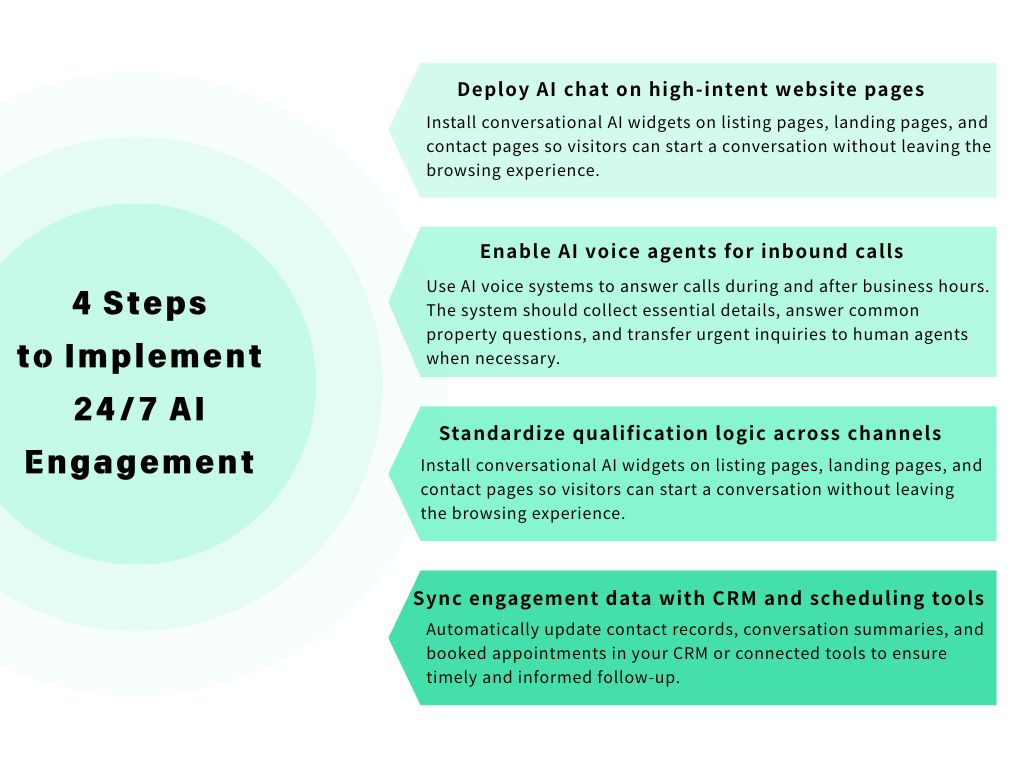
Platforms such as Solvea provide unified voice and chat engagement combined with workflow automation and CRM synchronization, while real estate marketing platforms like Ylopo offer AI-driven engagement features integrated with advertising and lead nurturing. The right choice depends on whether your priority is conversational automation, marketing amplification, or full pipeline management.
Your AI Receptionist, Live in Minutes.
Scale your front desk with an AI that never sleeps. Solvea handles unlimited multi-channel inquiries, books appointments into your calendar automatically, and ensures zero missed opportunities around the clock.
2. AI-Powered Property Recommendations
To maintain engagement and increase inquiry rates, real estate websites need to present listings that align closely with each visitor’s preferences. Generic property suggestions or broad listing alerts are often ignored because they lack relevance.
AI-powered recommendation systems analyze browsing behavior—such as saved listings, search filters, and repeat visits—to deliver personalized property suggestions. When users see homes that match their interests, they are more likely to continue browsing, return to the website, and ultimately submit an inquiry. Personalization not only improves engagement metrics but also builds trust by demonstrating a clear understanding of buyer intent.
Implementing AI-driven property recommendations requires a structured approach to behavioral tracking, real-time personalization, and data utilization.
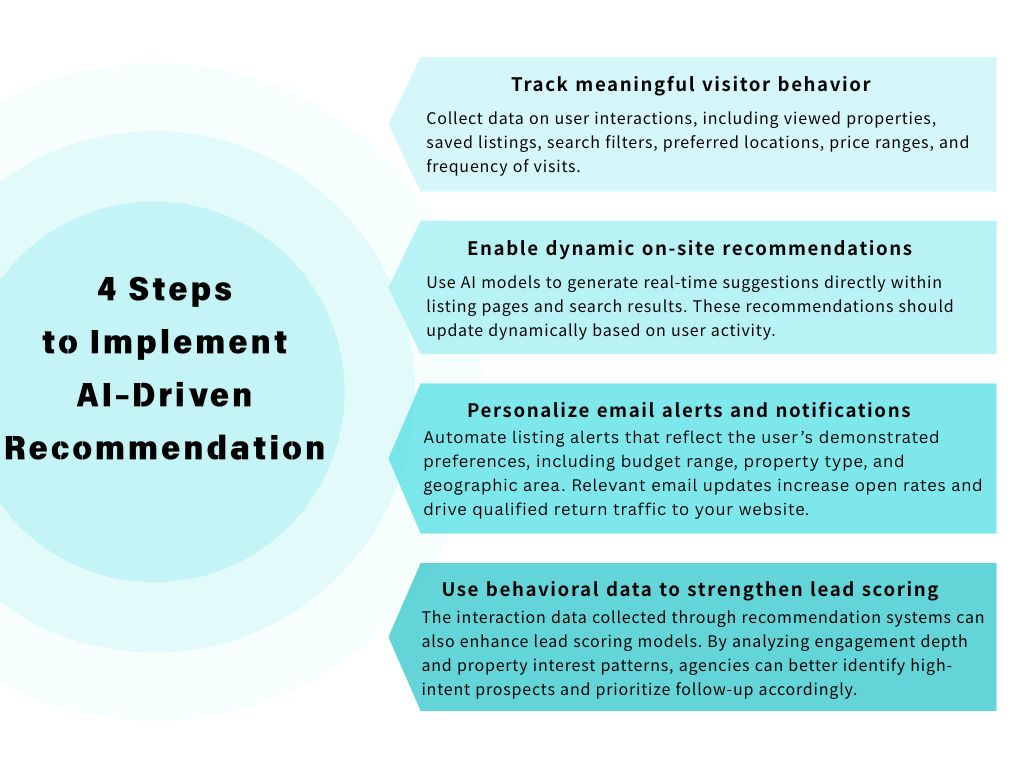
AI-powered recommendation capabilities are now embedded across different types of real estate technology. Solvea’s AI agents use conversational and qualification data to suggest relevant properties within live interactions. Other tools like HouseCanary rely more heavily on predictive modeling and market analytics to optimize listing matches. The best fit depends on whether your focus is real-time engagement or broader data-driven insights.
3. Automated Follow-Up Sequences
In real estate, most leads do not convert after the first interaction. Buyers and sellers often take weeks or even months to make a decision, which makes consistent follow-up essential. However, maintaining timely and personalized communication can be difficult for busy agents managing multiple listings and inquiries.
Automated follow-up sequences ensure that every lead receives ongoing engagement without requiring constant manual effort. By delivering timely and relevant messages, agencies can stay top-of-mind, build trust over time, and significantly increase long-term conversion rates. Structured automation prevents leads from going cold simply due to delayed responses or inconsistent outreach.
Effective follow-up automation should connect immediate response, structured nurturing, and long-term engagement.
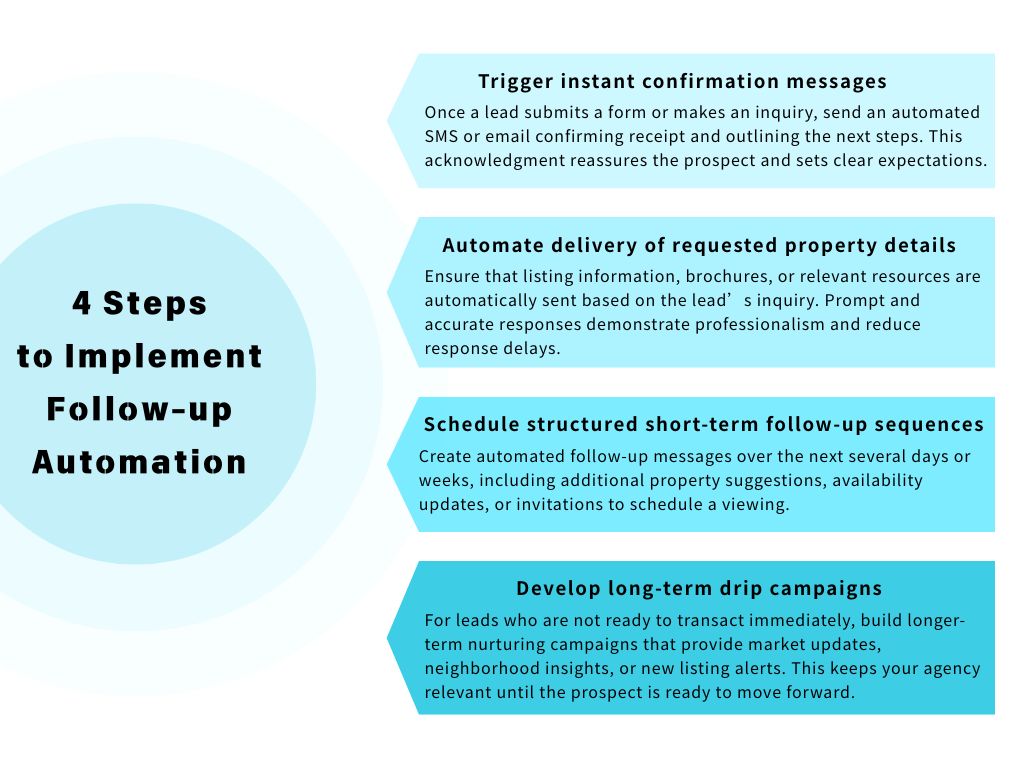
Effective follow-up automation depends on accurate intent data and seamless CRM synchronization. Solvea connects chatbot conversations, voice interactions, and behavioral signals to trigger targeted follow-up sequences automatically. Real estate CRM platforms like Follow Up Boss also provide structured workflow automation to support consistent long-term nurturing.
4. AI Lead Scoring and Prioritization
Not all real estate leads carry the same level of intent or urgency. Some prospects are casually browsing, while others are actively preparing to buy or sell. Treating every lead with the same level of intensity can dilute agent focus and reduce overall efficiency.
AI lead scoring helps agencies rank prospects based on engagement signals and behavioral data. By analyzing factors such as website activity, property interactions, and qualification responses, AI systems identify which leads are most likely to convert. This enables agents to prioritize high-intent prospects and allocate their time more strategically, improving both productivity and conversion rates.
Effective AI lead scoring requires structured criteria, weighted evaluation, and real-time activation.
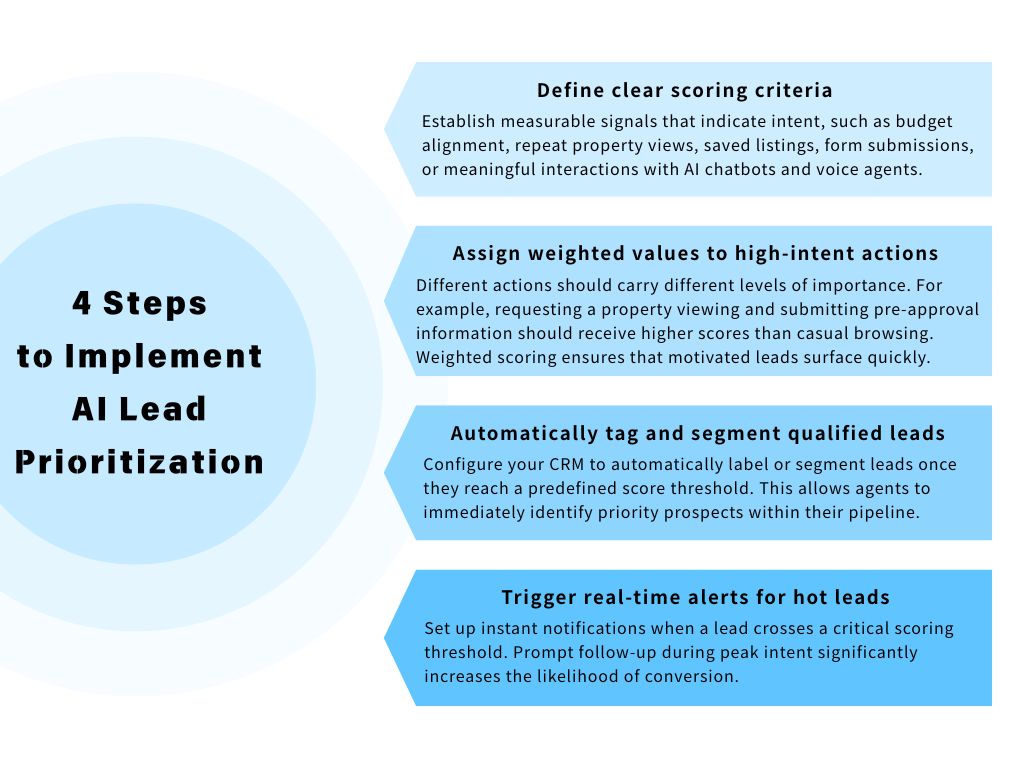
AI lead scoring becomes significantly more powerful when it pulls data from every interaction point, including chatbot conversations, voice calls, website behavior, and email engagement. The more structured intent data the system captures, the more accurate the prioritization model becomes.
5. AI for Social Media Lead Capture
A growing number of real estate inquiries now originate on social media platforms such as Facebook and Instagram, where users discover listings, comment on posts, or send direct messages. However, these interactions often remain fragmented and fail to enter the agency’s formal lead management system. When responses are delayed or conversations are not structured, high-intent prospects can quickly disengage.
AI enables agencies to capture and qualify leads directly within social platforms, converting casual engagement into structured opportunity data. By responding instantly and guiding prospects through conversational flows, agencies can reduce response delays, increase inquiry conversion rates, and maintain consistent communication across channels.
Successful social media lead capture depends on immediate engagement, structured qualification, seamless booking, and centralized data management.
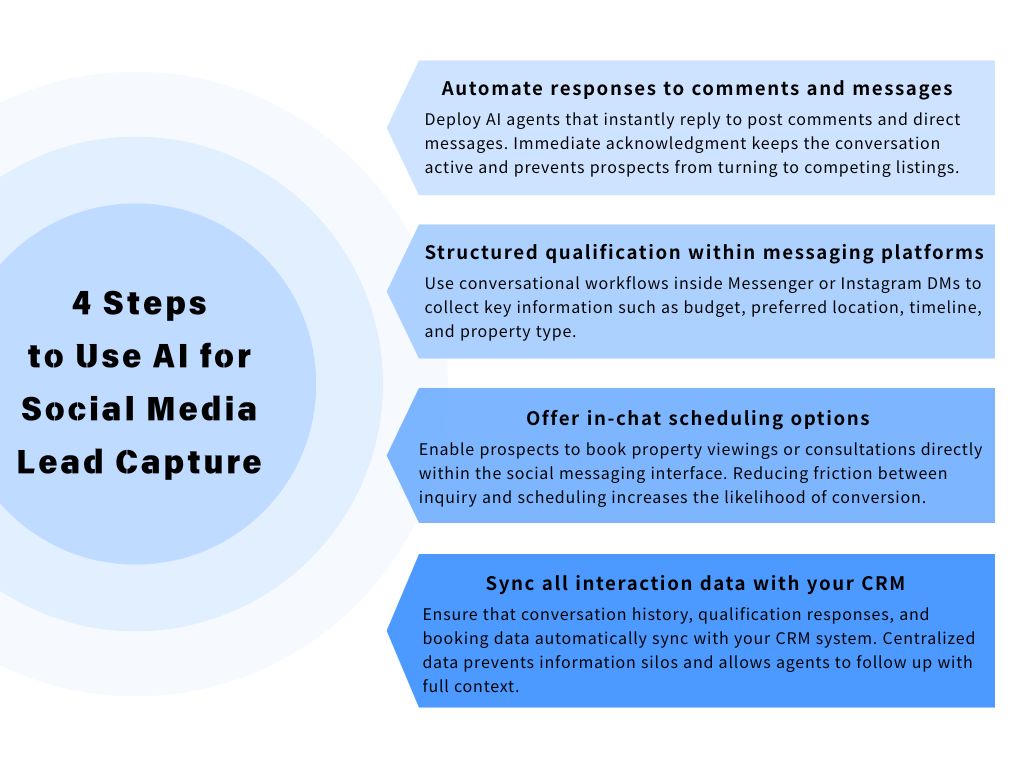
When social media conversations are connected to automation tools, engagement becomes structured and trackable rather than fragmented. Platforms like ManyChat and Chatfuel automate Messenger and Instagram DM workflows, enabling qualification and booking directly within social platforms. Syncing these interactions with a CRM ensures that social inquiries become actionable, follow-up-ready leads.
AI Tools Commonly Used for Real Estate Lead Generation
There are many lead generation AI tools. Today, real estate teams typically combine multiple AI tools rather than relying on a single system, as different platforms serve different parts of the lead generation funnel. Understanding where each tool excels is key to building an effective technology stack.
For unified engagement and workflow automation across channels, Solvea combines voice AI, website chat, structured qualification, booking automation, and CRM synchronization within a single operational layer.
For traffic generation and lead acquisition, platforms such as Zillow and BoomTown play a major role in distributing and capturing buyer and seller inquiries. Marketing-driven platforms like Ylopo further integrate paid advertising with AI-powered communication strategies to support retargeting and long-term engagement.
For real-time engagement, ManyChat and Chatfuel specialize in automating Messenger and Instagram DM workflows, enabling teams to convert comments and direct messages into trackable inquiries.
For CRM-based nurturing and pipeline management, Follow Up Boss helps agents organize contacts, automate follow-up, and prioritize outreach through structured workflows.
For data intelligence and market insights, HouseCanary applies predictive modeling and valuation analytics to support pricing strategy and property-level decision-making.
Each of these platforms addresses a specific operational need. The effectiveness of a real estate AI strategy depends not only on the individual tools selected, but on how well engagement, qualification, nurturing, advertising, and market intelligence are aligned into a coherent system.
How Solvea Empowers Your Real Estate Lead Generation
Throughout this article, we have explored how AI can improve different stages of real estate lead generation. As an automatic AI agent platform, Solvea brings these capabilities together within a unified system designed to help agencies respond faster, qualify smarter, and manage workflows more efficiently without adding operational complexity.
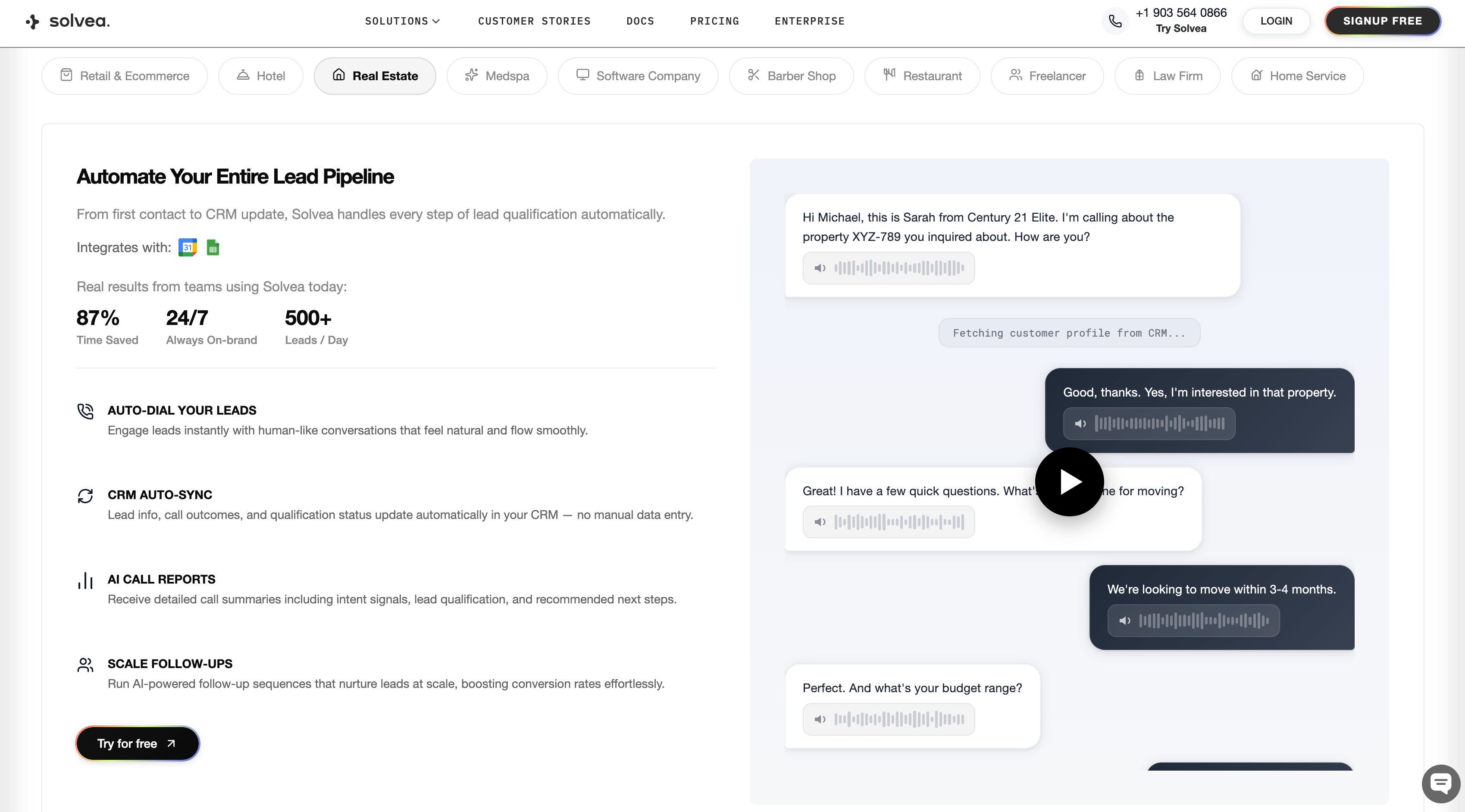
Solvea’s core capabilities include:
- 24/7 Responsiveness Across Channels: Solvea operates continuously, ensuring that inquiries from website chat, inbound calls, SMS, and social messaging receive immediate responses. This round-the-clock availability helps agencies avoid missed opportunities and engage prospects at peak interest, even outside business hours.
- Customizable AI Agents (No-Code Setup): Agencies can create tailored AI agents aligned with their specific services, qualification criteria, and workflows. Without requiring technical setup, teams can configure conversational logic and update knowledge bases to match their real estate processes.
- Automated Workflows and Action Triggers: Solvea converts conversations into structured actions, such as booking property viewings, triggering follow-up sequences, or routing high-intent leads to agents. These automated workflows reduce manual coordination and ensure consistent execution.
- Integration with Other Tools: Solvea has seamless integrations. Through built-in integrations and plugins, Solvea can log data into Google Sheets, schedule appointments in Google Calendar, and synchronize information with CRM systems. This keeps lead records updated in real time and minimizes manual data entry.
By combining continuous responsiveness, structured qualification, automated workflows, and practical integrations, Solvea functions as an operational layer rather than a standalone tool. For small and mid-sized real estate agencies in particular, this integrated approach makes it possible to implement AI without rebuilding existing systems, while still improving speed, organization, and conversion performance.
Conclusion
AI in real estate is most effective when viewed as a system rather than a single tool. The six strategies outlined in this article — from chatbots and voice automation to personalized recommendations, structured follow-up, lead scoring, and social media capture — work best when they operate together. Each method addresses a different stage of the lead journey, and when combined, they create a more responsive, data-driven, and conversion-focused process.
However, successful adoption depends on selecting the right solution for your agency’s size, workflow, and growth goals. Some teams may need stronger voice automation, while others may prioritize CRM integration or multi-channel engagement. Platforms such as Solvea are particularly well-suited for small and mid-sized real estate agencies that need an integrated, no-code system capable of handling chat, voice, qualification, and follow-up within a unified framework. Larger brokerages may combine multiple specialized tools to achieve similar results.
Ultimately, Agencies that align technology with their operational needs will be better positioned to generate, manage, and convert leads in an increasingly competitive market.
FAQ
1. What is the most effective AI strategy for real estate lead generation?
The most effective strategy is building a connected system rather than relying on a single tool. High-performing real estate teams typically combine instant response (chat or voice AI), structured qualification, automated follow-up, lead scoring, and CRM synchronization. Platforms like Solvea help unify these steps into one workflow, while CRM-focused tools such as Chime or Follow Up Boss manage longer-term pipeline nurturing. The real advantage comes from connecting every stage—from first inquiry to prioritization—into one continuous process.
2. How does AI improve conversion rates in real estate?
AI improves conversion rates primarily by reducing response time and maintaining consistent engagement. When prospects receive immediate replies, personalized property recommendations, and timely follow-ups, their interest is less likely to fade. AI also collects structured qualification data, allowing agents to focus their time on high-intent leads instead of chasing every inquiry equally.
3. Is AI suitable for small and mid-sized real estate agencies?
Yes. Modern AI platforms are designed to be accessible without complex technical setup. For small and mid-sized agencies in particular, tools like Solvea allow teams to implement 24/7 responsiveness, automated workflows, and CRM synchronization without hiring additional administrative staff. This makes AI not just scalable, but often more cost-efficient than expanding headcount.
4. What are the best AI tools for real estate lead qualification?
The best AI tools for real estate lead qualification depend on how and where you capture leads.
For conversational qualification across website chat and inbound calls, platforms like Solvea provide AI voice and chat agents that collect structured intent data. For CRM-based follow-up and prioritization, tools such as Follow Up Boss help manage pipelines and automate workflows. For social media inquiries, ManyChat and Chatfuel automate Messenger and Instagram conversations. For traffic generation and marketing automation, platforms like Ylopo, Zillow, and BoomTown support lead acquisition and engagement. For property analytics and predictive insights, HouseCanary provides valuation and market intelligence tools.
5. Do AI systems replace real estate agents?
No. AI supports agents rather than replacing them. It handles repetitive processes such as initial screening, scheduling, data entry, and follow-up automation. The core responsibilities of real estate professionals—building trust, advising clients, negotiating terms, and closing transactions—remain human-driven. AI simply ensures agents spend more time on high-value interactions.