Artificial intelligence is rapidly evolving from simple chat interfaces into autonomous agent systems capable of executing workflows, calling tools, and automating core business processes. As organizations move beyond experimentation and into production deployment, the need for reliable, scalable agent infrastructure has become critical. Without a structured framework, building autonomous systems quickly becomes fragmented, difficult to govern, and costly to maintain.
AI agent frameworks now serve as the foundational layer of modern AI automation. They determine how agents reason, access memory, orchestrate tools, integrate with enterprise systems, and scale under real-world workloads. Choosing the right framework is no longer a technical preference—it is a strategic decision that directly impacts speed of deployment, operational stability, and long-term ROI. This guide provides a detailed comparison of the leading AI agent frameworks in 2026 to help you navigate this rapidly maturing landscape.
Top 9 AI Agent Frameworks in 2026: TL;DR
Product | Pricing | Best For | Key Features |
Custom pricing | Enterprise business automation | AI voice agents, resolution engine, deep integrations | |
Free / LangSmith from $39/seat | LLM agent development | Tool calling, memory, LangGraph orchestration | |
Free / Professional from $25/mo | Multi-agent workflows | Role-based agents, visual editor, orchestration | |
Free / Pro from $150/mo | High-performance execution | Lightweight runtime, AgentOS, private cloud deployment | |
Free | Autonomous research | Goal-based execution loops, autonomous planning | |
Free | Multi-agent collaboration | Agent messaging, conversational patterns, Microsoft backing | |
Free Trial / Cloud plans from $20/mo | Workflow automation | Visual builder, 400+ integrations, AI nodes | |
Free Tier / LlamaCloud from $50/mo | Data-aware agents | RAG pipelines, advanced indexing, LlamaParse | |
Free | Enterprise orchestration | Plugin architecture, multi-language SDK, planners |
What Is an AI Agent Framework?
An AI agent framework is a comprehensive software toolkit that enables developers to build autonomous AI systems capable of planning tasks, using external tools, accessing memory, and executing complex, multi-step workflows. Unlike traditional programs that follow rigid, predefined logic, AI agents can reason through problems, evaluate options, and dynamically determine the best course of action. This fundamentally changes how users interact with AI: instead of issuing isolated prompts, they can define a broader objective and rely on the system to figure out the intermediate steps.
At their core, these frameworks provide the infrastructure that allows AI to translate high-level goals into executable actions. The agent can break down complex objectives into manageable sub-tasks, call external APIs to retrieve real-time data, run code to process information, update systems, or even collaborate with other specialized agents. For users, this means less manual coordination across tools and significantly reduced operational friction—tasks that once required constant supervision can now be handled autonomously.
In essence, AI agent frameworks serve as the scaffolding for building production-ready systems that move beyond conversation. They enable AI not only to understand intent, but to execute workflows and deliver measurable, outcome-driven results.
Top 9 AI Agent Frameworks
1. Solvea: Best for enterprise business automation
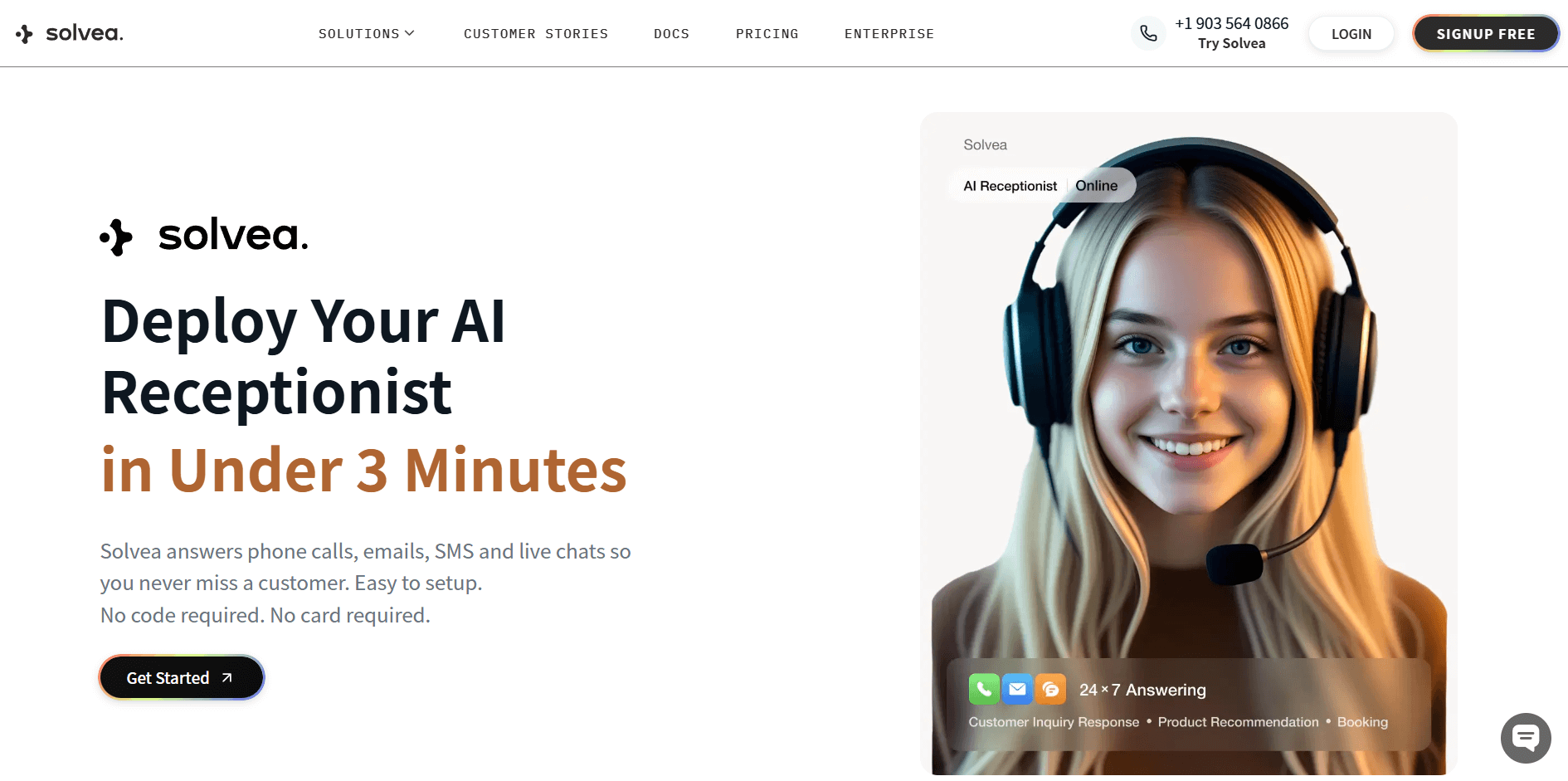
Solvea operates as a specialized, enterprise-grade AI agent platform engineered to help businesses deploy powerful automation agents without the need to build complex infrastructure from the ground up. The platform is designed to replace repetitive manual support workflows with AI-driven automation that delivers measurable operational outcomes.
Deployment is structured to be fast and low-friction. Businesses can integrate Solvea directly with existing systems such as Shopify, Amazon, and Google Calendar through one-click connections. The platform learns from historical knowledge bases and existing support workflows, enabling rapid onboarding without heavy engineering involvement. Once activated, Solvea agents operate continuously, handling customer interactions and improving performance through ongoing workflow learning.
Rather than focusing solely on conversational capabilities, Solvea emphasizes resolution efficiency, instant response, and scalable automation. The system is built to manage high volumes of concurrent conversations while maintaining consistency, accuracy, and operational reliability.
Key Features
- Outcome-Driven Agent Architecture: Solvea designs AI agents around defined business goals so that each interaction advances toward task completion and measurable results rather than open-ended dialogue.
- One-Click Integration and Rapid Deployment: The platform connects directly with major commerce and support systems, allowing organizations to deploy AI agents quickly without complex technical implementation.
- Continuous Autonomous Learning: Solvea enables agents to learn from historical and live support workflows, improving accuracy and performance over time without requiring manual reprogramming.
- Instant, Real-Time Response: The system processes customer interactions within seconds, delivering natural language replies and reducing wait times across support channels.
- 24/7 Multilingual Support at Scale: Solvea provides always-on service in major global languages and supports thousands of concurrent conversations while maintaining enterprise-level reliability.
Use Cases
- Automated Customer Support: Organizations use Solvea to handle FAQs, order inquiries, account issues, and complex support cases with consistent and scalable automation.
- Multichannel Deployment: Businesses deploy Solvea across chat, email, SMS, and phone channels to ensure continuous coverage without expanding support headcount.
- Continuous Service Optimization: Solvea analyzes interaction data to help organizations identify recurring issues and refine operational workflows over time.
2. LangChain: Best for LLM agent development
LangChain remains one of the foundational open-source frameworks for developers building applications powered by large language models. Unlike packaged enterprise automation platforms, LangChain provides a flexible development toolkit that allows engineers to compose modular components into structured AI applications.
Its architecture is centered around “chains,” where developers connect prompts, tools, memory modules, and reasoning logic into a defined execution flow. Developers can specify external tools such as search engines or calculators, attach memory layers for contextual continuity, and configure reasoning strategies such as ReAct to guide decision-making. With the introduction of LangGraph, LangChain also supports stateful and graph-based execution, enabling more complex interaction patterns and multi-agent coordination.
Key Features
- Modular Chain Composition: LangChain enables developers to connect prompts, tools, memory, and logic components into structured execution pipelines that define how an application processes input and produces output.
- Flexible Agent Reasoning Framework: The framework allows engineers to configure agent behavior through selectable reasoning strategies, enabling dynamic tool use and step-by-step decision-making within defined execution patterns.
- Stateful Graph-Based Orchestration: LangChain supports graph-structured application flows, allowing developers to build stateful systems with conditional branches, cycles, and multi-agent interaction models.
- Extensive Integration Ecosystem: The framework integrates with a wide range of LLM providers, vector databases, APIs, and developer tools, enabling teams to extend functionality and build fully customized AI stacks.
Use Cases
- Custom AI Agent Development: Engineering teams use LangChain to build highly tailored agents for technical or domain-specific tasks that require fine-grained control.
- Advanced Retrieval-Augmented Generation (RAG): Developers implement complex retrieval pipelines that connect large knowledge bases with LLM reasoning components.
- Experimental LLM Application Prototyping: Teams leverage LangChain to rapidly prototype and iterate on new AI workflows before deploying production-grade systems.
3. CrewAI: Best for multi-agent workflows
CrewAI is a framework purpose-built for orchestrating collaborative, role-based AI agents. Its central concept is to organize multiple agents into a structured “crew,” where each agent is assigned a defined role, a specific objective, and access to a tailored set of tools.
Development in CrewAI begins with role definition. Engineers specify distinct responsibilities—such as a Researcher to gather data, a Writer to draft content, or an Analyst to evaluate findings. The developer then establishes a structured workflow that governs how these agents interact. When a task is triggered, agents execute responsibilities in a coordinated sequence, passing outputs between roles until the final objective is achieved.
By modeling collaboration after human team structures, CrewAI enables clear division of labor within AI systems.
Key Features
- Role-Based Agent Architecture: CrewAI enables developers to assign explicit roles, goals, and tool access to individual agents, creating structured specialization within a multi-agent system.
- Structured Task Orchestration: The framework defines how agents pass outputs between one another, allowing teams to build predictable, step-by-step collaboration pipelines.
- Flexible Process Control Models: CrewAI supports multiple execution strategies—including sequential, hierarchical, and consensus-driven processes—so developers can tailor collaboration logic to different problem types.
- Visual Workflow Builder: The platform provides a visual interface for designing and managing agent workflows, enabling teams to construct coordination logic with reduced coding complexity.
Use Cases
- Multi-Agent Content Production: Teams use CrewAI to coordinate research, drafting, editing, and review tasks across specialized AI agents.
- Collaborative Research and Analysis: Organizations deploy CrewAI to divide complex research or evaluation tasks into structured roles with controlled handoffs.
- Complex Multi-Step Coordination Systems: Developers build systems that require structured collaboration across multiple reasoning agents rather than relying on a single generalized model.
4. Agno: Best for high-performance execution
Agno, formerly known as Phidata, is a lightweight agent orchestration framework built for high performance and minimal overhead. It targets developers who value execution speed, composable architecture, and infrastructure-level control when deploying AI agents.
Engineers define agents using a Python-based SDK that supports memory, knowledge retrieval, and tool integration within a structured code environment. These agents can then be deployed to AgentOS, a scalable runtime designed to run inside private cloud environments such as AWS or GCP, ensuring that data remains within organizational boundaries. Rather than positioning itself as a low-code automation platform, Agno focuses on delivering a streamlined runtime model for teams that require speed, control, and secure private deployment.
Key Features
- Lightweight High-Performance Runtime: Agno provides a minimal-overhead execution environment that enables fast agent instantiation and efficient runtime performance for latency-sensitive applications.
- Python-Based Agent SDK: The framework allows developers to define agents using a composable Python SDK that integrates memory, knowledge retrieval, and external tools within a clean architectural structure.
- Private Cloud Deployment Architecture: Agno enables organizations to deploy agents inside their own cloud environments, ensuring data control and compliance with internal security requirements.
- Scalable AgentOS Runtime Layer: The platform includes a scalable runtime system that manages and operates multi-agent workloads through a centralized control plane without compromising infrastructure ownership.
Use Cases
- Real-Time Automation Systems: Engineering teams use Agno to build high-frequency automation workflows where execution speed and low latency are critical.
- Secure Enterprise Agent Infrastructure: Organizations deploy Agno in private cloud environments to run multi-agent systems while maintaining strict data governance and security controls.
- High-Performance AI Service Backends: Developers leverage Agno to power backend AI services that require scalable, infrastructure-level management rather than application-layer orchestration.
5. AutoGPT: Best for autonomous research
AutoGPT is one of the most recognized open-source projects in the autonomous agent space, built around the idea of fully self-directed, goal-driven AI execution. Unlike traditional assistant-style systems, AutoGPT operates through continuous autonomous loops, allowing it to pursue objectives with minimal human intervention once a task is initiated.
After a user defines a high-level goal, the agent enters an iterative cycle of reasoning, planning, acting, and reflecting. In each loop, it evaluates progress, selects the next action, and leverages available tools—such as web browsing, file handling, or API calls—to move closer to completion. This persistent autonomy makes AutoGPT well-suited for extended research tasks and complex, multi-step workflows that require ongoing decision-making.
Key Features
- Autonomous Goal-Execution Loop: AutoGPT operates through a continuous think–plan–act cycle that allows agents to independently evaluate progress and determine subsequent actions without constant human input.
- Tool and Plugin Extensibility: The framework supports external tools and community-contributed plugins, enabling agents to perform web searches, manage files, and interact with external systems.
- Persistent Memory Architecture: AutoGPT incorporates memory mechanisms that allow agents to store, retrieve, and reference information across execution cycles to maintain contextual continuity.
- Sub-Agent Delegation Capability: The system enables agents to spawn or delegate sub-tasks to additional agents, allowing decomposition of complex objectives into smaller executable units.
Use Cases
- Research Automation: Teams use AutoGPT to conduct iterative market analysis, competitive research, or structured information gathering across multiple sources.
- Content Production Pipelines: Developers leverage AutoGPT to automate multi-stage content workflows, from research and outlining to drafting and revision.
- Exploratory Task Execution: Experimentation-focused users deploy AutoGPT to test autonomous goal completion scenarios that require repeated reasoning cycles.
6. AutoGen: Best for multi-agent collaboration
AutoGen is a multi-agent framework developed by Microsoft Research that centers on structured, agent-to-agent conversations as the foundation for application logic. Instead of relying on a single autonomous execution loop, AutoGen enables multiple agents to collaborate through message exchanges, jointly reasoning about tasks and dynamically adjusting their strategies as interactions evolve.
Developers configure conversable agents with defined roles and capabilities, allowing them to coordinate through iterative dialogue, tool execution, and refinement cycles. This conversation-driven orchestration model supports flexible, adaptive workflows and is particularly suited for collaborative problem-solving, human-in-the-loop systems, and scenarios that require multi-step reasoning or validation.
Key Features
- Conversational Multi-Agent Architecture: AutoGen structures applications around message-based interactions between agents, enabling collaborative reasoning through iterative dialogue rather than fixed execution chains.
- Flexible Agent Configuration: The framework allows developers to define agents with customizable roles, capabilities, and underlying LLM backends, supporting both automated and human-in-the-loop participation.
- Integrated Tool and Code Execution: AutoGen enables agents to execute code, call external APIs, and utilize tools directly within the conversational workflow, extending problem-solving capabilities beyond text generation.
- Dynamic Interaction Patterns: The system supports diverse communication structures, including hierarchical and group-based conversations, allowing developers to design adaptive multi-agent collaboration models.
Use Cases
- Collaborative Software Development: Teams use AutoGen to coordinate multiple agents for coding, testing, debugging, and iterative refinement tasks.
- Multi-Step Analytical Workflows: Organizations deploy AutoGen to handle business logic that requires validation, back-and-forth reasoning, or consensus-driven decision processes.
- Human-in-the-Loop Systems: Developers implement AutoGen in environments where AI agents must interact with human supervisors for clarification, approval, or oversight.
7. n8n: Best for workflow automation
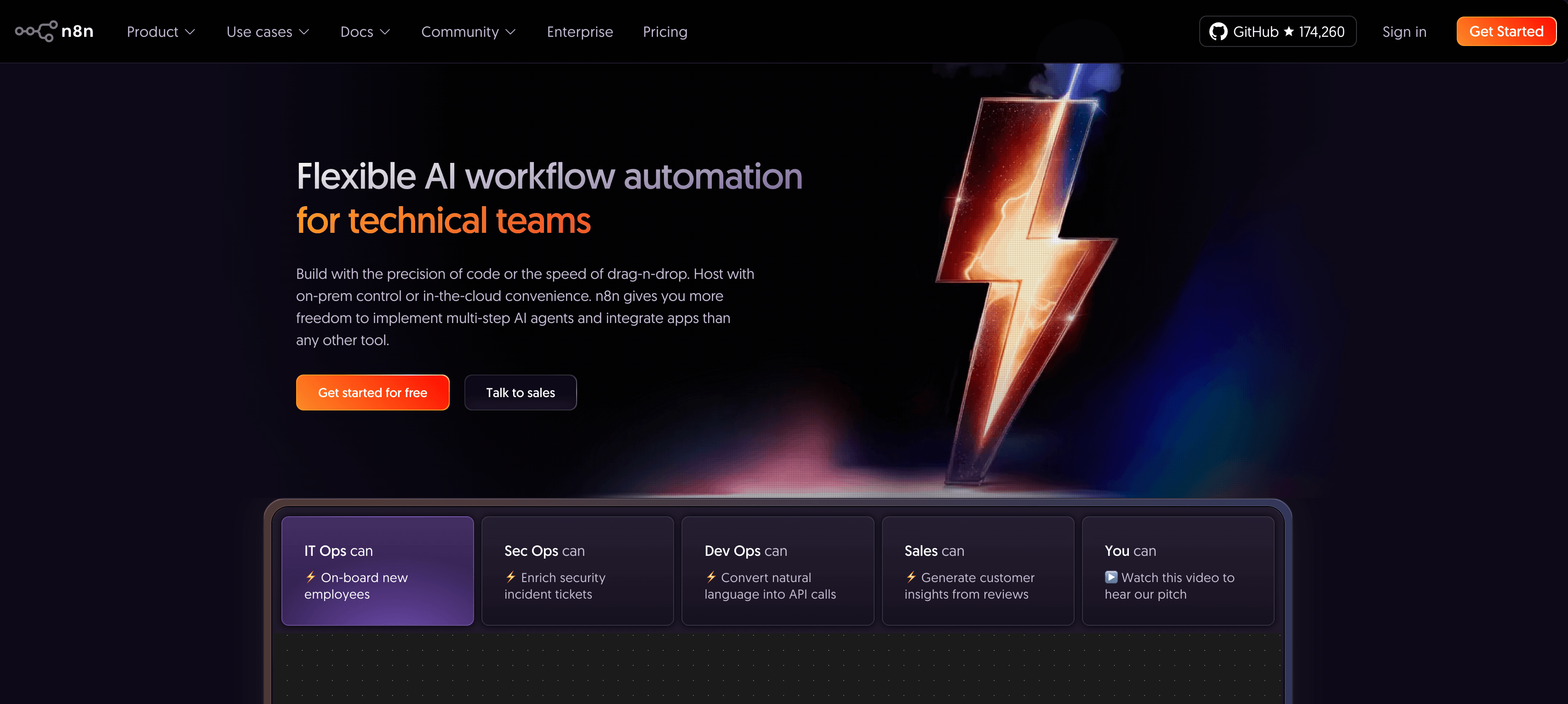
n8n is a workflow automation platform that combines a visual, node-based builder with integrated AI capabilities. It enables users to design event-driven automations by connecting applications, logic, and AI functions within a unified interface, making it accessible to both technical and non-technical teams.
Workflows are constructed by linking nodes that represent triggers, actions, or processing steps. AI nodes allow integration with LLMs, memory handling, and intelligent decision logic directly inside automation pipelines. This visual orchestration model supports flexible deployment options and scalable execution, making n8n suitable for organizations seeking both automation breadth and operational control.
Key Features
- Visual Workflow Builder: n8n provides a drag-and-drop interface for connecting hundreds of applications and services into structured automation pipelines.
- AI Node Integration: Dedicated AI nodes enable LLM usage, memory management, and AI-driven logic within workflows.
- Flexible Deployment Options: Available as both a managed cloud service and a self-hosted solution to meet different security and infrastructure needs.
- Extensive Integrations: Supports 400+ integrations, allowing seamless connectivity across enterprise tools and services.
Use Cases
- Enterprise Workflow Automation: Automating repetitive business processes across departments with AI-enhanced logic.
- Event-Driven AI Actions: Triggering intelligent workflows based on application events such as new emails, CRM updates, or form submissions.
- Cross-System Orchestration: Coordinating data and actions across multiple SaaS platforms and internal systems within a unified automation flow.
8. LlamaIndex: Best for data-aware agents
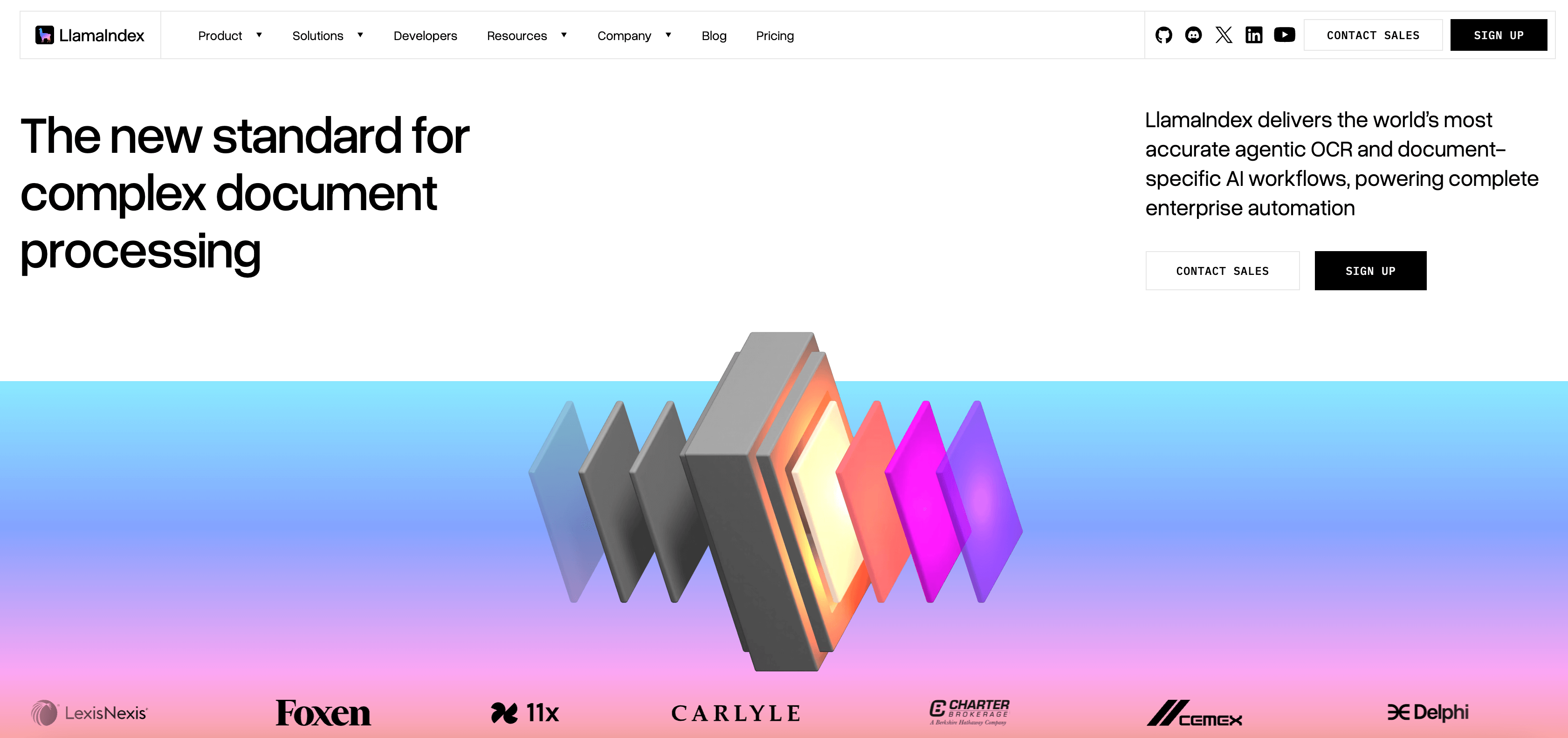
LlamaIndex is a framework designed to build data-aware AI applications by connecting large language models to external data sources. It focuses on enabling Retrieval-Augmented Generation (RAG) workflows, allowing developers to ground model responses in structured or unstructured enterprise data.
Development with LlamaIndex typically involves ingesting data from documents, databases, or cloud storage systems, transforming that data into structured indexes, and retrieving relevant context at query time. When a user submits a request, the system retrieves relevant information from the index and provides it to the language model to generate context-aware responses. This architecture supports scalable knowledge integration and makes LlamaIndex well-suited for building enterprise search, question-answering systems, and data-driven AI agents.
Key Features
- Advanced Indexing Framework: Provides tools for parsing, structuring, and indexing complex data from documents, databases, and APIs to optimize retrieval performance.
- Data Connectors: Offers a broad set of connectors for integrating with external data sources such as cloud storage platforms, collaboration tools, and databases.
- Document Parsing Capabilities: Includes specialized parsing tools designed to improve ingestion accuracy for complex documents in RAG pipelines.
- Managed Deployment Options: Supports cloud-based deployment solutions for managing production-grade data indexing and retrieval workflows.
Use Cases
- Enterprise Knowledge Assistants: Building internal AI systems that answer questions based on proprietary company data.
- Retrieval-Augmented Applications: Developing agents that rely on contextual data retrieval to improve factual accuracy.
- Document Intelligence Systems: Processing and querying large collections of structured and unstructured documents.
9. Semantic Kernel: Best for enterprise orchestration
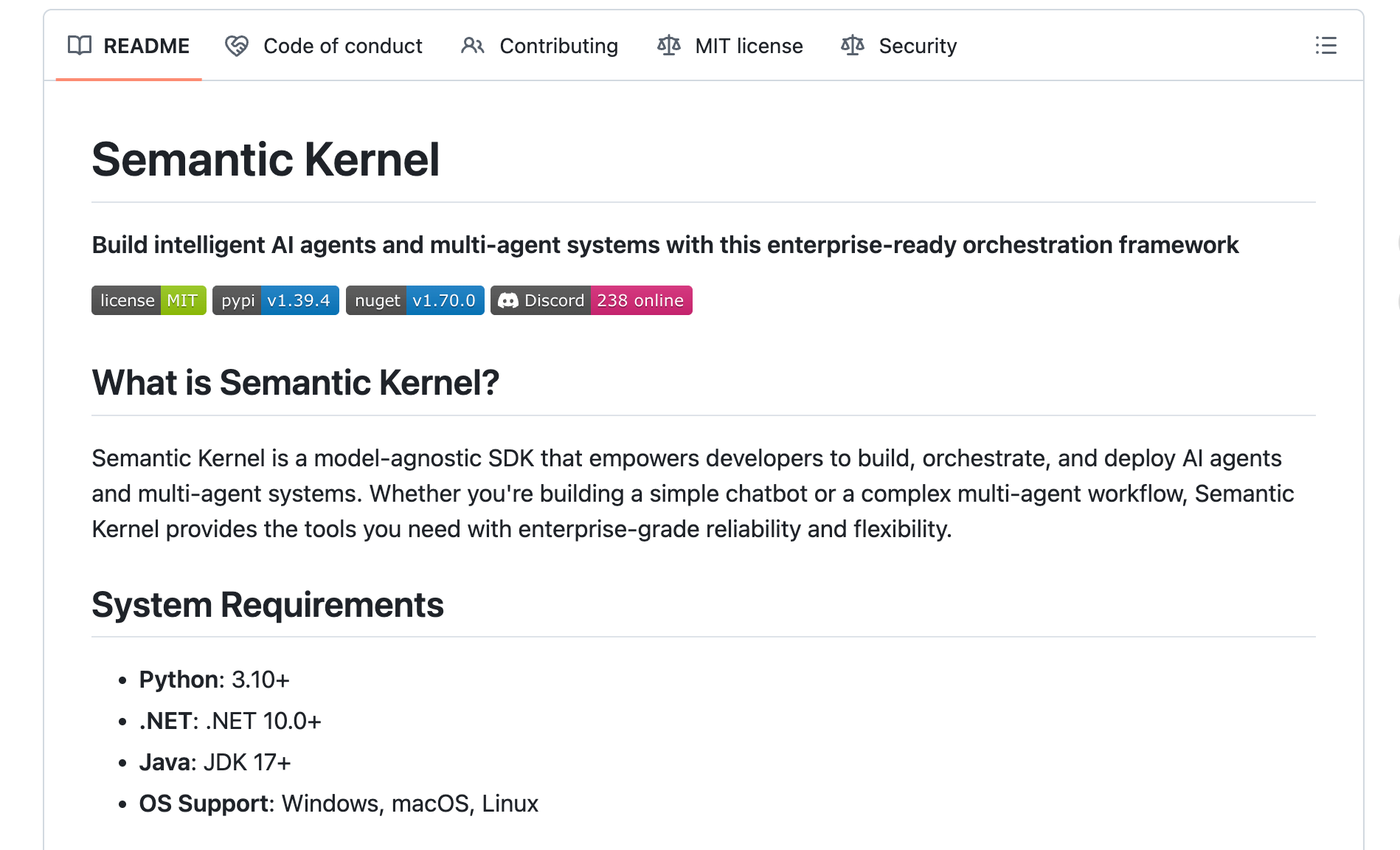
Semantic Kernel is an open-source SDK developed by Microsoft for integrating AI capabilities into enterprise-grade applications. It provides a structured programming model that enables developers to combine large language models with conventional application code across multiple programming environments.
Development in Semantic Kernel revolves around organizing capabilities into reusable plugins, which expose functions that can be invoked by AI-driven workflows. The framework supports planning and orchestration mechanisms that allow the system to select and sequence appropriate functions based on user goals. This structured integration model makes Semantic Kernel well-suited for embedding AI into existing enterprise systems while maintaining architectural control and governance standards.
Key Features
- Plugin-Based Architecture: Enables developers to encapsulate application logic and external integrations as callable plugins within AI workflows.
- Planning and Orchestration: Supports automated function selection and sequencing to accomplish multi-step objectives.
- Enterprise Integration Support: Designed to align with enterprise requirements such as authentication, logging, and structured deployment models.
- Multi-Language SDKs: Provides support for multiple programming environments, such as Python.
Use Cases
- Enterprise Application Enhancement: Integrating AI-driven capabilities into existing large-scale business systems.
- AI Orchestration Backends: Building structured backend systems to coordinate tools, workflows, and AI reasoning.
- Governed AI Workflows: Implementing AI solutions in environments requiring compliance, oversight, and operational control.
Why Choose Solvea?
Most AI agent frameworks are designed with developers in mind. They offer deep flexibility and architectural control, but turning those capabilities into a secure, production-ready system often demands significant engineering resources. While large technical teams may embrace that complexity, many growing businesses—especially SMBs—need a faster and more predictable path from concept to measurable results. Solvea is built to address that reality.
Solvea combines production-ready workflows, native AI voice capabilities, and fully managed infrastructure into a single platform focused on outcomes. Businesses can deploy operational agents in days rather than months, without assembling custom orchestration layers or scaling infrastructure internally. Its performance-based pricing model aligns cost with successful resolutions, reducing financial risk while maintaining enterprise-grade reliability. As a result, Solvea is particularly attractive for SMBs seeking rapid ROI, while still providing the robustness required by larger organizations.
Conclusion
AI agent frameworks have become a foundational layer for modern automation and intelligent systems. In this guide, we examined a diverse set of leading solutions in 2026, including Solvea, LangChain, AutoGen, AutoGPT, LlamaIndex, Semantic Kernel, n8n, and Agno—each representing a distinct architectural philosophy and deployment model within the evolving agent ecosystem.
There is no single framework that fits every scenario. Developer-centric tools emphasize flexibility and composability, data-focused frameworks specialize in retrieval-based intelligence, multi-agent systems enable collaborative reasoning, and deployment-oriented platforms streamline production rollout. The right choice ultimately depends on your organization’s technical capabilities, business priorities, and desired time-to-value. Carefully aligning these factors is essential to selecting an AI agent framework that supports both immediate goals and long-term strategy.
Your AI Receptionist, Live in Minutes.
Scale your front desk with an AI that never sleeps. Solvea handles unlimited multi-channel inquiries, books appointments into your calendar automatically, and ensures zero missed opportunities around the clock.
FAQ
1. What are the best AI agent frameworks in 2026?
The leading frameworks in 2026 can be grouped based on their core functionality and target users:
Enterprise & Business Platforms: Solvea and n8n are the top choices for organizations looking for production-ready deployment. While Solvea focuses on high-impact business resolutions and AI voice, n8n provides a versatile low-code environment for workflow automation.
Developer Orchestration Frameworks: LangChain, CrewAI, and Semantic Kernel provide the essential tools for building custom agent logic. These frameworks excel at role-based task delegation and complex orchestration for professional developers.
Autonomous & Research Systems: AutoGPT, AutoGen, and Agno represent the cutting edge of autonomous execution. They are ideal for building self-directed agents that can communicate, reason, and execute continuous loops with high performance.
Data-Centric Infrastructure: LlamaIndex remains the specialized choice for data-aware agents, offering the most advanced tools for connecting LLMs to private knowledge bases through RAG pipelines.
2. Can AI agent frameworks integrate with my existing legacy systems?
Most modern AI agent frameworks are built with extensibility as a core feature. For enterprise environments running legacy systems that lack modern APIs, agents can be integrated using middleware, custom adapters, or Robotic Process Automation (RPA) tools that allow the agent to interact with older user interfaces. Specialized platforms like Solvea are designed specifically to bridge this gap, providing a secure connection between advanced AI reasoning and traditional business infrastructure.
3. How do I choose between an open-source framework and a managed platform?
The decision should be based on your team’s technical resources and the urgency of your deployment. Open-source frameworks such as LangChain or AutoGen provide maximum flexibility and are ideal for engineering teams that want to maintain full control over the underlying code. Conversely, managed platforms like Solvea or n8n are better for organizations that prioritize security, scalability, and speed to market, as these platforms handle the infrastructure and provide pre-built workflows for common business needs.
4. What are the primary security risks when deploying AI agents?
Security is a major concern when agents are given the authority to access sensitive data or execute actions in live systems. The main risks include unauthorized data exposure, insecure API connections, and "prompt injection" attacks where the agent is tricked into bypassing its safety protocols. To minimize these risks, organizations should implement the Principle of Least Privilege, ensuring agents only have the minimum necessary access, and select frameworks that offer detailed audit logs and real-time monitoring.
5. Are there no-code options for building AI agents in 2026?
The market in 2026 offers several powerful no-code and low-code solutions for building autonomous agents. Platforms like n8n use a visual, drag-and-drop canvas to create complex automations, while Solvea provides a resolution-driven environment that allows businesses to deploy sophisticated, customer-facing agents without writing extensive code. These options make it possible for non-technical teams to implement AI automation that significantly improves operational efficiency.