The front desk is the first and last thing every client experiences. Before they meet a provider, they've spoken to your front desk staff — or tried to, didn't get through, and booked somewhere else. After their treatment, the front desk is who confirms their next appointment, processes their payment, and decides whether they leave feeling like a valued client or a transaction.
Med spa front desk operations fail in predictable ways. Staff juggle too many roles — answering phones, checking clients in, processing payments, responding to online messages — while simultaneously trying to give full attention to the person standing in front of them. The phone rings during checkout. A cancellation comes in during a rushed check-in. A new client walks in unannounced during the mid-morning rush.
This guide breaks down what a high-functioning med spa front desk actually looks like, what roles and responsibilities it requires, and where automation picks up the work that burns out front desk staff fastest.
TL;DR
Field | Summary |
Core function | Client experience, appointment management, payment processing, and first-line communication |
Staff-to-chair ratio | 1 front desk staff per 2–3 treatment rooms is a common starting point |
Biggest bottleneck | Phone volume during peak hours — most front desks are understaffed for call load |
Who it's for | Med spa owners, practice managers, and front desk coordinators |
Fastest path to capacity | Route after-hours calls and routine questions to AI; reserve staff for in-person clients |
What a Med Spa Front Desk Actually Does
Med spa front desk staff are asked to handle more roles than most practices explicitly acknowledge. The job description often says "greet clients and manage scheduling." The actual job includes:
Client management- Greeting walk-in and arriving clients- Checking in patients and verifying intake forms- Managing the treatment room queue and wait times- Handling checkout, post-treatment instructions, and rebooking
Communication- Answering inbound calls (new inquiries, appointment changes, policy questions)- Responding to online booking requests, DMs, and form submissions- Sending appointment reminders and following up on no-shows- Managing voicemail during treatment hours
Administrative- Processing payments and handling deposits- Maintaining client records and updating contact information- Verifying that consent forms and health histories are complete before appointments- Coordinating schedule changes between providers
Sales support- Recommending retail products at checkout- Presenting package or membership options when relevant- Collecting and following up on consultation leads
The friction point is not any individual task — it's that all of them happen simultaneously. A front desk coordinator checking out a patient while answering the phone while a new client walks in is not a scheduling problem; it's a capacity problem that gets misread as a staffing problem.
How to Write Clear Front Desk Role Boundaries
The most common front desk inefficiency is undefined scope. When everyone on the front desk team does everything, no one owns anything. Two clarifications that most med spas don't make explicitly:
1. Who owns inbound calls vs. in-person client priority?Define the rule. Most high-volume practices prioritize the person physically present and let calls go to voicemail or a second line during peak check-in/checkout hours (typically 9–10am and 4–6pm). If you don't define this, staff will choose inconsistently and clients on both ends will feel deprioritized.
2. Who is allowed to modify the schedule?Limit schedule modification access to a defined role. When every front desk team member can move appointments, block times, and override holds, the schedule becomes fragmented and providers lose predictability. One coordinator should own final schedule decisions; others take requests and escalate.
Medspa operations specialists recommend this structure: define whether front desk staff are managing appointments and greeting clients, or whether separate coordinators handle each function. For practices with two or more treatment rooms, separating these functions prevents the bottleneck of one person doing both simultaneously.
How to Write a Med Spa Front Desk SOP
A standard operating procedure (SOP) for your front desk doesn't need to be a 40-page manual. It needs to answer, in writing, what a staff member does in each of these five situations:
Step 1: Opening Protocol (first 30 minutes)
- Confirm the day's schedule, including any provider changes or gaps
- Verify that all pending deposit payments are received for the day's appointments
- Pull up the no-show/late cancellation log from the prior day
- Check voicemail and overnight messages for any same-day changes
- Prepare the check-in queue (intake forms, consent documents) for the first three appointments
Step 2: Client Check-In
- Greet by name (pull up the client profile before they reach the desk)
- Verify contact information, consent forms, and health intake are current — not "do you have any updates?" but specific fields: "Can you confirm your current address and any medication changes since your last visit?"
- Note the treatment room assigned and estimated start time
- Communicate any wait to the client before they sit down, not after
Step 3: Inbound Call Handling
- Answer within three rings during staffed hours
- Have a script for the top 10 questions: pricing, appointment availability, cancellation policy, deposit requirements, parking, what to bring
- If the call cannot be handled at the desk (in-person client present), route to voicemail with a commitment: "You'll receive a callback within 2 hours"
- Log every message; prioritize callbacks before the next appointment block
Step 4: Checkout and Rebooking
- Confirm the service completed and any provider notes for the client
- Process payment; confirm deposit credited if applicable
- Offer rebooking before the client leaves (rebooking at checkout has a significantly higher conversion rate than follow-up calls)
- Collect any retail product interest or recommendations from the provider
Step 5: Closing Protocol
- Update the no-show log for any missed appointments
- Confirm tomorrow's appointments are correctly documented and deposits received
- Clear any pending online booking requests
- Check voicemail and return outstanding callbacks
The Biggest Front Desk Bottleneck: Phone Volume
Every med spa front desk has a version of this problem: the phone rings most during the hours when the desk is busiest with in-person clients. Morning check-in (9–11am) and afternoon checkout (3–6pm) are peak call hours because clients are calling to reschedule appointments they realized they can't make.
A common failure mode: the front desk misses a call from a client trying to reschedule. The client doesn't leave a message. The slot stays blocked and shows up as a no-show.
The two-part fix:1. After-hours and overflow call routing: All calls that can't be answered in three rings during peak periods route to an AI or voicemail system that can schedule, reschedule, or collect basic information. This is not about replacing the desk — it's about eliminating the "missed call that never gets returned" category.2. Dedicated callback blocks: Schedule two 20-minute callback windows per day (mid-morning and early afternoon) where front desk staff return accumulated calls. This is more efficient than scattered individual callbacks and ensures nothing falls through.
How Solvea Handles What Your Front Desk Can't
The highest-friction front desk task is answering the same questions repeatedly: What are your hours? What's your cancellation policy? Do you have openings this week? Can I reschedule my appointment? These questions arrive by phone, text, DM, and web form — at all hours, including weekends and evenings when no one is staffed.
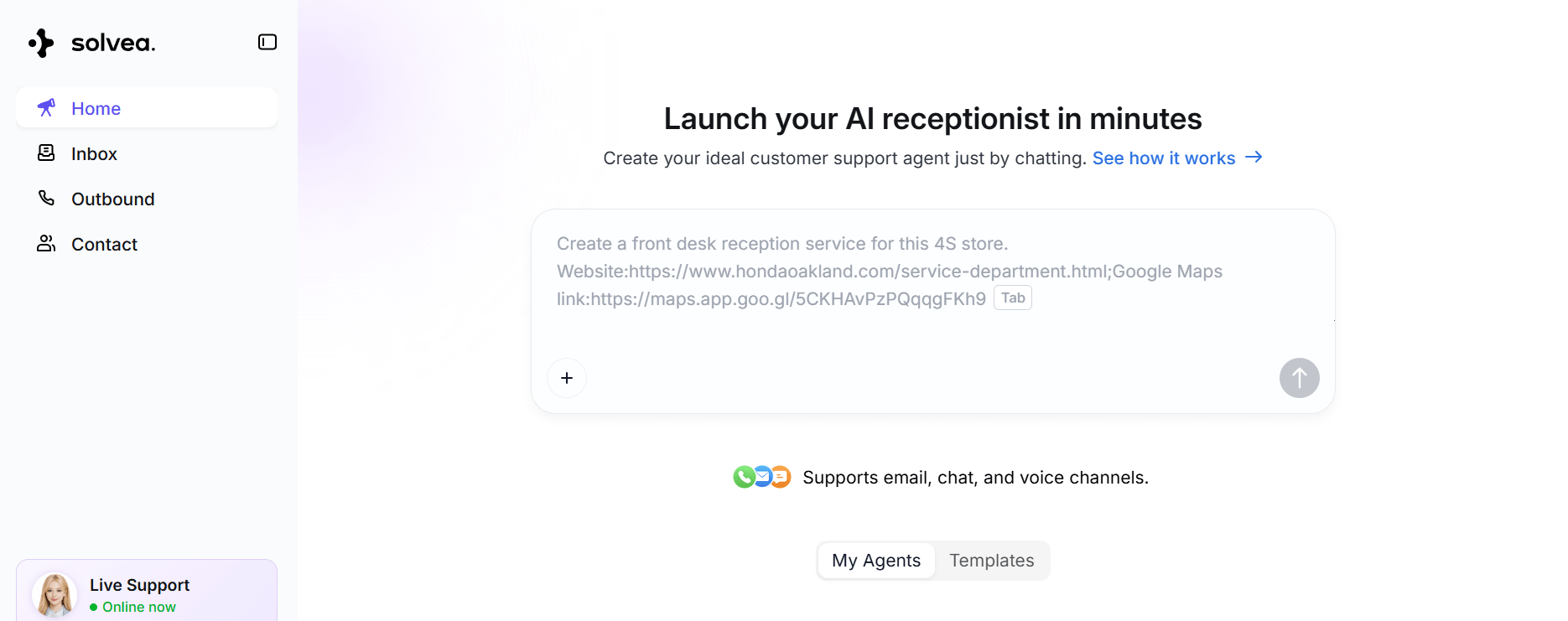
With Solvea, your med spa has an AI receptionist that answers calls, responds to messages, and handles appointment booking and cancellation requests using the information you upload. When a client calls after hours to reschedule, Solvea handles the change according to your cancellation policy, confirms the new appointment, and logs the interaction for your team. When a new inquiry calls during checkout, Solvea answers, collects their information, and books a consultation — without pulling your front desk staff off the client in front of them.
To connect Solvea to your front desk workflow:1. Upload your service menu, hours, cancellation policy, and FAQ document to Solvea → Knowledge Base2. Forward your overflow and after-hours calls to your Solvea number3. Review bookings, cancellations, and flagged interactions each morning in the Solvea inbox
Common Front Desk Mistakes to Fix
❌ No defined priority rule for in-person vs. phone✓ Write: "In-person clients take priority during check-in and checkout. Inbound calls during 9–11am and 3–6pm route to voicemail with a 2-hour callback commitment."
❌ Every staff member can modify the appointment schedule✓ Assign one coordinator as schedule owner. Others collect requests and escalate.
❌ Check-out happens without rebooking conversation✓ Write: "Before processing payment, confirm next appointment or offer to schedule the follow-up recommended by the provider."
❌ No log of missed calls or no-shows✓ Maintain a daily missed interaction log: missed calls not returned within 2 hours, no-shows not followed up within 24 hours.
❌ Onboarding is verbal, not documented✓ Maintain a written front desk SOP with scripts for the top 10 situations. Verbal onboarding creates inconsistency within weeks.
Your AI Receptionist, Live in Minutes.
Scale your front desk with an AI that never sleeps. Solvea handles unlimited multi-channel inquiries, books appointments into your calendar automatically, and ensures zero missed opportunities around the clock.
FAQ
What does a med spa front desk coordinator do?
A med spa front desk coordinator manages client check-in and checkout, inbound appointment calls, schedule management, deposit collection, and first-line communication via phone, email, and messaging. In smaller practices, one person often covers all of these; in larger practices, these functions are split between a coordinator and a patient care concierge.
How many front desk staff does a med spa need?
A common baseline is one front desk staff member per two to three treatment rooms during peak hours. This assumes calls are being routed and some administrative tasks (appointment reminders, follow-up messages) are automated. Practices without any call routing or automation typically need more staff per room to maintain response times.
What skills does a med spa front desk person need?
The core skills are: patient communication (phone and in-person), scheduling software proficiency, basic knowledge of the services offered (not clinical depth, but enough to answer common questions), and the ability to stay composed during busy periods. AmSpa's Front Desk Fundamentals course specifically emphasizes patient expectation management and making a strong first impression — the soft skills that determine whether a new client returns.
How do you handle difficult clients at the front desk?
Stay factual and calm, defer to written policy, and escalate to a manager for any situation that can't be resolved by the written rules. The front desk should not be the final authority on exceptions to cancellation fees or refund decisions — that creates inconsistency and puts staff in an impossible position. Define which escalations go to a manager before the situation happens.
Can AI replace a med spa front desk?
Not fully — in-person client experience requires human staff. But AI handles the tasks that consume the most front desk time with the lowest value-add: answering repetitive phone inquiries, booking and rescheduling routine appointments after hours, and sending follow-up messages. Practices that route these tasks to AI report that their front desk staff spend significantly more time on higher-value interactions with clients who are physically present.