A last-minute cancellation at a med spa isn't just an inconvenience — it's a revenue hole that usually can't be filled. Unlike a restaurant that can seat a walk-in, a laser appointment or Botox session requires a licensed provider, prepped equipment, and blocked time that no one else can use on 30 minutes' notice. When that slot goes empty, it costs both revenue and provider pay.
Most med spa owners write a cancellation policy once, post it somewhere clients ignore, and then argue about it for years. The problem isn't the policy itself — it's that the policy was written without a clear structure, communicated in a way clients miss, and enforced inconsistently because no one wants the awkward conversation. Clients who cancel last-minute often don't know they've caused a problem; providers who absorb the loss start to resent it.
This guide walks through how to write a cancellation policy that clients actually read and accept, and how to enforce it without making every booking feel like a legal negotiation.
TL;DR
Field | Summary |
What it is | A written policy that defines notice requirements, cancellation fees, no-show penalties, and exceptions for your med spa |
Typical notice window | 24 hours for standard services; 48 hours for longer or higher-cost procedures |
Standard fee range | $50–$100 for late cancellations; 50–100% of service cost for no-shows |
Who it's for | Med spa owners, practice managers, and front desk teams who book and enforce appointments |
Fastest enforcement path | Collect a card on file at booking and automate reminders 48h + 24h before the appointment |
What Goes Into a Med Spa Cancellation Policy
Before you draft a single sentence, list the specific decisions your policy needs to make. Most med spa policies that fail do so because they cover one situation (late cancellations) but leave gaps that clients exploit — like whether a reschedule counts as a cancellation, or what happens when a client says they had a medical emergency.
Your policy needs to answer, in writing, all six of these:
- How much advance notice is required? (24 hours vs. 48 hours, and does it vary by service?)
- What happens if the client cancels late? (flat fee vs. % of service cost, tiered by appointment length)
- What constitutes a no-show? (zero contact vs. showing up after a grace period)
- What is the no-show penalty? (deposit forfeiture vs. full charge)
- When does a repeat offender trigger a prepay requirement? (most practices use a 3-strike rule)
- What exceptions do you accept, and how do clients invoke them? (medical emergency with documentation? family emergency without?)
Write those answers before you write the policy itself. If you can't answer them clearly, clients will find the ambiguity and use it.
How to Write a Med Spa Cancellation Policy: Step-by-Step
Step 1: Choose Your Cancellation Notice Window
The most common standard is 24 hours for most services and 48 hours for longer or higher-cost procedures — verified across a survey of published med spa policies including Amelie Med Spa, Charleston Medical Spa, Royal Medical Spa, and Integrated Med Spa.
When choosing your window, answer one practical question: How long does it realistically take your front desk to fill a cancelled appointment slot? For a 15-minute Botox top-up, 24 hours is usually enough. For a 90-minute laser resurfacing session at $600+, 48 hours gives you time to reach your waitlist, post to your booking page, and actually confirm a replacement.
Service-based notice windows are increasingly standard:
Service Type | Notice Required |
Skincare / facials / standard spa | 24 hours |
Botox, fillers, chemical peels | 24 hours |
Laser treatments (IPL, resurfacing) | 48 hours |
Body contouring, multi-step procedures | 48 hours |
Surgery-adjacent / prep-required procedures | 72 hours |
Write this decision into your policy in plain language. Avoid "adequate notice" or "as soon as possible" — both are unenforceable.
Step 2: Define Cancellation Fees by Service Type
A flat $50 fee works well for short appointments but sends the wrong signal for a $400 laser session. Most high-performing med spas use a tiered structure tied to appointment length or service cost:
Option A — Tiered by appointment length (used by Amelie Med Spa):- 15–30 min appointments: $50 cancellation fee- 45–60 min appointments: $100 cancellation fee- 60+ min appointments: $200 cancellation fee
Option B — Percentage of service cost (used by THAT Med Spa):- Less than 48h notice: 50% of service cost- No-show, no contact: 100% of service cost
Option C — Flat fee for all late cancellations (used by Charleston Medical Spa):- Any missed appointment or no-show without 48h notice: $100 flat fee
Choose the option that matches how you price your services. Percentage-based is cleaner if your menu has wide price variance; flat-fee tiers are easier for clients to understand.
Add one sentence to your policy about when the fee is charged: at the time of the missed appointment, before the client's next service, or immediately via the card on file. Clients who don't know when they'll be charged often dispute the charge later as unauthorized.
Step 3: Define Your No-Show Policy
A no-show is different from a late cancellation. A client who calls at 11:58pm for a 9am appointment has technically given "notice" — but it's notice that can't be acted on. Your policy needs to define the line.
Common definitions:- No-show: Client does not appear and does not contact the practice before the appointment time- No-contact no-show: Client does not appear and cannot be reached after the appointment- Late arrival no-show: Client arrives more than X minutes after the scheduled start time and the appointment cannot be completed (typically 10–15 minutes)
For no-shows, most med spas charge the full deposit collected at booking, or the full service cost if no deposit was required. Royal Medical Spa's published policy states: "Clients who do not show up for their appointment without prior notice will be charged the full deposit amount collected."
State the penalty clearly: "A no-show fee of [amount or % of service] will be charged to the card on file." If you don't have a card on file, you can't charge — which is why Step 5 matters.
Step 4: Set Rescheduling Rules
Many clients interpret "I need to reschedule" as a loop that avoids a cancellation fee indefinitely. Your policy should clarify:
- Rescheduling within the notice window: Treated as a late cancellation — fee applies, even if the client immediately books a future appointment.
- Rescheduling outside the notice window: No fee. Client books a new time freely.
- Same-day reschedule: Treated as a cancellation — deposit forfeited or fee charged.
One practical addition: allow one free reschedule per booking period per client, outside the late window. This handles genuine life disruptions without training clients to reschedule instead of commit.
Step 5: Specify Exceptions and Grace Periods
Your policy needs an exceptions clause — not because you'll use it constantly, but because its absence invites argument. A client who shows up 10 minutes late for a 20-minute appointment should not receive the same treatment as one who ghosts you entirely.
Write these specific exceptions into the policy:
- Medical emergency: Accepted with documentation (hospital discharge note, urgent care receipt) within 48 hours. Fee waived on first occurrence.
- Documented family emergency: Accepted at management discretion. Fee waived on first occurrence.
- Weather/act of God: Accepted on day-of if your practice is also operating under disruption.
- Provider-initiated rescheduling: Client receives priority rebooking at no cost.
Also define your grace period for late arrivals: the point at which a late client becomes a no-show. Ten to fifteen minutes is standard. Integrated Med Spa's policy states services may be modified or shortened after 10 minutes; Couture Med Spa lists 5 minutes for deposit-requiring appointments.
Your policy should say: "If you arrive more than [X] minutes after your scheduled time and we are unable to complete the service, the appointment will be treated as a late cancellation and the cancellation fee applies."
Step 6: Require a Card on File and Communicate the Policy at Booking
A cancellation policy only works if you can enforce it. That means:
- Credit card on file at booking — required to confirm the appointment. This is universal across high-compliance med spas. Amelie, Charleston, Eternal, Couture, and Royal all require it explicitly.
- Policy acknowledgment at booking — a checkbox or signed consent form, not just text buried in your confirmation email. Verbal agreement is not enforceable.
- 48h and 24h automated reminders — with the cancellation policy and cancellation link included. Most chargebacks and disputes come from clients who claim they didn't know the policy or forgot the appointment. A documented reminder chain shuts that down.
- Three-strikes escalation: After 3 late cancellations or no-shows, require prepayment in full at booking. Integrated Med Spa, Amelie, and others use this threshold. State it explicitly in the policy so the conversation isn't a surprise.
Post the policy in writing in at least three places: your booking page, your confirmation email, and your intake/consent form. Clients who feel surprised by a policy they weren't clearly told about are more likely to dispute fees and less likely to return.
What Most Med Spas Get Wrong When Communicating a Cancellation Policy
The policy itself is usually not the problem. The enforcement breakdown happens in three places:
1. Policy buried in fine print nobody reads. If your cancellation fee is on page 4 of your new patient intake PDF, clients won't see it until you charge them — and then they'll dispute it. The solution: add one sentence to your booking confirmation with the cancellation window and fee, bolded.
2. Inconsistent enforcement creates expectation of exceptions. If you waive fees "this one time" for every apologetic client, your staff will eventually stop bringing up the policy at all. Decide your enforcement standard once, document it, and train your front desk to follow it without escalating every case.
3. No-shows go unaddressed because no one has a card on file. Without a card on file requirement at booking, your cancellation policy is a suggestion. U.S. medical group data bears this out: practices that enforce a no-show fee policy reported 25% improvement in no-show rates in 2024, versus 16% improvement in practices without such a policy, according to a 2025 MGMA survey of 622 medical group leaders.
Put Your Cancellation Policy to Work with an AI Receptionist
Your cancellation policy is only as good as your ability to communicate it — at booking, in reminders, and in the moment a client tries to cancel or reschedule. That's where most front desks lose enforcement: a client calls at 9pm to cancel, the front desk is closed, and by 9am the policy argument has already started.
With Solvea, you upload your cancellation policy once — the AI reads it, answers client questions about it across phone, chat, and email, and handles cancellation and reschedule requests according to your rules. When a client calls after hours to cancel, Solvea captures the timestamp, sends them your cancellation policy, and logs the interaction so your team has documentation the next morning. The AI flags anything that falls outside the policy for your team to handle.
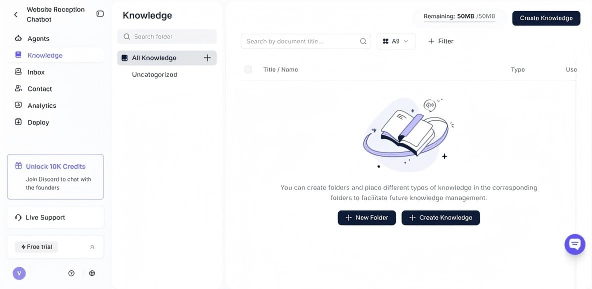
To connect your cancellation policy to Solvea:1. Go to Settings → Knowledge Base in your Solvea dashboard2. Upload your cancellation policy as a PDF or paste it as a document3. Set Solvea to route cancellation and rescheduling requests through the policy4. Review flagged edge cases in the Solvea inbox each morning
Common Med Spa Cancellation Policy Mistakes to Avoid
❌ Writing "adequate notice required" instead of a specific time window✓ Write: "All cancellations must be made at least 24 hours before the appointment for standard services and 48 hours for laser, body contouring, and multi-step procedures."
❌ Listing a fee without saying when it's charged✓ Write: "Cancellation fees will be charged to the credit card on file at the time of the missed appointment."
❌ Not defining what counts as a no-show✓ Write: "A no-show is defined as any appointment where the client does not appear and has not contacted the practice before the scheduled start time."
❌ Accepting reschedules as a way to avoid cancellation fees✓ Write: "Same-day reschedules and reschedules requested within the cancellation window are treated as late cancellations — the cancellation fee applies."
❌ Having an exceptions clause so broad it negates the policy✓ Write specific, documentable exceptions (medical emergency with documentation) rather than "any reasonable circumstance."
Your AI Receptionist, Live in Minutes.
Scale your front desk with an AI that never sleeps. Solvea handles unlimited multi-channel inquiries, books appointments into your calendar automatically, and ensures zero missed opportunities around the clock.
FAQ
What is a fair cancellation fee for a med spa?
Most med spas charge $50 for appointments under 30 minutes, $100 for 45–60 minute services, and $200 or 50–100% of service cost for longer or higher-cost procedures. The most important thing is that the fee is proportional to the revenue lost and communicated clearly at booking. A $50 cancellation fee on a $600 laser session sends the wrong signal; a $200 fee on a $75 facial may deter bookings.
Should a med spa require a deposit or just a card on file?
Both serve different purposes. A card on file lets you charge a cancellation fee after the fact — it's lower friction at booking but requires the client to trust you won't abuse it. A deposit (typically $50–$300 depending on service cost) is collected upfront and forfeited on no-show. High-value or repeat no-show-prone services benefit from deposits; standard bookings do fine with card on file.
How much notice should a med spa require for cancellations?
24 hours is the industry baseline for most services. 48 hours is standard for laser, body contouring, and any procedure requiring provider prep time or specific supplies. If your schedule typically fills 3–5 days out, you may be able to justify a 72-hour window for your most expensive services — but it can reduce booking conversion if communicated poorly.
What happens if a client disputes a cancellation charge with their bank?
A chargeback dispute is won or lost on documentation. If you have: (1) a signed acknowledgment of the cancellation policy, (2) a booking confirmation showing the policy, (3) evidence the policy was communicated (email/text), and (4) a clear record that the appointment was missed — you have a strong case. Most disputes against med spas are won by the practice when this documentation exists.
Can I require prepayment for all appointments?
Yes, and some med spas do — especially for new clients or after a history of no-shows. The tradeoff is that full prepayment reduces booking friction tolerance; some clients will choose a competitor rather than prepay for a first appointment. A middle path: require prepayment only after 2–3 missed appointments, or for bookings made less than 24 hours in advance.
Does Solvea help enforce cancellation policies automatically?
Yes. Solvea can be configured to answer client questions about your cancellation policy, handle cancellation requests by phone and chat, log cancellation timestamps for documentation, and escalate anything that falls outside your written rules. This removes the front desk from the middle of uncomfortable policy enforcement conversations while keeping a clear record.